Casual Dining Market Size, Share & Trends Analysis Report By Cuisine Type (American & Grill, Italian & Mediterranean, Steakhouse, Asian & International, Mexican & Latin), By Restaurant Ownership (Chain Restaurants, Independent Restaurants), By Revenue Channel (Dine-In & On-Premise, Takeout & Delivery, Catering & Group Dining) and Forecasts, 2026–2034
USD 3950
Casual Dining Market Size
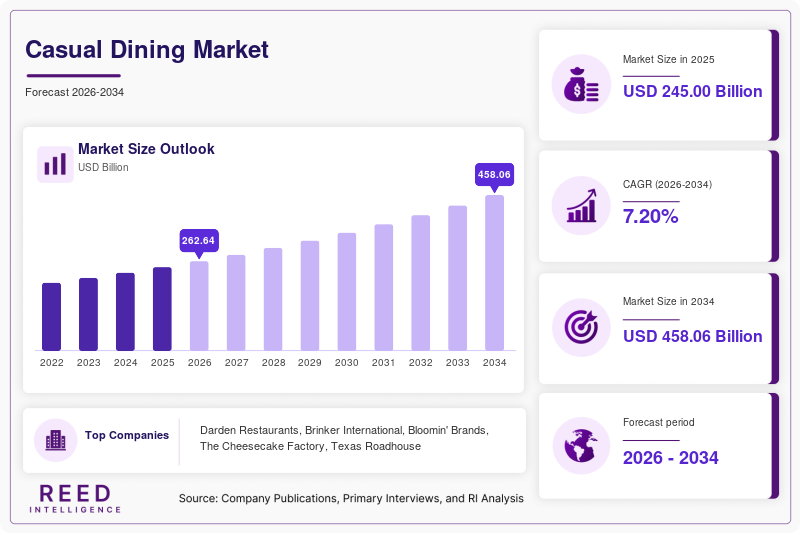
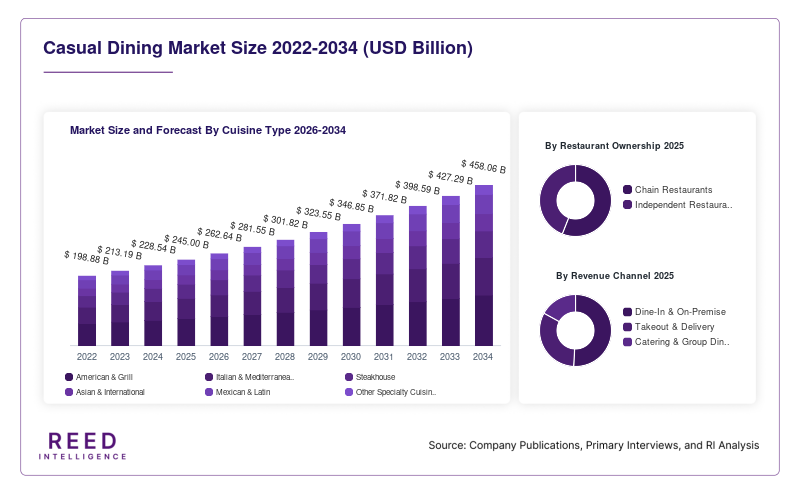
The global casual dining market is valued at USD 245.00 Billion in 2025 and USD 262.64 Billion in 2026. The market is projected to reach USD 458.06 Billion by 2034, registering a 7.20% CAGR during the forecast period.
The casual dining market consists of full-service restaurant concepts positioned between quick-service restaurants and fine dining. The segment generally combines table service, moderately priced meals, broader menus, comfortable dining environments and a stronger emphasis on hospitality and experience than limited-service formats. Major concepts include neighborhood grills, steakhouses, Italian restaurants, family-oriented restaurants, brewpubs and other themed or cuisine-focused full-service businesses.
Casual dining is increasingly operating as an omnichannel restaurant format rather than a purely dine-in business. Customers can discover restaurants through social media, place orders through branded applications or third-party platforms, dine in restaurants, collect takeout orders and participate in loyalty programs through the same brand ecosystem.
Casual Dining Market Drivers
Consumers continue to prioritize restaurant experiences while becoming more selective about value
Restaurants remain an important part of discretionary spending even during periods of financial pressure. The National Restaurant Association reported in September 2026 that restaurants remained consumers' top discretionary spending priority, despite affordability concerns and renewed inflation pressure.
Casual dining benefits from this environment because it offers a middle ground between inexpensive limited-service meals and higher-priced fine dining. Consumers can use casual restaurants for family meals, social gatherings, celebrations, work occasions and everyday dining.
The challenge is that customers increasingly compare value rather than simply price. Discounts, loyalty benefits, portion size, menu variety, service quality and perceived experience all affect the value equation.
The National Restaurant Association found that 40% of surveyed consumers increased their use of restaurant discounts and value promotions in Q3 2026.
This is encouraging casual-dining brands to use limited-time offers, bundled meals, loyalty rewards and targeted promotions without permanently repositioning the brand around discounting.
Digital ordering and off-premise consumption are expanding the revenue opportunity beyond restaurant dining rooms
Takeout and delivery have become an established component of full-service restaurant economics. The National Restaurant Association found that 47% of adults picked up takeout at least weekly, 37% ordered delivery weekly and that younger consumers were particularly active users of off-premise channels.
Casual dining operators can therefore generate revenue from customers who do not want the time commitment of a full dine-in visit.
Digital ordering also provides restaurants with first-party customer data, enabling loyalty programs, personalized offers and targeted retention initiatives. Brinker has emphasized digital engagement and value at Chili's, while The Cheesecake Factory has linked its rewards program and digital capabilities with customer engagement.
This makes technology investment increasingly relevant even for concepts whose primary value proposition remains the in-restaurant experience.
Restaurant-chain expansion and portfolio diversification are increasing the addressable market
Large casual-dining operators continue to expand through new locations, franchising, brand acquisition and multi-concept portfolios.
Darden acquired Chuy's, adding 103 restaurants to its portfolio, while The Cheesecake Factory continues to develop The Cheesecake Factory, North Italia, Flower Child and other Fox Restaurant Concepts. First Watch opened 64 system-wide restaurants during 2025 and was targeting another 59–63 net openings during 2026.
Expansion provides economies of scale in procurement, marketing, technology and training while increasing brand awareness across more geographic markets.
It also encourages restaurant groups to operate multiple concepts at different price points or occasions, enabling them to capture a broader range of consumer demand.
Casual Dining Market Restraints
Elevated food and labor costs continue to constrain restaurant margins
Food and labor represent the two largest operating cost categories for restaurants. The National Restaurant Association reported that each accounted for roughly 33 cents of every dollar in sales in 2026, while 33% of operators said their restaurants were not profitable during the first half of the year.
Casual dining can be particularly sensitive because table service requires more labor than limited-service formats, while larger dining rooms create higher occupancy and maintenance expenses.
Operators are therefore required to balance menu pricing with traffic sensitivity. Raising prices can protect margins but may weaken visit frequency among price-sensitive consumers.
Uneven customer traffic makes sales growth increasingly dependent on pricing and productivity
Restaurant operators reported mixed traffic conditions during 2026. In July, 49% of operators reported lower customer traffic compared with a year earlier, while only 40% reported an increase. July represented the 17th month in the previous 18 months with a net decline in reported traffic.
This makes operational execution more important. Restaurants cannot rely solely on menu-price increases to produce sustainable growth when consumers are reducing visit frequency.
Casual-dining companies must therefore improve guest acquisition, loyalty, service speed, restaurant productivity and menu value simultaneously.
Casual Dining Market Opportunities
Loyalty, personalization and restaurant technology can improve frequency and customer lifetime value
Restaurant technology is increasingly moving from transaction processing toward customer relationship management.
The National Restaurant Association reports that operators are investing in digital ordering, automation, analytics, marketing and customer-feedback technologies.
The Cheesecake Factory cited its rewards program, menu innovation and marketing as contributors to customer engagement and second-quarter fiscal 2026 performance.
Casual-dining brands can use loyalty data to identify visit frequency, favorite menu categories, order channel, promotion responsiveness and customer lifecycle stage. This enables targeted promotions that can stimulate visits without applying broad discounts across the entire customer base.
Experiential dining can differentiate full-service concepts from limited-service competitors
Casual dining has an advantage in environments where consumers value social interaction, atmosphere and hospitality.
The category can create differentiation through themed interiors, open kitchens, live entertainment, sports viewing, craft beverages, special events, seasonal menus and localized experiences.
Chili's August 2026 activation at DeBell Golf Club demonstrates this broader experiential strategy. The company transformed a golf-course clubhouse into a temporary Chili's Golf Club experience and partnered with apparel brand Rhoback on a limited-edition collection.
Experiential extensions can create brand awareness beyond conventional restaurant advertising and provide additional occasions for customer interaction.
Multi-brand portfolios can expand geographic coverage and consumer occasions
Restaurant groups increasingly operate multiple concepts that target different price points, cuisines and consumption occasions.
The Cheesecake Factory's portfolio includes The Cheesecake Factory, North Italia, Flower Child and other Fox Restaurant Concepts, while Darden operates brands spanning Italian, steakhouse, Mexican-American, seafood, polished casual and fine-dining categories.
This portfolio strategy allows restaurant companies to leverage centralized procurement, development capabilities, technology and real-estate expertise while maintaining differentiated consumer brands.
Cuisine Type Analysis
American & Grill remains the dominant cuisine category because burgers, grilled proteins and broad menus have wide consumer appeal
The American & Grill segment accounts for 31% of the global market in 2026 and is projected to register a 6.80% CAGR.
The category encompasses neighborhood grills, burger-focused full-service restaurants, brewpubs and broad-menu concepts that combine familiar dishes with moderate price points.
Its broad demographic appeal supports frequent family, social and casual dining occasions. Large chains such as Chili's and other grill-led concepts have continued to invest in menu innovation, value offers and restaurant-level execution. Brinker has specifically linked Chili's performance to menu enhancements, competitive pricing and operating improvements.
Asian & International is the fastest-growing major cuisine category as consumers seek broader flavors and differentiated concepts
The Asian & International segment accounts for 14% of the global market in 2026 and is projected to register an 8.30% CAGR, making it the fastest-growing major cuisine category.
Growth is supported by broader consumer familiarity with Asian cuisines, fusion formats, Korean and Japanese flavors, international-inspired menus and differentiated restaurant concepts.
The category also benefits from younger consumers' willingness to experiment with cuisines and limited-time menu concepts.
Restaurant Ownership Analysis
Chain Restaurants remain the dominant ownership model because scale supports procurement, technology and brand expansion
The Chain Restaurants segment accounts for 61% of the global market in 2026 and is projected to register a 7.00% CAGR.
Chain operators can spread technology, advertising, training, menu development and procurement costs across larger restaurant networks.
Darden operates a multi-brand portfolio including Olive Garden, LongHorn Steakhouse, Yard House, Ruth's Chris, Cheddar's, Chuy's and other concepts, while Brinker operates Chili's and Maggiano's across more than 1,600 restaurants.
Scale also provides greater access to data, centralized loyalty platforms and standardized operating procedures.
Independent Restaurants are the fastest-growing ownership category as differentiated local concepts attract consumers
The Independent Restaurants segment accounts for 39% of the global market in 2026 and is projected to register an 8.00% CAGR, making it the fastest-growing ownership category.
Independent operators can differentiate through local menus, neighborhood positioning, chef-led concepts, regional ingredients and highly personalized hospitality.
Digital ordering, social media marketing and third-party delivery platforms have reduced some of the historical barriers to customer acquisition, allowing small restaurant concepts to develop local followings without matching national advertising budgets.
Revenue Channel Analysis
Dine-In & On-Premise remains the dominant revenue channel because hospitality and experience define the casual dining proposition
The Dine-In & On-Premise segment accounts for 69% of the global market in 2026 and is projected to register a 6.40% CAGR.
Casual dining's central proposition remains seated service combined with an atmosphere designed for meals, conversations, social occasions and celebrations.
The National Restaurant Association found that consumers continue to prioritize eating at restaurants despite financial pressure, with 53% of respondents in its Q3 2026 survey having eaten at a restaurant during the reference week.
Operators are therefore continuing to invest in restaurant remodels, hospitality training, menu innovation and customer experience.
Takeout & Delivery is the fastest-growing major revenue channel as convenience becomes embedded in full-service dining
The Takeout & Delivery segment accounts for 24% of the global market in 2026 and is projected to register a 9.40% CAGR, making it the fastest-growing revenue channel.
The National Restaurant Association reports that off-premise dining has become an essential part of consumers' routines and that 37% of adults order delivery at least weekly. It also identifies speed, customer service, intuitive ordering technology, value and loyalty programs as important off-premise requirements.
Casual-dining operators can therefore use the channel to expand revenue per location without proportionately increasing dining-room capacity.
Catering & Group Dining provides an additional revenue pool around occasions and larger orders
The segment is projected to register a 7.70% CAGR.
Catering and group dining can increase average transaction sizes through corporate events, birthdays, sports gatherings, celebrations and family occasions.
Casual restaurants are particularly suited to the segment because their broad menus can accommodate groups with different dietary preferences and price sensitivities.
Casual Dining Market Regional Analysis
North America Casual Dining Market
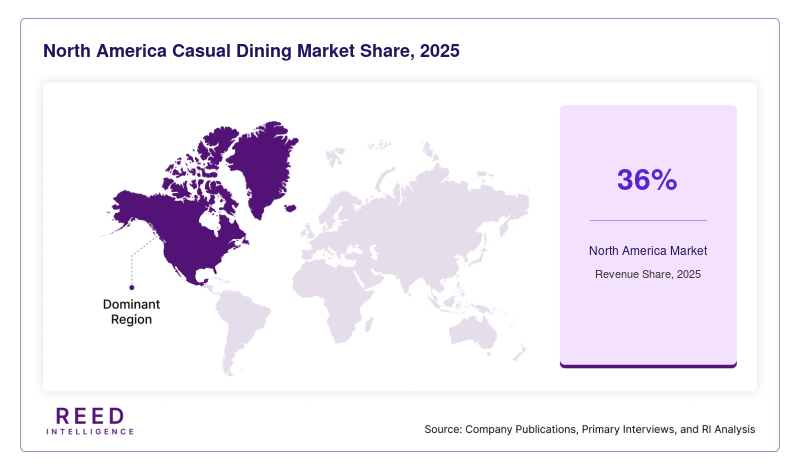
North America remains the dominant regional market because of its mature full-service restaurant industry, high chain penetration, strong restaurant-brand ecosystem and extensive use of technology across ordering, loyalty and operations.
The North America region accounts for 36% of the global market in 2026 and is projected to register a 6.50% CAGR.
The U.S. market continues to face a mixed operating environment. The National Restaurant Association reported that consumer demand remains resilient but traffic is uneven and operating costs remain elevated.
The region also contains the largest concentration of major casual-dining chains, including Darden, Brinker, Bloomin' Brands, Texas Roadhouse, The Cheesecake Factory, BJ's Restaurants and First Watch.
Digital ordering and loyalty remain important growth mechanisms, while large operators continue to pursue selective restaurant expansion and remodeling.
Europe Casual Dining Market
Europe is projected to register a 7.10% CAGR, supported by urban dining, tourism, social occasions and growing consumer interest in international cuisines.
The market is increasingly influenced by premium-casual concepts that combine accessible pricing with higher-quality ingredients, distinctive interiors and experiential formats.
Digital reservations, delivery and loyalty technology are also improving the ability of restaurants to manage customer relationships across multiple occasions.
APAC Casual Dining Market
APAC is the fastest-growing regional market as urbanization, disposable-income growth, tourism, organized foodservice and Western restaurant concepts expand.
The APAC region accounts for 24% of the global market in 2026 and is projected to register a 9.20% CAGR, making it the fastest-growing regional market.
Japan, Australia, South Korea, China, India and Southeast Asia represent distinct growth environments. International restaurant companies are increasingly using franchising, licensing and local partnerships to expand while adapting menus to local tastes.
The increasing popularity of international cuisines is particularly relevant to casual dining because consumers can experiment with new concepts while remaining within a moderate price range.
Middle East and Africa Casual Dining Market
The Middle East and Africa market is projected to register an 8.00% CAGR, supported by urbanization, tourism, shopping-center development, hospitality investment and premium casual restaurant openings.
The region has strong demand for international restaurant brands in major urban and tourism markets, while local operators are also developing modern casual concepts.
Shopping malls, mixed-use developments and hospitality districts provide important locations for restaurant expansion.
LATAM Casual Dining Market
LATAM is projected to register a 8.40% CAGR, supported by urban population growth, consumer demand for dining experiences and development of organized restaurant chains.
Mexico and Brazil represent major restaurant markets, while Argentina, Chile and Colombia provide additional opportunities for differentiated casual concepts.
Value-oriented promotions remain important because household purchasing power varies substantially across markets.
Competitive Landscape
The casual dining market is characterized by competition among large multi-brand restaurant companies, national and regional chains, franchise systems and independent restaurants.
Darden Restaurants operates one of the broadest full-service restaurant portfolios in the United States, including Olive Garden, LongHorn Steakhouse, Yard House, Ruth's Chris, Cheddar's Scratch Kitchen, Chuy's, Seasons 52, Eddie V's and Bahama Breeze. Its acquisition of Chuy's added 103 restaurants and expanded its exposure to Mexican-American casual dining.
Brinker International operates Chili's and Maggiano's. Brinker reported that its fiscal 2026 Chili's business benefited from menu enhancements, competitive pricing, advertising and operating improvements. The company also operates more than 1,600 restaurants across the United States and international markets.
Key Market Players
- Darden Restaurants
- Brinker International
- Bloomin' Brands
- The Cheesecake Factory
- Texas Roadhouse
- BJ's Restaurants
- First Watch Restaurant Group
- Cracker Barrel Old Country Store
- Cooper's Hawk Winery & Restaurants
- Ruth's Chris Steak House
- Yard House
- Cheddar's Scratch Kitchen
- Carrabba's Italian Grill
- Bonefish Grill
- Maggiano's Little Italy
- Regional and Independent Casual Dining Operators
Recent Developments
August 2026 – Brinker International reported fiscal 2026 full-year results and provided fiscal 2027 guidance. The company said Chili's completed five consecutive years of same-store sales growth and reported a cumulative 71% increase over that period. Brinker continues to focus on Chili's brand relevance, value proposition, streamlined operations and restaurant investments while operating more than 1,600 restaurants.
August 2026 – First Watch reported second-quarter fiscal 2026 results and continued rapid restaurant development. Same-restaurant sales increased 3.4%, total revenue increased 15.2%, and 18 new system-wide restaurants opened across 15 states. The company raised its full-year development target to 60–62 net new system-wide restaurants.
Casual Dining Market Segments
By Cuisine Type
- American & Grill
- Italian & Mediterranean
- Steakhouse
- Asian & International
- Mexican & Latin
- Other Specialty Cuisines
By Restaurant Ownership
- Chain Restaurants
- Independent Restaurants
By Revenue Channel
- Dine-In & On-Premise
- Takeout & Delivery
- Catering & Group Dining
By Region
- North America
- Europe
- APAC
- Middle East and Africa
- LATAM