Casual Wear Market Size, Share & Trends Analysis Report By Product (Top Wear, Bottom Wear), By Material (Synthetic, Cotton, Wool, Denim, Satin), By Distribution Channel (Supermarkets & Hypermarkets, Specialty Stores/Branded Stores, Department Stores, Online Retail) Forecasts 2026–2034
USD 3950
Casual Wear Market Size
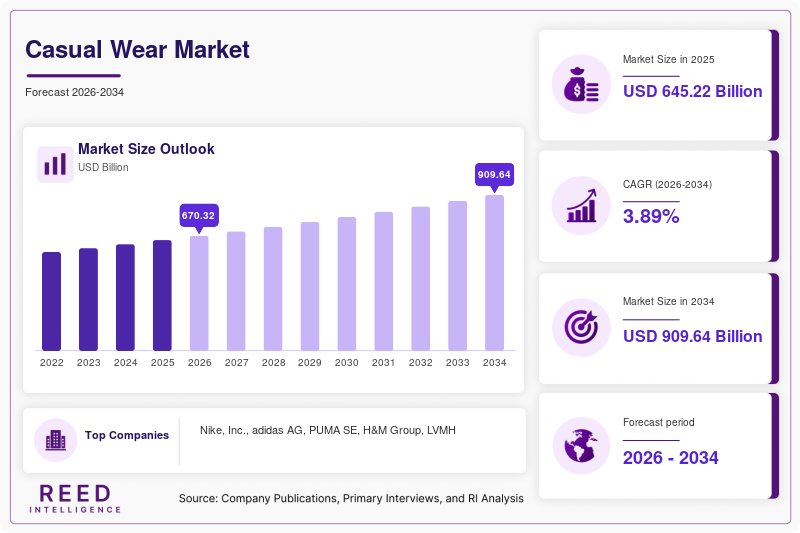
The global casual wear market size was valued at USD 645.22 billion in 2025 and is projected to grow from USD 667.63 billion in 2026 to USD 906.64 billion by 2034, registering a CAGR of 3.89% during the forecast period from 2026 to 2034.
Casual wear has evolved from a basic everyday apparel category into a broad fashion segment covering T-shirts, tops, shirts, jackets, jeans, trousers, dresses, hoodies, sweatshirts and other versatile garments. The category benefits from consumers seeking clothing that can transition between home, work, travel, social activities and fitness-related lifestyles.
The increasing acceptance of relaxed workplace dress codes has expanded demand for smart-casual garments that combine appearance and comfort. Hybrid working arrangements have also reduced the distinction between formal and informal wardrobes, encouraging consumers to purchase apparel that can serve multiple occasions.
Casual Wear Market Drivers
Shift Toward Comfort and Versatile Clothing
Consumer wardrobes increasingly favor garments that can serve multiple occasions rather than clothing designed for a single setting. T-shirts, polos, relaxed trousers, hoodies, lightweight jackets and casual dresses can be combined across work, leisure and travel environments. This versatility increases the frequency with which casual apparel competes for consumers' discretionary clothing expenditure.
The continued normalization of relaxed workplace attire strengthens this mechanism. Smart-casual clothing allows consumers to maintain a polished appearance without returning to traditional formalwear, expanding the addressable use cases for casual garments.
Expansion of Athleisure and Lifestyle Apparel
The boundaries between casual clothing and performance-oriented apparel continue to narrow. Consumers increasingly use sports-inspired garments in everyday settings, creating demand for breathable fabrics, stretch construction, moisture management and relaxed silhouettes.
This convergence allows apparel companies to introduce products positioned simultaneously around fashion, comfort and functionality. Nike's 2026 Studio Fleece launch, for example, combines everyday styling with performance-oriented product design and includes tops, hoodies, shorts and sweatpants.
E-Commerce and Social-Commerce Expansion
Online retail has increased the accessibility of casual apparel across both developed and emerging markets. Mobile-first purchasing, social-media discovery, influencer-led product exposure and direct-to-consumer models shorten the path between emerging fashion trends and consumer purchases.
For brands, digital channels also provide faster feedback on product performance and enable more targeted merchandising. H&M reported in September 2026 that it was increasing in-season purchasing and improving digital infrastructure to enhance precision across product development, purchasing, allocation, marketing and sales.
Casual Wear Market Restraints
Price Competition and Margin Pressure
Casual wear is highly competitive across value, mass-market, premium and sportswear categories. Brands compete on price, design refresh frequency, product differentiation and promotional intensity. Fast-fashion operators can accelerate product cycles, while established sportswear and premium brands use brand equity and technical features to justify higher prices.
This creates pressure on inventory management because fashion demand can change rapidly. Excess inventory may require markdowns, while insufficient inventory can result in missed seasonal demand.
Raw-Material and Supply-Chain Volatility
Casual wear manufacturers remain exposed to cotton, synthetic-fiber, energy, logistics and manufacturing costs. International sourcing also creates exposure to freight disruptions, tariffs, currency movements and geopolitical changes.
H&M's September 2026 reporting highlighted continued logistics-network and global supply-chain disruptions, while the company also noted tariff-related effects on gross margin.
Casual Wear Market Opportunities
Sustainable and Recycled Casual Apparel
Sustainability is creating opportunities for brands to differentiate products through recycled fibers, lower-impact materials, improved traceability and circular business models. Consumers increasingly encounter environmental attributes during online product discovery, making material information part of product positioning.
The opportunity extends beyond fabric substitution. Brands can differentiate through durability, repairability, resale, take-back programs and more transparent supply-chain practices.
Premium Smart-Casual and Performance-Lifestyle Products
The convergence of fashion, sportswear and everyday clothing creates room for higher-value products incorporating technical fabrics, improved construction, elevated finishing and versatile silhouettes.
Recent adidas and Entire Studios activity illustrates this convergence: their September 2026 FW26 collection combines sportswear engineering with tailoring and everyday styling, positioning technical apparel across training and non-training occasions.
Casual Wear Market Segmental Analysis
By Product
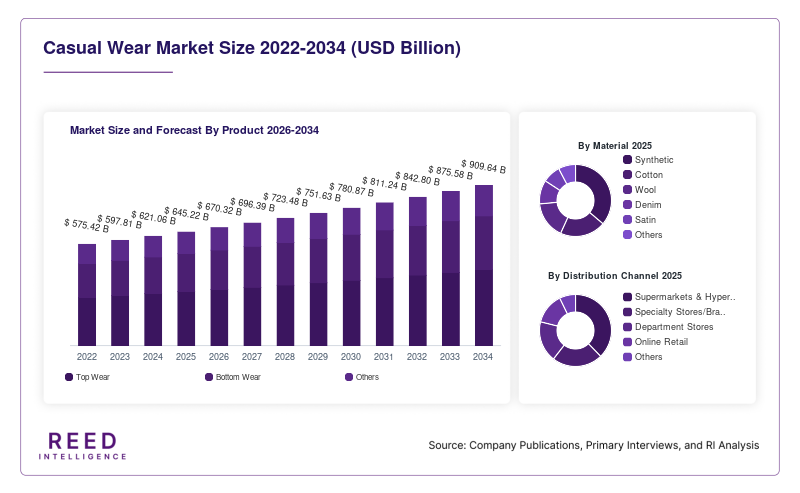
Top Wear is the dominant product segment in the global casual wear market. The category includes shirts, tops, blouses, jackets, sweaters, pullovers, dresses and related garments. The cited market analysis identifies top wear as the largest product segment and also indicates that it is projected to maintain the fastest CAGR during the forecast period.
Demand is supported by the versatility of T-shirts, polos, jackets and other upper-body garments across everyday, sports and social settings. Functional attributes such as breathability, moisture management and UV protection are also increasing the relevance of casual tops.
Bottom Wear remains an important category through jeans, trousers, shorts and other relaxed silhouettes, while Others captures additional casual garments that do not fall directly within the principal top- or bottom-wear categories.
By Material
Synthetic materials represent the dominant material segment according to the cited 2024 market analysis. Their position is supported by flexibility, durability, ease of maintenance and the ability to incorporate performance characteristics into everyday clothing.
Cotton remains commercially important because of its established consumer association with comfort and breathability. Denim maintains a strong position in casual wardrobes through jeans and jackets, while wool and satin serve more specialized casual and fashion-oriented applications.
The accessible source confirms synthetic materials as the leading category but does not provide sufficiently detailed comparable CAGR figures for every material segment; therefore, individual fastest-growing material rankings are not assigned without additional verifiable data.
By Distribution Channel
Specialty and branded stores remain important because consumers can evaluate fit, fabric quality and styling directly before purchase. These channels also allow brands to control merchandising and customer experience.
Online Retail represents the structurally fastest-expanding channel in broader casual-wear industry analyses, supported by mobile commerce, social selling and greater digital product discovery. A separate 2026 industry analysis estimates e-commerce at an 8.1% CAGR through 2034, although its overall market-size methodology differs from the market-size dataset used in this report.
Supermarkets and hypermarkets serve value-conscious consumers, while department stores retain relevance through multi-brand assortments. The channel mix therefore reflects both convenience-driven purchasing and experience-oriented shopping.
Casual Wear Market Regional Analysis
North America Casual Wear Market
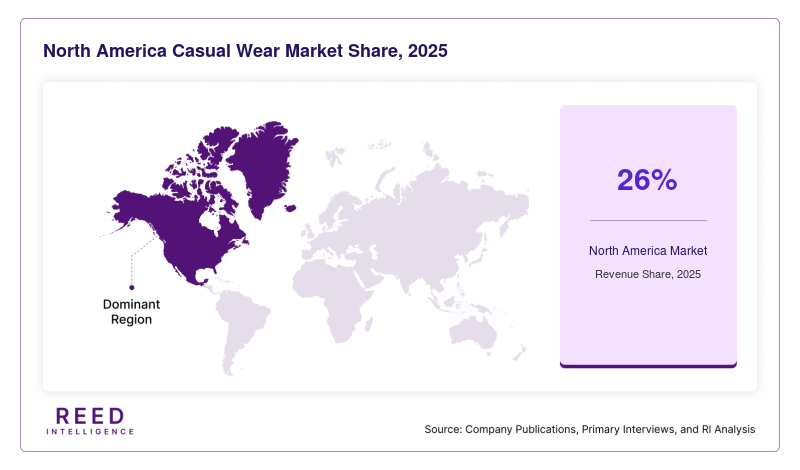
North America accounted for 26.00% of the global casual wear market, making it the second-largest region in the cited 2024 dataset. Consumer preference for comfort, versatility, athleisure and relaxed dress codes supports consistent demand across everyday apparel categories.
The United States represents the principal market within the region, supported by established apparel brands, high e-commerce penetration and strong sportswear and streetwear cultures. Hybrid work arrangements have also strengthened demand for clothing that combines casual comfort with presentable styling.
Europe Casual Wear Market
Europe represents a major established casual-wear market supported by its strong fashion ecosystem, premium apparel brands and developed retail infrastructure. Italy, France, the U.K. and Germany contribute through established fashion industries and sophisticated consumer markets.
Demand is increasingly shaped by sustainability considerations, premium materials, contemporary streetwear and the integration of casual products into everyday wardrobes. European brands are also balancing physical retail with digital channels and direct-to-consumer distribution.
Asia Pacific Casual Wear Market
Asia Pacific is the dominant regional market, accounting for 41.51% of the global casual wear market in 2024. Its position reflects a large consumer base, expanding middle-class purchasing power, rising participation of women in the workforce, strong apparel manufacturing capabilities and rapidly expanding online clothing sales.
China and India provide substantial demand and production capacity, while Japan, South Korea and Southeast Asia contribute through fashion innovation, streetwear, digital commerce and increasingly sophisticated consumer preferences. Available sources consistently identify Asia Pacific as a major growth market, although the principal market-size source does not publish a numerical 2026–2034 CAGR for the region.
Latin America Casual Wear Market
Latin America's casual-wear demand is influenced by expanding modern retail, e-commerce adoption, younger consumers and growing interest in sports and lifestyle clothing. Brazil represents an important market because of its population scale and established fashion and retail ecosystem.
Digital marketplaces are increasing product accessibility, while international and local brands compete through pricing, localized designs and social-media marketing. The region also provides opportunities for lightweight apparel suited to warmer climates.
Middle East & Africa Casual Wear Market
The Middle East & Africa market is influenced by population growth, urbanization, expanding retail infrastructure and increasing consumer interest in fashion and health-oriented lifestyles. Demand varies considerably between Gulf markets, North Africa and Sub-Saharan Africa because of differences in climate, income and cultural preferences.
A separate 2026 industry analysis identifies Middle East & Africa as the fastest-growing regional market at approximately 6.4% CAGR through 2034. Because this estimate comes from a different market-sizing methodology than the USD 645.22 billion global dataset, it should be treated as an external regional growth indicator rather than reconciled directly with the global market figures.
Casual Wear Market Competitive Landscape
The casual wear market is highly fragmented, with competition spanning global sportswear companies, fast-fashion retailers, premium fashion houses and vertically integrated apparel brands. Competitive positioning increasingly depends on product refresh rates, brand identity, digital reach, supply-chain responsiveness, material innovation and the ability to connect casual clothing with sportswear and lifestyle trends.
Nike, Inc. competes through the intersection of sports performance and everyday apparel. Its product strategy increasingly emphasizes comfort, functionality and lifestyle versatility. The July 2026 Studio Fleece launch illustrates this approach by combining everyday silhouettes with performance-oriented design and engineered comfort.
Key Market Players
Casual Wear Market Recent Developments
-
September 2026 adidas AG: adidas and Entire Studios unveiled their second collaboration, the FW26 collection, combining sportswear engineering with tailoring-inspired casual styling. The collection is scheduled for worldwide launch on September 29, 2026.
-
September 2026 H&M Group: H&M reported nine-month 2026 results showing a 1% increase in third-quarter sales in local currencies and highlighted increased in-season purchasing, digital infrastructure improvements and supply-chain initiatives.
Casual Wear Market Segments
By Product
- Top Wear
- Bottom Wear
- Others
By Material
- Synthetic
- Cotton
- Wool
- Denim
- Satin
- Others
By Distribution Channel
- Supermarkets & Hypermarkets
- Specialty Stores/Branded Stores
- Department Stores
- Online Retail
- Others
By Region
- North America
- Europe
- APAC
- Middle East and Africa
- LATAM