Catalyst Coated Membranes Market Size, Share & Demand Report By Type (Proton Exchange Membrane (PEM), Alkaline Membrane, Others), By Material (Platinum-Based Catalysts, Non-Precious Metal Catalysts, Others), By Application (Fuel Cells, Electrolyzers, Others), By End-Use Industry (Automotive, Industrial, Energy & Power, Others), By Region & Segment Forecasts, 2025–2034
USD 3950
Market Overview
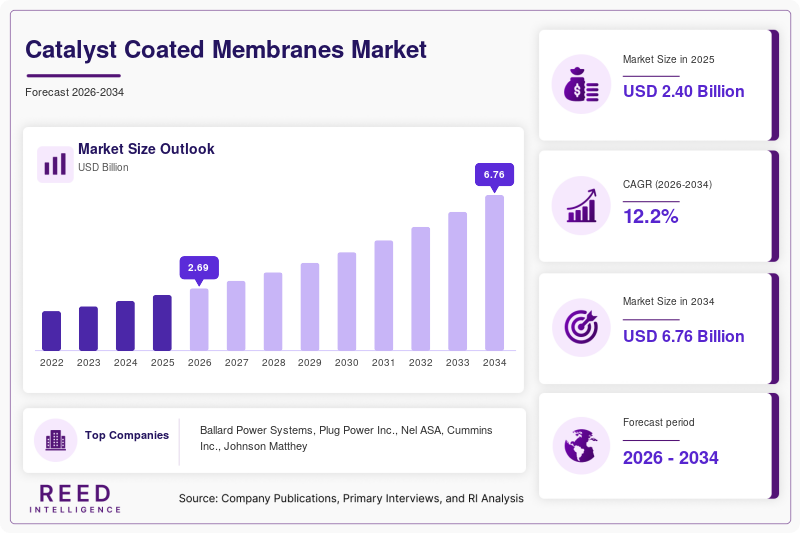
The global Catalyst Coated Membranes Market size was valued at approximately USD 2.4 billion in 2025 and is projected to reach USD 6.8 billion by 2034, expanding at a CAGR of 12.2% during the forecast period (2025–2034). The market growth is primarily driven by the rising demand for efficient electrochemical energy conversion technologies, particularly in fuel cells and electrolyzers. Catalyst coated membranes (CCMs) play a crucial role in enhancing performance, durability, and energy efficiency in hydrogen-based systems, making them central to the evolving clean energy ecosystem.
A key global factor supporting the expansion of the Catalyst Coated Membranes Market is the increasing adoption of hydrogen as a sustainable energy carrier. Governments and private stakeholders across major economies are investing in hydrogen infrastructure, which has accelerated demand for proton exchange membrane (PEM) fuel cells and electrolyzers, both of which rely heavily on CCMs for optimal functionality.
Key Highlights
- North America dominated the market with a 36% share in 2025, while Asia Pacific is expected to grow at the fastest CAGR of 13.8% through 2034.
- Proton Exchange Membrane (PEM) type accounted for the largest share among types, while alkaline membrane technology is projected to grow at a CAGR of 14.5%.
- Fuel cell application led the market, while electrolyzers are expected to witness the fastest growth at a CAGR of 14.2%.
- The United States remained the dominant country, with market values of USD 780 million in 2025 and USD 860 million in 2026.
Market Trends
Integration of CCMs in Hydrogen Economy Infrastructure
The growing emphasis on hydrogen production and utilization is significantly shaping the Catalyst Coated Membranes Market. CCMs are integral components in proton exchange membrane fuel cells and water electrolyzers, which are widely used in hydrogen generation and storage systems. As countries pursue carbon neutrality goals, investments in green hydrogen projects have surged. This has increased the adoption of CCMs in large-scale electrolyzers and mobility applications such as hydrogen-powered vehicles. The shift toward decentralized energy systems and renewable integration is further reinforcing the role of CCMs in enabling efficient hydrogen conversion technologies.
Advancements in Catalyst Materials and Membrane Engineering
Technological advancements in catalyst formulations and membrane structures are emerging as a notable trend in the Catalyst Coated Membranes Market. Manufacturers are focusing on reducing precious metal content, such as platinum, while improving catalytic efficiency and durability. Innovations in nanostructured catalysts and advanced polymer membranes are enhancing performance under varying operating conditions. Additionally, research into alternative materials, including non-precious metal catalysts, is gaining traction to address cost challenges. These developments are expected to expand the application scope of CCMs across industries, including automotive, stationary power generation, and industrial electrolysis.
Market Drivers
Increasing Demand for Fuel Cell Electric Vehicles (FCEVs)
The rapid growth of fuel cell electric vehicles is a major driver for the Catalyst Coated Membranes Market. FCEVs rely on proton exchange membrane fuel cells, where CCMs serve as the core functional component. Rising concerns regarding carbon emissions and the need for sustainable mobility solutions have led governments to promote hydrogen-powered vehicles through subsidies and infrastructure development. As automotive manufacturers expand their hydrogen vehicle portfolios, the demand for high-performance CCMs is expected to rise significantly.
Expansion of Renewable Energy Integration and Storage Solutions
The increasing penetration of renewable energy sources such as solar and wind has created a need for efficient energy storage and conversion technologies. Catalyst coated membranes are widely used in electrolyzers that convert excess renewable energy into hydrogen for storage. This process enables grid balancing and long-term energy storage. As energy systems transition toward decentralization and sustainability, CCMs are becoming critical in bridging the gap between renewable generation and consumption, thereby driving market growth.
Market Restraint
High Cost of Catalyst Materials and Manufacturing Processes
One of the major challenges in the Catalyst Coated Membranes Market is the high cost associated with catalyst materials, particularly precious metals such as platinum and iridium. These materials are essential for achieving high catalytic efficiency but significantly increase production costs. Additionally, the manufacturing process of CCMs requires precision and advanced technologies, further contributing to overall expenses. This cost barrier limits widespread adoption, especially in price-sensitive markets and emerging economies. Efforts to develop cost-effective alternatives are ongoing, but large-scale commercialization remains a challenge.
Market Opportunities
Development of Low-Cost and Non-Precious Metal Catalysts
The ongoing research into alternative catalyst materials presents a strong opportunity in the Catalyst Coated Membranes Market. Scientists and manufacturers are exploring non-precious metal catalysts that can deliver comparable performance at a lower cost. Successful commercialization of such materials could significantly reduce overall system costs, making CCM-based technologies more accessible. This development is expected to expand market penetration across various industries, including transportation and power generation.
Growing Adoption in Industrial Hydrogen Applications
Industrial sectors such as chemicals, refining, and steel production are increasingly adopting hydrogen as a cleaner alternative to traditional fuels. Catalyst coated membranes are essential in electrolyzers used for hydrogen production in these industries. As industrial players seek to reduce carbon emissions and comply with environmental regulations, the demand for CCMs is expected to increase. This trend opens new avenues for market expansion beyond traditional applications.
Segmental Analysis
By Type
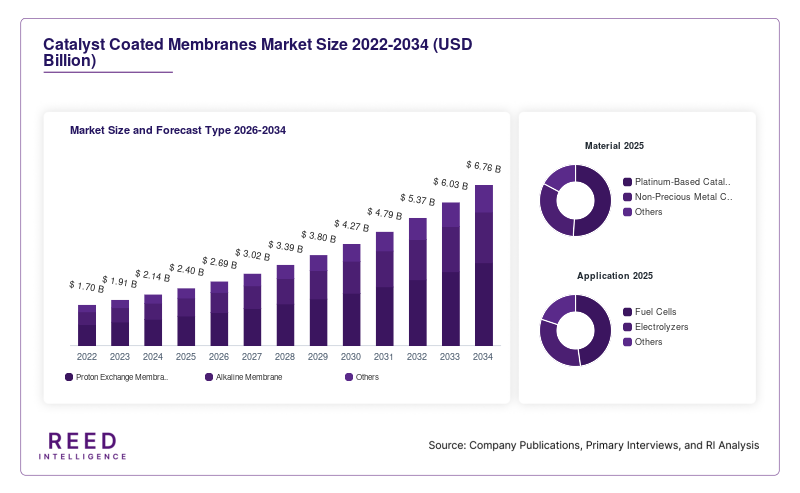
Proton Exchange Membrane (PEM) segment dominated the Catalyst Coated Membranes Market in 2025, accounting for approximately 64% of the total share. The dominance was attributed to its widespread use in fuel cells and electrolyzers, offering high efficiency and reliability.
Alkaline membrane segment is expected to grow at the fastest CAGR of 14.5% during the forecast period. Its cost advantages and suitability for large-scale hydrogen production will drive its adoption, particularly in industrial applications.
By Material
Platinum-based catalysts held the largest share of around 58% in 2025 due to their superior catalytic performance and durability. These materials were widely used in high-performance fuel cells.
Non-precious metal catalysts are projected to grow at a CAGR of 15.2% through 2034. The increasing focus on cost reduction and sustainability will drive the development and adoption of alternative materials.
By Application
Fuel cells accounted for the largest share of approximately 62% in 2025, driven by their extensive use in transportation and stationary power generation.
Electrolyzers are expected to witness the fastest growth at a CAGR of 14.2% during the forecast period. The rising demand for hydrogen production and energy storage will support this growth.
By End-Use Industry
Automotive sector dominated the market with a share of 48% in 2025, owing to the increasing adoption of fuel cell electric vehicles.
Industrial sector is projected to grow at a CAGR of 13.9%, driven by the use of hydrogen in manufacturing processes and energy applications.
Regional Analysis
North America
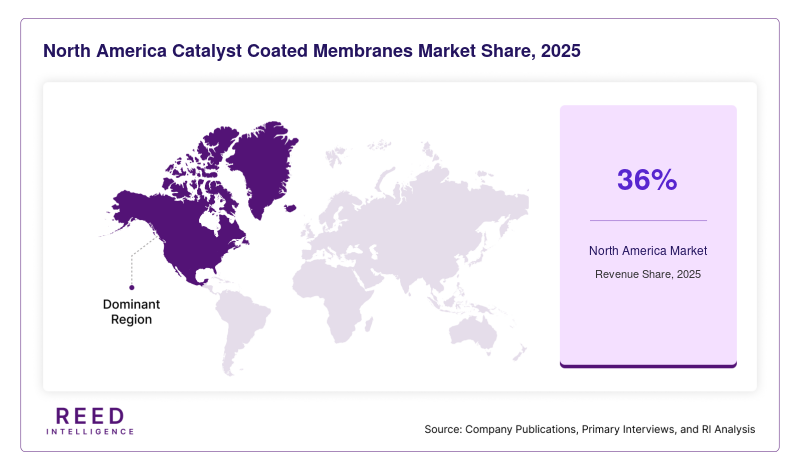
North America accounted for approximately 36% of the Catalyst Coated Membranes Market share in 2025 and is projected to grow at a CAGR of 11.5% during the forecast period. The region’s established hydrogen infrastructure and strong focus on clean energy technologies supported its dominance.
The United States led the regional market due to its extensive investments in hydrogen fuel cell technology. Government initiatives promoting zero-emission vehicles and renewable energy integration have accelerated CCM adoption. The presence of leading technology providers and ongoing research activities further supported market growth.
Europe
Europe held around 28% share of the Catalyst Coated Membranes Market in 2025 and is expected to grow at a CAGR of 12.0% through 2034. The region’s strong regulatory framework aimed at reducing carbon emissions played a key role in market expansion.
Germany emerged as the dominant country, driven by its focus on hydrogen energy and industrial decarbonization. The country’s investments in green hydrogen projects and collaborations between public and private sectors have boosted demand for CCMs in electrolyzers and fuel cells.
Asia Pacific
Asia Pacific accounted for nearly 22% of the market in 2025 and is anticipated to register the fastest CAGR of 13.8% during the forecast period. Rapid industrialization and increasing energy demand supported market growth in this region.
China led the market due to its large-scale investments in hydrogen production and fuel cell vehicles. The government’s supportive policies and growing focus on renewable energy integration have significantly increased the adoption of CCM technologies.
Middle East & Africa
The Middle East & Africa region captured about 8% of the Catalyst Coated Membranes Market in 2025 and is projected to grow at a CAGR of 11.0% through 2034. The region’s focus on diversifying energy sources contributed to market growth.
Saudi Arabia dominated the regional market, driven by its investments in hydrogen production and renewable energy projects. The country’s strategic initiatives to become a global hydrogen hub have increased demand for advanced CCM technologies.
Latin America
Latin America held approximately 6% share of the market in 2025 and is expected to grow at a CAGR of 10.8% during the forecast period. The region’s increasing adoption of clean energy solutions supported market expansion.
Brazil emerged as the leading country, supported by its renewable energy resources and growing interest in hydrogen technologies. Government initiatives promoting sustainable energy solutions have encouraged the adoption of CCM-based systems.
Competitive Landscape
The Catalyst Coated Membranes Market is moderately consolidated, with key players focusing on technological advancements and strategic collaborations. The leading companies are investing in research and development to enhance product efficiency and reduce costs.
A prominent market leader is Ballard Power Systems, which has strengthened its position through continuous innovation in fuel cell technologies. The company recently introduced advanced CCM solutions with improved durability and performance, supporting its expansion in the hydrogen energy sector.
Other major players are also expanding their production capacities and forming partnerships to gain a competitive edge in the global market.
Key Players
- Ballard Power Systems
- Plug Power Inc.
- Nel ASA
- Cummins Inc.
- Johnson Matthey
- 3M Company
- Gore & Associates
- BASF SE
- Toyota Motor Corporation
- Hyundai Motor Company
- Bloom Energy
- ITM Power
- Siemens Energy
- SGL Carbon
- Umicore
Recent Developments
- 2024: Major manufacturers increased investments in non-precious metal catalyst research to reduce production costs.
- 2025: Expansion of hydrogen infrastructure projects globally boosted demand for CCM technologies.
- 2025: Strategic partnerships between energy companies and technology providers accelerated innovation in catalyst coated membranes.
- 2026: New product launches focused on improving membrane durability and efficiency under extreme conditions.
Catalyst Coated Membranes Market Segments
Type
- Proton Exchange Membrane (PEM)
- Alkaline Membrane
- Others
Material
- Platinum-Based Catalysts
- Non-Precious Metal Catalysts
- Others
Application
- Fuel Cells
- Electrolyzers
- Others
End-Use Industry
- Automotive
- Industrial
- Energy & Power
- Others
By Region
- North America
- Europe
- APAC
- Middle East and Africa
- LATAM