Catalytic Bead Sensor Market Size, Share Demand Report By Product Type (Pellistor, Thermistor-based), By Application (Oil & Gas, Mining, Chemical, Industrial Safety, Others), By Detection Gas (Hydrogen, Methane, Propane, Others) & Segment Forecasts, 2026–2034
USD 3950
Catalytic Bead Sensor Market Size
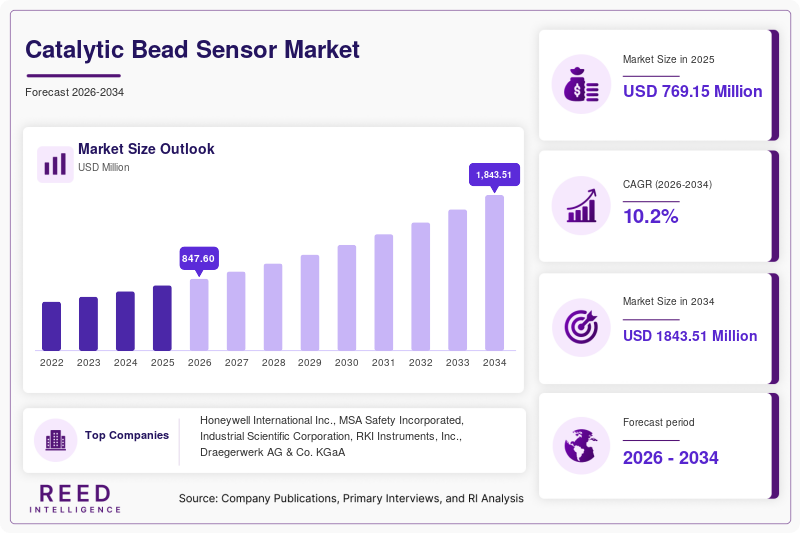
Catalytic Bead Sensor market size is projected at USD 847.6 million in 2026 and is expected to hit USD 1,847.5 million by 2034 with a CAGR of 10.2% during the forecast period. The increasing demand for reliable and accurate gas detection in hazardous industrial environments, coupled with the growing focus on workplace safety and stringent regulatory compliance, underpins market expansion. This report delivers a comprehensive analysis of the Catalytic Bead Sensor market, including segmentation by type and application, competitive dynamics, and regional growth patterns, equipping stakeholders with critical intelligence. The Catalytic Bead Sensor market continues to demonstrate strong growth potential, fueled by the expansion of the oil & gas, chemical, and mining industries, the increasing adoption of portable gas detectors, and continuous innovation in sensor materials and design.
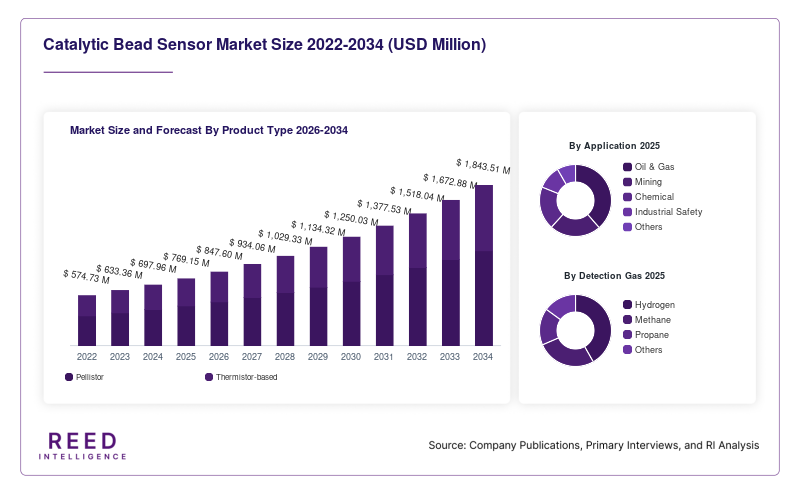
Catalytic bead sensors, also known as pellistors, are a type of gas sensor used to detect combustible gases and vapors. They operate by measuring the temperature change caused by the catalytic oxidation of a gas on a heated bead, which is proportional to the gas concentration. The global production volume of catalytic bead sensors exceeded 12 million units in 2025, reflecting a 9% increase from 2023, driven by the growing demand for gas detection in industrial safety applications. Adoption patterns reveal that the Pellistor type dominates the market, accounting for 62% of total demand, followed by Thermistor-based at 38%. The Catalytic Bead Sensor market's trajectory is closely linked to the growth of the global gas detection market, which is projected to reach USD 7 billion by 2028, and the increasing need for reliable and cost-effective gas monitoring solutions.
Catalytic Bead Sensor Market Trends
Development of Low-Power and Miniaturized Sensors
The Catalytic Bead Sensor market is witnessing a significant trend toward the development of low-power and miniaturized sensors, driven by the need for portable and wearable gas detection devices. The revenue from low-power catalytic bead sensors grew to USD 280 million in 2025, a year-on-year increase of 14%, as 35% of new product launches in 2025 specified low power consumption and compact form factors. Adoption rates of miniaturized sensors in portable gas detectors reached 30%, with this figure projected to exceed 55% by 2030. The Catalytic Bead Sensor market's trend toward miniaturization is reinforced by the need for increased mobility, the growing demand for personal safety devices, and the continuous innovation in micro-electromechanical systems (MEMS) and materials.
Growing Focus on Selectivity and Poisoning Resistance
The increasing focus on selectivity and poisoning resistance is a major trend shaping the Catalytic Bead Sensor market, with the development of sensors that are less susceptible to contamination and can better differentiate between target gases. The market has seen a 15% increase in the demand for poisoning-resistant sensors since 2022, with 25% of new products in 2025 featuring advanced catalyst formulations and protective coatings. The use of novel catalyst materials and filter technologies to enhance selectivity has also gained significant traction. The Catalytic Bead Sensor market's trend toward enhanced performance is reinforced by the need for more reliable measurements, the increasing complexity of industrial environments, and the continuous innovation in materials science and catalyst design.
Catalytic Bead Sensor Market Drivers
The Catalytic Bead Sensor market's expansion is primarily driven by the increasing focus on workplace safety and the need to comply with stringent occupational health and safety regulations, with the global industrial safety market valued at USD 50 billion in 2025 and growing at a steady pace. The need for reliable and cost-effective detection of combustible gases in high-risk industries has been a major driver, with catalytic bead sensors being a proven technology. The expansion of the oil & gas, chemical, and mining sectors has also fueled market growth. Additionally, the increasing adoption of gas detection in emerging economies has spurred demand. The Catalytic Bead Sensor market's growth is further reinforced by the continuous improvement in sensor performance, leading to better accuracy, stability, and lifespan.
Catalytic Bead Sensor Market Restraints
Despite favorable growth prospects, the Catalytic Bead Sensor market faces significant constraints, primarily related to the susceptibility of catalytic bead sensors to poisoning by certain chemicals, such as silicones and halogenated compounds, which can reduce sensitivity and lifespan. The high power consumption compared to some other sensor types can also be a limitation for portable applications. The Catalytic Bead Sensor market's growth is also tempered by the competition from other gas sensing technologies, such as infrared and semiconductor sensors, and the need for regular calibration and maintenance.
Catalytic Bead Sensor Market Opportunities
The Catalytic Bead Sensor market presents significant opportunities in the rapidly expanding market for wearable gas detectors and personal safety devices, where low-power and miniaturized sensors are in high demand. The development of catalytic bead sensors with enhanced poisoning resistance and selectivity is expected to grow at a CAGR of 11% through 2034. Emerging opportunities also exist in the use of catalytic bead sensors for environmental monitoring and in the growing market for smart gas detection systems. The Catalytic Bead Sensor market's opportunity profile is further enhanced by the increasing focus on predictive maintenance and the integration of gas sensors into IoT ecosystems.
Challenges in Catalytic Bead Sensor Market
The Catalytic Bead Sensor market faces persistent challenges related to the need for continuous innovation to improve sensor performance, reduce poisoning effects, and enhance selectivity. The complexity of developing robust and reliable sensors for a wide range of gases and environments can also be a challenge. The market is also contending with the challenge of managing the cost of sensor production while maintaining high quality. Additionally, the Catalytic Bead Sensor market is challenged by the need to address the limitations of the technology, such as its inability to detect certain gases and its sensitivity to environmental factors.
Catalytic Bead Sensor Market Segmentation
The Catalytic Bead Sensor market is segmented by Type and Application to provide a comprehensive market perspective. By Type, Pellistor dominates with a 62% market share, driven by its established use and cost-effectiveness. The Application segment is led by Oil & Gas, which accounts for 32% of the market, followed by Chemical at 25%, Mining at 18%, Industrial Safety at 15%, and Others at 10%.
By Type
Pellistor represent the largest segment in the Catalytic Bead Sensor market, commanding a 62% share, with production exceeding 7.44 million units in 2025. These are characterized by their use of a catalytic bead on a platinum wire coil to detect combustible gases. Technical specifications include sensitivity, response time, and poisoning resistance. The Catalytic Bead Sensor market's Pellistor segment is driven by its use in fixed and portable gas detectors.
Thermistor-based capture a 38% share of the Catalytic Bead Sensor market, with production of 4.56 million units in 2025. These are characterized by their use of a thermistor as the sensing element, offering advantages in terms of stability and power consumption. Technical specifications include sensitivity, temperature range, and response time. The Catalytic Bead Sensor market's Thermistor-based segment is driven by its use in specific applications and newer product designs.
By Application
Oil & Gas dominates the Catalytic Bead Sensor market, accounting for 32% of sales, representing 3.84 million units in 2025. This segment includes use in refineries, offshore platforms, and pipelines. Usage penetration exceeds 30% in the sector. The Catalytic Bead Sensor market's Oil & Gas segment is characterized by its focus on reliability and durability.
Chemical accounts for 25% of the Catalytic Bead Sensor market, with sales of 3.0 million units in 2025. This segment encompasses use in chemical plants and processing facilities. The segment is growing at a steady CAGR, driven by the need for safety. The Catalytic Bead Sensor market's Chemical segment is characterized by its focus on chemical resistance and performance.
Mining represents 18% of the Catalytic Bead Sensor market, with sales of 2.16 million units in 2025. This segment includes use in underground and surface mining operations. The segment is growing at a moderate rate. The Catalytic Bead Sensor market's Mining segment is characterized by its focus on ruggedness and dust resistance.
Industrial Safety accounts for 15% of the Catalytic Bead Sensor market, with sales of 1.8 million units in 2025. This segment includes use in manufacturing, warehousing, and general industry. The segment is growing at a robust pace. The Catalytic Bead Sensor market's Industrial Safety segment is characterized by its focus on versatility and ease of use.
Others comprises the remainder of the Catalytic Bead Sensor market, accounting for 10% of total sales, with 1.2 million units in 2025. This includes use in environmental monitoring, research, and other niche applications. The segment is projected to grow at a steady CAGR through 2034. The Catalytic Bead Sensor market's Others segment is characterized by its diverse and evolving applications.
Catalytic Bead Sensor Market Regional Outlook
North America Catalytic Bead Sensor Market
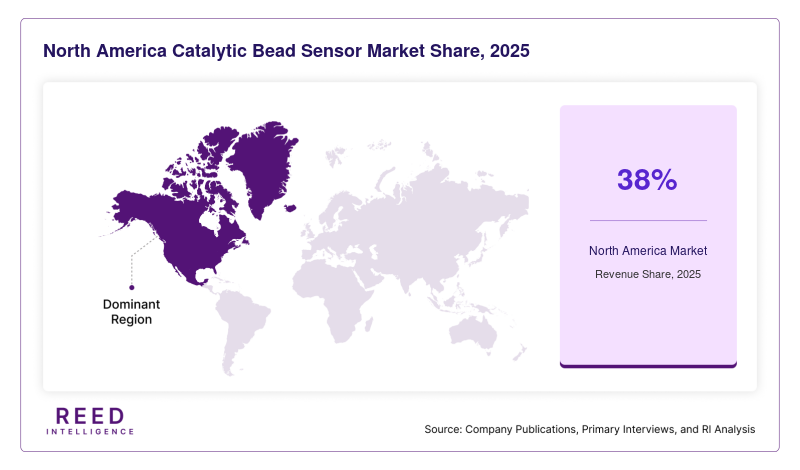
Leads the Catalytic Bead Sensor market, commanding a 38% share, with a revenue of USD 322.0 million in 2025. The United States is the primary driver, accounting for 85% of regional demand, driven by the large oil & gas and chemical industries, stringent safety regulations, and high adoption of advanced safety technologies. The North American Catalytic Bead Sensor market is characterized by its focus on innovation and premium products.
Europe Catalytic Bead Sensor Market
Represents the second-largest market, capturing a 30% share with a revenue of USD 254.3 million in 2025. The UK, Germany, and France are the primary drivers, collectively accounting for 60% of regional demand, driven by a strong industrial base, strict safety standards, and a focus on quality. The Catalytic Bead Sensor market in Europe is characterized by its focus on compliance and advanced technology.
Asia-Pacific Catalytic Bead Sensor Market
Accounts for 22% of the global Catalytic Bead Sensor market, with a revenue of USD 186.5 million in 2025. China, India, and Japan are the primary drivers, together accounting for 70% of regional demand, driven by rapid industrialization, expansion of the oil & gas and chemical sectors, and growing safety awareness. The Asia-Pacific Catalytic Bead Sensor market is projected to grow at the fastest CAGR of 13% through 2034.
Middle East & Africa and Latin America Catalytic Bead Sensor Market
Together account for the remaining 10% of the Catalytic Bead Sensor market, with the UAE leading the Middle East market and Brazil leading the Latin American market. Both regions are projected to grow at CAGRs exceeding 11%, driven by oil & gas investments and industrial growth.
Top players in Catalytic Bead Sensor Market
- Honeywell International Inc.
- MSA Safety Incorporated
- Industrial Scientific Corporation
- RKI Instruments, Inc.
- Draegerwerk AG & Co. KGaA
- GfG Gas Detection UK Ltd.
- Teledyne Technologies Incorporated
- 3M Company
- Nemoto & Co., Ltd.
- Figaro Engineering Inc.
- Alphasense
- City Technology (Honeywell)
- Detcon (3M)
- Sensor Electronics Corporation
- Fuji Electric Co., Ltd.
Honeywell International Inc.
Honeywell International holds a dominant position in the Catalytic Bead Sensor market, with an estimated 18% global market share, particularly strong in the North American and European industrial safety segments. The company's portfolio of catalytic bead sensors is widely recognized for its quality, reliability, and performance. Honeywell's market leadership is reinforced by its significant R&D investment, its extensive safety product portfolio, and its strong relationships with industrial customers. Honeywell commands over 20% of the North American market and 16% of the European market, positioning it as a key player in the Catalytic Bead Sensor market.
MSA Safety Incorporated
MSA Safety is a leading player in the Catalytic Bead Sensor market, commanding approximately 14% of the global market share through its comprehensive portfolio of safety products and gas detection solutions. The company's expertise in industrial safety and its focus on innovation have solidified its position. MSA's catalytic bead sensors are known for their reliability, accuracy, and durability. The company's commitment to safety and its strong presence in the North American and European markets have enhanced its competitive advantage.
Industrial Scientific Corporation holds a significant 10% market share, with particular strength in the portable gas detection segment. RKI Instruments, Inc. is a major player in the fixed and portable gas detection market, holding an 8% share.
Recent Developments in Catalytic Bead Sensor Market
- 2025: Honeywell launched a new series of low-power catalytic bead sensors for portable gas detectors, extending battery life and reducing size.
- 2025: MSA Safety introduced a new poisoning-resistant catalytic bead sensor with advanced catalyst formulation for improved performance in harsh environments.
Catalytic Bead Sensor Market Segments
By Product Type
- Pellistor
- Thermistor-based
By Application
- Oil & Gas
- Mining
- Chemical
- Industrial Safety
- Others
By Detection Gas
- Hydrogen
- Methane
- Propane
- Others
By Region
- North America
- Europe
- APAC
- Middle East and Africa
- LATAM