Catering Services Market Size, Share, Demand Report By Service Type (Corporate Catering, Wedding & Event Catering, Mobile Catering, Industrial Catering, Airline Catering), By End-Use Industry (Corporate Offices, Healthcare Facilities, Educational Institutions, Hospitality & Tourism, Events & Entertainment), By Service Mode (Full-Service Catering, Self-Service Catering, Online & App-Based Catering, Contract Catering, Buffet Catering) & Regional Forecasts, 2026–2034
USD 3950
Market Overview
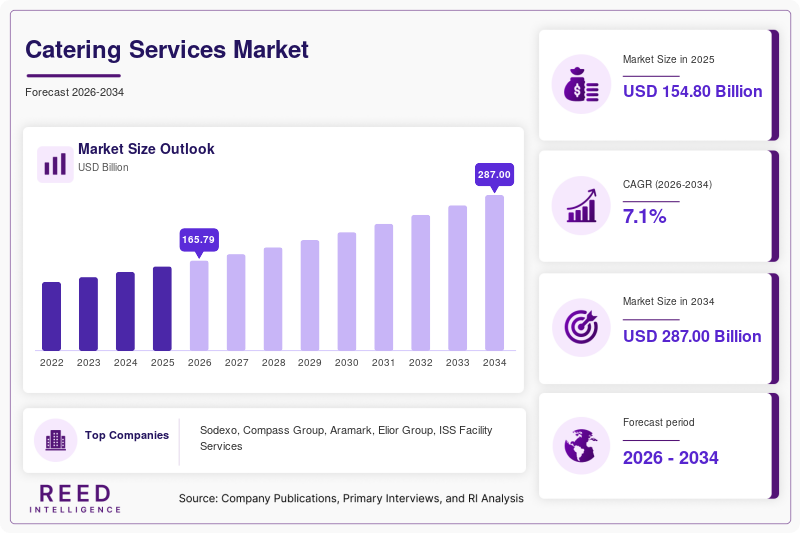
The global Catering Services Market size is valued at approximately USD 154.8 billion in 2026 and is projected to reach USD 268.5 billion by 2034, expanding at a CAGR of 7.1% during the forecast period. The market growth is driven by increasing demand for outsourced food services across corporate, institutional, and event-based sectors, along with rising urbanization and changing consumption patterns in both developed and emerging economies. Expansion in organized foodservice infrastructure and digital catering management platforms is also supporting market penetration globally.
One of the major global factors supporting market expansion is the rapid transformation of workplace culture, particularly the growth of hybrid and corporate events requiring professional food management solutions. Organizations are increasingly outsourcing catering operations to enhance efficiency, reduce operational costs, and ensure standardized food quality. Additionally, rising disposable incomes and the growing popularity of social events, weddings, and hospitality tourism continue to contribute to steady demand across multiple end-use sectors.
Key Highlights
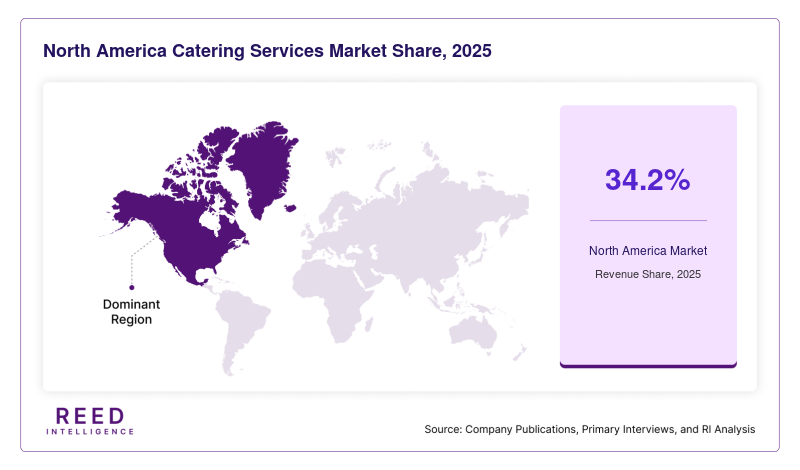
- North America dominated the market with a 34.2% share in 2025.
- while Asia Pacific is expected to grow at the fastest CAGR of 11.2% during 2026–2034.
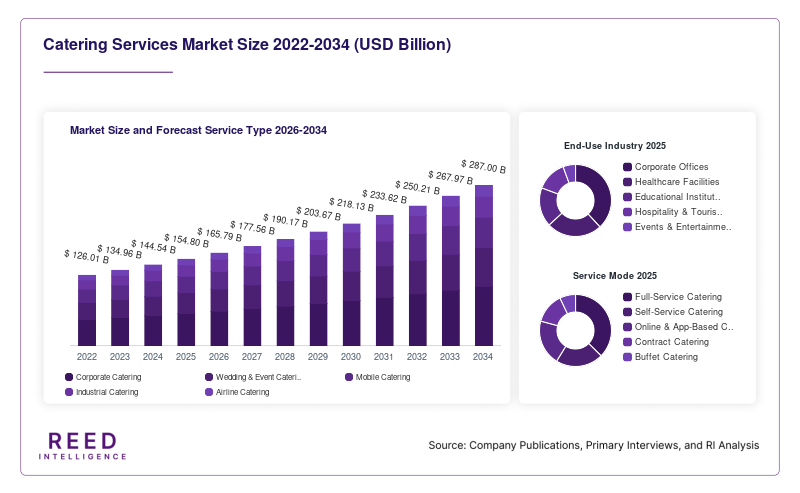
- By service type, corporate catering accounted for the largest share of 39.1%.
- while mobile catering solutions are projected to grow at a CAGR of 10.8%.
- By end-use, corporate offices led with a 41.5% share.
- whereas healthcare catering is expected to expand at a CAGR of 9.6%.
- The United States remained the dominant country, with market values of USD 22.4 billion in 2024 and USD 24.1 billion in 2025.
Market Trends
Digitalization and Smart Catering Management Systems
The Catering Services Market is witnessing strong adoption of digital platforms that streamline menu planning, order management, and service coordination. Cloud-based catering management systems are increasingly used by service providers to enhance operational efficiency and reduce manual errors. These systems integrate AI-driven demand forecasting, enabling caterers to optimize food preparation and minimize waste. Mobile applications and online booking platforms are also improving customer accessibility and engagement, especially in corporate and event catering segments. Additionally, digital payment integration and real-time tracking of food delivery services are improving transparency and customer satisfaction. This technological shift is reshaping competitive dynamics in the industry and supporting scalable business models across regions.
Growth of Sustainable and Health-Focused Catering Solutions
Another significant trend shaping the Catering Services Market is the increasing emphasis on sustainability and health-conscious food offerings. Consumers and organizations are demanding organic ingredients, plant-based menus, and locally sourced food options. Catering companies are responding by redesigning menus to align with environmental, social, and governance (ESG) principles. Waste reduction initiatives, eco-friendly packaging, and energy-efficient kitchen operations are becoming standard practices among leading providers. Additionally, dietary customization based on health conditions, allergies, and lifestyle preferences is gaining traction, particularly in corporate and healthcare catering. This trend is further supported by regulatory pressure and growing awareness regarding food safety and nutritional transparency across global markets.
Market Drivers
Expansion of Corporate and Institutional Catering Demand
A major driver of the Catering Services Market is the rapid expansion of corporate offices, educational institutions, and healthcare facilities requiring large-scale food service solutions. Companies are increasingly outsourcing catering operations to improve employee satisfaction and productivity while focusing on core business activities. Institutional catering, particularly in schools, universities, and hospitals, is also experiencing steady growth due to standardized nutrition programs and government-supported meal initiatives. The rise of multinational corporations and remote office hubs has further increased demand for flexible catering services capable of handling diverse workforce needs. This structural shift toward outsourcing food services continues to strengthen long-term market growth across developed and developing economies.
Rising Social Events, Hospitality, and Lifestyle Changes
Another key driver is the growing number of social events such as weddings, conferences, festivals, and private gatherings that require professional catering services. Rising disposable incomes and urban lifestyle changes have led to increased spending on premium event experiences, including curated food services. The hospitality and tourism sectors also contribute significantly to market expansion, as hotels and resorts increasingly outsource specialized catering functions. Additionally, globalization has influenced food preferences, leading to higher demand for diverse cuisines and customized menus. The growing preference for convenience and professional service delivery continues to support strong market demand across both residential and commercial segments.
Market Restraint
High Operational Costs and Supply Chain Dependencies
One of the primary restraints affecting the Catering Services Market is the high operational cost associated with food procurement, labor, logistics, and infrastructure maintenance. Fluctuations in raw material prices, particularly in meat, dairy, and fresh produce, significantly impact profit margins for catering companies. Additionally, the industry is highly dependent on efficient supply chain networks, which are vulnerable to disruptions caused by geopolitical tensions, climate conditions, and transportation delays. Labor shortages and rising wage expectations further increase operational pressure, especially in developed markets. Smaller catering businesses often struggle to maintain profitability due to limited economies of scale, making market entry and expansion challenging in competitive regions.
Market Opportunities
Integration of Artificial Intelligence and Automation
The increasing integration of artificial intelligence and automation presents a major opportunity in the Catering Services Market. AI-powered systems can optimize menu planning, predict demand patterns, and reduce food waste through accurate forecasting. Automation in food preparation, packaging, and delivery processes enhances operational efficiency and consistency in service quality. Robotics in kitchen operations is gradually being introduced in large-scale catering facilities, reducing dependency on manual labor and improving turnaround time. Furthermore, AI-driven customer analytics enables personalized catering experiences, improving client retention and satisfaction. As digital transformation accelerates across the foodservice industry, technology-driven catering solutions are expected to unlock significant growth potential.
Expansion in Emerging Markets and Event-Based Services
Emerging economies present substantial growth opportunities due to rapid urbanization, rising middle-class populations, and increasing corporate investments. Countries in Asia Pacific, Latin America, and parts of Africa are witnessing strong demand for organized catering services as lifestyle changes and disposable incomes rise. Additionally, the expansion of event-based industries such as exhibitions, weddings, and entertainment festivals is creating new revenue streams for catering providers. International food chains and local catering companies are increasingly forming partnerships to expand service reach in untapped markets. Infrastructure development, including commercial spaces and hospitality venues, further supports the growth of catering demand in these regions.
Segmental Analysis
By Service Type
Corporate catering dominated the market with a 39.1% share in 2024, driven by increasing demand from office complexes, business events, and institutional clients. Large organizations prefer outsourced catering services to ensure consistent food quality and reduce internal operational complexity. This segment benefits from long-term contracts and recurring demand structures, making it a stable revenue contributor for service providers. Additionally, standardized meal planning and bulk service delivery further strengthen its dominant position across global markets.
Mobile catering is the fastest-growing subsegment with a projected CAGR of 10.8%, supported by increasing demand for flexible food service solutions at outdoor events, festivals, and temporary gatherings. The growth is driven by rising consumer preference for convenience-based food delivery models and the expansion of food truck culture in urban areas. Technological advancements in mobile kitchen equipment and logistics optimization are also improving service efficiency, enabling operators to scale rapidly across multiple locations.
By End-Use
Corporate offices accounted for the largest share of 41.5% in 2024, driven by the growing trend of outsourced employee meal programs and workplace dining services. Companies are increasingly investing in catering solutions to improve employee productivity and workplace satisfaction. Institutional demand from educational and healthcare sectors also contributes significantly to this dominance, supported by structured meal programs and government initiatives in many regions.
Healthcare catering is emerging as the fastest-growing end-use segment with a CAGR of 9.6%, supported by rising patient care standards and nutritional requirements in hospitals and care facilities. The need for specialized diets, hygiene compliance, and personalized meal planning is driving demand for professional catering services. Increasing healthcare infrastructure investments globally further enhance growth opportunities in this segment.
By Service Mode
Full-service catering leads the market with a 42.7% share in 2024, due to its comprehensive offerings that include food preparation, delivery, setup, and service management. This model is widely adopted in corporate events, weddings, and large-scale institutional gatherings where end-to-end service is required. The reliability and consistency of full-service providers make them a preferred choice across developed markets.
Online and app-based catering services represent the fastest-growing subsegment with a CAGR of 11.5%, driven by digital transformation and increasing consumer preference for convenience. Mobile ordering platforms and real-time tracking systems are enhancing customer experience. The rise of cloud kitchens and digital-first catering brands is further accelerating growth in this segment.
Regional Analysis
North America
North America accounted for approximately 34.2% market share in 2025, with a projected CAGR of 6.5% during 2026–2034. The region benefits from a highly organized foodservice industry and strong demand from corporate and institutional sectors. High adoption of outsourced catering solutions continues to support regional dominance.
The United States leads the regional market, driven by advanced hospitality infrastructure and high demand from corporate offices. Growth is further supported by increasing adoption of digital catering platforms that improve operational efficiency and customer engagement across large-scale food service providers.
Europe
Europe held around 27.8% market share in 2025, with an expected CAGR of 6.2% through 2034. The region demonstrates strong demand from corporate catering and event management industries, supported by well-established hospitality networks.
Germany remains the leading country due to its strong industrial base and corporate culture. Growth is driven by increasing demand for sustainable catering practices and strict food safety regulations that encourage high-quality service standards.
Asia Pacific
Asia Pacific captured approximately 22.4% market share in 2025, with the fastest CAGR of 11.2% during 2026–2034. Rapid urbanization and expanding corporate infrastructure are driving strong market growth.
China dominates the regional market, supported by its large population and rapid expansion of commercial spaces. Increasing disposable incomes and rising demand for premium catering services in urban centers further accelerate market expansion.
Middle East & Africa
The Middle East & Africa region held about 8.3% market share in 2025, with a CAGR of 8.1% forecast through 2034. Growth is supported by expanding hospitality and tourism industries.
The United Arab Emirates leads the region due to strong tourism inflows and large-scale event hosting. Demand for luxury catering services in hotels and international exhibitions continues to drive market expansion.
Latin America
Latin America accounted for approximately 7.3% market share in 2025, with a CAGR of 7.4% during the forecast period. Increasing urbanization and growing corporate investments are contributing to steady demand.
Brazil dominates the regional market, supported by a large hospitality sector and rising number of social events. Growth is further driven by expanding corporate outsourcing of catering services in metropolitan areas.
Competitive Landscape
The Catering Services Market is moderately fragmented with the presence of global players and regional service providers competing on quality, pricing, and service customization. Leading companies include Sodexo, Compass Group, Aramark, ISS Facility Services, and Elior Group. These players focus on expanding service portfolios, adopting digital technologies, and forming long-term corporate contracts to strengthen market position.
Sodexo remains a key industry leader due to its extensive global footprint and diversified foodservice solutions. A recent development includes expansion of AI-based meal planning systems to enhance operational efficiency and reduce food waste across large institutional contracts.
Key Players
- Sodexo
- Compass Group
- Aramark
- Elior Group
- ISS Facility Services
- Delaware North
- Centerplate
- Bartlett Mitchell
- KBR Catering Services
- Abu Dhabi National Hotels Catering
- Do & Co Aktiengesellschaft
- Gate Gourmet
- NexDine Hospitality
- Flying Food Group
- The Caterers Ltd
Recent Developments
- Expansion of AI-driven catering management platforms by major global service providers to optimize food preparation and reduce waste.
- Increasing partnerships between hospitality companies and catering firms to support large-scale international events and conferences.
- Launch of sustainable catering initiatives focused on zero-waste kitchens, biodegradable packaging, and carbon-neutral food service operations.
Catering Services Market Segments
Service Type
- Corporate Catering
- Wedding & Event Catering
- Mobile Catering
- Industrial Catering
- Airline Catering
End-Use Industry
- Corporate Offices
- Healthcare Facilities
- Educational Institutions
- Hospitality & Tourism Sector
- Events & Entertainment Industry
Service Mode
- Full-Service Catering
- Self-Service Catering
- Online & App-Based Catering
- Contract Catering
- Buffet Catering
By Region
- North America
- Europe
- APAC
- Middle East and Africa
- LATAM