Caustic Calcined Magnesia Market Size, Share & Demand Report By Grade (High-Purity Grade, Agricultural Grade, Refractory Grade), By Application (Refractory Materials, Chemical Processing, Construction Materials), By End Use (Chemical Manufacturing, Environmental Management, Agriculture Industry, Steel Industry, Mining Industry) By Region & Segment Forecasts, 2026–2034
USD 3950
Market Overview
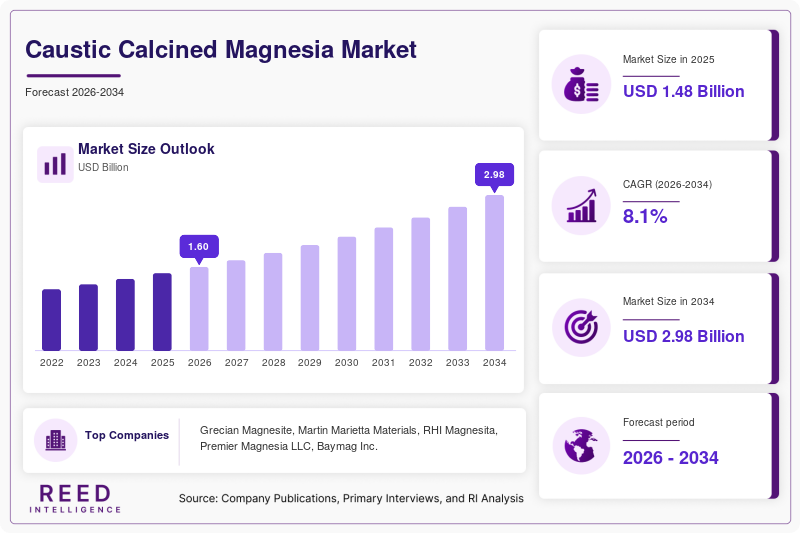
The global Caustic Calcined Magnesia Market size was valued at USD 1.48 billion in 2026 and is projected to reach USD 2.76 billion by 2034, expanding at a CAGR of 8.1% during the forecast period from 2026 to 2034. The market is experiencing stable expansion due to the increasing use of caustic calcined magnesia across agriculture, environmental treatment, construction materials, steel processing, and chemical manufacturing. Rising industrial activity in emerging economies and the growing requirement for magnesium-based compounds in water purification systems have created favorable conditions for market growth. Manufacturers are also investing in energy-efficient calcination technologies to improve production capacity and reduce operational costs.
The growing focus on wastewater treatment and environmental compliance has become one of the major global factors supporting the Caustic Calcined Magnesia Market. Industries such as mining, pulp and paper, and municipal water treatment increasingly use magnesia products for neutralization and pH control applications. In addition, the expansion of sustainable farming practices has increased demand for magnesium-based fertilizers and animal feed additives. The steel industry continues to remain an important consumer due to the material’s thermal resistance and chemical stability.
Key Highlights
- North America dominated the market with a 35.1% share in 2025.
- Asia Pacific is expected to grow at the fastest CAGR of 9.4% during 2026–2034.
- By grade, industrial grade accounted for the largest share of 46.8%.
- while high-purity grade is projected to grow at a CAGR of 9.8%.
- By application, wastewater treatment led with a 33.7% share.
- whereas agriculture applications are expected to expand at a CAGR of 9.6%.
- By end use, chemical manufacturing held the dominant share of 31.4%.
- while environmental management applications are projected to grow at a CAGR of 9.9%.
- China remained the dominant country, with market values of USD 268 million in 2024 and USD 291 million in 2025.
Market Trends
Rising Adoption of High-Purity Magnesia in Specialty Applications
The increasing use of high-purity caustic calcined magnesia in specialty industrial applications is becoming an important trend in the global market. Industries such as pharmaceuticals, specialty chemicals, cosmetics, and advanced ceramics are demanding higher quality magnesium compounds with controlled impurity levels and improved thermal performance. This shift has encouraged producers to invest in advanced refining processes and better raw material selection. The market is also benefiting from stronger quality standards in industrial production, particularly in Europe and Asia Pacific. High-purity products are gaining attention because they improve operational efficiency and reduce contamination risks during chemical processing. The trend is expected to support long-term market expansion as industrial users continue to prioritize performance-oriented materials.
Increasing Integration of Sustainable Manufacturing Technologies
Manufacturers operating in the Caustic Calcined Magnesia Market are increasingly integrating sustainable production technologies to reduce carbon emissions and energy consumption. Traditional calcination methods require significant thermal energy, which has encouraged producers to adopt energy-efficient kilns and waste heat recovery systems. Companies are also focusing on recycling industrial byproducts and improving raw material utilization rates. This trend is particularly visible in regions with strict environmental regulations, including North America and Europe. Buyers across construction, mining, and chemical sectors are showing greater preference for suppliers with sustainable manufacturing capabilities. As sustainability standards continue to influence procurement decisions, environmentally responsible production methods are expected to become a critical competitive factor in the market.
Market Drivers
Growing Demand from Wastewater Treatment and Environmental Industries
The expanding requirement for wastewater treatment solutions across industrial and municipal sectors is a major driver for the Caustic Calcined Magnesia Market. Caustic calcined magnesia is widely used for pH adjustment, heavy metal precipitation, and acid neutralization due to its stable chemical properties and cost efficiency. Rapid industrialization in developing countries has increased wastewater generation, leading governments to implement stricter environmental regulations. Industries including mining, textiles, pulp and paper, and chemicals are investing heavily in treatment infrastructure, creating stable demand for magnesia-based products. The market is also benefiting from rising public awareness regarding water quality management. As industrial facilities modernize their treatment systems, the demand for efficient magnesium compounds is expected to increase steadily.
Expansion of Agricultural and Animal Feed Applications
The growing use of magnesium-based products in agriculture and animal nutrition is supporting market growth globally. Farmers increasingly use caustic calcined magnesia in fertilizers and soil conditioning products to improve crop productivity and correct magnesium deficiencies in agricultural land. Livestock producers are also incorporating magnesium supplements into animal feed to enhance health and productivity. Rising global food demand and increasing focus on sustainable agricultural practices are strengthening the need for nutrient-rich soil additives. Countries with large agricultural sectors, particularly in Asia Pacific and Latin America, are witnessing greater product adoption. The ability of magnesia products to improve soil quality and livestock performance is expected to support consistent market demand during the forecast period.
Market Restraint
Volatility in Raw Material Prices and Energy Costs
Fluctuations in raw material prices and rising energy costs continue to restrain the growth potential of the Caustic Calcined Magnesia Market. The production process depends heavily on magnesite ore availability and high-temperature calcination systems, both of which are sensitive to supply chain disruptions and fuel price changes. Energy-intensive manufacturing operations increase overall production expenses, particularly in regions facing unstable electricity or natural gas costs. Smaller manufacturers often struggle to maintain profit margins during periods of economic uncertainty. In addition, environmental regulations related to mining operations and industrial emissions can increase compliance expenses for producers. These factors may create pricing pressure for downstream industries such as chemicals, construction, and agriculture. For example, several manufacturers in Europe experienced temporary production slowdowns during periods of elevated energy prices, resulting in reduced supply availability and delayed procurement cycles for industrial customers.
Market Opportunities
Increasing Investment in Infrastructure and Construction Activities
The expansion of infrastructure and construction activities across emerging economies presents strong opportunities for the Caustic Calcined Magnesia Market. Caustic calcined magnesia is increasingly used in construction materials, refractory products, and cement applications due to its thermal resistance and binding properties. Governments in Asia Pacific, the Middle East, and Latin America are investing in transportation networks, industrial parks, and urban housing developments, which is increasing demand for durable building materials. Industrial growth has also encouraged higher consumption of steel and refractory products that rely on magnesium compounds. Manufacturers are responding by expanding production capacities and strengthening regional distribution networks. The continued modernization of industrial infrastructure is expected to create long-term opportunities for suppliers operating in the market.
Emerging Demand for Sustainable Agricultural Inputs
The rising preference for environmentally sustainable agricultural solutions is creating new growth opportunities for market participants. Caustic calcined magnesia is increasingly incorporated into eco-friendly fertilizers and soil conditioners because it supports balanced nutrient management and improves crop quality. Governments and agricultural organizations are promoting sustainable farming methods to reduce soil degradation and improve long-term agricultural productivity. Organic farming practices and precision agriculture technologies are also contributing to increased demand for magnesium-based additives. Producers are developing customized formulations to meet specific crop and soil requirements across different climatic regions. As agricultural sustainability becomes a strategic priority worldwide, demand for magnesium-rich soil enhancement products is expected to increase significantly during the forecast period.
Segmental Analysis
By Grade
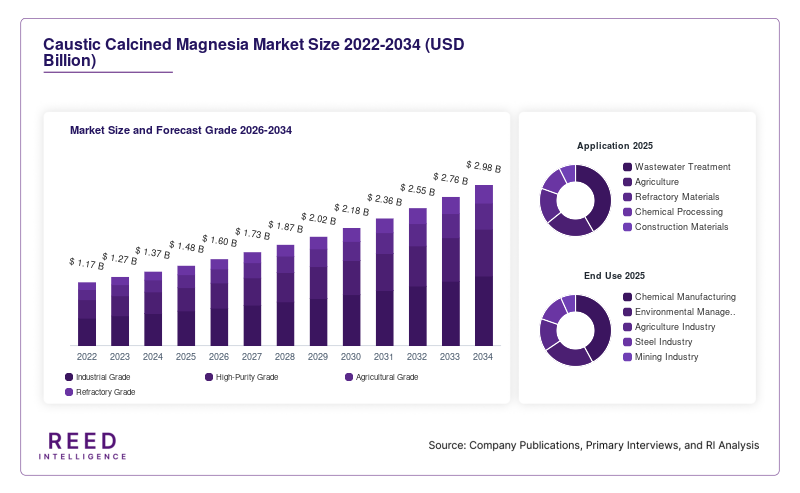
Industrial grade accounted for the largest share of the Caustic Calcined Magnesia Market in 2024, representing approximately 46.8% of total revenue. This dominance is linked to its extensive use across wastewater treatment, construction materials, mining operations, and chemical manufacturing applications. Industrial-grade products are preferred because they provide cost-effective performance in high-volume industrial environments. The segment also benefits from rising demand for neutralizing agents and refractory materials in steel processing industries. Several manufacturers continue to focus on improving production efficiency and supply consistency to support large-scale industrial buyers. In addition, increasing investments in infrastructure projects across emerging economies have strengthened consumption of industrial-grade magnesia products in cement and building material applications.
High-purity grade is projected to witness the fastest CAGR of 9.8% during the forecast period due to increasing demand from specialty chemical, pharmaceutical, and advanced ceramic industries. Manufacturers in these industries require products with low impurity levels and consistent chemical performance. Rising investment in high-value industrial applications is encouraging suppliers to develop premium-grade magnesia products with improved processing characteristics. Asia Pacific and Europe are expected to remain major growth centers for this segment because of strong industrial innovation and quality-focused manufacturing standards. The increasing adoption of advanced production technologies and precision chemical formulations is also expected to contribute to rapid growth in the high-purity grade segment over the coming years.
By Application
Wastewater treatment emerged as the dominant application segment in 2024, accounting for 33.7% of the overall Caustic Calcined Magnesia Market share. The segment benefits from rising industrial wastewater generation and stricter environmental regulations worldwide. Caustic calcined magnesia is widely used for pH stabilization, acid neutralization, and heavy metal precipitation in municipal and industrial treatment facilities. Industries such as mining, chemicals, textiles, and pulp and paper continue to invest in efficient treatment systems to meet environmental compliance standards. The product’s stable chemical properties and operational efficiency make it suitable for large-scale treatment operations. Growing public concern regarding water pollution and environmental sustainability is expected to support continued demand from this segment.
Agriculture applications are anticipated to register the fastest CAGR of 9.6% during the forecast period due to the increasing adoption of magnesium-enriched soil additives and fertilizers. Farmers are focusing on improving crop quality, nutrient balance, and soil productivity to meet rising food demand. Caustic calcined magnesia supports plant growth by correcting magnesium deficiencies and improving nutrient absorption in agricultural land. Expanding awareness regarding sustainable farming practices is further contributing to segment growth. Countries with strong agricultural economies, including India, Brazil, and China, are increasing investments in advanced nutrient management systems. The expansion of precision farming technologies and environmentally responsible agricultural practices is expected to accelerate product adoption across the agriculture sector.
By End Use
Chemical manufacturing held the dominant position in the Caustic Calcined Magnesia Market in 2024 with a revenue share of 31.4%. The segment’s growth is driven by the increasing use of magnesium compounds in catalysts, specialty chemicals, flame retardants, and industrial processing applications. Chemical manufacturers prefer caustic calcined magnesia because of its high reactivity, thermal stability, and versatility in chemical synthesis operations. Demand is particularly strong in developed industrial economies where advanced manufacturing processes require reliable raw materials. The market is also benefiting from increasing production of industrial chemicals and specialty formulations used in construction, automotive, and electronics industries. Growing industrial automation and process optimization activities are expected to support further demand growth.
Environmental management is projected to witness the fastest CAGR of 9.9% during the forecast period due to rising investments in sustainable industrial operations and pollution control technologies. Governments and private organizations are increasing spending on environmental protection initiatives, including wastewater treatment, emission control, and hazardous waste management systems. Caustic calcined magnesia is gaining attention because it offers efficient neutralization properties and supports environmentally responsible industrial practices. Demand is expected to increase significantly in regions implementing stricter environmental policies, particularly North America and Europe. In addition, mining and manufacturing industries are adopting advanced environmental management systems to improve operational sustainability and reduce long-term compliance risks, which is expected to drive segment expansion.
Regional Analysis
North America
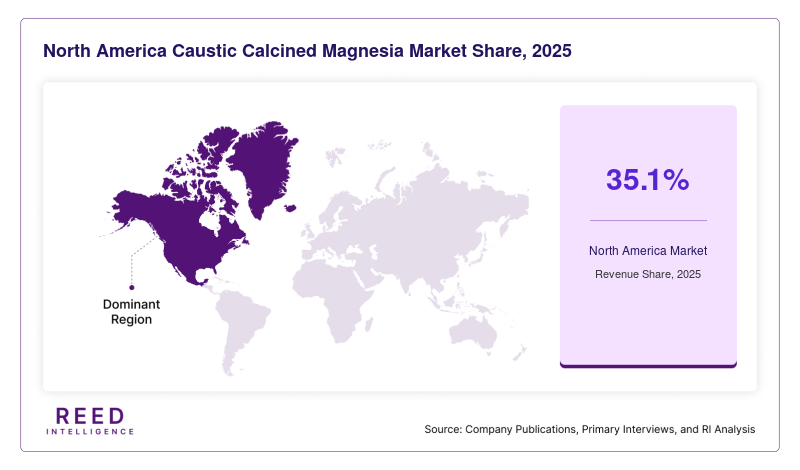
North America accounted for 35.1% of the global Caustic Calcined Magnesia Market share in 2025 and continues to represent one of the most established regional markets. The region is expected to expand at a CAGR of 7.4% during the forecast period due to strong industrial demand and advanced environmental management systems. Stable consumption from wastewater treatment facilities, steel manufacturing plants, and chemical processing industries continues to support market revenue. The United States and Canada are also investing in industrial modernization projects, creating additional demand for high-performance magnesium compounds. Growing emphasis on sustainable industrial practices further strengthens market expansion across the region.
The United States remains the dominant country in North America due to its large industrial base and strong environmental compliance standards. One unique growth factor in the country is the increasing investment in municipal wastewater treatment upgrades. Several local governments are modernizing aging treatment infrastructure to meet stricter water quality regulations, leading to higher demand for magnesia-based neutralization products. In addition, industrial manufacturers are increasingly adopting sustainable chemical treatment solutions to reduce operational risks and improve efficiency. The presence of advanced research facilities and established supply chains also supports regional product innovation.
Europe
Europe represented a significant share of the global Caustic Calcined Magnesia Market in 2025 and is projected to grow at a CAGR of 7.1% through 2034. Demand remains stable due to strong consumption across construction, specialty chemicals, and environmental treatment industries. European countries continue to enforce strict industrial emission standards, increasing the use of magnesia products in pollution control applications. The market is also benefiting from technological advancements in energy-efficient calcination systems. Several regional manufacturers are improving operational efficiency and focusing on premium-grade products to strengthen competitiveness in international markets.
Germany remains the leading country within the European market because of its advanced manufacturing sector and established chemical industry. A unique factor supporting growth in Germany is the increasing integration of sustainable industrial materials in production facilities. Chemical and steel manufacturers are actively seeking low-emission processing materials, which has increased the use of high-quality magnesia products. The country also benefits from strong research and development activities focused on improving industrial mineral processing technologies. Stable export demand from neighboring European countries continues to support regional market growth.
Asia Pacific
Asia Pacific held a considerable share of the Caustic Calcined Magnesia Market in 2025 and is projected to register the fastest CAGR of 9.4% during the forecast period. Rapid industrialization, urbanization, and infrastructure expansion are driving demand for magnesium compounds across multiple sectors. Countries such as China, India, Japan, and South Korea are experiencing rising consumption from steel manufacturing, agriculture, and wastewater treatment industries. The increasing focus on industrial productivity and environmental management is also supporting market expansion. In addition, lower production costs and abundant mineral reserves provide a competitive advantage for regional manufacturers.
China remains the dominant country in Asia Pacific due to its extensive magnesite reserves and large-scale industrial production capabilities. One unique growth factor in China is the rapid expansion of domestic infrastructure projects, including transportation networks and industrial construction. The country’s strong steel manufacturing sector also creates consistent demand for refractory and chemical-grade magnesia products. In addition, government initiatives promoting water treatment modernization and sustainable agricultural development are encouraging broader product adoption. The presence of large export-oriented manufacturers further strengthens China’s position in the global market.
Middle East & Africa
The Middle East & Africa region is witnessing gradual expansion in the Caustic Calcined Magnesia Market and is forecast to grow at a CAGR of 6.8% through 2034. Industrial diversification strategies across Gulf countries are creating demand for chemicals, construction materials, and wastewater treatment solutions. Mining activities and infrastructure projects are also contributing to regional consumption. Several countries are increasing investments in industrial processing facilities to reduce dependence on imports and strengthen local manufacturing capabilities. Although the market size remains smaller compared to other regions, long-term industrial development plans continue to create favorable growth conditions.
Saudi Arabia remains the dominant country within the Middle East & Africa market due to ongoing industrial expansion and infrastructure development initiatives. A unique growth factor in the country is the rapid development of industrial cities and large-scale construction projects linked to economic diversification programs. These initiatives have increased demand for refractory materials, steel production inputs, and water treatment chemicals. In addition, rising investment in desalination infrastructure supports the use of magnesia-based treatment products. Government-backed industrial growth programs are expected to continue supporting regional market development during the forecast period.
Latin America
Latin America accounted for a moderate share of the global Caustic Calcined Magnesia Market in 2025 and is anticipated to grow at a CAGR of 7.0% during the forecast period. The market is supported by expanding mining operations, agricultural activities, and industrial processing industries. Countries across the region are increasing investments in wastewater management and environmental compliance, creating new demand for magnesium compounds. The agriculture sector also plays a critical role, particularly in fertilizer and soil treatment applications. Economic recovery and industrial modernization efforts are expected to strengthen long-term market prospects.
Brazil remains the dominant country in the Latin American market because of its large agricultural economy and expanding industrial sector. One unique growth factor supporting market expansion is the increasing adoption of nutrient management solutions in commercial farming operations. Brazilian farmers are investing in soil enhancement products to improve crop yields and maintain long-term soil productivity. The country’s mining industry also contributes to steady demand for wastewater treatment chemicals and refractory materials. Improved industrial investment and stronger export activity continue to create growth opportunities for regional manufacturers and suppliers.
Competitive Landscape
The Caustic Calcined Magnesia Market is characterized by the presence of regional mineral processors, global chemical suppliers, and vertically integrated magnesium product manufacturers. Companies are focusing on capacity expansion, long-term raw material sourcing agreements, and product quality improvements to strengthen their market position. Strategic partnerships with industrial buyers and investments in sustainable production technologies are becoming increasingly common across the industry.
Grecian Magnesite continues to maintain a strong leadership position due to its diversified product portfolio, advanced processing capabilities, and established global distribution network. The company has focused on improving energy-efficient production methods and strengthening supply relationships with environmental treatment and industrial manufacturing sectors. Several other major players are also expanding operations in Asia Pacific and Latin America to capture emerging industrial demand.
Recent industry developments include investments in modern calcination facilities, expansion of wastewater treatment product lines, and research focused on high-purity magnesia applications. Companies are also increasing research and development activities to improve thermal performance and reduce production-related emissions. Competitive differentiation is increasingly based on product consistency, sustainability standards, and regional supply chain efficiency.
Key Players
- Grecian Magnesite
- Martin Marietta Materials
- RHI Magnesita
- Premier Magnesia LLC
- Baymag Inc.
- Qinghai Western Magnesium Co., Ltd.
- Magnezit Group
- Konoshima Chemical Co., Ltd.
- Nedmag B.V.
- Ube Material Industries Ltd.
- Liaoning Jinding Magnesite Group
- ICL Group
- Israel Chemicals Ltd.
- Haicheng Magnesite Refractory General Factory
Recent Developments
- In February 2025, Grecian Magnesite announced the expansion of its energy-efficient calcination facility to improve high-purity magnesia production capacity.
- In August 2024, RHI Magnesita introduced a new industrial-grade magnesia product line designed for wastewater treatment and environmental management applications.
- In May 2025, Baymag Inc. entered a strategic supply agreement with a North American chemical manufacturer to strengthen regional distribution capabilities.
- In November 2024, Premier Magnesia LLC invested in advanced ore purification technology to improve product consistency and reduce operational waste.
Caustic Calcined Magnesia Market Segments
Grade
- Industrial Grade
- High-Purity Grade
- Agricultural Grade
- Refractory Grade
Application
- Wastewater Treatment
- Agriculture
- Refractory Materials
- Chemical Processing
- Construction Materials
End Use
- Chemical Manufacturing
- Environmental Management
- Agriculture Industry
- Steel Industry
- Mining Industry
By Region
- North America
- Europe
- APAC
- Middle East and Africa
- LATAM