CBD Oil Market Size, Share Demand Report By Product Type (Full-Spectrum CBD Oil, Broad-Spectrum CBD Oil, CBD Isolate Oil), By Application (Nutraceuticals & Dietary Supplements, Pharmaceuticals), By Distribution Channel (Online Retail, Pharmacies & Drug Stores), By End Use (Healthcare & Wellness Consumers, Pharmaceutical Companies) By Region & Segment Forecasts, 2026–2034
USD 3950
Market Overview
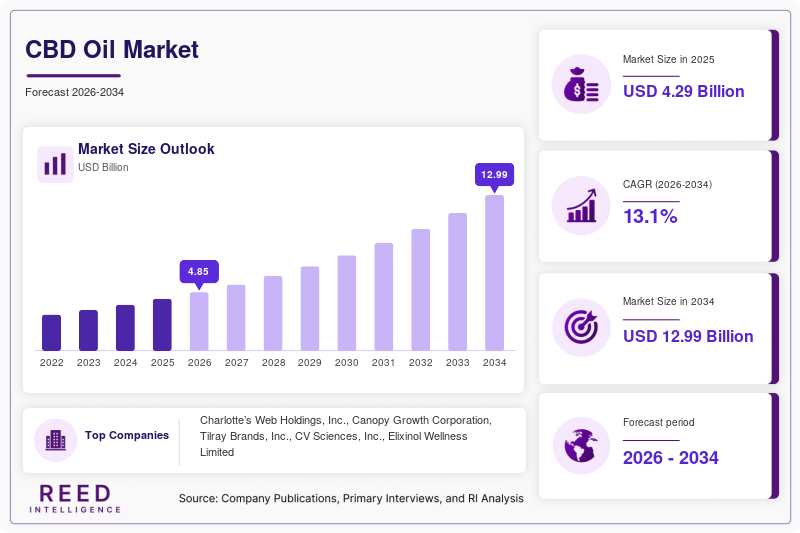
The CBD Oil Market size was valued at approximately USD 4.85 billion and is projected to reach USD 12.96 billion by 2034, registering a CAGR of 13.1% during the forecast period (2026–2034). A key factor supporting the growth of the CBD Oil Market globally is the increasing integration of CBD-based formulations into nutraceutical, pharmaceutical, and personal care applications.
Expanding clinical research on non-psychoactive cannabinoids and their potential role in stress management, sleep support, and pain relief has further strengthened consumer confidence, leading to higher adoption across both developed and emerging economies.
Key Highlights
- North America accounted for the largest regional share of 41.6% in 2025, while Asia Pacific is projected to register the fastest CAGR of 15.4% during 2026–2034 in the CBD Oil Market.
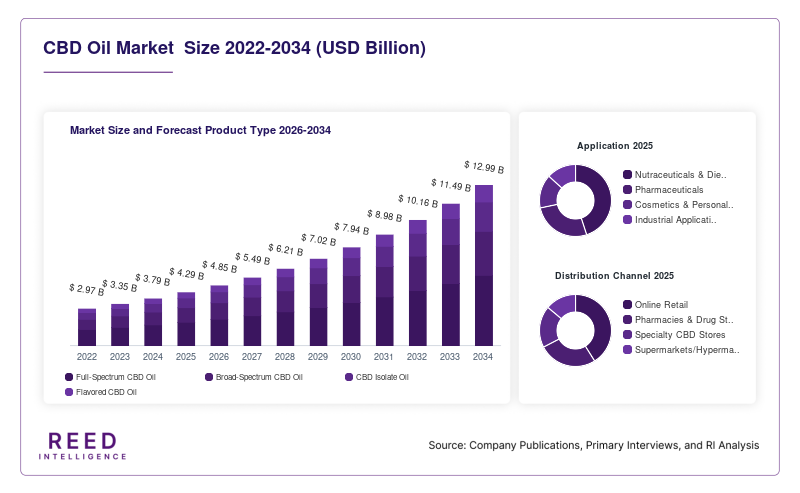
- By product type, Full-Spectrum CBD Oil held the dominant share of 46.2% in 2025, whereas CBD Isolate Oil is expected to grow at a CAGR of 14.8% through 2034.
- By application, Nutraceuticals & Dietary Supplements led with 38.5% share in 2025, while Pharmaceutical Applications are projected to expand at a CAGR of 15.2%.
- By distribution channel, Online Retail Platforms accounted for 52.1% share in 2025, while Specialty CBD Stores are expected to grow at a CAGR of 13.9%.
- The United States remained the dominant country in the CBD Oil Market, with market values of USD 1.62 billion in 2024 and USD 1.88 billion in 2025.
Market Trends
Expansion of CBD-Infused Functional Wellness Products
The CBD Oil Market is experiencing increased incorporation of cannabidiol into functional wellness products such as gummies, beverages, skincare formulations, and sleep aids. Manufacturers are focusing on combining CBD with vitamins, adaptogens, and herbal extracts to create multifunctional products targeting stress relief, immunity enhancement, and overall wellness. This trend is reshaping product portfolios across nutraceutical and personal care industries, encouraging broader consumer adoption.
Advancement in Nanoemulsion and Bioavailability Technologies
Technological advancements in nanoemulsion and liposomal delivery systems are improving the absorption rate and effectiveness of CBD oil products. These innovations are addressing long-standing challenges related to bioavailability, enabling faster onset of effects and more consistent dosage performance. As a result, companies in the CBD Oil Market are investing in advanced formulation technologies to differentiate their offerings and improve consumer satisfaction.
Market Drivers
Rising Demand for Natural and Plant-Based Therapeutics
The growing preference for plant-derived wellness solutions is a major driver of the CBD Oil Market. Consumers are increasingly shifting away from synthetic pharmaceuticals toward natural alternatives for managing anxiety, chronic pain, and sleep disorders. CBD oil, derived from hemp plants, is gaining acceptance as a complementary wellness ingredient, supported by increasing scientific exploration and regulatory clarity in multiple regions.
Expansion of Legalization and Regulatory Acceptance
The gradual legalization of hemp cultivation and CBD-based products across various countries is significantly boosting market growth. Regulatory frameworks in North America and parts of Europe have enabled commercial-scale production and distribution of CBD oil. This has encouraged investments in cultivation, extraction technologies, and product innovation, strengthening the overall supply chain of the CBD Oil Market.
Market Restraint
Regulatory Uncertainty and Product Standardization Challenges
Despite increasing legalization, inconsistent regulations across countries remain a key restraint in the CBD Oil Market. Variations in permissible THC levels, labeling standards, and product approval processes create compliance complexities for manufacturers. Additionally, lack of global standardization in product quality and dosing limits broader international expansion, particularly in highly regulated pharmaceutical and food sectors.
Market Opportunities
Growth in Pharmaceutical-Grade CBD Applications
The rising exploration of CBD in pharmaceutical formulations presents significant opportunities in the CBD Oil Market. Clinical research focusing on epilepsy, chronic pain, and neurological disorders is driving demand for high-purity, pharmaceutical-grade CBD oil. As regulatory approvals expand, pharmaceutical companies are expected to integrate CBD into prescription-based therapies, opening new revenue streams.
Increasing Demand in Personal Care and Cosmetics Industry
The cosmetic and personal care industry is emerging as a high-growth opportunity area for the CBD Oil Market. CBD-infused skincare products are gaining traction due to their perceived anti-inflammatory and antioxidant properties. Brands are introducing CBD-based creams, serums, and lotions targeting acne, aging, and skin sensitivity, supporting sustained market penetration in beauty and wellness segments.
Segmental Analysis
By Product Type
The CBD Oil Market is segmented into Full-Spectrum CBD Oil, Broad-Spectrum CBD Oil, CBD Isolate Oil, and Flavored CBD Oil. Full-Spectrum CBD Oil held the dominant share of 46.2% in 2025, driven by the “entourage effect” preference among consumers seeking enhanced therapeutic benefits. CBD Isolate Oil is projected to grow at a CAGR of 14.8%, supported by rising demand for THC-free formulations in pharmaceutical and wellness applications.
By Application
The market includes Nutraceuticals & Dietary Supplements, Pharmaceuticals, Cosmetics & Personal Care, and Industrial Applications. Nutraceuticals & Dietary Supplements led with 38.5% share in 2025 due to widespread use of CBD in wellness products. Pharmaceuticals are expected to grow at a CAGR of 15.2%, driven by increasing clinical validation and drug development activities involving cannabinoid-based therapies.
By Distribution Channel
The CBD Oil Market is segmented into Online Retail, Pharmacies & Drug Stores, Specialty CBD Stores, and Supermarkets/Hypermarkets. Online Retail dominated with 52.1% share in 2025, supported by convenience, wider product availability, and direct-to-consumer brand strategies. Specialty CBD Stores are expected to grow at a CAGR of 13.9%, driven by personalized customer engagement and product education services.
Regional Analysis
North America
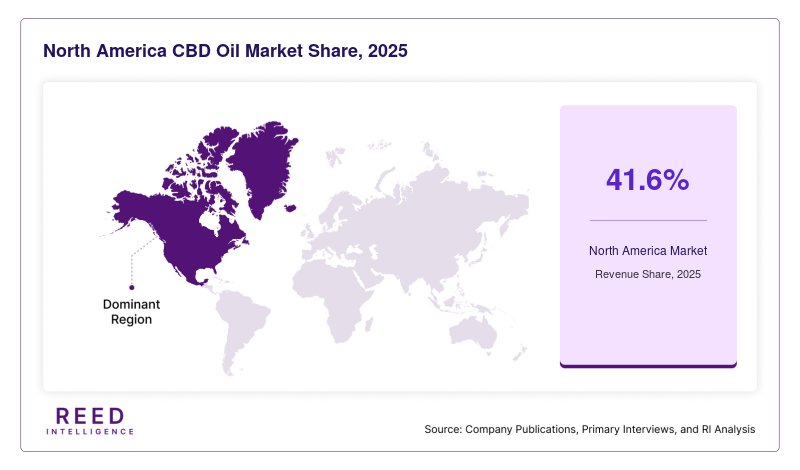
North America held 41.6% share of the CBD Oil Market in 2025 and is projected to grow at a CAGR of 12.8% during 2026–2034. The region benefits from advanced regulatory frameworks, high consumer awareness, and strong retail infrastructure for wellness products. The United States dominated the region due to widespread legalization of hemp-derived CBD products and strong investment in cannabis-based research and product development.
Europe
Europe accounted for 27.3% share in 2025 and is expected to grow at a CAGR of 13.5% during the forecast period. Growth is supported by increasing acceptance of CBD in wellness applications and expanding regulatory approvals in countries such as Germany, the United Kingdom, and Switzerland. Germany led the regional CBD Oil Market due to its strong pharmaceutical sector and rising demand for natural health products.
Asia Pacific
Asia Pacific represented 18.4% share in 2025 and is forecast to register the fastest CAGR of 15.4% during 2026–2034 in the CBD Oil Market. Growth is driven by increasing consumer interest in alternative medicine, expanding wellness industries, and gradual regulatory relaxation in countries such as Australia and Thailand. China emerged as the dominant country due to growing hemp cultivation and rising export-oriented CBD production capabilities.
Middle East & Africa
Middle East & Africa held 6.1% share in 2025 and is projected to grow at a CAGR of 11.2% through 2034. Market expansion is supported by increasing adoption of wellness supplements and gradual regulatory openness in select countries. South Africa led the regional market due to legalized cannabis cultivation and growing investment in health-focused product development.
Latin America
Latin America accounted for 6.6% share in 2025 and is expected to grow at a CAGR of 12.1% during 2026–2034. Brazil dominated the region due to expanding medical cannabis regulations and increasing consumer awareness of CBD-based wellness products. The region is witnessing growing adoption in pharmaceutical and personal care applications.
Competitive Landscape
The CBD Oil Market is moderately fragmented with the presence of established cannabis companies, wellness brands, and specialized CBD manufacturers. Companies are focusing on product innovation, organic sourcing, and expansion of distribution networks to strengthen market presence.
Charlotte's Web Holdings remains a key player due to its strong brand recognition and wide product portfolio in tinctures, gummies, and capsules. The company recently expanded its product line with improved bioavailability formulations targeting stress and sleep support applications.
Canopy Growth Corporation and Tilray Brands Inc. continue to strengthen their CBD divisions through strategic acquisitions and international expansion.
CV Sciences Inc. focuses on nutraceutical CBD formulations, while Elixinol Wellness Limited emphasizes organic and plant-based wellness solutions across global markets.
Key Players List
- Charlotte’s Web Holdings
- Canopy Growth Corporation
- Tilray Brands Inc.
- CV Sciences Inc.
- Elixinol Wellness Limited
- Aurora Cannabis Inc.
- Medical Marijuana Inc.
- Green Roads
- Medterra CBD
- Joy Organics
- Isodiol International Inc.
- Endoca
- CBDistillery (Balanced Health Botanicals)
- NuLeaf Naturals
- Charlotte’s Web Holdings Europe
Recent Developments
- In 2025, several companies in the CBD Oil Market introduced enhanced nanoemulsion-based CBD oil formulations aimed at improving absorption efficiency and onset time. Manufacturers expanded production capacities to meet rising global demand for wellness and pharmaceutical-grade CBD products.
- Strategic collaborations between cannabis cultivators and pharmaceutical firms increased, focusing on standardized CBD extraction and clinical research applications. Companies also invested in sustainable hemp farming practices to improve supply chain transparency and product consistency.
- Additionally, digital commerce platforms expanded their CBD product categories, enabling direct-to-consumer growth and strengthening global distribution networks across wellness-focused markets.
CBD Oil Market Segments
Product Type
- Full-Spectrum CBD Oil
- Broad-Spectrum CBD Oil
- CBD Isolate Oil
- Flavored CBD Oil
Application
- Nutraceuticals & Dietary Supplements
- Pharmaceuticals
- Cosmetics & Personal Care
- Industrial Applications
Distribution Channel
- Online Retail
- Pharmacies & Drug Stores
- Specialty CBD Stores
- Supermarkets/Hypermarkets
End Use
- Healthcare & Wellness Consumers
- Pharmaceutical Companies
- Cosmetic Manufacturers
- Research Institutions
By Region
- North America
- Europe
- APAC
- Middle East and Africa
- LATAM