Ccus Absorption Market Size, Share & Demand Report By Type (Chemical Absorption, Physical Absorption), By Application (Power Generation, Hydrogen Production, Industrial Processing), By End-Use Industry (Oil & Gas, Cement, Chemicals, Steel), By Solvent Type (Amine-Based Solvents, Advanced Solvents), By Region & Segment Forecasts, 2025–2034
USD 3950
Market Overview
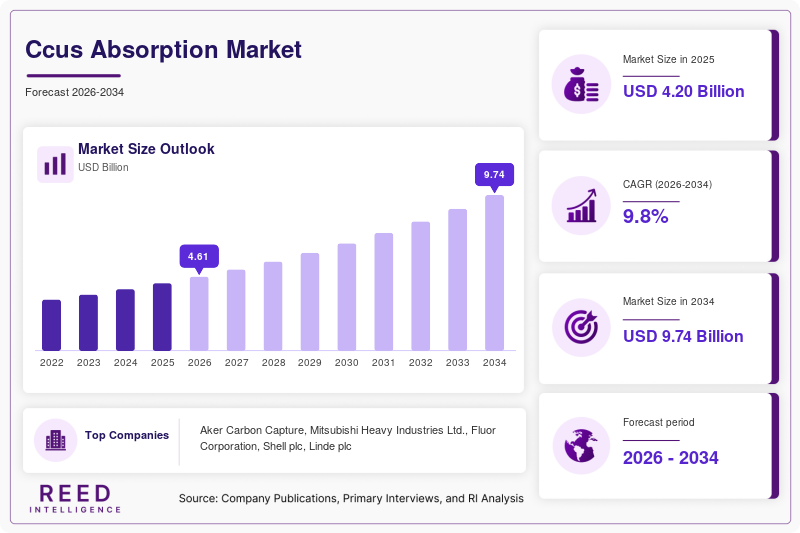
The Ccus Absorption Market size was valued at approximately USD 4.2 billion in 2025 and is projected to reach USD 9.8 billion by 2034, expanding at a CAGR of 9.8% during the forecast period (2025–2034). The market has gained momentum due to increasing adoption of carbon capture, utilization, and storage (CCUS) technologies across industrial sectors aiming to reduce greenhouse gas emissions. Absorption-based capture, particularly chemical absorption, remains a widely deployed method due to its efficiency in separating CO₂ from flue gases in power plants and heavy industries.
A key global factor supporting market growth is the strengthening of carbon neutrality commitments across developed and emerging economies. Governments and industries are aligning with climate targets, accelerating the installation of CCUS infrastructure. This has directly increased demand for advanced absorption solvents and technologies capable of delivering cost-effective and scalable carbon capture.
Key Highlights
- North America dominated the market with a 34% share in 2025, while Asia Pacific is projected to be the fastest-growing region with a CAGR of 11.6%.
- Chemical absorption emerged as the leading type segment with a 62% share, while physical absorption is expected to grow fastest at a CAGR of 10.9%.
- Power generation was the dominant application segment (41%), whereas hydrogen production is projected to expand at the fastest CAGR of 12.3%.
- The United States led the market with USD 1.3 billion in 2025 and is expected to reach USD 1.4 billion in 2026.
Market Trends
Shift Toward Advanced Solvent Technologies
The market is witnessing a transition from traditional amine-based solvents to advanced formulations such as blended amines and phase-change solvents. These newer solutions reduce energy consumption during regeneration and improve CO₂ capture efficiency. Industries are increasingly adopting these solvents to lower operational costs and enhance sustainability performance. Continuous research and development in solvent chemistry are shaping innovation within the Ccus Absorption Market.
Integration of CCUS with Hydrogen and Bioenergy Systems
The integration of CCUS absorption technologies with hydrogen production and bioenergy systems is gaining traction. Blue hydrogen projects are increasingly incorporating absorption-based carbon capture units to minimize emissions. Similarly, bioenergy with carbon capture and storage (BECCS) is emerging as a viable pathway to achieve negative emissions. This integration trend is expanding the application scope of absorption technologies beyond traditional sectors.
Market Drivers
Rising Industrial Decarbonization Initiatives
Industries such as cement, steel, and chemicals are adopting CCUS absorption technologies to meet emission reduction targets. The increasing pressure from regulatory bodies and investors is encouraging companies to invest in carbon capture solutions. Absorption systems offer proven performance and scalability, making them a preferred choice for industrial decarbonization efforts.
Supportive Policy Frameworks and Incentives
Government policies, including carbon pricing mechanisms, tax credits, and subsidies for CCUS projects, are driving market growth. Financial incentives reduce the cost burden of deploying absorption technologies and encourage adoption across sectors. National strategies focused on carbon neutrality are further strengthening the demand for CCUS absorption systems.
Market Restraint
High Capital and Operational Costs
The high cost associated with the installation and operation of CCUS absorption systems remains a significant challenge for market expansion. Absorption technologies require substantial capital investment for equipment, infrastructure, and integration into existing industrial processes. Additionally, operational expenses, particularly energy consumption during solvent regeneration, increase the overall cost of carbon capture.
Small and medium-scale industries often find it difficult to justify such investments without strong financial incentives. Moreover, fluctuations in carbon pricing and uncertainty in long-term policy support can delay project implementation. While technological advancements are gradually reducing costs, affordability remains a barrier, particularly in developing regions where budget constraints limit adoption.
Market Opportunities
Expansion in Emerging Economies
Emerging economies present significant growth potential for the Ccus Absorption Market due to rising industrialization and increasing environmental awareness. Governments in these regions are gradually introducing emission regulations, creating opportunities for CCUS deployment. Investments in energy infrastructure and industrial modernization further support the adoption of absorption technologies.
Development of Modular and Scalable Systems
The development of modular CCUS absorption systems is creating new opportunities for market players. These systems offer flexibility, reduced installation time, and lower initial investment compared to large-scale setups. Modular solutions are particularly attractive for smaller facilities and pilot projects, enabling broader adoption across diverse industries.
As technology providers focus on scalable designs, the market is expected to witness increased penetration in sectors that previously faced barriers due to cost and complexity.
Segmental Analysis
By Type
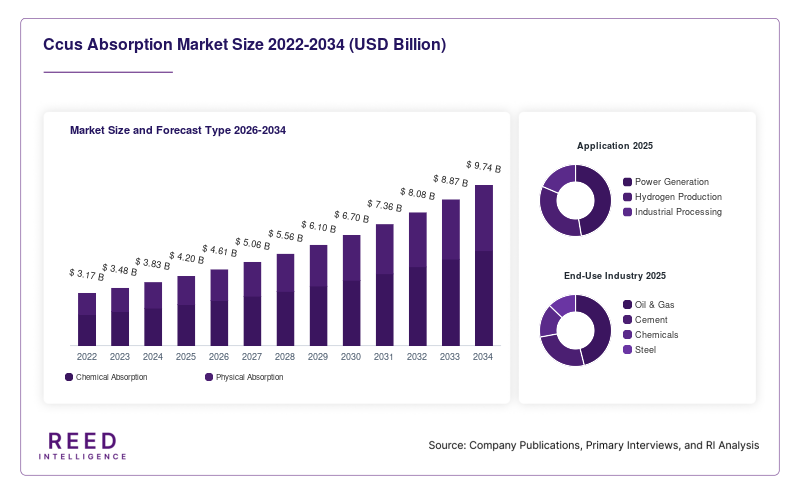
Chemical absorption dominated the Ccus Absorption Market in 2025, accounting for around 62% of the total share. This segment’s dominance was attributed to its high efficiency in capturing CO₂ from flue gases, especially in power plants and industrial facilities. The widespread use of amine-based solvents contributed significantly to its market leadership.
Physical absorption is expected to grow at the fastest CAGR of 10.9% during the forecast period. Its growth will be driven by lower energy requirements and suitability for high-pressure gas streams. Industries seeking cost-effective solutions for specific applications will increasingly adopt physical absorption technologies.
By Application
Power generation was the dominant application segment, holding approximately 41% of the market share in 2025. The need to reduce emissions from coal and gas-fired power plants has driven the adoption of absorption-based carbon capture systems.
Hydrogen production is projected to be the fastest-growing application, with a CAGR of 12.3%. The increasing focus on clean hydrogen production and the integration of CCUS technologies in hydrogen plants will drive demand for absorption systems.
By End-Use Industry
The oil and gas sector dominated the market in 2025, accounting for nearly 38% of the share. The sector’s reliance on CCUS technologies for enhanced oil recovery and emission reduction contributed to its leading position.
The cement industry is expected to witness the fastest growth, with a CAGR of 11.8%. The high carbon intensity of cement production and the need for emission control will drive the adoption of absorption technologies in this sector.
By Solvent Type
Amine-based solvents dominated the market with a share of approximately 55% in 2025. Their proven efficiency and widespread availability made them the preferred choice for CO₂ capture.
Advanced solvents are expected to grow at the fastest CAGR of 12.1%. Innovations in solvent chemistry aimed at reducing energy consumption and improving performance will drive their adoption.
Regional Analysis
North America
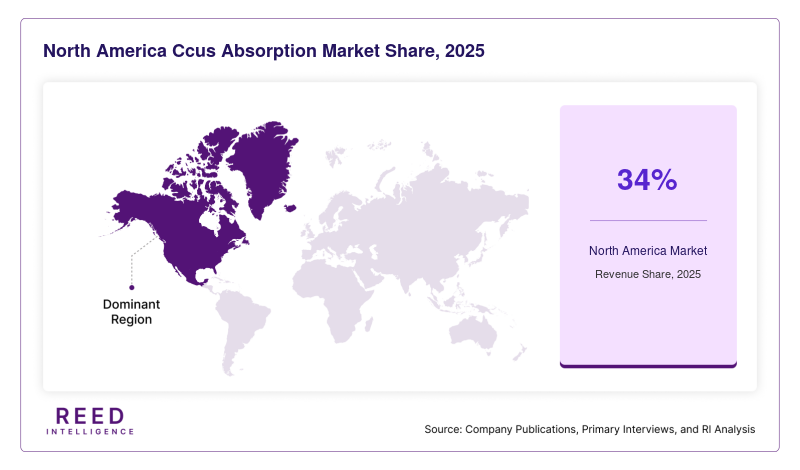
North America accounted for approximately 34% of the Ccus Absorption Market share in 2025 and will grow at a CAGR of 9.1% during the forecast period. The region’s growth is driven by strong investments in carbon capture infrastructure and established regulatory frameworks supporting emission reduction.
The United States dominated the regional market due to extensive deployment of CCUS projects in power generation and industrial sectors. The presence of advanced research institutions and technology providers has accelerated innovation in absorption technologies, further strengthening the country’s leadership.
Europe
Europe held around 27% of the market share in 2025 and is expected to grow at a CAGR of 9.5% through 2034. The region’s focus on achieving carbon neutrality has led to widespread adoption of CCUS technologies. Strict emission regulations and carbon pricing mechanisms are key factors supporting market expansion.
Germany emerged as the dominant country, driven by its industrial base and commitment to reducing carbon emissions. The country’s transition toward sustainable energy systems has increased demand for efficient absorption-based carbon capture solutions.
Asia Pacific
Asia Pacific represented nearly 22% of the market share in 2025 and is projected to grow at the fastest CAGR of 11.6%. Rapid industrialization and increasing energy demand are driving the adoption of CCUS technologies in the region.
China led the market due to its large-scale industrial activities and growing focus on emission control. Government initiatives promoting clean energy and carbon reduction have significantly boosted the deployment of absorption technologies.
Middle East & Africa
The Middle East & Africa region accounted for about 9% of the market share in 2025 and will expand at a CAGR of 8.7% during the forecast period. The region’s growth is supported by investments in energy infrastructure and efforts to reduce carbon emissions in oil and gas operations.
Saudi Arabia dominated the market, leveraging its energy sector to integrate CCUS technologies. The country’s initiatives to diversify its economy and reduce environmental impact are driving demand for absorption systems.
Latin America
Latin America held approximately 8% of the market share in 2025 and is expected to grow at a CAGR of 8.9% through 2034. Increasing awareness of climate change and gradual implementation of environmental policies are supporting market growth.
Brazil emerged as the leading country due to its industrial base and focus on sustainable development. Investments in renewable energy and emission reduction initiatives are contributing to the adoption of CCUS absorption technologies.
Competitive Landscape
The Ccus Absorption Market is characterized by the presence of several global and regional players focusing on technological advancements and strategic collaborations. Companies are investing in research and development to enhance solvent performance and reduce operational costs.
A leading player in the market is Aker Carbon Capture, which has established a strong presence through its advanced carbon capture solutions. The company recently expanded its portfolio by introducing next-generation solvent technologies aimed at improving capture efficiency.
Other key players are focusing on partnerships with industrial operators and energy companies to deploy large-scale CCUS projects. Competitive strategies include product innovation, mergers and acquisitions, and expansion into emerging markets.
Key Players List
- Aker Carbon Capture
- Mitsubishi Heavy Industries Ltd.
- Fluor Corporation
- Shell plc
- Linde plc
- BASF SE
- Siemens Energy AG
- Honeywell International Inc.
- ExxonMobil Corporation
- Chevron Corporation
- Schlumberger Limited
- Halliburton Company
- Equinor ASA
- Carbon Clean Solutions Limited
- Climeworks AG
Recent Developments
- Several companies have introduced advanced solvent technologies to improve energy efficiency in carbon capture processes.
- Strategic partnerships between technology providers and industrial firms have increased the deployment of CCUS projects globally.
- Investments in hydrogen production facilities integrated with CCUS absorption systems have expanded significantly.
- Governments have announced funding initiatives to support large-scale carbon capture projects.
Ccus Absorption Market Segments
Type
- Chemical Absorption
- Physical Absorption
Application
- Power Generation
- Hydrogen Production
- Industrial Processing
End-Use Industry
- Oil & Gas
- Cement
- Chemicals
- Steel
Solvent Type
- Amine-Based Solvents
- Advanced Solvents
By Region
- North America
- Europe
- APAC
- Middle East and Africa
- LATAM