Cefpodoxime Proxetil Tablets Market Size, Share & Demand Report By Dosage Strength (100 mg Tablets, 200 mg Tablets, High-Dosage Variants, Pediatric/Dispersible Tablets), By Application (Respiratory Tract Infections, Urinary Tract Infections, Skin and Soft Tissue Infections, Ear and Sinus Infections), By Distribution Channel (Hospital Pharmacies, Retail Pharmacies, Online Pharmacies, Drug Stores and Clinics), By End-Use (Hospitals, Clinics, Homecare Settings) By Region & Segment Forecasts, 2025–2
USD 3950
Market Overview
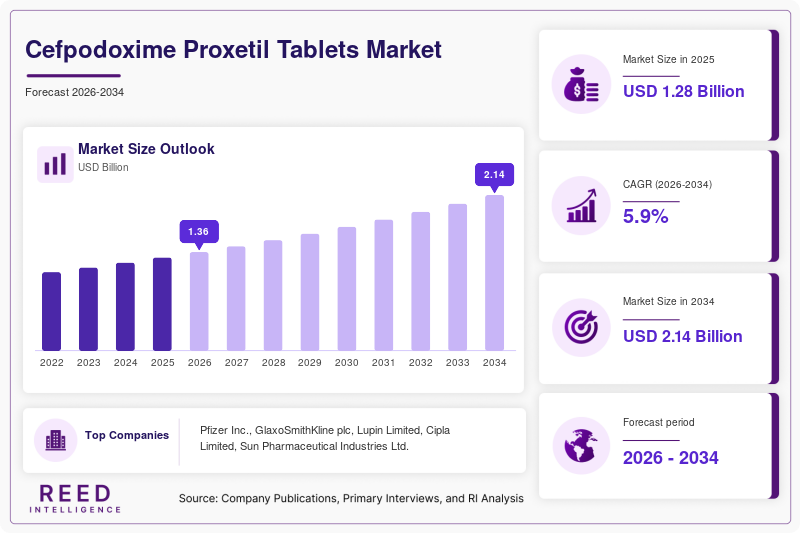
The global Cefpodoxime Proxetil Tablets Market size was valued at approximately USD 1.28 billion in 2025 and is projected to reach USD 2.14 billion by 2034, expanding at a CAGR of 5.9% during the forecast period (2025–2034). The market growth is primarily supported by the increasing global burden of bacterial infections, particularly respiratory tract infections, urinary tract infections, and skin infections, which continue to drive the demand for broad-spectrum antibiotics such as cefpodoxime proxetil.
A significant global factor supporting market expansion is the rising accessibility of generic antibiotics across emerging economies. Governments and healthcare organizations are actively promoting affordable treatment options, enabling wider patient access to essential medications. Additionally, the continued reliance on oral antibiotic formulations for outpatient care has strengthened the adoption of cefpodoxime proxetil tablets in primary healthcare settings.
Key Highlights
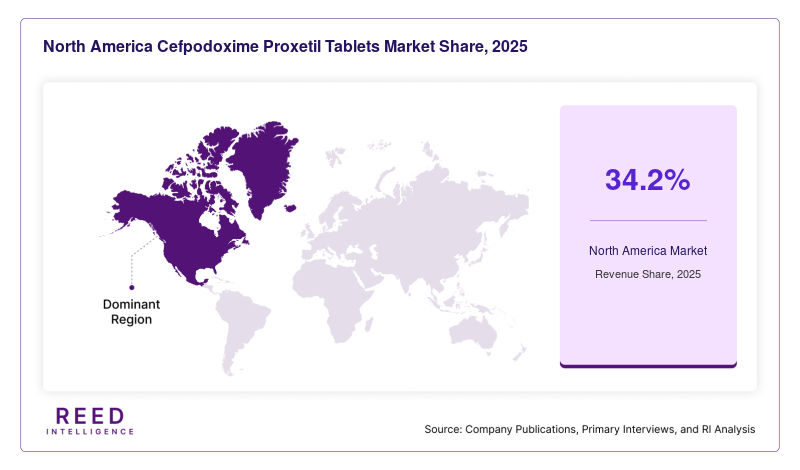
- North America dominated the market with a share of 34.2% in 2025, while Asia Pacific is expected to register the fastest CAGR of 7.1%.
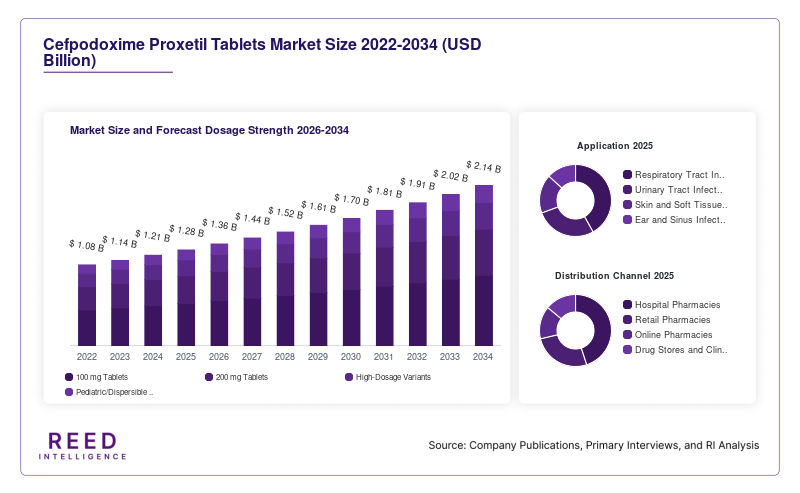
- Among segments, 200 mg tablets led the dosage segment with a 41.5% share, while pediatric formulations are projected to grow fastest at a CAGR of 6.8%.
- Hospital pharmacies dominated distribution with 46.3% share, while online pharmacies are expected to expand at a CAGR of 8.2%.
- The United States accounted for USD 412 million in 2025 and is estimated to reach USD 436 million in 2026.
Market Trends
Increasing Preference for Oral Antibiotic Therapies
A key trend shaping the Cefpodoxime Proxetil Tablets Market is the growing preference for oral antibiotic therapies over injectable alternatives. Patients and healthcare providers increasingly favor oral formulations due to ease of administration, reduced hospital stays, and improved patient compliance. Cefpodoxime proxetil tablets, being a third-generation cephalosporin with strong efficacy against Gram-positive and Gram-negative bacteria, are widely prescribed in outpatient settings. This trend is particularly prominent in regions with high outpatient treatment volumes and expanding primary care infrastructure. The shift toward home-based care and telemedicine consultations further reinforces the demand for oral antibiotics, supporting sustained market growth.
Expansion of Generic Drug Manufacturing
Another notable trend is the rapid expansion of generic drug manufacturing, especially in emerging markets. As patents expire and regulatory pathways for generics become more streamlined, multiple pharmaceutical companies are entering the cefpodoxime proxetil segment. This has led to increased price competition and improved accessibility. Generic versions of cefpodoxime proxetil tablets are being widely adopted in public healthcare systems and insurance-backed treatment programs. Furthermore, bulk procurement by government agencies and hospital chains is encouraging large-scale production, thereby strengthening supply consistency. The growing role of contract manufacturing organizations (CMOs) is also enabling smaller firms to participate in the market, contributing to overall industry growth.
Market Drivers
Rising Incidence of Infectious Diseases
The increasing prevalence of bacterial infections worldwide remains a primary driver of the Cefpodoxime Proxetil Tablets Market. Respiratory tract infections, including bronchitis and pneumonia, along with urinary tract infections, are among the most common conditions treated with cefpodoxime proxetil. Population growth, urbanization, and changing environmental conditions are contributing to higher infection rates, particularly in densely populated regions. Additionally, seasonal outbreaks and the persistence of healthcare-associated infections continue to sustain the demand for effective antibiotic therapies. The broad-spectrum activity of cefpodoxime proxetil makes it a preferred choice in empirical treatment, further driving its adoption.
Growing Healthcare Infrastructure in Emerging Economies
The expansion of healthcare infrastructure in developing countries is significantly boosting market growth. Governments are investing in primary healthcare centers, rural clinics, and diagnostic facilities, which increases access to medical treatment. As healthcare penetration improves, more patients receive timely diagnosis and antibiotic prescriptions. Cefpodoxime proxetil tablets are often included in essential drug lists, ensuring their availability in public healthcare systems. Moreover, rising health awareness and increasing healthcare expenditure among middle-income populations are contributing to higher demand for reliable antibiotic treatments. This structural growth in healthcare systems is expected to sustain long-term market expansion.
Market Restraint
Rising Concerns Over Antibiotic Resistance
A major challenge for the Cefpodoxime Proxetil Tablets Market is the growing concern over antibiotic resistance. The misuse and overuse of antibiotics have led to the emergence of resistant bacterial strains, reducing the effectiveness of commonly used drugs, including cephalosporins. Regulatory authorities and healthcare organizations are implementing stricter guidelines on antibiotic prescriptions, which may limit the indiscriminate use of cefpodoxime proxetil tablets. Additionally, awareness campaigns promoting responsible antibiotic usage are influencing prescribing behavior among physicians. While these measures are essential for public health, they may restrain market growth by reducing overall consumption volumes. Pharmaceutical companies are also facing increasing pressure to invest in antimicrobial stewardship programs, which could impact profitability.
Market Opportunities
Growth in Pediatric Antibiotic Segment
The pediatric segment presents a strong growth opportunity for the Cefpodoxime Proxetil Tablets Market. Children are particularly susceptible to bacterial infections such as otitis media and respiratory infections. The development of child-friendly formulations, including dispersible tablets and flavored variants, is enhancing treatment adherence. Increasing focus on pediatric healthcare and vaccination programs also supports early diagnosis and treatment, thereby driving demand.
Expansion of Online Pharmacy Channels
The rapid growth of online pharmacies offers a significant opportunity for market expansion. Digital health platforms are transforming the way patients access medications, providing convenience and competitive pricing. In regions with high internet penetration, online pharmacies are becoming a preferred distribution channel. This trend is expected to accelerate with the integration of e-prescriptions and telehealth services, enabling seamless medication delivery.
Segmental Analysis
By Dosage Strength
The 200 mg segment dominated the Cefpodoxime Proxetil Tablets Market with a share of 41.5% in 2025, owing to its widespread use in treating moderate infections. Its effectiveness and standard dosing guidelines contributed to its high adoption.
The 100 mg segment is expected to grow at the fastest CAGR of 6.5%, driven by its suitability for mild infections and dose flexibility in pediatric and elderly patients.
By Application
Respiratory tract infections accounted for the largest share of 38.7% in 2025, as these conditions are among the most common indications for cefpodoxime proxetil.
Urinary tract infections are projected to grow at a CAGR of 6.2%, supported by increasing incidence rates and improved diagnostic practices.
By Distribution Channel
Hospital pharmacies held a dominant share of 46.3% in 2025 due to high prescription volumes and inpatient treatment requirements.
Online pharmacies are anticipated to grow at the fastest CAGR of 8.2%, driven by digital transformation in healthcare and increasing consumer preference for home delivery services.
By End-User
Hospitals accounted for 49.8% of the market share in 2025, supported by high patient inflow and comprehensive treatment facilities.
Homecare settings are expected to grow at a CAGR of 7.4%, as more patients opt for outpatient treatment and home-based care.
Regional Analysis
North America
North America accounted for 34.2% of the Cefpodoxime Proxetil Tablets Market share in 2025 and is expected to grow at a CAGR of 4.8% during the forecast period. The region’s established healthcare system and high antibiotic consumption rates contributed to its leading position.
The United States dominated the regional market due to its advanced diagnostic capabilities and strong outpatient care network. The widespread use of prescription antibiotics in primary care settings has driven consistent demand for cefpodoxime proxetil tablets.
Europe
Europe held a 27.6% market share in 2025 and is projected to expand at a CAGR of 5.1%. The region benefited from well-regulated pharmaceutical markets and strong public healthcare systems.
Germany emerged as the dominant country, supported by efficient healthcare delivery and high awareness of bacterial infection management. The country’s focus on quality healthcare services has sustained demand for reliable antibiotic treatments.
Asia Pacific
Asia Pacific captured 22.8% of the market in 2025 and is anticipated to grow at the fastest CAGR of 7.1%. The region’s growth is driven by increasing population and improving healthcare access.
India led the regional market due to its large patient pool and expanding pharmaceutical manufacturing sector. The availability of cost-effective generic antibiotics has significantly boosted market penetration.
Middle East & Africa
The Middle East & Africa region accounted for 8.1% of the market in 2025 and is expected to grow at a CAGR of 5.6%. The region is witnessing gradual improvements in healthcare infrastructure.
Saudi Arabia dominated the market, supported by government investments in healthcare modernization and increasing access to medical services.
Latin America
Latin America held a 7.3% share in 2025 and is projected to grow at a CAGR of 5.3%. The region’s growth is supported by expanding healthcare coverage and rising awareness of infectious diseases.
Brazil emerged as the leading country due to its large population and improving access to pharmaceutical products.
Competitive Landscape
The Cefpodoxime Proxetil Tablets Market is characterized by the presence of several global and regional pharmaceutical companies competing on pricing, product quality, and distribution reach. Leading players are focusing on expanding their generic drug portfolios and strengthening supply chains.
Among them, Pfizer Inc. is recognized as a key market leader, leveraging its extensive global presence and strong brand portfolio. The company recently expanded its antibiotic production capacity to meet growing demand in emerging markets.
Other players are actively investing in product approvals and partnerships to enhance market penetration. The competitive environment remains moderately fragmented, with numerous regional manufacturers contributing to market dynamics.
Key Players
- Pfizer Inc.
- GlaxoSmithKline plc
- Lupin Limited
- Cipla Limited
- Sun Pharmaceutical Industries Ltd.
- Aurobindo Pharma Limited
- Zydus Lifesciences Ltd.
- Alkem Laboratories Ltd.
- Torrent Pharmaceuticals Ltd.
- Teva Pharmaceutical Industries Ltd.
- Mylan N.V.
- Hikma Pharmaceuticals PLC
- Dr. Reddy’s Laboratories Ltd.
- Abbott Laboratories
- Sandoz International GmbH
Recent Development
- In 2024, several generic manufacturers expanded production capacity for cefpodoxime proxetil tablets to address rising global demand.
- In 2025, new pediatric-friendly formulations were introduced, improving patient compliance.
- Strategic distribution agreements between pharmaceutical companies and online pharmacy platforms increased product accessibility.
- Regulatory approvals for generic versions in multiple countries enhanced market competition and affordability.
Cefpodoxime Proxetil Tablets Market Segments
Dosage Strength
- 100 mg Tablets
- 200 mg Tablets
- High-Dosage Variants
- Pediatric/Dispersible Tablets
Application
- Respiratory Tract Infections
- Urinary Tract Infections
- Skin and Soft Tissue Infections
- Ear and Sinus Infections
Distribution Channel
- Hospital Pharmacies
- Retail Pharmacies
- Online Pharmacies
- Drug Stores and Clinics
By Region
- North America
- Europe
- APAC
- Middle East and Africa
- LATAM