Ceftiofur Market Size, Share & Demand Report By Type (Ceftiofur Sodium, Ceftiofur Hydrochloride, Ceftiofur Crystalline Free Acid), By Application (Respiratory Disease, Foot Rot, Mastitis, Others), By End-Use (Veterinary Hospitals, Livestock Farms, Veterinary Clinics) By Region & Segment Forecasts, 2025–2034
USD 3950
Market Overview
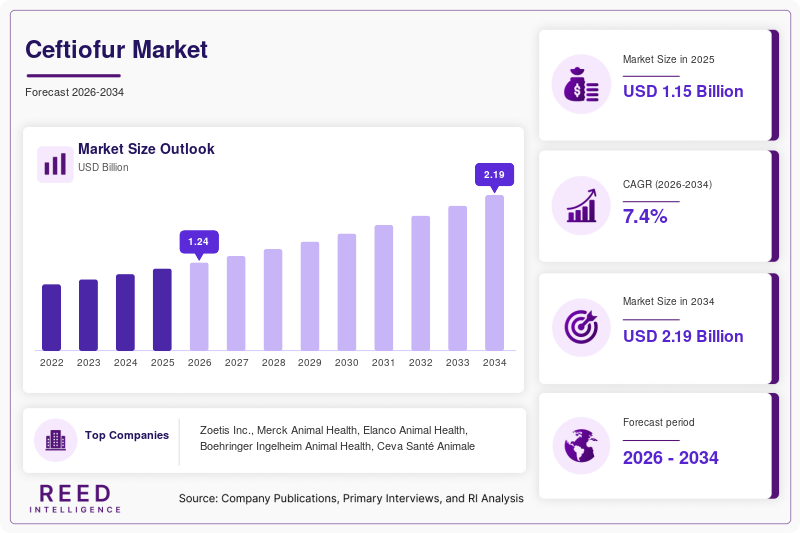
The global Ceftiofur Market is size is estimated at approximately USD 1.15 billion, and it is projected to reach USD 1.23 billion in 2026. Over the forecast period from 2025 to 2034, the market is expected to grow to nearly USD 2.35 billion, registering a compound annual growth rate (CAGR) of 7.4%.
Ceftiofur, a third-generation cephalosporin antibiotic, is widely used in veterinary medicine for treating bacterial infections in cattle, swine, poultry, and companion animals. Its broad-spectrum activity and effectiveness against respiratory and soft tissue infections make it a preferred choice in livestock healthcare. The increasing consumption of animal-based products globally has led to intensive farming practices, which in turn require efficient disease management solutions, supporting market growth.
Key Highlights
- North America dominated the market with approximately 32% share in 2025, supported by advanced veterinary infrastructure and high adoption of regulated antibiotics
- Asia Pacific is the fastest-growing region with a CAGR of 8.5% from 2025 to 2034, driven by expanding livestock population and rising meat consumption
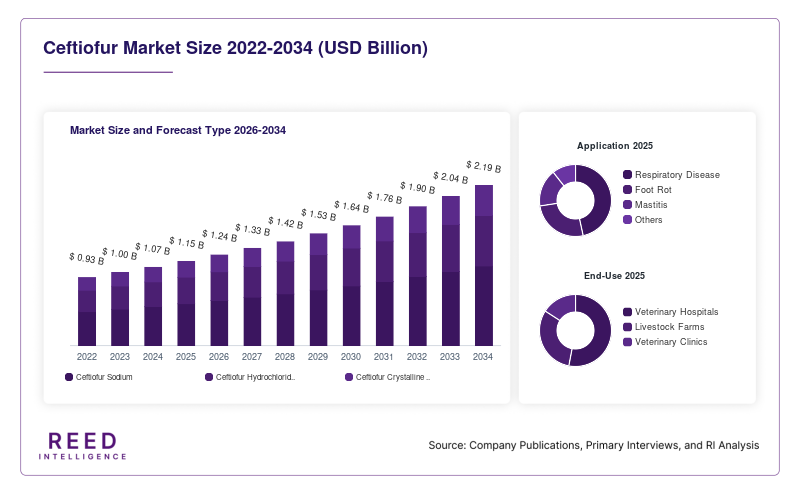
- Ceftiofur Sodium dominated the type segment with around 45% share in 2024 due to its widespread use in treating respiratory infections in cattle and swine
- Ceftiofur Crystalline Free Acid is the fastest-growing type segment with a CAGR of 8.2%, supported by increasing demand for long-acting formulations
Market Trends
Shift Toward Long-Acting and Sustained-Release Formulations
A notable trend in the Ceftiofur Market is the increasing demand for long-acting and sustained-release formulations. These formulations reduce the frequency of dosing, making them highly suitable for large-scale livestock operations where handling animals repeatedly can be labor-intensive and stressful. Pharmaceutical companies are investing in research and development to enhance drug delivery systems, ensuring prolonged therapeutic effects and improved bioavailability.
This trend is particularly relevant in cattle and swine farming, where respiratory diseases are prevalent and require consistent treatment. Long-acting ceftiofur formulations not only improve treatment outcomes but also reduce labor costs and enhance compliance among farmers. Additionally, these formulations align with industry goals of minimizing antibiotic usage while maintaining efficacy, which is gaining importance due to increasing scrutiny on antimicrobial resistance.
Increasing Integration of Veterinary Healthcare with Digital Monitoring Systems
Another emerging trend is the integration of veterinary pharmaceuticals with digital livestock monitoring systems. Farmers are increasingly adopting precision livestock farming technologies that use sensors and data analytics to detect early signs of disease. This enables timely administration of antibiotics such as ceftiofur, improving treatment success rates and reducing mortality.
Digital platforms also facilitate better record-keeping and traceability, which are becoming essential in meeting regulatory requirements and ensuring food safety. The combination of real-time monitoring and targeted antibiotic therapy supports efficient resource utilization and enhances productivity. As digital adoption grows across developed and developing regions, this trend is expected to further strengthen the demand for ceftiofur-based treatments.
Market Drivers
Expansion of the Global Livestock Industry
The rapid expansion of the global livestock industry is a key driver of the Ceftiofur Market. Rising population levels and increasing disposable incomes are fueling demand for meat, milk, and other animal-derived products. To meet this demand, farmers are adopting intensive farming practices that often lead to higher disease prevalence, necessitating effective veterinary treatments.
Ceftiofur is widely used to treat respiratory infections and other bacterial diseases in livestock, making it an essential component of animal healthcare protocols. The growing scale of commercial farming operations, particularly in Asia Pacific and Latin America, is further boosting demand. Additionally, government initiatives aimed at improving livestock productivity and food security are encouraging the use of advanced veterinary medicines, thereby supporting market growth.
Rising Awareness of Animal Health and Disease Management
Increasing awareness regarding animal health and disease prevention is another major factor driving market growth. Farmers and livestock owners are recognizing the importance of maintaining animal health to ensure productivity and profitability. This has led to greater adoption of veterinary services and pharmaceuticals, including ceftiofur.
Educational programs and extension services provided by governments and industry organizations are playing a significant role in spreading awareness. These initiatives emphasize the benefits of timely diagnosis and treatment, as well as the responsible use of antibiotics. As a result, the demand for effective and reliable treatments such as ceftiofur is increasing, particularly in regions where traditional practices are being replaced by modern farming techniques.
Market Restraint
Growing Concerns Over Antimicrobial Resistance
One of the major restraints affecting the Ceftiofur Market is the growing concern over antimicrobial resistance (AMR). The widespread use of antibiotics in livestock has raised concerns among regulatory authorities and public health organizations regarding the potential development of resistant bacterial strains. This has led to stricter regulations governing the use of veterinary antibiotics, including ceftiofur.
In many regions, authorities are implementing guidelines to limit the prophylactic and non-therapeutic use of antibiotics. These measures can restrict market growth by reducing overall consumption. For instance, certain countries have imposed bans or limitations on specific antibiotic classes in animal feed, encouraging the use of alternative treatments such as vaccines and probiotics.
The impact of these regulations is particularly significant in developed markets, where compliance requirements are stringent. Companies operating in the ceftiofur segment must invest in research and development to ensure their products meet evolving regulatory standards. Additionally, the need for responsible usage practices may limit market expansion, especially in regions transitioning toward sustainable livestock management systems.
Market Opportunities
Growth in Emerging Markets and Commercial Farming
Emerging markets present significant growth opportunities for the Ceftiofur Market. Countries in Asia Pacific, Latin America, and Africa are experiencing rapid growth in livestock production due to increasing population and changing dietary preferences. The shift toward commercial farming practices in these regions is driving demand for efficient veterinary healthcare solutions.
As farmers transition from traditional to modern farming systems, the adoption of antibiotics such as ceftiofur is increasing. Governments are also investing in agricultural development programs, which include improving animal health infrastructure and access to veterinary services. This creates a favorable environment for market expansion, as companies can tap into a large and underserved customer base.
Development of Combination Therapies and Innovative Formulations
The development of combination therapies and innovative formulations represents another key opportunity. Pharmaceutical companies are exploring the potential of combining ceftiofur with other therapeutic agents to enhance efficacy and broaden the spectrum of activity. These advancements can address complex infections and reduce treatment duration.
In addition, innovations in drug delivery systems, such as injectable suspensions and controlled-release formulations, are improving treatment outcomes. These developments not only enhance product differentiation but also cater to the evolving needs of the livestock industry. As research continues to advance, the introduction of new and improved ceftiofur-based products is expected to drive market growth.
Segmental Analysis
By Type
The ceftiofur sodium segment dominated the market in 2024, accounting for approximately 45% of the total share. This dominance is attributed to its widespread use in treating respiratory infections in cattle and swine. Ceftiofur sodium is known for its rapid absorption and effectiveness, making it a preferred choice among veterinarians. The availability of various formulations and dosage forms further supports its adoption across different livestock categories.
Additionally, the segment benefits from established distribution channels and strong brand recognition among veterinary professionals. Its compatibility with different treatment protocols and ease of administration contribute to its leading position. The consistent demand from large-scale livestock operations ensures steady growth for this segment, maintaining its dominance in the market.
The ceftiofur crystalline free acid segment is expected to witness the fastest growth, with a projected CAGR of 8.2% during the forecast period. This growth is driven by its long-acting properties, which reduce the need for frequent dosing. The convenience offered by this formulation is particularly beneficial in large herds, where handling animals multiple times can be challenging.
Moreover, the increasing focus on improving treatment efficiency and reducing labor costs is encouraging the adoption of long-acting formulations. The ability to provide sustained therapeutic effects enhances treatment outcomes, making ceftiofur crystalline free acid an attractive option for farmers and veterinarians. This is expected to drive significant growth in the coming years.
By Application
The respiratory disease segment held the largest share of approximately 52% in 2024. This is primarily due to the high prevalence of respiratory infections in livestock, particularly in intensive farming environments. Ceftiofur is widely used to treat these conditions due to its broad-spectrum activity and effectiveness against common pathogens.
The segment’s dominance is further supported by the increasing focus on disease prevention and management in livestock. Farmers are adopting proactive measures to maintain animal health, which includes the use of effective antibiotics. The consistent demand for respiratory disease treatments ensures the continued growth of this segment.
The foot rot segment is expected to grow at the fastest CAGR of 7.9% during the forecast period. This growth is driven by the increasing incidence of foot-related infections in cattle, particularly in regions with high humidity and poor farm hygiene conditions. Effective treatment is essential to prevent productivity losses, which is boosting the demand for ceftiofur-based solutions.
Additionally, the rising awareness of animal welfare and the economic impact of untreated infections are encouraging farmers to adopt timely treatment measures. The development of targeted therapies for foot rot is further supporting the growth of this segment, making it a key area of opportunity.
By End-Use
The veterinary hospitals segment dominated the market in 2024, accounting for around 48% of the total share. This is due to the availability of skilled professionals and advanced diagnostic facilities in these settings. Veterinary hospitals are often the first point of contact for disease diagnosis and treatment, making them a major distribution channel for ceftiofur.
The segment’s growth is supported by increasing investments in veterinary healthcare infrastructure and the rising number of veterinary professionals. The availability of specialized services and treatment options ensures high adoption rates, maintaining the segment’s leading position in the market.
The livestock farms segment is expected to grow at the highest CAGR of 8.6% during the forecast period. This growth is driven by the increasing adoption of on-site treatment practices, where farmers administer medications directly to animals. The convenience and cost-effectiveness of this approach are encouraging its adoption.
Furthermore, the integration of digital monitoring tools and precision farming techniques is enabling farmers to detect diseases early and administer timely treatments. This is significantly boosting the demand for ceftiofur in livestock farms, making it the fastest-growing end-use segment.
Regional Analysis
North America
North America accounted for approximately 32% of the global Ceftiofur Market share in 2025 and is projected to grow at a CAGR of 6.5% during the forecast period. The region’s strong market position is supported by advanced veterinary healthcare infrastructure and high awareness of animal health management practices. The presence of established livestock industries and stringent regulatory frameworks ensures the consistent use of approved antibiotics.
The United States dominates the regional market due to its large-scale cattle and swine farming operations. A key growth factor is the increasing adoption of precision livestock farming technologies, which enable early disease detection and targeted treatment. This enhances the demand for effective antibiotics such as ceftiofur, supporting steady market growth.
Europe
Europe held around 25% of the market share in 2025 and is expected to grow at a CAGR of 6.2%. The region’s market growth is influenced by strict regulations on antibiotic usage and a strong focus on animal welfare. While these regulations may limit excessive use, they also promote the adoption of high-quality and approved veterinary drugs.
Germany leads the European market, supported by its well-developed livestock sector and emphasis on sustainable farming practices. A unique growth factor is the increasing adoption of organic and antibiotic-free farming, which encourages the use of targeted treatments like ceftiofur under controlled conditions, ensuring compliance with regulatory standards.
Asia Pacific
Asia Pacific accounted for nearly 28% of the market share in 2025 and is projected to grow at the highest CAGR of 8.5%. The region’s growth is driven by rising meat consumption, expanding livestock populations, and improving veterinary healthcare infrastructure. Rapid urbanization and changing dietary patterns are further contributing to market expansion.
China is the dominant country in this region, owing to its large livestock population and increasing investment in animal health. A key growth factor is government support for modernizing agricultural practices, including the adoption of advanced veterinary medicines. This is significantly boosting the demand for ceftiofur in the region.
Middle East & Africa
The Middle East & Africa region held approximately 8% of the market share in 2025 and is expected to grow at a CAGR of 7.0%. The market is gradually expanding due to increasing awareness of animal health and the need for improved livestock productivity. Investments in agricultural development are also supporting market growth.
South Africa dominates the regional market, driven by its relatively advanced livestock industry. A unique growth factor is the increasing focus on food security, which is encouraging governments to invest in animal health solutions. This is creating opportunities for the adoption of veterinary antibiotics such as ceftiofur.
Latin America
Latin America accounted for around 7% of the market share in 2025 and is projected to grow at a CAGR of 7.8%. The region’s growth is supported by expanding livestock industries and increasing exports of meat and dairy products. The adoption of modern farming practices is further driving demand for veterinary pharmaceuticals.
Brazil leads the market in Latin America due to its large cattle population and strong agricultural sector. A key growth factor is the country’s focus on improving livestock productivity and export quality standards. This is encouraging the use of effective antibiotics, including ceftiofur, to ensure animal health and meet international requirements.

Competitive Landscape
The Ceftiofur Market is moderately competitive, with the presence of several global and regional players focusing on product innovation and strategic collaborations. Companies are investing in research and development to introduce advanced formulations and improve treatment efficacy. The market is characterized by strong distribution networks and established relationships with veterinary professionals.
Zoetis Inc. is considered a leading player in the market, owing to its extensive product portfolio and global presence. The company has recently focused on expanding its range of long-acting ceftiofur formulations to cater to the growing demand for efficient treatment solutions. Other key players are also adopting strategies such as mergers, acquisitions, and partnerships to strengthen their market position.
Key Players List
- Zoetis Inc.
- Merck Animal Health
- Elanco Animal Health
- Boehringer Ingelheim Animal Health
- Ceva Santé Animale
- Virbac
- Vetoquinol
- Dechra Pharmaceuticals
- Phibro Animal Health
- Norbrook Laboratories
- Huvepharma
- HIPRA
- Zydus Animal Health
- Indian Immunologicals Limited
- Intas Pharmaceuticals
Recent Developments
- Zoetis Inc. introduced an improved long-acting ceftiofur formulation to enhance treatment efficiency in cattle.
- Elanco Animal Health expanded its distribution network in Asia Pacific to strengthen market presence.
- Boehringer Ingelheim Animal Health invested in research to develop combination therapies involving ceftiofur for broader applications.
Ceftiofur Market Segments
Type
- Ceftiofur Sodium
- Ceftiofur Hydrochloride
- Ceftiofur Crystalline Free Acid
Application
- Respiratory Disease
- Foot Rot
- Mastitis
- Others
End-Use
- Veterinary Hospitals
- Livestock Farms
- Veterinary Clinics
By Region
- North America
- Europe
- APAC
- Middle East and Africa
- LATAM