Ceiling Grid System Market Size, Share & Trends Analysis Report By Grid Type (Exposed Tee Grid, Concealed Grid, Drywall Grid, Structural Grid, Others), By Material (Steel, Aluminum, Other Materials), By Application (Commercial & Office, Education, Healthcare, Retail & Hospitality, Industrial & Data Centers, Residential, Others) and By Region (North America, Europe, APAC, Middle East and Africa, LATAM) Forecasts, 2026–2034
USD 3950
Ceiling Grid System Market Size
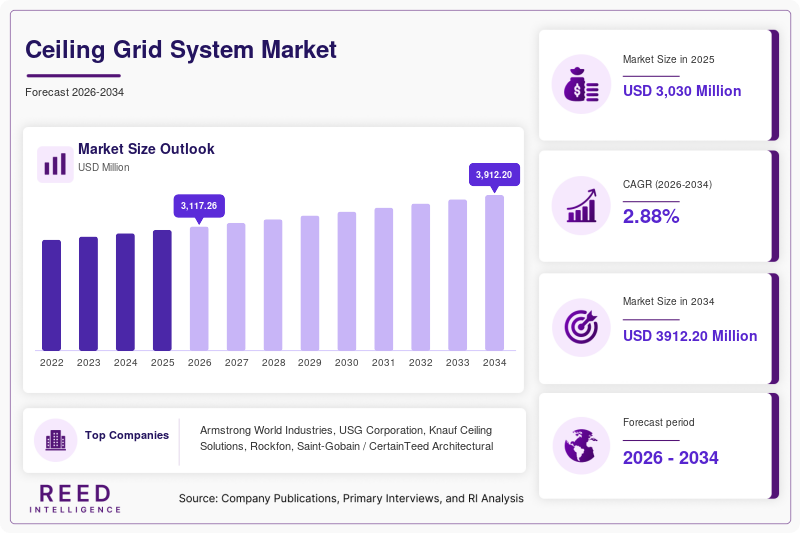
The global ceiling grid system market is valued at USD 3,030 Million in 2025 and USD 3,120 Million in 2026. The market is projected to reach USD 3912.20 Million by 2034, registering a 2.88% CAGR during the forecast period.
The ceiling grid system market is a mature construction-components market centered on suspension frameworks used to support acoustic tiles, metal panels, drywall systems, lighting, HVAC interfaces and other overhead building services. The product ecosystem includes exposed T-grid systems, concealed and semi-concealed suspension systems, drywall grids and structural ceiling systems designed for higher load requirements.
Conventional ceiling-grid demand remains anchored by commercial offices, education facilities, healthcare buildings, retail properties and hospitality projects. Suspended systems continue to provide an accessible platform for integrating lighting, ventilation and other building services while allowing individual ceiling panels to be removed for maintenance.
Ceiling Grid System Market Drivers
Data-center construction is creating demand for structural and high-capacity ceiling grids
The strongest incremental demand opportunity is coming from high-density digital infrastructure. Modern data centers require overhead systems that can support cable trays, containment barriers, equipment and mechanical services while maintaining access for maintenance and future reconfiguration.
Armstrong's DYNAMAX LT was designed around the load-bearing requirements of colocation data centers, while its SKYLO system adds walkable structural ceiling capability for controlled environments.
USG's CIMA structural suspension system and DataConstrux containment initiative similarly demonstrate a move toward ceiling systems that perform both architectural and infrastructure-support functions.
JLL's record 25 GW of North American data-center absorption during H1 2026 reinforces the underlying construction pipeline supporting these specialty systems.
As AI-related infrastructure increases rack density and overhead cooling, electrical and containment requirements, structural ceiling systems become more commercially relevant than conventional lightweight acoustic grids in mission-critical projects.
Acoustic and building-performance requirements are raising specification standards
Ceiling systems are increasingly selected based on total building performance rather than grid cost alone. Projects may require acoustic absorption, fire performance, hygiene, humidity resistance, seismic performance, low emissions and compatibility with integrated mechanical and electrical systems.
Knauf Ceiling Solutions' TOPIQ Alpha, for example, combines Class A sound absorption, humidity resistance, high light reflectance and Euroclass A1 fire performance.
Specialized healthcare and cleanroom systems are also becoming more important because ceiling assemblies must support controlled environments and maintenance requirements.
The market is therefore shifting toward engineered ceiling packages in which the grid, panel and accessories are evaluated as one coordinated performance system.
Sustainable construction is increasing demand for recycled and documented grid systems
Environmental specifications are becoming more important in large commercial projects. Architects, contractors and owners increasingly request recycled content, environmental product declarations, health-product information and recyclable materials.
Manufacturers are responding by increasing recycled content and providing greater documentation around material origin and environmental performance.
This changes competitive dynamics because suppliers must increasingly demonstrate sustainability credentials in addition to structural performance, installation efficiency and price.
Ceiling Grid System Market Restraints
Slow growth in conventional building construction limits volume expansion
The ceiling-grid market remains exposed to office, retail and conventional commercial construction cycles. When new construction weakens, demand for standard suspension systems can slow because ceiling-grid installation is directly connected to interior-fit-out activity.
U.S. construction spending demonstrates this mixed environment. While private nonresidential construction spending increased slightly month over month in July 2026, total construction spending remained below the prior-year level.
The result is greater dependence on renovations, replacement demand and specialized projects to offset slower conventional new-build volumes.
Material and installation costs pressure project economics
Steel and aluminum remain important input materials, while grid installation requires labor and coordination with multiple building trades.
Higher input prices, skilled-labor shortages, project scheduling constraints and tariff-related cost pressure can encourage contractors to value-engineer ceiling systems or choose simpler configurations.
This increases the commercial importance of lightweight designs, faster connections, pre-engineered components and systems that reduce onsite cutting and installation time.
Market Opportunities
Structural ceiling systems for data centers and mission-critical facilities
Structural grids represent a higher-value opportunity than conventional acoustic suspension systems because they can carry heavier loads and accommodate complex overhead infrastructure.
Armstrong's DYNAMAX LT and SKYLO systems and USG's structural and containment solutions indicate increasing demand for ceiling infrastructure designed around data centers, semiconductor plants, pharmaceutical facilities and controlled environments.
The opportunity extends beyond hyperscale data centers into colocation facilities, AI infrastructure, clean manufacturing, life sciences and high-performance industrial buildings.
Retrofit-friendly and high-recycled-content ceiling systems
Building owners are increasingly looking for systems that allow interiors to be modified without extensive demolition. Accessible, demountable and maintenance-friendly ceiling systems can lower disruption during renovation.
High-recycled-content grids and systems backed by environmental documentation also offer opportunities in projects pursuing sustainable-building objectives.
This favors manufacturers capable of combining modularity, recyclability, acoustic performance and installation flexibility in a single product platform.
Grid Type Analysis
Exposed Tee Grid remains the dominant grid configuration
Exposed Tee Grid systems remain dominant because they provide accessibility, modularity, installation familiarity and compatibility with a wide variety of acoustic panels.
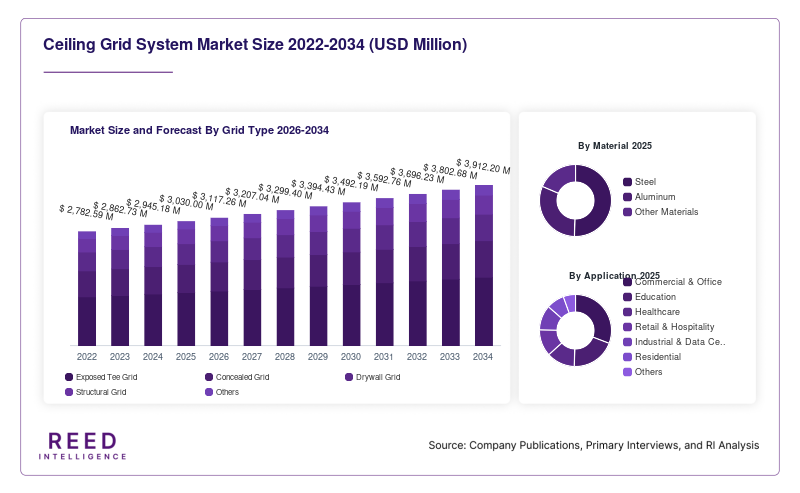
The Exposed Tee Grid segment accounts for 62% of the global market in 2026, making it the dominant grid configuration.
The segment is projected to register a 2.30% CAGR during the forecast period as it continues to serve mainstream offices, schools, healthcare facilities, retail environments and renovation projects.
Concealed Grid systems serve premium architectural interiors
Concealed grid systems reduce visible suspension components and support more continuous ceiling aesthetics. They are particularly relevant to premium offices, hospitality, healthcare and architecturally focused commercial interiors.
The segment is projected to register a 2.60% CAGR, supported by demand for cleaner ceiling appearances and integrated architectural design.
Drywall Grid supports monolithic ceiling aesthetics
Drywall grids allow suspended gypsum-board ceilings to create a more continuous visual surface while retaining the advantages of a suspended framework.
The segment is projected to register a 2.90% CAGR, supported by commercial interiors where architects want monolithic ceiling aesthetics with coordinated access and installation benefits.
Application Analysis
Commercial & Office remains the dominant application
Commercial and office buildings remain the largest application because suspended ceiling systems are deeply established in office fit-outs, multi-tenant properties and commercial refurbishment.
The Commercial & Office segment accounts for 34% of the global market in 2026, making it the dominant application.
The segment is projected to register a 2.50% CAGR, supported by workplace remodeling, service-access requirements and replacement of aging ceiling systems.
Education remains a stable institutional application
Schools and universities continue to use suspended ceilings because they provide acoustic management, service access, maintainability and straightforward panel replacement.
The Education segment is projected to register a 2.60% CAGR, supported by school modernization, institutional renovation and continued demand for acoustically controlled learning spaces.
Regional Analysis
North America Ceiling Grid System Market
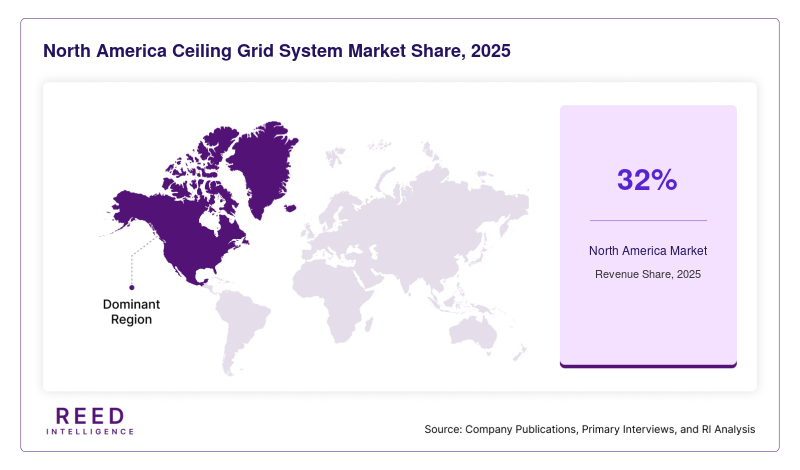
North America remains the dominant regional market because of its mature commercial-construction base, widespread use of suspended ceiling systems, strong renovation activity and concentration of major manufacturers.
The North America region accounts for 32% of the global market in 2026 and is projected to register a 2.60% CAGR.
The region is also at the center of the structural-ceiling opportunity. Armstrong and USG have expanded data-center-oriented systems and containment solutions, while North American data-center demand reached record levels during the first half of 2026.
APAC Ceiling Grid System Market
APAC is the fastest-growing regi onal market because of urbanization, commercial development, manufacturing expansion, infrastructure investment and increasing data-center construction.
The APAC region accounts for approximately 24% of the global market in 2026 and is projected to register a 4.40% CAGR, making it the fastest-growing regional market.
China, India, Southeast Asia, Japan, South Korea and Australia are contributing to demand across offices, healthcare, manufacturing, education and digital infrastructure.
Europe Ceiling Grid System Market
Europe remains an important market supported by commercial renovation, sustainability requirements and established acoustic-ceiling adoption.
The region is projected to register a 2.70% CAGR, with product selection increasingly influenced by recyclability, environmental documentation and indoor-environment performance.
Middle East and Africa Ceiling Grid System Market
Middle East and Africa demand is supported by commercial developments, hospitality, healthcare infrastructure, airports and major urban projects.
The region is projected to register a 3.10% CAGR, with premium architectural and acoustic systems benefiting from high-performance specifications.
LATAM Ceiling Grid System Market
LATAM is supported by commercial renovation, education, healthcare, retail and industrial construction.
The region is projected to register a 3.00% CAGR, while market growth remains sensitive to construction spending, material prices and installation economics.
Competitive Landscape
The ceiling grid system market is concentrated around major ceiling and building-material manufacturers increasingly competing through complete ceiling systems rather than standalone suspension components.
Armstrong World Industries remains a leading provider of suspension and architectural ceiling systems. Its 2026 product pipeline has emphasized structural and integrated applications through DYNAMAX LT, SKYLO, Axiom Design Troughs and large-format MetalWorks systems.
USG, part of Knauf, maintains a broad suspension-system portfolio alongside structural and mission-critical systems. Its June 2026 alliance with Subzero Engineering extends its data-center offering into integrated containment.
Key Market Players
- Armstrong World Industries
- USG Corporation
- Knauf Ceiling Solutions
- Rockfon
- Saint-Gobain / CertainTeed Architectural
- Hunter Douglas Architectural
- OWA
- Ecophon
- Chicago Metallic
- Decoustics
- 9Wood
- Rulon International
- Arktura
- Turf Design
- WAVE / Armstrong Architectural Specialties
Recent Developments
- September 2026 – Associated Builders and Contractors reported continued strength in data-center-related construction demand. ABC reported that its Construction Backlog Indicator rebounded to 8.5 months in August 2026 and that one in six surveyed contractor members performs data-center work, reinforcing the construction pipeline supporting structural and specialty ceiling systems. Source: Associated Builders and Contractors, September 15, 2026.
- August 2026 – Armstrong launched MetalWorks Torsion Spring Large Format Ceiling Panels. The system includes standard 5-foot-by-10-foot panels, a grid-concealing installation and swing-down accessibility. The product broadens Armstrong's large-format architectural ceiling offering while targeting faster installation and clean visual layouts. Source: Armstrong World Industries, August 20, 2026.
Ceiling Grid System Market Segments
By Grid Type
- Exposed Tee Grid
- Concealed Grid
- Drywall Grid
- Structural Grid
- Others
By Material
- Steel
- Aluminum
- Other Materials
By Application
- Commercial & Office
- Education
- Healthcare
- Retail & Hospitality
- Industrial & Data Centers
- Residential
- Others
By Region
- North America
- Europe
- APAC
- Middle East and Africa
- LATAM