Ceiling Microphone Market Size, Share Demand Report By Type (Beamforming Ceiling Microphones, Networked Ceiling Microphones), By Application (Corporate Conferencing, Education, Healthcare, Government & Public Sector), By End-Use (Commercial, Institutional, Residential), By Distribution Channel (B2B, B2C) By Region & Segment Forecasts, 2026–2034
USD 3950
Market Overview
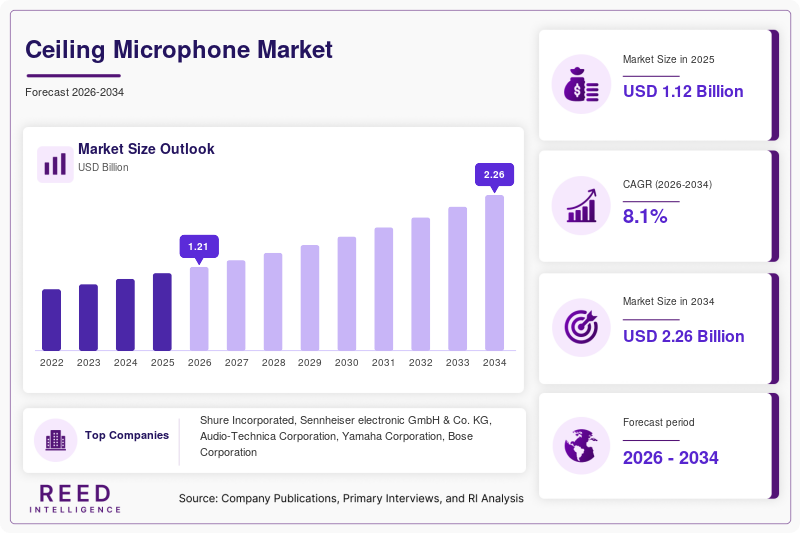
The global Ceiling Microphone Market size was valued at approximately USD 1.12 billion in 2026 and is projected to reach USD 2.08 billion by 2034, expanding at a CAGR of 8.1% during the forecast period (2026–2034). The market is gaining traction due to the increasing adoption of advanced audio solutions in corporate, educational, and commercial environments. Ceiling microphones, known for their ability to capture clear audio without cluttering workspace surfaces, are widely used in conferencing systems, lecture halls, and hybrid work setups.
A key global factor supporting the Ceiling Microphone Market growth is the rapid expansion of unified communication and collaboration technologies. Organizations are investing in high-quality audio systems to enhance remote communication, which has accelerated the demand for ceiling-mounted microphone solutions.
Key Highlights
- North America dominated the market with 39.4% share in 2025, while Asia Pacific is projected to grow at the fastest CAGR of 9.2%
- Beamforming ceiling microphones segment led with 62.7% share, while networked ceiling microphones are expected to grow at a CAGR of 9.5%
- Corporate conferencing application held 41.3% share, while education sector is forecasted to grow at a CAGR of 9.0%
- The United States market was valued at USD 420 million in 2024 and reached USD 455 million in 2025
Ceiling Microphone Market Trends
Adoption of Beamforming Technology
Beamforming technology is transforming audio capture by enabling microphones to focus on specific sound sources while reducing background noise. This advancement is improving audio clarity in conferencing environments and shaping key Ceiling Microphone Market trends.
Integration with Smart Building Systems
Ceiling microphones are increasingly being integrated with smart building and IoT systems. This integration allows for automated audio control, improved energy efficiency, and enhanced user experience in modern commercial spaces.
Market Drivers
Growth of Hybrid Work and Remote Collaboration
The shift toward hybrid work models has increased demand for reliable audio solutions in meeting rooms and remote collaboration setups. Ceiling microphones provide seamless audio coverage, supporting efficient communication across distributed teams.
Rising Demand for Advanced Audio Quality
Organizations and institutions are prioritizing high-quality audio systems to improve communication efficiency. Ceiling microphones offer superior sound capture compared to traditional microphones, driving their adoption across multiple sectors.
Market Restraint
High Installation and Integration Costs
The installation of ceiling microphones requires specialized infrastructure and professional setup, which can increase overall costs. This may limit adoption among small and medium enterprises with budget constraints.
Market Opportunities
Expansion in Smart Classrooms
The growing adoption of digital learning environments is creating opportunities for ceiling microphones in educational institutions. Smart classrooms require high-quality audio solutions to support interactive learning experiences.
Increasing Demand in Healthcare Facilities
Healthcare settings are adopting advanced communication systems for telemedicine and patient monitoring. Ceiling microphones can enhance audio clarity in such environments, presenting new growth opportunities for the market.
Segmental Analysis
By Type
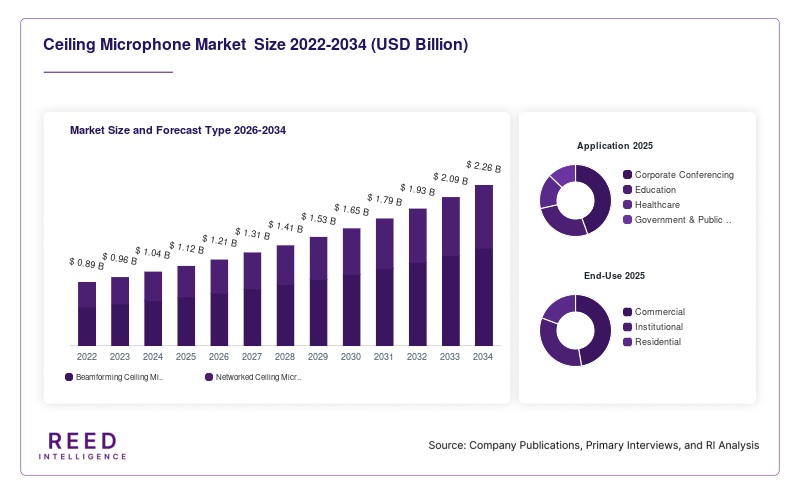
The beamforming ceiling microphones segment dominated the Ceiling Microphone Market with 62.7% share in 2025 due to superior sound focusing capabilities. The networked ceiling microphones segment is expected to grow at the fastest CAGR of 9.5%, driven by integration with digital communication systems.
By Application
The corporate conferencing segment held the largest share of 41.3% in 2025, supported by demand from businesses adopting hybrid work models. The education segment is projected to grow at a CAGR of 9.0%, driven by the expansion of smart classrooms.
By End-Use
The commercial sector dominated with 46.9% share in 2025 due to widespread use in offices and conference rooms. The healthcare segment is expected to grow at a CAGR of 8.8%, supported by increasing adoption of telemedicine solutions.
By Distribution Channel
The B2B segment accounted for 64.2% share in 2025, as organizations are primary buyers of ceiling microphones. The B2C segment is projected to grow at a CAGR of 8.4%, driven by rising demand for home office setups.
Regional Analysis
North America
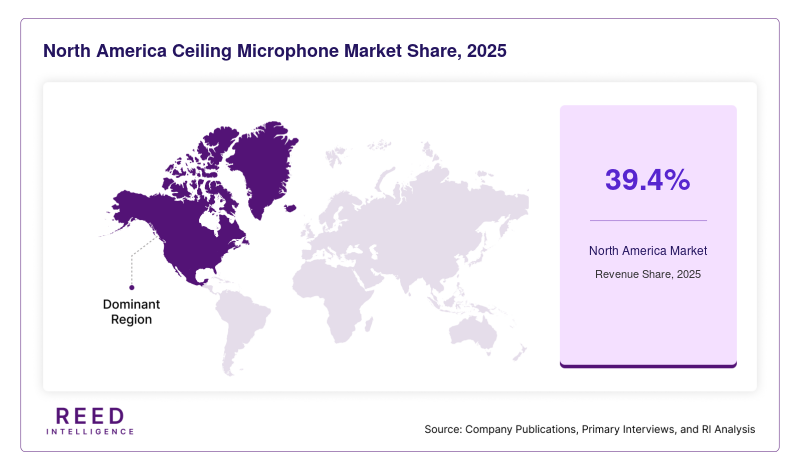
North America accounted for 39.4% of the Ceiling Microphone Market share in 2025 and is expected to grow at a CAGR of 7.5% through 2034. The United States dominated the region due to widespread adoption of advanced communication technologies and strong corporate infrastructure.
Europe
Europe held 26.8% share in 2025 and is projected to expand at a CAGR of 7.8%. Germany led the regional market, supported by increasing investments in smart building technologies and corporate communication systems.
Asia Pacific
Asia Pacific captured 22.3% share in 2025 and is expected to grow at the fastest CAGR of 9.2%. China dominated the region due to rapid urbanization and increasing adoption of digital communication tools.
Middle East & Africa
The Middle East & Africa region held 6.1% share in 2025 and is projected to grow at a CAGR of 8.0%. The UAE led the market due to rising investments in commercial infrastructure and smart city projects.
Latin America
Latin America accounted for 5.4% share in 2025 and is expected to grow at a CAGR of 8.2%. Brazil dominated the region, supported by increasing adoption of conferencing technologies.
Competitive Landscape
The Ceiling Microphone Market is characterized by the presence of established global players focusing on technological innovation and product differentiation. Key companies are investing in advanced audio processing technologies to enhance performance and user experience. One leading player has recently introduced a new beamforming ceiling microphone with improved noise cancellation features, strengthening its market position.
Other companies are adopting strategies such as partnerships, product launches, and geographic expansion to increase their market presence. The integration of ceiling microphones with digital communication platforms is influencing competitive dynamics. As demand for high-quality audio solutions grows, companies are focusing on innovation and scalability to remain competitive.
Key Players List
- Shure Incorporated
- Sennheiser electronic GmbH & Co. KG
- Audio-Technica Corporation
- Yamaha Corporation
- Bose Corporation
- Biamp Systems
- ClearOne, Inc.
- AKG Acoustics (Harman International)
- Televic Group
- Beyerdynamic GmbH & Co. KG
- Clockaudio Ltd.
- Nureva Inc.
- Revolabs, Inc.
- Audix Corporation
- Samson Technologies Corp.
Recent Developments
- In 2025, a leading company launched an advanced beamforming ceiling microphone with enhanced noise suppression features
- In 2024, manufacturers introduced integrated solutions compatible with unified communication platforms
- In 2025, partnerships were formed to expand distribution networks in emerging markets
- In 2024, advancements in AI-based audio processing improved sound clarity and performance
- In 2025, increased investment in smart building integration supported product innovation
Ceiling Microphone Market Segments
Type
- Beamforming Ceiling Microphones
- Networked Ceiling Microphones
Application
- Corporate Conferencing
- Education
- Healthcare
- Government & Public Sector
End-Use
- Commercial
- Institutional
- Residential
Distribution Channel
- B2B
- B2C
By Region
- North America
- Europe
- APAC
- Middle East and Africa
- LATAM