Cell Culture Media Bags Market Size, Share & Demand Report By Product Type (2D Media Bags, 3D Media Bags), By Application (Biopharmaceutical Production, Cell Therapy, Research & Development), By End-Use (Biopharmaceutical Companies, CROs & CMOs, Academic & Research Institutes) By Region & Segment Forecasts, 2026–2034
USD 3950
Market Overview
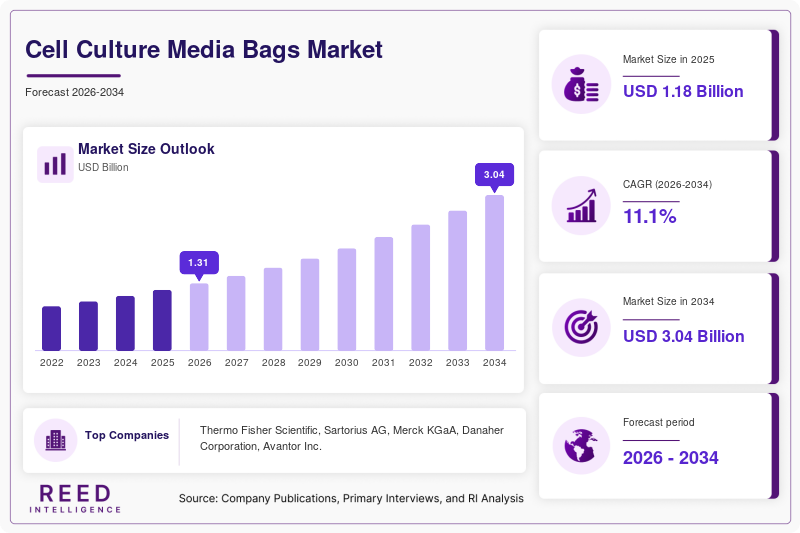
The global Cell Culture Media Bags Market was valued at approximately USD 1.18 billion in 2026 and is projected to reach USD 2.74 billion by 2034, expanding at a CAGR of 11.1% during the forecast period. This growth reflects the increasing adoption of single-use technologies across biopharmaceutical manufacturing and research laboratories. Cell culture media bags are widely used for storage, mixing, and transportation of media in sterile environments, enabling cost-effective and contamination-free workflows.
A key global factor supporting market growth is the rising demand for biologics and advanced therapies, including monoclonal antibodies, vaccines, and cell-based therapies. These products require scalable, sterile, and flexible manufacturing systems. Media bags play a critical role in reducing cleaning validation requirements, minimizing cross-contamination risks, and improving production efficiency. Furthermore, the shift toward decentralized manufacturing and modular bioprocessing facilities has strengthened the demand for disposable solutions.
Key Highlights
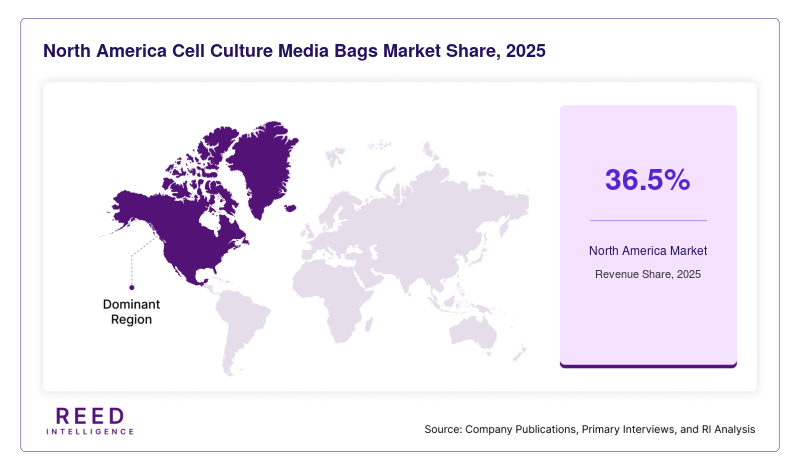
- North America dominated the market with a 36.5% share in 2025.
- Asia Pacific is expected to grow at the fastest CAGR of 12.3% during 2026–2034.
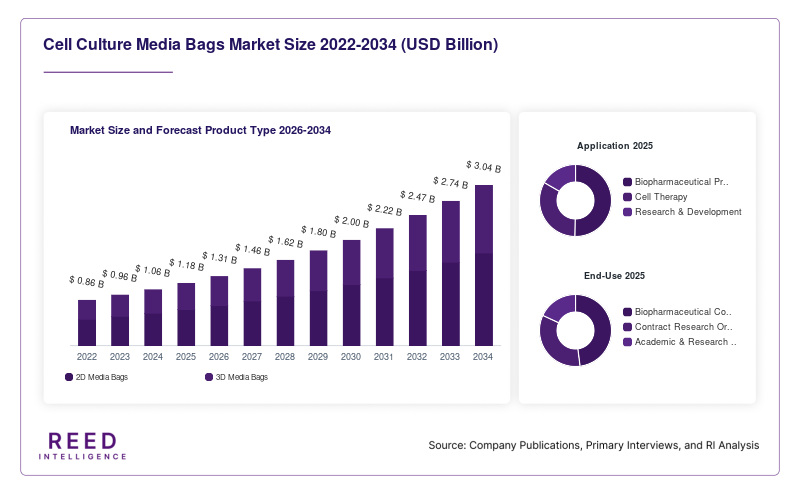
- By product type, 2D media bags accounted for the largest share of 42.8%.
- while 3D media bags are projected to grow at a CAGR of 12.9%.
- By application, biopharmaceutical production led with a 47.2% share, whereas cell therapy is expected to expand at a CAGR of 13.5%.
- The United States remained the dominant country, with market values of USD 520 million in 2024 and USD 575 million in 2025.
Market Trends
Increasing Adoption of Single-Use Bioprocessing Systems
The adoption of single-use systems in biomanufacturing has gained momentum due to their operational flexibility and cost efficiency. Cell culture media bags are a central component of these systems, offering advantages such as reduced cleaning requirements, faster turnaround times, and lower capital expenditure. Biopharmaceutical companies are increasingly transitioning from traditional stainless-steel systems to disposable solutions, especially in small-batch and multi-product facilities. This trend is particularly prominent in contract manufacturing organizations, where flexibility and scalability are essential. Additionally, regulatory agencies are showing greater acceptance of single-use technologies, encouraging broader implementation. As the pipeline of biologics and personalized therapies expands, the reliance on disposable media storage and transfer systems is expected to intensify, driving sustained market growth.
Integration of Advanced Materials and Smart Technologies
Manufacturers are focusing on improving the material composition and functionality of cell culture media bags. Advanced multilayer polymer films are being developed to enhance gas permeability, chemical resistance, and durability. These innovations help maintain media stability and extend shelf life. Furthermore, the integration of sensors and monitoring systems is emerging as a key trend. Smart media bags equipped with temperature, pH, and pressure sensors enable real-time monitoring and process control. This aligns with the broader trend of digitalization in bioprocessing, where data-driven decision-making enhances efficiency and compliance. The convergence of material science and digital technologies is expected to create new opportunities for product differentiation and value-added solutions in the market.
Market Drivers
Growth in Biopharmaceutical Production
The rapid expansion of the biopharmaceutical sector is a major driver of the Cell Culture Media Bags Market. Biologics such as monoclonal antibodies, recombinant proteins, and vaccines require complex cell culture processes that depend on sterile and efficient media handling solutions. Media bags provide a contamination-free environment, reducing the risk of batch failure and improving yield. The increasing number of biologic drug approvals and ongoing clinical trials are fueling demand for scalable production systems. Moreover, the rise of biosimilars has intensified manufacturing activities, particularly in emerging markets. This has led to increased investment in production facilities that rely heavily on disposable technologies, thereby boosting the adoption of media bags.
Rising Demand for Cell and Gene Therapies
Cell and gene therapies are transforming modern medicine, offering potential cures for previously untreatable diseases. These therapies require highly controlled and sterile environments for cell culture and media handling. Media bags play a critical role in ensuring process integrity and scalability. The personalized nature of many cell therapies necessitates flexible and small-scale production systems, which are best supported by single-use solutions. Additionally, the growing number of research initiatives and funding in regenerative medicine is accelerating the adoption of advanced cell culture technologies. As the commercialization of these therapies increases, the demand for reliable and efficient media storage solutions is expected to grow significantly.
Market Restraint
Environmental Concerns and Waste Management Challenges
Despite their operational advantages, cell culture media bags face criticism due to environmental concerns associated with single-use plastics. The disposal of large volumes of plastic waste generated from bioprocessing activities poses a significant challenge. Many facilities lack adequate recycling infrastructure, leading to increased reliance on incineration or landfill disposal. This raises concerns about carbon emissions and environmental sustainability. Regulatory pressure and corporate sustainability goals are pushing companies to adopt greener practices, which may limit the widespread adoption of disposable systems.
Furthermore, the cost of implementing sustainable waste management solutions can be substantial, particularly for small and mid-sized organizations. Some companies are exploring biodegradable materials and recycling programs, but these solutions are still in the early stages of development. The lack of standardized guidelines for disposal and recycling adds complexity to the issue. As environmental awareness continues to grow, manufacturers may face increased scrutiny and potential regulatory constraints, which could impact market growth. Addressing these challenges will require innovation in materials science and collaboration across the industry to develop sustainable alternatives.
Market Opportunities
Expansion in Emerging Markets
Emerging economies in Asia Pacific, Latin America, and the Middle East are witnessing rapid growth in biotechnology and pharmaceutical sectors. Governments in these regions are investing heavily in healthcare infrastructure and research capabilities. This creates a favorable environment for the adoption of advanced bioprocessing technologies, including cell culture media bags. The lower cost of manufacturing and availability of skilled labor further attract global biopharmaceutical companies to establish production facilities in these regions. As local demand for biologics increases, the need for efficient and scalable media handling solutions is expected to rise. This presents significant growth opportunities for market players to expand their presence and tap into new customer bases.
Development of Sustainable and Recyclable Materials
The growing emphasis on sustainability presents an opportunity for innovation in the Cell Culture Media Bags Market. Manufacturers are investing in research to develop eco-friendly materials that maintain performance while reducing environmental impact. Biodegradable polymers and recyclable multilayer films are gaining attention as potential solutions. Companies that successfully commercialize sustainable media bags can gain a competitive advantage and meet the evolving demands of environmentally conscious customers. Additionally, partnerships with recycling service providers and waste management firms can help create closed-loop systems. This not only addresses environmental concerns but also enhances brand reputation and regulatory compliance, opening new avenues for market growth.
Segmental Analysis
By Product Type
2D media bags dominated the market in 2024, accounting for approximately 42.8% of the total share. These bags are widely used due to their simplicity, cost-effectiveness, and ease of handling. They are particularly suitable for small-scale applications and storage purposes. The demand for 2D bags is driven by their compatibility with existing systems and their ability to provide reliable performance in various bioprocessing environments. Additionally, their lower cost compared to more complex systems makes them an attractive option for research laboratories and small-scale production facilities.
3D media bags are expected to be the fastest-growing subsegment, with a projected CAGR of 12.9% during the forecast period. These bags are designed for large-scale applications and offer enhanced capacity and flexibility. The growth of this segment is driven by increasing demand for high-volume production in biopharmaceutical manufacturing. Their ability to integrate with automated systems and support large-scale operations makes them a preferred choice for commercial production facilities.
By Application
Biopharmaceutical production emerged as the dominant application segment in 2024, holding a share of 47.2%. The increasing demand for biologics and vaccines is driving the adoption of media bags in this segment. These bags play a crucial role in maintaining sterility and ensuring efficient media handling during production processes. The growth of this segment is further supported by the expansion of manufacturing facilities and the increasing number of biologic drug approvals.
Cell therapy is the fastest-growing application segment, with a CAGR of 13.5%. The rising focus on personalized medicine and regenerative therapies is driving demand for advanced cell culture technologies. Media bags provide the flexibility and scalability required for these applications, making them an essential component of cell therapy workflows.
By End-Use
Biopharmaceutical companies dominated the end-use segment in 2024, accounting for the largest share. These companies require reliable and scalable solutions for media storage and handling, making media bags an essential part of their operations. The increasing number of biologic drug approvals and ongoing research activities are driving demand in this segment.
Contract research organizations (CROs) and contract manufacturing organizations (CMOs) are expected to be the fastest-growing end-use segment, with a CAGR of 12.7%. The outsourcing of research and manufacturing activities is increasing, driven by cost considerations and the need for specialized expertise. These organizations rely heavily on flexible and scalable solutions, such as media bags, to meet diverse client requirements.
Regional Analysis
North America
North America held a dominant share of 36.5% in 2025 and is expected to maintain steady growth with a CAGR of 10.8% during the forecast period. The region benefits from a well-established biopharmaceutical industry, strong regulatory frameworks, and high adoption of advanced technologies. The presence of leading market players and significant R&D investments further support market expansion. Increasing demand for biologics and personalized medicine continues to drive the adoption of cell culture media bags.
The United States remains the dominant country in the region, driven by its advanced healthcare infrastructure and strong biotechnology ecosystem. A key growth factor is the high concentration of contract manufacturing organizations, which rely heavily on single-use systems for flexibility and efficiency. Additionally, government support for research and innovation plays a crucial role in sustaining market growth.
Europe
Europe accounted for a significant share of the market in 2025 and is projected to grow at a CAGR of 10.5% through 2034. The region’s growth is supported by increasing investments in biopharmaceutical manufacturing and a strong focus on regulatory compliance. Countries such as Germany, France, and the UK are leading contributors, with well-developed healthcare systems and research capabilities.
Germany stands out as the dominant country in Europe, driven by its robust pharmaceutical industry and technological advancements. A unique growth factor is the region’s emphasis on sustainable manufacturing practices, which is encouraging the development of eco-friendly media bag solutions. This aligns with broader environmental regulations and corporate sustainability goals.
Asia Pacific
Asia Pacific is the fastest-growing region, with a projected CAGR of 12.3% during the forecast period. The region is experiencing rapid expansion in biotechnology and pharmaceutical industries, supported by favorable government policies and increasing healthcare expenditure. Countries such as China, India, and Japan are investing heavily in research and manufacturing infrastructure.
China dominates the Asia Pacific market due to its large-scale production capabilities and growing demand for biologics. A key growth factor is the increasing number of domestic biopharmaceutical companies entering the global market. This has led to higher adoption of advanced manufacturing technologies, including single-use systems.
Middle East & Africa
The Middle East & Africa region is expected to witness moderate growth, with a CAGR of 9.6% over the forecast period. The market is driven by improving healthcare infrastructure and increasing investments in biotechnology. However, limited awareness and technical expertise may pose challenges to market expansion.
Saudi Arabia is the dominant country in the region, supported by government initiatives to diversify the economy and invest in healthcare. A unique growth factor is the establishment of new research centers and biopharmaceutical facilities, which is driving demand for modern bioprocessing solutions such as media bags.
Latin America
Latin America is projected to grow at a CAGR of 9.9% during the forecast period, supported by increasing healthcare investments and rising demand for biologics. The region is gradually adopting advanced technologies, although growth is somewhat constrained by economic challenges.
Brazil leads the Latin American market, driven by its large population and expanding pharmaceutical sector. A key growth factor is the growing focus on local production of biologics, which reduces dependency on imports and increases demand for efficient manufacturing solutions, including cell culture media bags.
Competitive Landscape
The Cell Culture Media Bags Market is characterized by the presence of several established players focusing on innovation, product development, and strategic collaborations. The market is moderately consolidated, with leading companies holding a significant share. Key players are investing in advanced materials, smart technologies, and sustainable solutions to strengthen their competitive position.
One of the leading companies in the market is Thermo Fisher Scientific, which has a strong global presence and a comprehensive product portfolio. The company recently introduced advanced single-use bioprocessing solutions with enhanced durability and performance. Other major players are also focusing on expanding their production capacities and entering emerging markets to capture new growth opportunities. Strategic partnerships and acquisitions are common in the market, enabling companies to enhance their technological capabilities and expand their customer base.
Key Players List
- Thermo Fisher Scientific
- Sartorius AG
- Merck KGaA
- Danaher Corporation
- Avantor Inc.
- Corning Incorporated
- Lonza Group
- GE HealthCare
- Meissner Filtration Products
- Saint-Gobain Life Sciences
- Entegris Inc.
- Parker Hannifin Corporation
- Charter Medical
- Fujifilm Irvine Scientific
- Cole-Parmer Instrument Company
Recent Developments
- In 2025, a leading manufacturer launched a new range of multilayer media bags with improved gas barrier properties and enhanced durability for large-scale applications.
- In 2024, a major company expanded its production facility in Asia Pacific to meet rising demand for single-use bioprocessing solutions.
- In 2025, a strategic collaboration between two industry players focused on developing recyclable media bag materials to address sustainability concerns.
Cell Culture Media Bags Market Segments
Product Type
- 2D Media Bags
- 3D Media Bags
Application
- Biopharmaceutical Production
- Cell Therapy
- Research & Development
End-Use
- Biopharmaceutical Companies
- Contract Research Organizations (CROs) & Contract Manufacturing Organizations (CMOs)
- Academic & Research Institutes
By Region
- North America
- Europe
- APAC
- Middle East and Africa
- LATAM