Cell Culture Protein Surface Coating Market Size, Share & Demand Report By Protein Type (Collagen, Laminin, Fibronectin, Vitronectin, Others), By Application (Cell Culture Research, Drug Discovery, Regenerative Medicine, Tissue Engineering), By End-Use (Biopharmaceutical Companies, Academic & Research Institutes, Contract Research Organizations), By Region & Segment Forecasts, 2026–2034
USD 3950
Market Overview
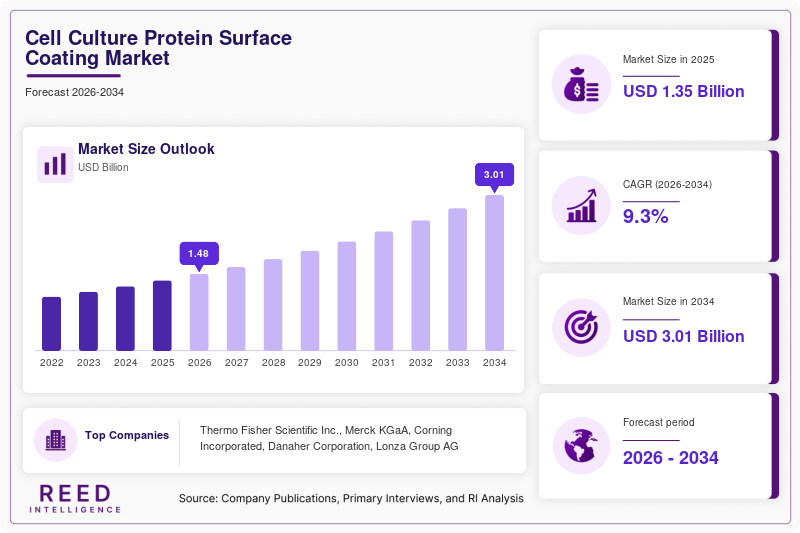
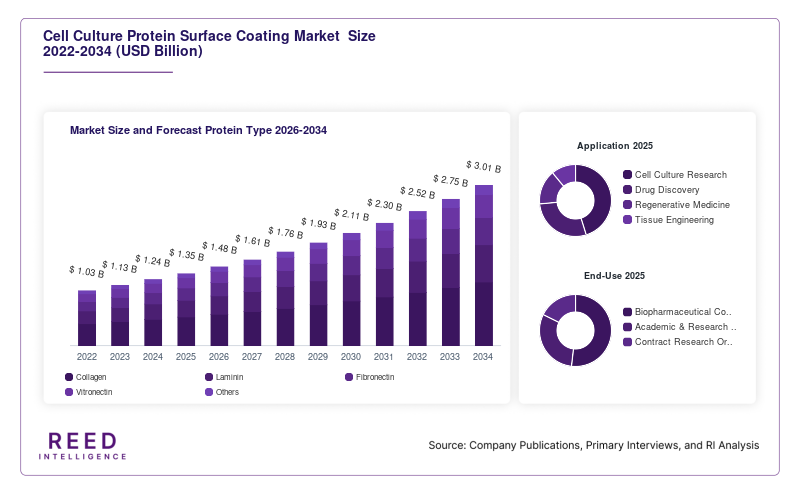
The global Cell Culture Protein Surface Coating Market was valued at approximately USD 1.35 billion in 2026 and is projected to reach USD 2.75 billion by 2034, expanding at a compound annual growth rate (CAGR) of 9.3% during 2026–2034. This growth trajectory reflects increasing demand for advanced cell culture techniques in regenerative medicine, drug discovery, and biopharmaceutical production. Protein surface coatings, such as collagen, fibronectin, laminin, and vitronectin, play a vital role in enhancing cell adhesion, proliferation, and differentiation, thereby improving experimental reliability and therapeutic outcomes.
A major global factor supporting market growth is the rapid expansion of biologics and cell-based therapies. Pharmaceutical and biotechnology companies are increasingly investing in monoclonal antibodies, stem cell therapies, and tissue engineering solutions, all of which require optimized cell culture environments. Protein coatings enable reproducibility and scalability, making them indispensable in both research and industrial applications.
Key Highlights
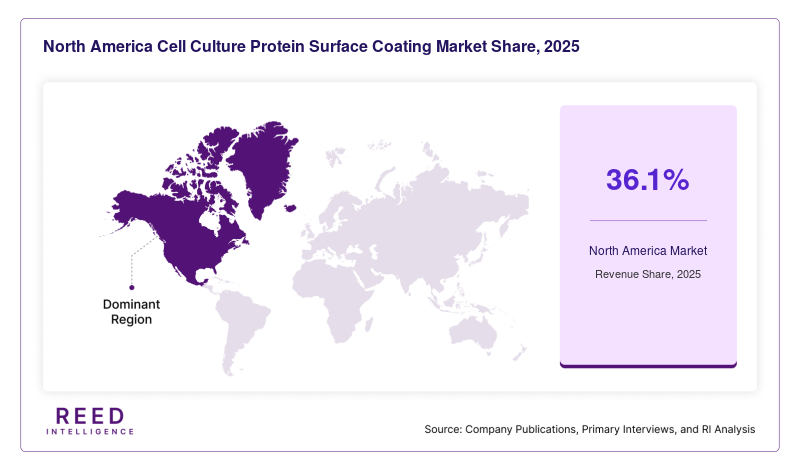
- North America dominated the market with a 36.1% share in 2025.
- Asia Pacific is expected to grow at the fastest CAGR of 10.8% during 2026–2034.
- By protein type, collagen accounted for the largest share of 39.4%, while laminin is projected to grow at a CAGR of 11.2%.
- By application, cell culture research led with a 44.6% share, whereas regenerative medicine is expected to expand at a CAGR of 10.9%.
- The United States remained the dominant country, with market values of USD 480 million in 2024 and USD 525 million in 2025.
Market Trends
Rising Adoption of Recombinant and Synthetic Protein Coatings
The market is witnessing a transition from animal-derived protein coatings to recombinant and synthetic alternatives. These coatings offer improved batch-to-batch consistency, reduced contamination risks, and better compliance with regulatory standards. Recombinant proteins, such as engineered laminin fragments, are widely used in stem cell culture applications due to their ability to support defined and xeno-free conditions. This shift is particularly important in clinical-grade cell production, where safety and reproducibility are critical. Moreover, synthetic peptide coatings that mimic extracellular matrix (ECM) components are gaining traction for their tunability and scalability. This trend is expected to reshape product development strategies among manufacturers.
Integration with 3D Cell Culture and Tissue Engineering Technologies
Another notable trend is the integration of protein surface coatings with 3D cell culture systems and tissue engineering platforms. Traditional 2D cultures are being replaced by 3D models that better mimic in vivo environments. Protein coatings enhance scaffold functionality by promoting cell attachment and differentiation within these complex systems. Researchers are increasingly using coated hydrogels, microcarriers, and bioprinted scaffolds to develop organoids and tissue constructs. This trend is driving innovation in coating technologies, including multi-protein blends and gradient coatings that replicate natural tissue environments more accurately.
Market Drivers
Growth in Biopharmaceutical and Cell Therapy Research
The rapid expansion of the biopharmaceutical sector is a key driver of the Cell Culture Protein Surface Coating Market. The development of biologics, including monoclonal antibodies and gene therapies, relies heavily on optimized cell culture conditions. Protein coatings improve cell viability and productivity, making them essential in upstream bioprocessing. Additionally, the increasing number of clinical trials involving stem cell and CAR-T therapies is fueling demand for advanced coating solutions. Research institutions and pharmaceutical companies are investing in high-quality coatings to ensure reproducibility and regulatory compliance, further driving market growth.
Increasing Demand for Advanced In Vitro Models
There is a growing need for physiologically relevant in vitro models for drug screening and toxicity testing. Protein surface coatings enable the development of more accurate cell culture systems that mimic the extracellular matrix. This improves the predictive value of preclinical studies and reduces reliance on animal testing. The adoption of organ-on-chip technologies and 3D culture systems is further boosting demand for specialized coatings. As regulatory bodies encourage alternatives to animal testing, the importance of reliable in vitro models continues to rise, supporting market expansion.
Market Restraint
High Cost and Limited Stability of Protein Coatings
One of the primary restraints in the Cell Culture Protein Surface Coating Market is the high cost associated with protein-based coatings, particularly recombinant and purified proteins. These materials require complex production processes, including expression, purification, and quality validation, which significantly increase their price. This can limit adoption among smaller research laboratories and institutions with constrained budgets. Additionally, protein coatings often have limited shelf life and stability, requiring specific storage conditions such as low temperatures and controlled environments. Degradation or denaturation of proteins can affect their functionality, leading to inconsistent experimental outcomes. For example, collagen coatings may lose their structural integrity over time, impacting cell adhesion. These challenges create barriers to widespread adoption, particularly in emerging markets where cost sensitivity is high.
Market Opportunities
Expansion in Regenerative Medicine Applications
Regenerative medicine presents a significant opportunity for the Cell Culture Protein Surface Coating Market. The development of tissue-engineered products, stem cell therapies, and organ regeneration techniques requires highly specialized cell culture environments. Protein coatings play a critical role in guiding cell behavior, including differentiation and proliferation. As healthcare systems increasingly adopt regenerative therapies for conditions such as cardiovascular diseases and neurodegenerative disorders, the demand for advanced coating solutions is expected to rise. Companies that develop customizable and clinically compliant coatings are likely to gain a competitive advantage.
Growth in Emerging Markets and Research Infrastructure
Emerging economies are investing heavily in biotechnology and life sciences research, creating new opportunities for market expansion. Countries in Asia Pacific and Latin America are establishing research centers, biopharmaceutical manufacturing facilities, and academic collaborations. This growth is increasing demand for cell culture reagents, including protein surface coatings. Government initiatives and funding programs are supporting innovation in these regions, making them attractive markets for global players. Additionally, the rising number of contract research organizations (CROs) is driving demand for standardized and high-quality coating products.
Segmental Analysis
By Protein Type
Collagen emerged as the dominant subsegment in 2024, accounting for approximately 39.4% of the market share. Its widespread use is attributed to its natural abundance in the extracellular matrix and its ability to support cell adhesion and proliferation. Collagen coatings are commonly used in tissue engineering, stem cell research, and cancer studies. Their compatibility with various cell types makes them a preferred choice among researchers. Additionally, the availability of different collagen types and formulations enhances their versatility, contributing to their leading position in the market.
Laminin is expected to be the fastest-growing subsegment, with a projected CAGR of 11.2% during the forecast period. Laminin plays a critical role in cell differentiation and tissue development, making it highly valuable in regenerative medicine applications. The increasing use of laminin-coated surfaces in stem cell culture and neural research is driving its growth. Advances in recombinant laminin production are also improving product consistency and scalability, further supporting market expansion.
By Application
Cell culture research dominated the application segment in 2024, holding a market share of 44.6%. This segment includes basic research, drug discovery, and toxicity testing, all of which rely heavily on optimized cell culture conditions. Protein surface coatings enhance cell attachment and growth, improving the reliability of experimental results. The growing number of research projects in biotechnology and pharmaceuticals is driving demand for these coatings. Additionally, the increasing adoption of high-throughput screening techniques is further boosting segment growth.
Regenerative medicine is projected to be the fastest-growing application segment, with a CAGR of 10.9%. This growth is driven by the increasing focus on developing therapies for chronic diseases and injuries. Protein coatings are essential for creating suitable environments for stem cell differentiation and tissue regeneration. The rise of personalized medicine and advancements in tissue engineering are also contributing to the growth of this segment.
By End-Use
Biopharmaceutical companies held the largest share of the market in 2024, accounting for approximately 41.8%. These companies rely on cell culture techniques for the production of biologics and biosimilars. Protein surface coatings improve cell viability and productivity, making them essential in bioprocessing. The increasing demand for biologic drugs is driving investment in cell culture technologies, supporting the growth of this segment.
Academic and research institutes are expected to be the fastest-growing end-use segment, with a CAGR of 10.5%. This growth is driven by increasing funding for life sciences research and the expansion of research infrastructure. Universities and research organizations are adopting advanced cell culture techniques to support innovative studies in areas such as stem cell biology and tissue engineering. The availability of grants and collaborative research programs is further boosting demand for protein surface coatings in this segment.
Regional Analysis
North America
North America held the largest share of the Cell Culture Protein Surface Coating Market in 2025, accounting for approximately 36.1%, and is expected to maintain steady growth at a CAGR of 8.7% through 2034. The region benefits from a strong presence of pharmaceutical and biotechnology companies, as well as advanced research infrastructure. High investment in drug discovery and regenerative medicine continues to drive demand for protein coatings. Additionally, regulatory support for biologics and cell therapies contributes to market stability and growth.
The United States dominates the North American market due to its robust research ecosystem and significant funding for life sciences. A unique growth factor is the increasing number of clinical trials involving cell-based therapies, which require consistent and high-quality culture conditions. Academic institutions and private companies are collaborating to develop innovative coating technologies, further strengthening the country’s market position.
Europe
Europe accounted for approximately 27.4% of the market share in 2025 and is projected to grow at a CAGR of 8.5% during the forecast period. The region has a well-established pharmaceutical industry and a strong focus on research and development. Increasing adoption of advanced cell culture techniques in drug discovery and toxicology studies is driving market demand. Government funding and collaborative research initiatives also play a crucial role in market growth.
Germany leads the European market, supported by its advanced biotechnology sector and strong academic research base. A unique growth factor is the emphasis on sustainable and ethical research practices, including reduced reliance on animal testing. This has led to increased adoption of in vitro models, boosting demand for protein surface coatings.
Asia Pacific
Asia Pacific is the fastest-growing region, with a CAGR of 10.8% from 2026 to 2034 and a market share of 22.6% in 2025. Rapid expansion of the biotechnology sector and increasing investments in healthcare infrastructure are key growth drivers. The region is also witnessing a surge in contract research and manufacturing activities, which require high-quality cell culture materials.
China dominates the Asia Pacific market due to its large-scale investments in biotechnology and pharmaceutical manufacturing. A unique growth factor is government support for domestic innovation, including funding for stem cell research and biopharmaceutical development. This has created a favorable environment for market expansion.
Middle East & Africa
The Middle East & Africa region accounted for approximately 7.1% of the market share in 2025 and is expected to grow at a CAGR of 7.9% during the forecast period. The market is driven by increasing healthcare investments and the gradual development of research infrastructure. While the region is still emerging, there is growing interest in biotechnology and life sciences.
Saudi Arabia is the dominant country in this region, supported by government initiatives to diversify the economy and invest in healthcare innovation. A unique growth factor is the establishment of research hubs and partnerships with international institutions, which are boosting demand for advanced cell culture technologies.
Latin America
Latin America held a market share of 6.8% in 2025 and is projected to grow at a CAGR of 8.2% through 2034. The region is experiencing gradual growth in biotechnology research and pharmaceutical manufacturing. Increasing focus on improving healthcare infrastructure is driving demand for advanced laboratory technologies.
Brazil leads the Latin American market, supported by its expanding pharmaceutical sector and research capabilities. A unique growth factor is the rising number of academic and government-funded research projects, which are increasing the adoption of cell culture techniques and associated products.
Competitive Landscape
The Cell Culture Protein Surface Coating Market is moderately fragmented, with several global and regional players competing based on product quality, innovation, and pricing. Leading companies are focusing on developing recombinant and synthetic protein coatings to meet the growing demand for consistent and scalable solutions. Strategic collaborations, product launches, and acquisitions are common strategies used to strengthen market presence.
Thermo Fisher Scientific is a leading player in the market, known for its extensive portfolio of cell culture products. The company recently introduced advanced recombinant protein coatings designed for stem cell applications, enhancing its competitive position. Other key players are investing in research and development to expand their product offerings and cater to emerging applications in regenerative medicine and 3D cell culture.
Key Players
- Thermo Fisher Scientific Inc.
- Merck KGaA
- Corning Incorporated
- Danaher Corporation
- Lonza Group AG
- Bio-Techne Corporation
- Sartorius AG
- STEMCELL Technologies
- PromoCell GmbH
- Advanced BioMatrix Inc.
- Greiner Bio-One International GmbH
- Cell Applications Inc.
- Sigma-Aldrich Corporation
- Becton, Dickinson and Company
- Takara Bio Inc.
Recent Developments
- In 2025, Thermo Fisher Scientific launched a new line of recombinant laminin coatings for stem cell research, improving consistency in clinical applications.
- In 2024, Corning Incorporated expanded its portfolio of extracellular matrix coatings to support 3D cell culture systems.
- In 2025, Merck KGaA introduced synthetic peptide-based coatings designed for xeno-free cell culture environments.
Cell Culture Protein Surface Coating Market Segments
Protein Type
- Collagen
- Laminin
- Fibronectin
- Vitronectin
- Others
Application
- Cell Culture Research
- Drug Discovery
- Regenerative Medicine
- Tissue Engineering
End-Use
- Biopharmaceutical Companies
- Academic & Research Institutes
- Contract Research Organizations
By Region
- North America
- Europe
- APAC
- Middle East and Africa
- LATAM