Cell Free Cartilage Repair Market Size, Share & Demand Report By Product Type (Scaffold-based Implants, Hydrogel-based Systems, Matrix-induced Implants), By Application (Knee Cartilage Repair, Hip Cartilage Repair, Shoulder Cartilage Repair), By End-Use (Hospitals, Ambulatory Surgical Centers, Specialty Clinics), By Region & Segment Forecasts, 2026–2034
USD 3950
Market Overview
The Cell Free Cartilage Repair Market size was valued at approximately USD 1.85 billion in 2026 and is projected to reach USD 3.96 billion by 2034, expanding at a CAGR of 10.0% during the forecast period (2026–2034). The market is gaining momentum due to increasing incidence of orthopedic disorders, sports injuries, and degenerative joint conditions such as osteoarthritis. Rising demand for minimally invasive procedures and advancements in biomaterials and scaffold-based therapies are further supporting adoption across clinical settings. Cell-free approaches, which eliminate the need for harvesting and culturing autologous cells, offer reduced procedural complexity and cost benefits, making them an attractive alternative to traditional cartilage repair techniques.
A key global factor driving market expansion is the rising aging population, particularly in developed economies, which is significantly increasing the prevalence of cartilage degeneration. Additionally, improved healthcare infrastructure and growing awareness regarding early intervention are contributing to higher treatment rates. Technological innovations such as bioresorbable scaffolds and enhanced matrix-based implants are also playing a critical role in improving clinical outcomes and expanding the application scope.
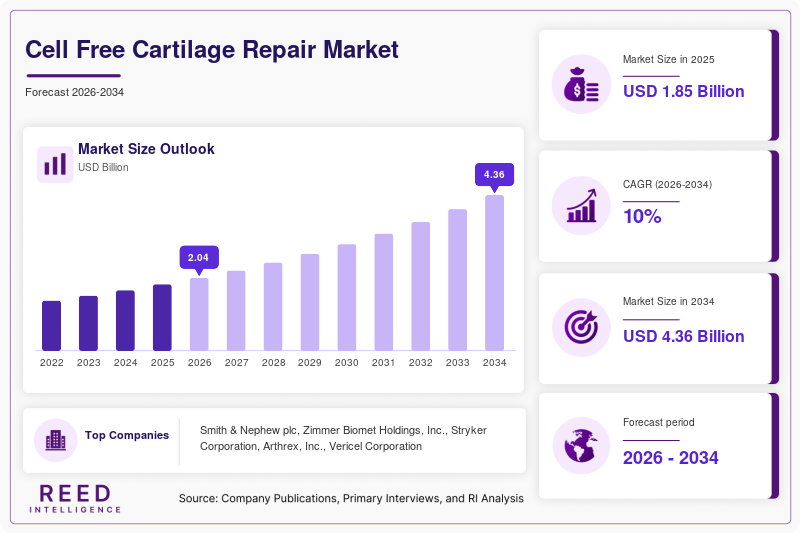
Key Highlights
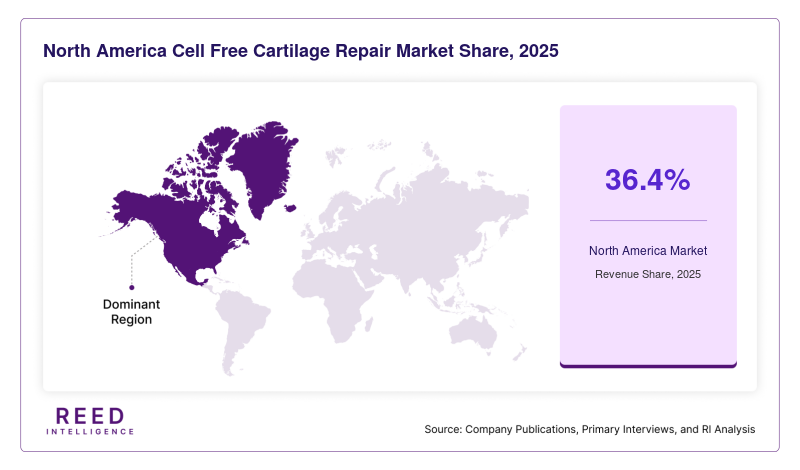
- North America dominated the market with a 36.4% share in 2025.
- Asia Pacific is expected to grow at the fastest CAGR of 11.8% during 2026–2034.
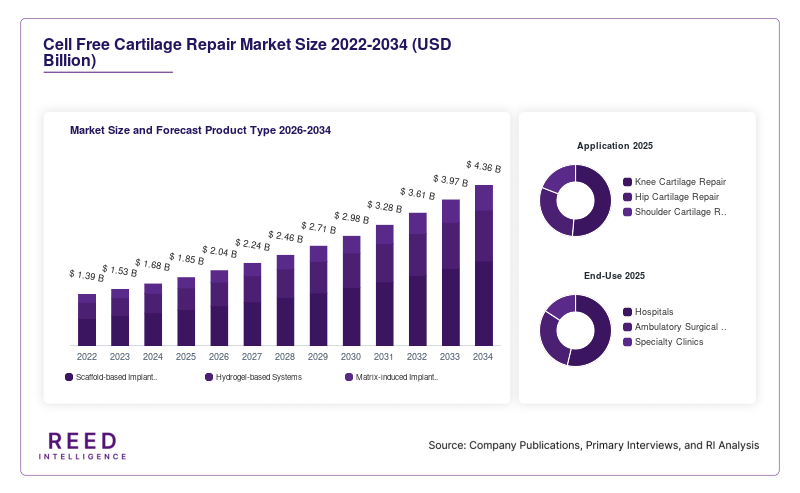
- By product type, scaffold-based implants accounted for the largest share of 42.7%, while hydrogel-based systems are projected to grow at a CAGR of 12.6%.
- By application, knee cartilage repair led with a 48.9% share, whereas hip cartilage repair is expected to expand at a CAGR of 11.3%.
- The United States remained the dominant country, with market values of USD 520 million in 2024 and USD 575 million in 2025.
Market Trends
Increasing adoption of biomimetic scaffolds
The market is witnessing a steady shift toward biomimetic scaffold technologies designed to replicate the natural extracellular matrix of cartilage tissue. These scaffolds support cell migration and tissue regeneration without requiring external cell implantation, making them efficient and less invasive. Manufacturers are focusing on advanced materials such as collagen, hyaluronic acid, and synthetic polymers to improve durability and integration with native tissues. The integration of nanotechnology into scaffold design is also enhancing structural integrity and biological compatibility. As clinical outcomes improve and regulatory approvals expand, biomimetic scaffolds are becoming a preferred option among orthopedic surgeons, contributing significantly to overall market growth and innovation.
Growing preference for minimally invasive orthopedic procedures
Another notable trend in the Cell Free Cartilage Repair Market is the rising demand for minimally invasive surgical techniques. Patients and healthcare providers are increasingly opting for procedures that offer reduced recovery time, lower risk of complications, and shorter hospital stays. Cell-free cartilage repair solutions align well with these requirements, as they simplify surgical workflows and eliminate the need for multiple interventions. Technological advancements in arthroscopy and imaging are further enabling precise implantation of cartilage repair materials. This trend is particularly prominent in urban healthcare centers and sports medicine clinics, where efficiency and patient outcomes are critical performance indicators.
Market Drivers
Rising prevalence of osteoarthritis and joint disorders
The increasing burden of osteoarthritis and related joint disorders is a major driver for the Cell Free Cartilage Repair Market. Aging populations, sedentary lifestyles, and rising obesity rates are contributing to higher incidences of cartilage degeneration globally. As cartilage has limited self-healing capacity, there is a growing demand for effective repair solutions. Cell-free techniques provide a viable treatment option by promoting natural tissue regeneration without the complexities of cell-based therapies. Healthcare systems are also prioritizing early diagnosis and intervention, which further boosts the demand for cartilage repair procedures. This expanding patient pool is expected to sustain long-term market growth.
Advancements in biomaterials and regenerative technologies
Technological progress in biomaterials and regenerative medicine is significantly accelerating market expansion. Innovations in bioengineered scaffolds, hydrogels, and matrix-induced systems are enhancing treatment effectiveness and patient outcomes. These advancements enable better integration with host tissues and improved durability of repaired cartilage. Research and development investments by medical device companies are leading to the introduction of next-generation products with enhanced performance characteristics. Additionally, favorable regulatory pathways for innovative therapies in several regions are encouraging product commercialization. This continuous evolution of technology is creating a strong foundation for market growth and differentiation.
Market Restraint
High treatment costs and limited reimbursement coverage
One of the primary challenges facing the Cell Free Cartilage Repair Market is the high cost associated with advanced treatment procedures. Although cell-free techniques reduce certain complexities, the cost of specialized biomaterials, surgical equipment, and skilled professionals remains substantial. In many regions, reimbursement policies for cartilage repair procedures are either limited or inconsistent, which restricts patient access to these treatments. This issue is particularly pronounced in developing economies, where healthcare budgets are constrained. The high upfront costs can also deter smaller healthcare facilities from adopting advanced solutions. Consequently, cost-related barriers continue to limit widespread adoption despite technological progress.
Market Opportunities
Expansion in emerging healthcare markets
Emerging economies present significant growth opportunities for the Cell Free Cartilage Repair Market. Countries in Asia Pacific, Latin America, and parts of the Middle East are investing heavily in healthcare infrastructure and expanding access to advanced medical treatments. Increasing awareness about orthopedic health and rising disposable incomes are driving demand for innovative procedures. Additionally, governments are focusing on improving insurance coverage and encouraging private sector participation in healthcare delivery. These factors are creating a favorable environment for market players to expand their presence and introduce cost-effective solutions tailored to local needs.
Integration of personalized medicine approaches
The integration of personalized medicine into cartilage repair is creating new avenues for market growth. Advances in diagnostics and imaging technologies are enabling clinicians to develop customized treatment plans based on individual patient conditions. Cell-free approaches can be adapted to specific injury types and patient profiles, improving treatment outcomes and satisfaction. Companies are also exploring the use of 3D printing and advanced biomaterials to create tailored implants and scaffolds. This trend toward customization is expected to enhance clinical effectiveness and drive adoption among healthcare providers seeking differentiated treatment options.
Segmental Analysis
By Product Type
Scaffold-based implants dominated the Cell Free Cartilage Repair Market in 2024, accounting for approximately 42.7% of the total share. These products are widely used due to their ability to provide structural support and facilitate natural tissue regeneration. They are designed to mimic the extracellular matrix, enabling efficient integration with surrounding tissues. The growing preference for minimally invasive procedures and improved clinical outcomes has further strengthened their adoption. Additionally, ongoing advancements in material science are enhancing the durability and performance of scaffold-based implants, making them a reliable choice for orthopedic surgeons.
Hydrogel-based systems are expected to be the fastest-growing subsegment, with a projected CAGR of 12.6% during the forecast period. These systems offer superior flexibility and biocompatibility, allowing them to conform to irregular cartilage defects. Their ability to deliver bioactive molecules and support tissue regeneration is driving increased adoption. Continuous innovation in hydrogel formulations and expanding clinical applications are expected to further boost their growth.
By Application
Knee cartilage repair emerged as the dominant application segment in 2024, capturing a 48.9% market share. The high incidence of knee injuries and osteoarthritis is a key factor driving demand in this segment. Knee joints are particularly susceptible to wear and tear, making them a primary focus for cartilage repair procedures. The availability of advanced treatment options and increasing awareness among patients are also contributing to segment growth.
Hip cartilage repair is anticipated to be the fastest-growing application, with a CAGR of 11.3% over the forecast period. The rising prevalence of hip-related disorders and increasing adoption of minimally invasive procedures are driving demand. Advances in surgical techniques and improved implant designs are further supporting the expansion of this segment.
By End-Use
Hospitals accounted for the largest share of the market in 2024, representing approximately 55.6% of total revenue. The availability of advanced surgical infrastructure and skilled healthcare professionals makes hospitals the primary setting for cartilage repair procedures. Additionally, hospitals often have access to a wide range of treatment options and technologies, enabling them to provide comprehensive care.
Ambulatory surgical centers are expected to grow at the fastest CAGR of 11.9% during the forecast period. These centers offer cost-effective and efficient treatment options, attracting patients seeking quicker recovery and lower expenses. The increasing shift toward outpatient procedures and advancements in minimally invasive techniques are driving growth in this segment.
Regional Analysis
North America
North America accounted for the largest share of the Cell Free Cartilage Repair Market in 2025, contributing approximately 36.4% of global revenue. The region is expected to maintain steady growth with a CAGR of 9.4% during the forecast period. High healthcare expenditure, advanced medical infrastructure, and strong adoption of innovative technologies are key factors supporting market dominance. The presence of leading medical device companies and well-established reimbursement frameworks further strengthens the region’s position.
The United States remains the dominant country in North America, driven by a high prevalence of sports injuries and degenerative joint diseases. A unique growth factor in this region is the strong focus on research and clinical trials, which accelerates the development and commercialization of advanced cartilage repair solutions.
Europe
Europe holds a significant share of the global market, accounting for around 27.1% in 2025, with a projected CAGR of 9.7% through 2034. The region benefits from well-developed healthcare systems and increasing adoption of minimally invasive surgical techniques. Government initiatives promoting early diagnosis and treatment of orthopedic conditions are also contributing to market growth.
Germany leads the European market due to its advanced healthcare infrastructure and strong focus on medical innovation. A unique growth factor is the increasing collaboration between research institutions and medical device manufacturers, which is fostering the development of next-generation cartilage repair technologies.
Asia Pacific
Asia Pacific is the fastest-growing region in the Cell Free Cartilage Repair Market, with a projected CAGR of 11.8% during the forecast period. The region accounted for approximately 21.3% of global revenue in 2025. Rapid urbanization, increasing healthcare investments, and growing awareness about orthopedic treatments are driving market expansion.
China dominates the regional market, supported by a large patient population and improving healthcare infrastructure. A unique growth factor is the increasing government support for advanced medical technologies, which is encouraging domestic production and adoption of innovative cartilage repair solutions.
Middle East & Africa
The Middle East & Africa region held a smaller share of around 7.2% in 2025 but is expected to grow at a CAGR of 8.9% over the forecast period. Improving healthcare infrastructure and rising awareness about advanced treatment options are contributing to gradual market growth.
Saudi Arabia is the leading country in this region, driven by increasing healthcare investments and expanding medical facilities. A unique growth factor is the growing focus on medical tourism, which is attracting patients seeking advanced orthopedic treatments.
Latin America
Latin America accounted for approximately 8.0% of the global market in 2025 and is projected to grow at a CAGR of 9.1% during the forecast period. Increasing healthcare spending and rising prevalence of joint disorders are supporting market growth.
Brazil leads the regional market, supported by a large population and improving access to healthcare services. A unique growth factor is the increasing adoption of private healthcare services, which is expanding the availability of advanced cartilage repair procedures.
Competitive Landscape
The Cell Free Cartilage Repair Market is moderately competitive, with several global and regional players focusing on product innovation and strategic partnerships. Leading companies are investing in research and development to introduce advanced biomaterials and improve clinical outcomes. The market is characterized by continuous technological advancements and increasing collaboration between medical device manufacturers and research institutions.
Smith & Nephew plc is a leading player in the market, known for its strong product portfolio and global presence. The company recently introduced an advanced cartilage repair system designed to enhance tissue regeneration and reduce recovery time. Other key players are also focusing on expanding their product offerings and strengthening their market position through mergers, acquisitions, and partnerships.
Key Players
- Smith & Nephew plc
- Zimmer Biomet Holdings, Inc.
- Stryker Corporation
- Arthrex, Inc.
- Vericel Corporation
- Anika Therapeutics, Inc.
- Geistlich Pharma AG
- Collagen Solutions plc
- B. Braun Melsungen AG
- Medtronic plc
- RTI Surgical Holdings, Inc.
- Integra LifeSciences Corporation
- BioTissue AG
- Orthofix Medical Inc.
- TiGenix NV
Recent Developments
- Smith & Nephew plc launched an advanced bioresorbable scaffold system to enhance cartilage regeneration outcomes.
- Zimmer Biomet Holdings, Inc. expanded its orthopedic portfolio with a new hydrogel-based cartilage repair solution.
- Stryker Corporation announced a strategic partnership with a research institute to develop next-generation cartilage repair technologies.
Cell Free Cartilage Repair Market Segments
Product Type
- Scaffold-based Implants
- Hydrogel-based Systems
- Matrix-induced Implants
Application
- Knee Cartilage Repair
- Hip Cartilage Repair
- Shoulder Cartilage Repair
End-Use
- Hospitals
- Ambulatory Surgical Centers
- Specialty Clinics
By Region
- North America
- Europe
- APAC
- Middle East and Africa
- LATAM