Cell Line Authentication Characterization Tests Market Size, Share Demand Report By Test Type (STR Profiling, PCR-Based Tests, Next-Generation Sequencing, Karyotyping), By Application (Cancer Research, Stem Cell Research, Drug Discovery, Toxicology Studies), By End-Use (Pharmaceutical & Biotechnology Companies, Academic & Research Institutes, Contract Research Organizations), By Region & Segment Forecasts, 2026–2034
USD 3950
Market Overview
The Cell Line Authentication Characterization Tests Market was valued at approximately USD 520 million in 2026 and is projected to reach USD 1,120 million by 2034, expanding at a CAGR of 10.1% during 2026–2034. The market is experiencing steady growth due to the increasing need for reproducibility and reliability in biomedical research, particularly in pharmaceutical development and academic laboratories. The growing incidence of cell line misidentification and contamination has prompted regulatory bodies and funding agencies to emphasize strict validation protocols, further supporting market expansion.
A key global factor driving growth is the rising demand for precision medicine and biologics development. As drug discovery becomes more targeted, accurate cell line validation has become essential for ensuring experimental consistency and reducing costly downstream errors. The integration of advanced genomic technologies and automation tools has also improved testing accuracy and efficiency, enabling wider adoption across research institutions and contract research organizations.
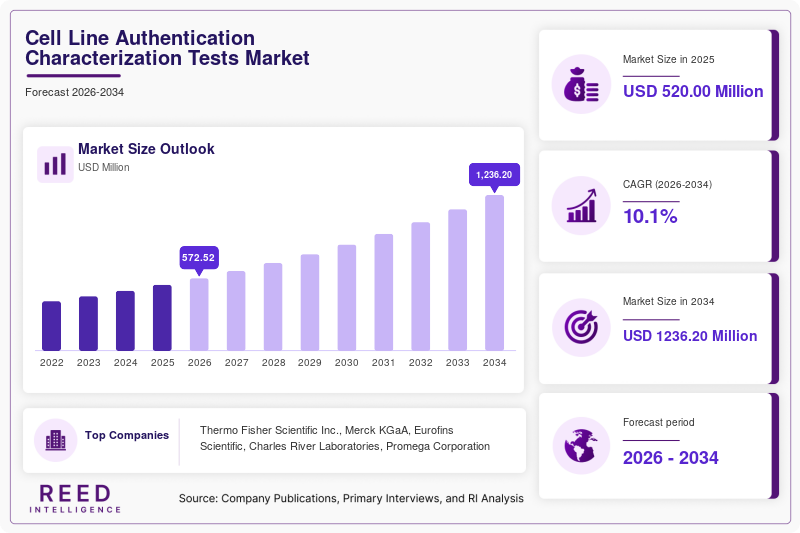
Key Highlights
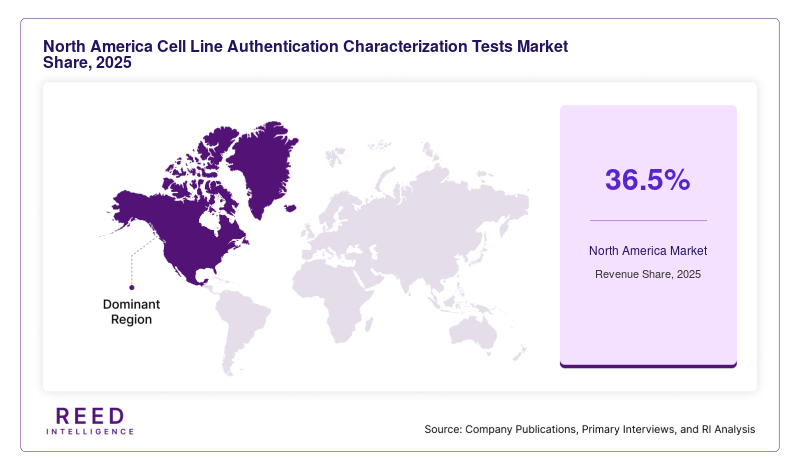
- North America dominated the market with a 36.5% share in 2025.
- Asia Pacific is expected to grow at the fastest CAGR of 11.8% during 2026–2034.
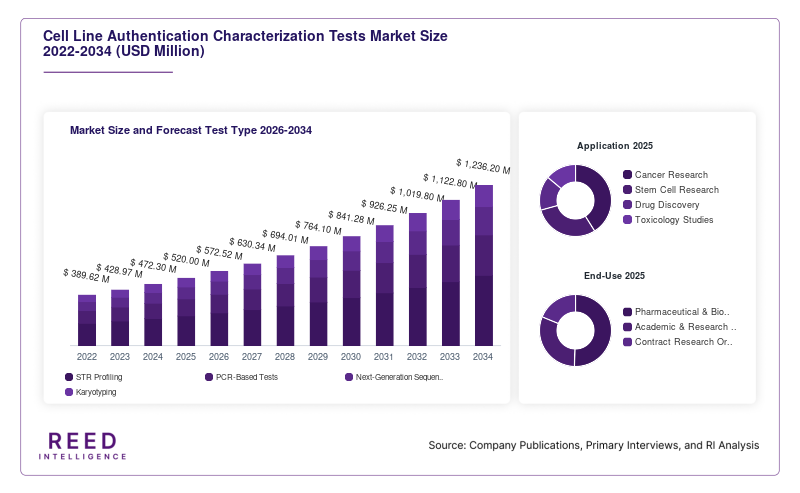
- By test type, STR profiling accounted for the largest share of 42.3%.
- while next-generation sequencing-based tests are projected to grow at a CAGR of 12.6%.
- By application, cancer research led with a 39.8% share, whereas stem cell research is expected to expand at a CAGR of 11.9%.
- The United States remained the dominant country, with market values of USD 185 million in 2024 and USD 205 million in 2025.
Market Trends
Increasing Adoption of Genomic-Based Authentication Technologies
The market is witnessing a shift from traditional authentication methods toward advanced genomic-based technologies such as next-generation sequencing (NGS). These methods provide comprehensive insights into genetic variations, enabling more accurate identification and characterization of cell lines. Laboratories are increasingly adopting these technologies to detect subtle mutations, cross-contamination, and genetic drift that may not be identified through conventional methods like short tandem repeat (STR) profiling. Additionally, declining sequencing costs and improvements in data processing capabilities are making genomic approaches more accessible. This trend is particularly strong in pharmaceutical companies and large research institutions, where precision and reproducibility are critical. The integration of bioinformatics tools further enhances data interpretation, supporting broader adoption and contributing to overall market growth.
Expansion of Outsourced Testing Services
Another notable trend is the growing reliance on outsourced cell line authentication services. Contract research organizations (CROs) and specialized testing laboratories are increasingly offering comprehensive authentication and characterization services, allowing research institutions to reduce operational complexity and costs. This trend is driven by the need for standardized testing procedures and access to advanced technologies that may not be available in-house. Outsourcing also helps organizations comply with regulatory requirements and quality standards without significant capital investment. Smaller biotech firms and academic labs, in particular, are adopting this model to focus on core research activities while ensuring the integrity of their cell lines. As service providers expand their global footprint and capabilities, this trend is expected to strengthen further.
Market Drivers
Rising Incidence of Cell Line Misidentification and Contamination
The increasing prevalence of misidentified and contaminated cell lines is a major driver of the market. Studies have shown that a significant proportion of cell lines used in research are either mislabeled or contaminated, leading to unreliable results and wasted resources. This issue has prompted funding agencies, journals, and regulatory bodies to mandate authentication before publication or grant approval. As a result, research institutions are investing in robust testing protocols to ensure data validity. The financial implications of flawed research outcomes further reinforce the importance of authentication. By preventing costly errors in drug development and academic research, authentication tests play a crucial role in maintaining scientific integrity, thereby driving demand across the market.
Growth in Biopharmaceutical and Cancer Research Activities
The rapid expansion of biopharmaceutical research, particularly in oncology and biologics, is fueling demand for cell line authentication and characterization tests. Cell lines serve as fundamental tools in drug discovery, toxicity testing, and therapeutic development. With the increasing focus on targeted therapies and personalized medicine, the need for accurate and well-characterized cell models has become more critical. Pharmaceutical companies are investing heavily in R&D pipelines, which require validated cell lines to ensure reliable outcomes. Additionally, collaborations between academia and industry are increasing the volume of research activities, further boosting demand. The growing number of clinical trials and regulatory requirements for data accuracy are also contributing to market growth.
Market Restraint
High Cost of Advanced Authentication Technologies
One of the primary restraints in the Cell Line Authentication Characterization Tests Market is the high cost associated with advanced testing technologies such as next-generation sequencing and multiplex assays. These methods require sophisticated equipment, skilled personnel, and specialized software, which can be financially challenging for small and mid-sized research institutions. The initial investment in infrastructure and ongoing operational costs may limit adoption, particularly in developing regions where funding for scientific research is constrained. Additionally, the complexity of these technologies can lead to longer turnaround times and increased reliance on external service providers. This creates a dependency that may not be feasible for all organizations. For example, smaller academic laboratories often rely on basic authentication methods due to budget limitations, which may not provide comprehensive validation. As a result, cost barriers continue to hinder widespread adoption of advanced solutions, impacting overall market growth.
Market Opportunities
Emerging Markets and Expanding Research Infrastructure
Emerging economies present significant growth opportunities for the market due to increasing investments in healthcare and research infrastructure. Countries in Asia Pacific, Latin America, and the Middle East are expanding their biotechnology and pharmaceutical sectors, creating demand for reliable cell line authentication solutions. Governments are providing funding and incentives to promote scientific research, leading to the establishment of new laboratories and research centers. As awareness about the importance of cell line validation grows, these regions are expected to adopt advanced testing technologies. Furthermore, collaborations with global research organizations are facilitating technology transfer and knowledge sharing, enhancing market penetration. This expansion into emerging markets is expected to contribute significantly to future growth.
Integration of Automation and AI in Testing Processes
The integration of automation and artificial intelligence (AI) in cell line authentication processes offers a promising opportunity for market expansion. Automated systems can streamline workflows, reduce human error, and improve testing efficiency, making authentication more accessible and cost-effective. AI-driven data analysis tools can enhance the interpretation of complex genomic data, enabling faster and more accurate results. These technologies are particularly beneficial for high-throughput laboratories and large-scale research projects. As digital transformation accelerates across the life sciences sector, the adoption of automated and AI-enabled solutions is expected to increase. This trend not only improves operational efficiency but also supports scalability, making it a key opportunity for market growth.
Segmental Analysis
By Test Type
STR profiling emerged as the dominant subsegment, accounting for 42.3% of the market share in 2024. This method is widely used due to its reliability, cost-effectiveness, and ability to accurately identify human cell lines. It is considered the gold standard for authentication and is recommended by regulatory bodies and research organizations. STR profiling is particularly popular in academic and clinical research settings, where cost constraints and standardization requirements are key considerations. The widespread availability of STR kits and established protocols further supports its dominance in the market.
Next-generation sequencing-based tests are the fastest-growing subsegment, with a projected CAGR of 12.6%. These methods offer comprehensive genetic analysis, enabling the detection of mutations, contamination, and genetic drift. The increasing demand for high-resolution data and the growing adoption of precision medicine are key factors driving this growth. Additionally, advancements in sequencing technologies and declining costs are making NGS-based tests more accessible to a broader range of users.
By Application
Cancer research dominated the application segment, accounting for 39.8% of the market share in 2024. Cell lines are extensively used in oncology research for studying disease mechanisms, drug responses, and therapeutic development. The high prevalence of cancer and the increasing number of research projects in this field contribute to the dominance of this segment. Pharmaceutical companies and academic institutions rely heavily on authenticated cell lines to ensure the accuracy and reproducibility of their findings.
Stem cell research is the fastest-growing application segment, with a CAGR of 11.9%. The increasing focus on regenerative medicine and personalized therapies is driving demand for stem cell-based studies. Accurate characterization and authentication of stem cell lines are critical for ensuring their safety and efficacy. The growing number of clinical trials and advancements in stem cell technologies further support the growth of this segment.
By End-Use
Pharmaceutical and biotechnology companies held the largest share of 44.6% in 2024. These organizations rely on authenticated cell lines for drug discovery, development, and testing processes. The increasing investment in R&D and the growing pipeline of biologics and targeted therapies contribute to the dominance of this segment. The need for compliance with regulatory standards also drives the adoption of authentication tests in this sector.
Academic and research institutes are the fastest-growing end-use segment, with a CAGR of 11.3%. The increasing number of research projects and funding opportunities is driving growth in this segment. Academic institutions are becoming more aware of the importance of cell line authentication, leading to increased adoption of testing solutions. Collaborations with industry players and access to advanced technologies further support this growth.
Regional Analysis
North America
North America held a dominant share of 36.5% in 2025 and is expected to maintain steady growth with a CAGR of 9.6% during the forecast period. The region benefits from a well-established research ecosystem, strong funding support, and the presence of leading biopharmaceutical companies. High adoption of advanced technologies and strict regulatory requirements further contribute to market growth. The increasing focus on precision medicine and biologics development also supports demand for authentication tests.
The United States is the leading country in this region, driven by extensive R&D activities and strong regulatory frameworks. A unique growth factor is the enforcement of authentication guidelines by funding agencies and scientific journals, which mandates validation of cell lines before publication. This has significantly increased the adoption of authentication tests across academic and commercial research institutions.
Europe
Europe accounted for approximately 27.8% of the market share in 2025 and is projected to grow at a CAGR of 9.2% through 2034. The region’s growth is supported by increasing investments in life sciences research and the presence of established pharmaceutical companies. Regulatory emphasis on research quality and reproducibility also drives demand for authentication solutions.
Germany is a dominant country in Europe, supported by its strong biotechnology sector and research infrastructure. A unique growth factor is the increasing collaboration between academic institutions and industry players, which enhances the adoption of standardized testing protocols and advanced authentication technologies.
Asia Pacific
Asia Pacific is the fastest-growing region, with a CAGR of 11.8% during the forecast period and a market share of 22.4% in 2025. Rapid expansion of the biotechnology and pharmaceutical sectors, coupled with increasing research funding, drives market growth. The region is also witnessing growing awareness about the importance of cell line authentication.
China leads the Asia Pacific market, driven by significant government investments in research and development. A unique growth factor is the establishment of new research institutes and biopharmaceutical manufacturing facilities, which increases the demand for reliable authentication and characterization tests.
Middle East & Africa
The Middle East & Africa region held a smaller share of 6.3% in 2025 but is expected to grow at a CAGR of 8.7% during the forecast period. Growth is driven by increasing investments in healthcare infrastructure and research initiatives. However, limited access to advanced technologies remains a challenge.
Saudi Arabia is a key country in this region, supported by government initiatives to diversify the economy and invest in biotechnology. A unique growth factor is the development of research hubs and partnerships with international organizations, which enhance access to advanced testing technologies.
Latin America
Latin America accounted for 7.0% of the market share in 2025 and is projected to grow at a CAGR of 9.0% through 2034. The region is experiencing growth due to increasing research activities and improving healthcare infrastructure. Rising awareness about research quality is also contributing to market expansion.
Brazil is the dominant country in Latin America, driven by its growing pharmaceutical industry and academic research sector. A unique growth factor is the increasing government support for scientific research, which encourages the adoption of authentication tests across various institutions.
Competitive Landscape
The competitive landscape of the Cell Line Authentication Characterization Tests Market is moderately consolidated, with several key players focusing on technological advancements and strategic collaborations. Leading companies are investing in research and development to enhance the accuracy and efficiency of their testing solutions. The market is characterized by the presence of both established players and emerging companies offering specialized services.
Thermo Fisher Scientific is a leading player in the market, known for its comprehensive portfolio of authentication and characterization solutions. The company recently introduced advanced genomic testing kits to improve accuracy and streamline workflows. Other key players are also expanding their service offerings and geographic presence to capture a larger market share. Strategic partnerships with research institutions and contract research organizations are common, enabling companies to strengthen their market position and enhance customer reach.
Key Players List
- Thermo Fisher Scientific Inc.
- Merck KGaA
- Eurofins Scientific
- Charles River Laboratories
- Promega Corporation
- ATCC (American Type Culture Collection)
- Lonza Group AG
- Bio-Rad Laboratories
- Agilent Technologies
- Qiagen N.V.
- Genetica DNA Laboratories
- IDEXX Laboratories
- CellBank Australia
- Creative Bioarray
- SGS SA
Recent Developments
- In 2025, a leading market player launched an AI-integrated cell line authentication platform to enhance data analysis and reduce turnaround time.
- In 2024, a major biotechnology firm expanded its genomic testing services portfolio to include advanced NGS-based authentication solutions.
- In 2025, a global CRO partnered with academic institutions to provide standardized cell line validation services across multiple regions.
Cell Line Authentication Characterization Tests Market Segments
Test Type
- STR Profiling
- PCR-Based Tests
- Next-Generation Sequencing
- Karyotyping
Application
- Cancer Research
- Stem Cell Research
- Drug Discovery
- Toxicology Studies
End-Use
- Pharmaceutical & Biotechnology Companies
- Academic & Research Institutes
- Contract Research Organizations
By Region
- North America
- Europe
- APAC
- Middle East and Africa
- LATAM