Cellulose Powder Market Size, Share, Demand Report By Type (Microcrystalline Cellulose Powder), By Application (Pharmaceutical Excipients, Food & Beverage Additives, Cosmetics & Personal Care, Industrial Applications), By End-Use Industry (Healthcare & Pharmaceuticals, Food Processing Industry, Packaging Industry, Chemical & Industrial Manufacturing) & Regional Forecasts, 2026–2034
USD 3950
Market Overview
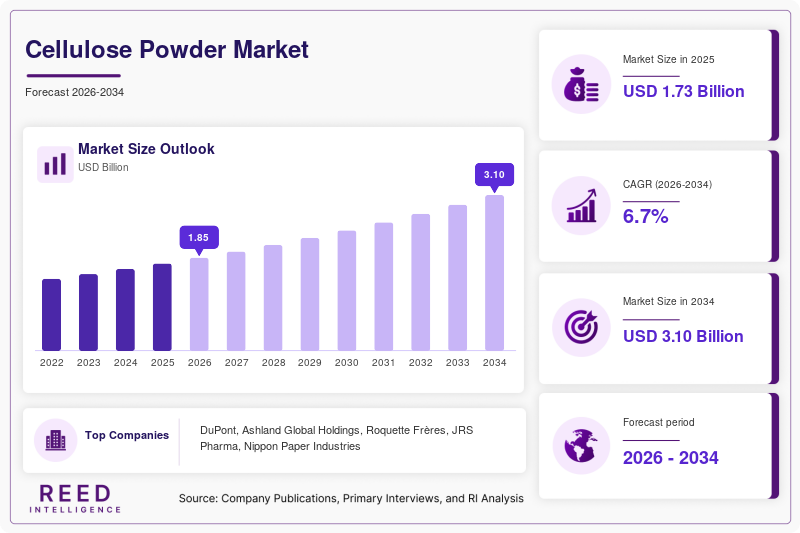
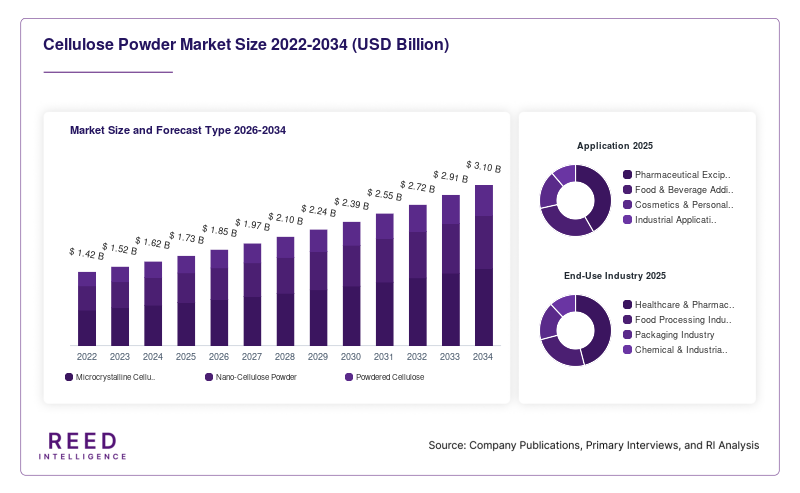
The Cellulose Powder Market is projected to reach USD 1.85 billion in 2026 and is expected to attain a value of USD 3.12 billion by 2034, expanding at a CAGR of 6.7% during the forecast period (2026–2034). Growth is primarily supported by increasing demand for plant-based and functional excipients across pharmaceuticals, food processing, and industrial applications. Cellulose powder, derived from purified wood pulp or cotton linters, is widely used as a stabilizer, anti-caking agent, and bulking agent, making it a critical ingredient in multiple downstream industries.
A major global factor supporting market expansion is the accelerating shift toward clean-label and sustainable ingredients. Food manufacturers and pharmaceutical companies are increasingly replacing synthetic additives with naturally derived alternatives, strengthening the adoption of cellulose-based products. Additionally, regulatory encouragement for non-toxic and biodegradable materials is reinforcing long-term demand stability across developed and emerging markets.
Key Highlights
- North America dominated the market with a 34.2% share in 2025.
- Asia Pacific is expected to grow at the fastest CAGR of 11.1% during 2026–2034.
- By application, pharmaceutical excipients accounted for the largest share of 39.6%.
- while food & beverage applications are projected to grow at a CAGR of 10.8%.
- By form, microcrystalline cellulose powder held a dominant share of 42.3%.
- whereas nano-cellulose-based powder is expected to expand at a CAGR of 12.6%.
- The United States remained the dominant country, with market values of USD 610 million in 2024 and USD 655 million in 2025.
Market Trends
Rising Adoption of Clean-Label Functional Ingredients
The Cellulose Powder Market is witnessing a strong shift toward clean-label formulations in food and pharmaceutical products. Consumers are increasingly scrutinizing ingredient lists and preferring products free from synthetic additives, preservatives, and chemical stabilizers. Cellulose powder serves as an effective plant-derived alternative that enhances texture, improves shelf stability, and maintains product consistency without altering taste or nutritional value. Food manufacturers are incorporating cellulose powder in bakery products, dairy alternatives, and processed meats to meet evolving consumer expectations. Pharmaceutical companies also rely on cellulose powder as a binder and disintegrant in tablet formulations. The rising demand for transparent labeling and natural sourcing is expected to sustain this trend across developed and emerging economies.
Expansion of Nano-Structured Cellulose Applications
Another key trend shaping the Cellulose Powder Market is the rapid development of nano-cellulose technologies. Nano-structured cellulose powder offers enhanced surface area, improved mechanical strength, and superior binding capabilities compared to conventional grades. These properties are driving its adoption in advanced applications such as drug delivery systems, biodegradable packaging, and high-performance composites. Research institutions and industrial manufacturers are increasingly investing in nano-cellulose production technologies to improve scalability and cost efficiency. The material is also gaining traction in the cosmetics industry for its stabilizing and thickening properties. As industries move toward lightweight and high-performance sustainable materials, nano-cellulose powder is expected to become a critical growth segment in the global market.
Market Drivers
Expanding Pharmaceutical Industry Demand
The pharmaceutical sector is a major growth driver for the Cellulose Powder Market, primarily due to its extensive use as an excipient in oral solid dosage forms. Cellulose powder improves compressibility, flowability, and stability of active pharmaceutical ingredients, making it essential in tablet manufacturing. The rising prevalence of chronic diseases such as diabetes, cardiovascular disorders, and respiratory conditions has increased global drug production volumes. Additionally, the expansion of generic drug manufacturing in Asia Pacific and Latin America is further boosting demand. Regulatory standards emphasizing safety, consistency, and bio-compatibility are also encouraging pharmaceutical companies to adopt cellulose-based excipients, ensuring sustained long-term consumption growth.
Growth in Processed Food and Beverage Consumption
The increasing consumption of processed and convenience foods is significantly driving the Cellulose Powder Market. Urbanization, changing dietary patterns, and busy lifestyles have increased reliance on packaged food products, where cellulose powder plays a critical role as a stabilizer and fat replacer. It is widely used in bakery products, sauces, frozen foods, and dairy alternatives to enhance texture and maintain product integrity during storage. Additionally, the rise of vegan and vegetarian diets has further expanded its application in plant-based food formulations. Food manufacturers are also focusing on calorie reduction strategies, where cellulose powder serves as a non-digestible bulking agent, supporting product innovation and market expansion.
Market Restraint
Fluctuating Raw Material Supply and Production Costs
One of the primary restraints in the Cellulose Powder Market is the fluctuation in raw material availability and production costs. Cellulose powder is derived from natural sources such as wood pulp and cotton linters, which are subject to supply chain disruptions, seasonal variations, and environmental regulations. Deforestation control policies and sustainable sourcing requirements have increased compliance costs for manufacturers. Additionally, energy-intensive processing methods used in cellulose extraction and purification contribute to high production expenses. These cost pressures are often transferred to end-use industries, limiting adoption in price-sensitive markets. Smaller manufacturers face challenges in maintaining profitability, which can hinder market expansion in developing economies.
Market Opportunities
Growth in Biodegradable Packaging Applications
The increasing demand for sustainable packaging materials presents a strong opportunity for the Cellulose Powder Market. Cellulose powder is being explored as a key component in biodegradable films, coatings, and packaging composites due to its renewable nature and low environmental impact. With global regulations targeting plastic reduction, manufacturers are investing in cellulose-based alternatives for single-use packaging applications. The food and beverage industry, in particular, is adopting cellulose-derived packaging to enhance sustainability credentials. Research into improving moisture resistance and mechanical strength is further expanding its commercial viability, creating long-term opportunities for market players.
Advancements in Pharmaceutical Formulation Technologies
Technological advancements in pharmaceutical formulation are creating new opportunities for cellulose powder applications. Continuous manufacturing processes and advanced drug delivery systems are increasing the need for high-performance excipients with consistent quality attributes. Cellulose powder is being engineered to improve drug release profiles and enhance bioavailability in controlled-release formulations. The rise of personalized medicine is also encouraging the use of specialized excipient systems tailored to individual patient needs. As pharmaceutical companies invest in innovative formulation techniques, demand for advanced cellulose powder grades is expected to grow significantly across global markets.
Segmental Analysis
By Type
Microcrystalline cellulose powder emerged as the dominant segment in the Cellulose Powder Market, accounting for approximately 42.3% share in 2024. The segment maintains strong market leadership because of its extensive use in pharmaceutical tablet manufacturing. Microcrystalline cellulose provides excellent compressibility, flow properties, and chemical stability, making it a preferred excipient for oral solid dosage formulations. Pharmaceutical companies widely utilize this material in tablets and capsules due to its compatibility with active pharmaceutical ingredients. In addition, the segment benefits from rising healthcare expenditure and increasing production of generic drugs globally. Food manufacturers also use microcrystalline cellulose as a stabilizer and anti-caking agent in processed foods, dairy products, and bakery applications. Continuous demand from both pharmaceutical and food industries is supporting segment expansion across developed and emerging markets.
Nano-cellulose powder is projected to be the fastest-growing subsegment, registering a CAGR of 12.6% during 2026–2034. The rapid growth is attributed to increasing research and development activities focused on advanced cellulose technologies. Nano-cellulose exhibits superior mechanical strength, lightweight properties, and enhanced surface functionality, making it suitable for biomedical applications, sustainable packaging, and industrial composites. Pharmaceutical manufacturers are exploring nano-cellulose for controlled drug delivery systems and enhanced bioavailability formulations. In addition, packaging companies are investing in nano-cellulose materials to develop biodegradable alternatives to plastic-based products. Growing global emphasis on environmentally sustainable materials is expected to further accelerate the adoption of nano-cellulose powder across multiple end-use industries.
By Application
Pharmaceutical excipients represented the largest application segment in the Cellulose Powder Market, accounting for approximately 39.6% share in 2024. The segment’s dominance is primarily linked to the extensive use of cellulose powder in tablet compression, capsule filling, and drug stabilization processes. Cellulose-based excipients improve product consistency, dissolution rates, and mechanical strength in pharmaceutical formulations. The increasing prevalence of chronic diseases and expanding global pharmaceutical production have significantly boosted demand for excipient-grade cellulose powder. In addition, regulatory requirements emphasizing formulation safety and ingredient stability continue to encourage pharmaceutical manufacturers to adopt cellulose-based solutions. Rising investment in generic medicine manufacturing across Asia Pacific and Latin America is also contributing to the segment’s long-term expansion.
Food and beverage applications are anticipated to witness the fastest growth, expanding at a CAGR of 10.8% during the forecast period. This growth is driven by rising demand for clean-label, plant-based, and low-calorie food products. Cellulose powder is widely used in bakery items, processed meat products, dairy alternatives, beverages, and sauces because it enhances texture and moisture retention while improving shelf life. Food manufacturers are increasingly incorporating cellulose ingredients to reduce fat content and improve fiber levels without compromising taste or consistency. In addition, the growing popularity of vegan and vegetarian diets is encouraging the use of cellulose-derived stabilizers and thickeners in alternative protein products. Continuous innovation in functional food formulations is expected to further strengthen demand in this application segment.
By End-Use Industry
The healthcare and pharmaceutical industry accounted for the largest share of the Cellulose Powder Market in 2024, contributing nearly 36.8% of total revenue. This dominance is supported by the increasing production of oral solid dosage drugs, dietary supplements, and nutraceutical products worldwide. Cellulose powder is extensively utilized in healthcare applications because of its inert nature, high purity, and formulation stability. Pharmaceutical companies rely on cellulose excipients to improve tablet hardness, disintegration performance, and manufacturing efficiency. The segment also benefits from rising healthcare spending and the growing global burden of chronic illnesses, which continue to increase medicine consumption. Additionally, stringent pharmaceutical regulations emphasizing product quality and safety are encouraging manufacturers to adopt advanced cellulose formulations in drug production processes.
The packaging industry is projected to be the fastest-growing end-use segment, registering a CAGR of 11.9% from 2026 to 2034. The shift toward sustainable and biodegradable packaging solutions is a major factor supporting this growth. Packaging manufacturers are increasingly incorporating cellulose powder into paper coatings, biodegradable films, and composite materials to reduce dependence on petroleum-based plastics. Consumer preference for environmentally responsible packaging is influencing companies across the food, beverage, and retail sectors to invest in cellulose-based alternatives. In addition, government regulations restricting single-use plastics in several countries are accelerating the adoption of renewable packaging materials. Continuous technological advancements in cellulose fiber processing and coating applications are expected to strengthen growth opportunities for this segment over the forecast period.
Regional Analysis
North America
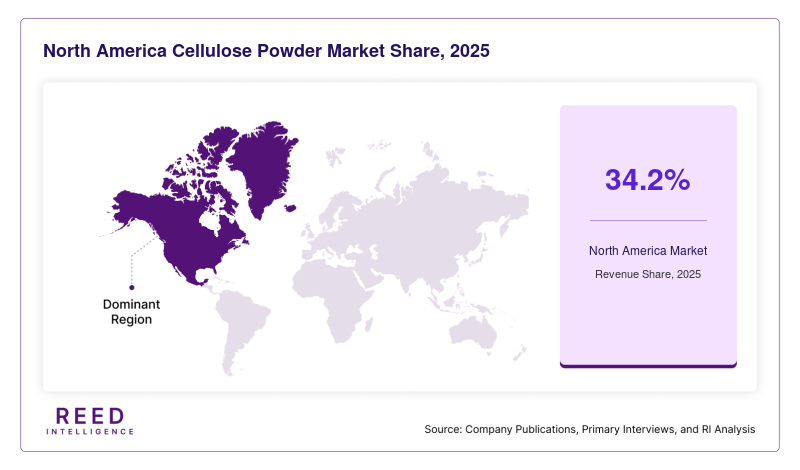
North America dominated the global Cellulose Powder Market with a market share of 34.2% in 2025 and is projected to expand at a CAGR of 6.1% during 2026–2034. The region benefits from strong pharmaceutical manufacturing capacity, growing clean-label food demand, and advanced industrial processing infrastructure. The United States and Canada continue to invest in sustainable material technologies, increasing the adoption of cellulose powder in food stabilizers, tablet excipients, and biodegradable packaging applications. Rising consumer preference for natural additives and fiber-enriched food ingredients further supports long-term regional market expansion.
The United States remains the dominant country in North America, accounting for the largest regional revenue contribution. The country recorded market values of USD 610 million in 2024 and USD 655 million in 2025. A key growth factor is the rapid expansion of nutraceutical and pharmaceutical manufacturing facilities. Drug manufacturers increasingly use microcrystalline cellulose powder in tablet formulations because of its compressibility and stability properties. In addition, the growing popularity of plant-based food products has accelerated demand for cellulose-derived ingredients across bakery, dairy alternative, and processed meat categories.
Europe
Europe accounted for approximately 27.5% of the global Cellulose Powder Market share in 2025 and is expected to register a CAGR of 5.8% during the forecast period. The market is supported by stringent environmental regulations and rising demand for biodegradable and non-toxic industrial materials. European manufacturers are increasingly incorporating cellulose powder into sustainable packaging and specialty chemical applications. The region also demonstrates strong pharmaceutical demand due to high healthcare spending and consistent production of prescription medicines and nutraceutical supplements.
Germany dominates the European market owing to its established pharmaceutical manufacturing ecosystem and advanced food processing industry. One major growth factor is the increasing investment in eco-friendly packaging solutions driven by European Union sustainability targets. German food and beverage companies are adopting cellulose powder to improve texture, shelf life, and moisture retention in processed foods. Furthermore, pharmaceutical excipient suppliers are expanding production capacities to meet growing demand for high-purity cellulose grades used in oral solid dosage formulations.
Asia Pacific
Asia Pacific represented 24.8% of the global market share in 2025 and is projected to grow at the fastest CAGR of 11.1% from 2026 to 2034. Rapid industrialization, expanding healthcare infrastructure, and increasing processed food consumption are supporting regional market growth. Countries such as China, India, Japan, and South Korea are experiencing strong demand for cellulose-based additives due to rising pharmaceutical production and changing consumer dietary habits. Growing awareness regarding sustainable and plant-derived ingredients is also creating opportunities for regional manufacturers and suppliers.
China remains the leading country in the Asia Pacific region because of its extensive pharmaceutical manufacturing base and large-scale industrial production capabilities. A major growth factor is the rapid expansion of generic drug manufacturing and exports. Chinese companies are increasing the use of cellulose powder in tablet compression and drug stabilization processes. In addition, the country’s booming packaged food industry is driving higher demand for cellulose ingredients in bakery products, instant foods, and beverage formulations. Government initiatives supporting bio-based materials are also encouraging innovation in nano-cellulose technologies.
Middle East & Africa
The Middle East & Africa region accounted for 7.1% of the global Cellulose Powder Market in 2025 and is expected to witness a CAGR of 6.9% through 2034. Growth is driven by increasing urbanization, rising processed food imports, and improving healthcare infrastructure across Gulf Cooperation Council countries and parts of Africa. The market is gradually expanding as regional industries adopt sustainable ingredients and pharmaceutical excipients. Growing investments in food manufacturing and industrial diversification projects are further strengthening the demand for cellulose powder products.
Saudi Arabia is the dominant market within the region due to expanding pharmaceutical production and increasing investment in food processing facilities. One unique growth factor is the government’s focus on industrial diversification under long-term economic transformation initiatives. Pharmaceutical manufacturers are increasing local drug production capacity, leading to greater consumption of cellulose-based excipients. Additionally, rising demand for packaged and convenience food products among urban consumers is encouraging food companies to use cellulose powder for texture enhancement and product stabilization purposes.
Latin America
Latin America held approximately 6.4% share of the global Cellulose Powder Market in 2025 and is projected to grow at a CAGR of 6.5% during the forecast period. Market expansion is supported by rising pharmaceutical production, increasing processed food consumption, and growing industrial applications of cellulose derivatives. Countries across the region are witnessing gradual improvements in manufacturing capabilities and supply chain infrastructure. Food companies are also adopting cellulose powder in bakery and meat processing applications to improve texture consistency and extend product shelf stability.
Brazil dominates the Latin American market because of its large food processing industry and expanding pharmaceutical manufacturing sector. A key growth factor is the increasing demand for low-calorie and fiber-enriched food products among urban populations. Brazilian manufacturers are incorporating cellulose powder into processed foods as a bulking and stabilizing agent. Additionally, the country’s growing pharmaceutical exports have increased the need for excipients with high formulation efficiency and regulatory compliance, supporting higher demand for microcrystalline cellulose products.
Competitive Landscape
The global Cellulose Powder Market is moderately consolidated, with leading manufacturers focusing on product innovation, capacity expansion, and sustainable sourcing strategies to strengthen their market positions. Major companies such as DuPont, Roquette Frères, Ashland Global Holdings, JRS Pharma, and Nippon Paper Industries account for a significant portion of global revenue generation. These companies emphasize research and development activities to improve cellulose functionality, purity levels, and performance across pharmaceutical, food, and industrial applications.
DuPont remains one of the leading participants in the market because of its extensive product portfolio and global manufacturing network. The company continues to invest in advanced cellulose technologies for pharmaceutical excipients and sustainable industrial materials. Roquette Frères has expanded its production capacity for microcrystalline cellulose products in Europe to meet increasing demand from pharmaceutical manufacturers. JRS Pharma is focusing on high-performance cellulose solutions designed for controlled-release drug formulations and specialty applications.
Key Players
- DuPont
- Ashland Global Holdings
- Roquette Frères
- JRS Pharma
- Nippon Paper Industries
- Sigachi Industries
- FMC Corporation
- DFE Pharma
- Dow Inc.
- International Fiber Corporation
- Ankit Pulps and Boards
- Mingtai Chemical
- Rayonier Advanced Materials
- Asahi Kasei Corporation
- Rettenmaier & Söhne Group
Recent Developments
- Roquette Frères expanded cellulose excipient production capacity in Europe to meet growing pharmaceutical demand.
- Sigachi Industries announced new investment in microcrystalline cellulose manufacturing facilities in India to support export markets.
- JRS Pharma introduced enhanced-grade cellulose powder designed for improved tablet disintegration and controlled-release formulations
Cellulose Powder Market Segments
Type
- Microcrystalline Cellulose Powder
- Nano-Cellulose Powder
- Powdered Cellulose
Application
- Pharmaceutical Excipients
- Food & Beverage Additives
- Cosmetics & Personal Care
- Industrial Applications
End-Use Industry
- Healthcare & Pharmaceuticals
- Food Processing Industry
- Packaging Industry
- Chemical & Industrial Manufacturing
By Region
- North America
- Europe
- APAC
- Middle East and Africa
- LATAM