Cellulosic Thickener Market Size, Share & Demand Report By Product Type (Hydroxyethyl Cellulose, Methyl Cellulose), By Application (Paints & Coatings, Construction Materials, Pharmaceuticals, Food & Beverages), By End-Use Industry (Construction, Chemical Processing, Healthcare), By Distribution Channel (Direct Industrial Sales, Specialty Chemical Distributors), By Grade Type (Industrial Grade, Food Grade, Pharmaceutical Grade) By Region & Segment Forecasts, 2026–2034
USD 3950
Market Overview
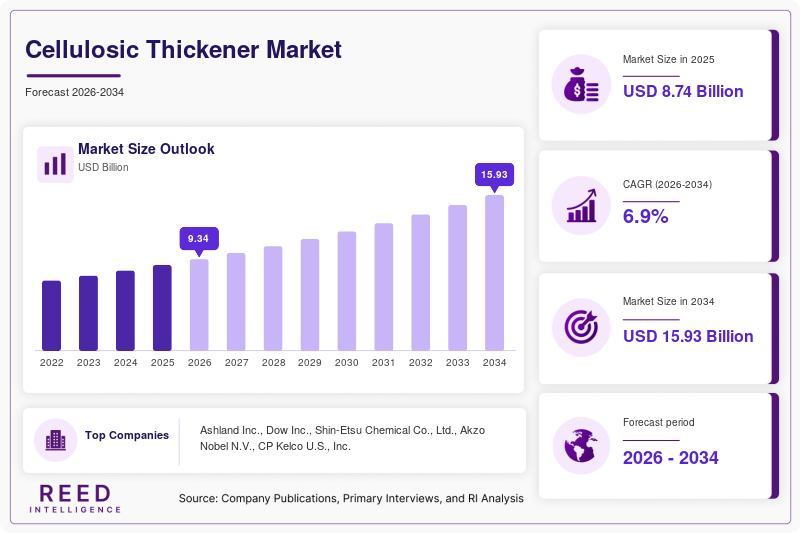
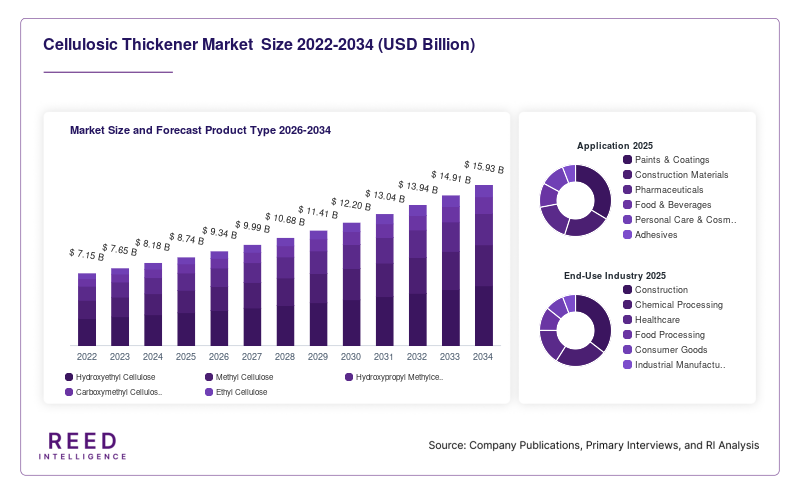
The Cellulosic Thickener Market size was valued at USD 8.74 billion in 2026 and is projected to reach USD 14.96 billion by 2034, expanding at a CAGR of 6.9% during the forecast period from 2026 to 2034. The global Cellulosic Thickener Market growth has been supported by increasing global demand for sustainable and biodegradable additives across paints & coatings, pharmaceuticals, personal care, construction, and food processing industries. Rising environmental regulations and the shift toward bio-based chemicals have accelerated the adoption of cellulosic thickening agents in multiple industrial applications.
Cellulosic thickeners are widely used for viscosity control, stabilization, water retention, and texture enhancement in industrial formulations. These products are derived from natural cellulose and offer compatibility with water-based systems, making them suitable for eco-conscious manufacturing environments. The Cellulosic Thickener Market has experienced steady expansion due to growing demand for low-VOC coatings, sustainable construction chemicals, and clean-label food ingredients.
Key Highlights
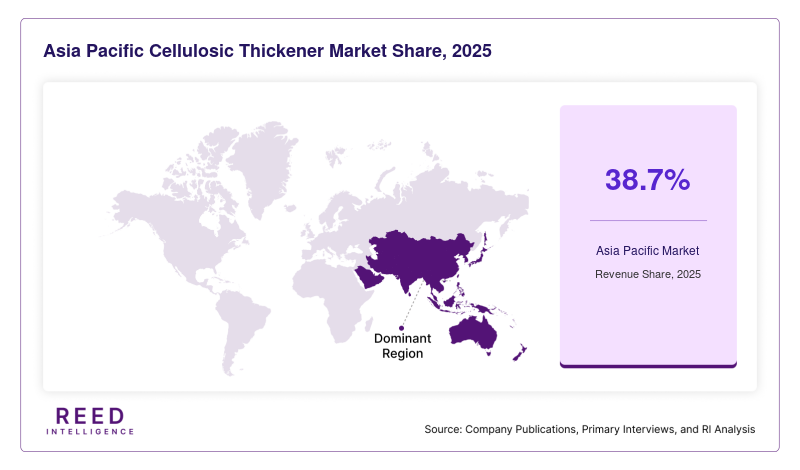
- Asia Pacific accounted for 38.7% of the global Cellulosic Thickener Market share in 2025, while the Middle East & Africa is projected to register the fastest CAGR of 7.6% during the forecast period.
- By product type, hydroxyethyl cellulose held the leading market share of 34.9% in 2025, whereas carboxymethyl cellulose is expected to expand at a CAGR of 7.4% through 2034.
- By application, paints & coatings accounted for 31.6% of the Cellulosic Thickener Market share in 2025, while personal care & cosmetics is projected to grow at a CAGR of 7.8%.
- By end-use industry, construction represented 28.5% of the market share in 2025, whereas pharmaceuticals are anticipated to witness a CAGR of 7.5% during the study period.
- By distribution channel, direct industrial sales held 52.4% of the market share in 2025, while online specialty chemical distribution is forecast to grow at a CAGR of 8.1%.
- China Cellulosic Thickener Market was valued at USD 1.12 billion in 2024 and increased to USD 1.21 billion in 2025 due to strong demand from construction chemicals and water-based coatings industries.
Market Trends
Rising Adoption of Bio-Based Industrial Additives
One of the major trends shaping the Cellulosic Thickener Market is the increasing adoption of bio-based industrial additives. Manufacturers across coatings, food processing, and personal care industries are shifting toward renewable and biodegradable ingredients to align with sustainability goals and environmental regulations.
Cellulosic thickeners derived from natural cellulose sources are gaining popularity because they reduce dependency on petroleum-based additives. Companies are introducing eco-friendly rheology modifiers that support low-emission manufacturing processes and improved biodegradability. The growing demand for sustainable industrial formulations is expected to strengthen long-term market growth.
Expansion of Waterborne Formulation Technologies
Another important trend influencing the Cellulosic Thickener Market is the rapid expansion of waterborne formulation technologies. Water-based paints, adhesives, cosmetics, and construction chemicals require advanced thickeners that provide viscosity stability and improved texture performance.
Cellulosic thickeners are increasingly preferred in waterborne systems because of their compatibility, dispersion efficiency, and formulation flexibility. Manufacturers are investing in specialty cellulose derivatives that improve flow control, anti-settling performance, and product consistency in modern industrial applications.
Market Drivers
Growing Demand from Construction Chemicals Industry
The increasing demand from the construction chemicals industry has emerged as a key driver for the Cellulosic Thickener Market. Cellulosic thickeners are extensively used in cement-based materials to improve water retention, consistency, and workability.
Rapid urbanization and infrastructure development activities are supporting the consumption of tile adhesives, self-leveling compounds, renders, and mortars. Construction companies are increasingly adopting cellulose-based additives to improve product durability and application performance.
Expansion of Personal Care and Pharmaceutical Applications
The expansion of personal care and pharmaceutical applications has significantly contributed to Cellulosic Thickener Market growth. These thickeners are used in creams, lotions, gels, shampoos, suspensions, and controlled-release drug formulations due to their stability and non-toxic properties.
Consumer demand for plant-derived ingredients and mild formulation additives has encouraged manufacturers to adopt cellulose-based compounds. Increasing spending on healthcare and cosmetic products is expected to support market expansion throughout the forecast period.
Market Restraint
Volatility in Raw Material Pricing
Volatility in raw material pricing remains a major restraint for the Cellulosic Thickener Market. Production costs are influenced by fluctuations in wood pulp, cotton linters, and chemical processing materials used in cellulose derivative manufacturing.
Supply chain disruptions and rising energy costs can affect product pricing and profit margins for manufacturers. Smaller producers may face challenges in maintaining competitive pricing during periods of raw material instability.
Market Opportunities
Increasing Demand for Clean-Label Food Ingredients
The growing demand for clean-label food ingredients presents a major opportunity for the Cellulosic Thickener Market. Food manufacturers are increasingly using cellulose-based stabilizers and thickeners in sauces, dairy products, bakery fillings, and processed foods.
Consumers are seeking plant-based and recognizable ingredients in packaged food products. This trend is expected to encourage greater adoption of food-grade cellulose derivatives across the global food processing industry.
Growth of Sustainable Packaging Coatings
The growth of sustainable packaging coatings is creating favorable opportunities for the Cellulosic Thickener Market. Packaging manufacturers are increasingly developing recyclable and water-based coating systems that require advanced rheology modifiers and stabilizers.
Cellulosic thickeners provide viscosity control and improved coating performance in environmentally safer packaging materials. Rising demand for biodegradable packaging solutions is likely to support future market expansion.
Segmental Analysis
By Product Type
Based on product type, the Cellulosic Thickener Market is segmented into hydroxyethyl cellulose, methyl cellulose, hydroxypropyl methylcellulose, carboxymethyl cellulose, and ethyl cellulose.
Hydroxyethyl cellulose dominated the market with a 34.9% share in 2025 due to its extensive use in paints, coatings, adhesives, and personal care formulations. Its water solubility and viscosity control properties supported widespread industrial adoption.
Carboxymethyl cellulose is projected to witness the fastest CAGR of 7.4% during the forecast period. Increasing usage in food processing, pharmaceuticals, and oilfield applications is expected to strengthen segment growth.
By Application
Based on application, the Cellulosic Thickener Market is segmented into paints & coatings, construction materials, pharmaceuticals, food & beverages, personal care & cosmetics, and adhesives.
Paints & coatings accounted for the highest market share of 31.6% in 2025 due to rising demand for waterborne coating technologies and low-VOC formulations.
Personal care & cosmetics are anticipated to expand at a CAGR of 7.8% through 2034. Growing demand for plant-based skincare and haircare products is expected to accelerate the use of cellulose-based thickeners in cosmetic formulations.
By End-Use Industry
Based on end-use industry, the Cellulosic Thickener Market is categorized into construction, chemical processing, healthcare, food processing, consumer goods, and industrial manufacturing.
Construction held the leading market share of 28.5% in 2025 because of extensive usage of cellulose additives in cement-based products and tile adhesives.
Healthcare is projected to register the fastest CAGR of 7.5% during the forecast period. Increasing pharmaceutical production and demand for controlled-release drug formulations are expected to support segment expansion.
By Distribution Channel
Based on distribution channel, the Cellulosic Thickener Market is segmented into direct industrial sales, specialty chemical distributors, online specialty chemical distribution, and retail commercial suppliers.
Direct industrial sales dominated the market with a 52.4% share in 2025 because large-scale manufacturers preferred direct procurement agreements for bulk specialty chemicals.
Online specialty chemical distribution is anticipated to witness the fastest CAGR of 8.1% during the forecast period. Expanding digital procurement platforms and simplified industrial sourcing systems are likely to strengthen segment demand.
By Grade Type
Based on grade type, the Cellulosic Thickener Market is segmented into industrial grade, food grade, pharmaceutical grade, and cosmetic grade.
Industrial grade held the dominant market share of 47.3% in 2025 due to high consumption in construction chemicals, paints, and adhesives manufacturing.
Pharmaceutical grade is expected to grow at a CAGR of 7.7% through 2034. Increasing demand for safe excipients and stabilizers in advanced drug formulations is projected to support segment growth.
Regional Analysis
Asia Pacific
Asia Pacific accounted for 38.7% of the Cellulosic Thickener Market share in 2025 and is projected to expand at a CAGR of 7.3% during the forecast period. The region maintained a dominant position due to rapid industrialization, infrastructure development, and increasing production of paints and coatings.
China represented the leading country within the regional market because of its large construction chemicals industry and expanding manufacturing capacity for specialty chemicals. Rising demand for sustainable industrial additives further supported regional growth.
North America
North America held 24.2% of the global Cellulosic Thickener Market share in 2025 and is expected to grow at a CAGR of 6.5% through 2034. The market benefited from strong demand for environmentally safer coatings, pharmaceuticals, and personal care products.
The United States dominated the regional market due to increasing adoption of bio-based additives and technological advancements in specialty chemical manufacturing. Growing demand for clean-label consumer products also supported market expansion.
Europe
Europe accounted for 22.4% of the Cellulosic Thickener Market share in 2025 and is forecast to register a CAGR of 6.6% during the study period. The region experienced strong demand for sustainable industrial materials and waterborne coating technologies.
Germany emerged as the dominant country within Europe because of its advanced chemical manufacturing sector and increasing focus on eco-friendly construction materials. Regulatory emphasis on reducing VOC emissions further strengthened market demand.
Middle East & Africa
The Middle East & Africa represented 8.1% of the Cellulosic Thickener Market share in 2025 and is anticipated to witness the fastest CAGR of 7.6% through 2034. Infrastructure expansion and increasing construction activities contributed significantly to regional market growth.
Saudi Arabia led the regional market due to growing investments in urban development projects and industrial manufacturing diversification. Rising demand for construction additives and waterborne paints supported product consumption.
Latin America
Latin America accounted for 6.6% of the Cellulosic Thickener Market share in 2025 and is projected to grow at a CAGR of 6.4% during the forecast period. The market expanded because of increasing industrial production and growth in the food processing and paints industries.
Brazil dominated the regional market owing to rising demand for construction chemicals and personal care products. Expanding domestic manufacturing activities further supported regional market development.
Competitive Landscape
The Cellulosic Thickener Market remains moderately competitive, with global and regional manufacturers focusing on sustainable product development, specialty cellulose innovation, and production capacity expansion. Companies are investing in advanced cellulose chemistry and environmentally safer manufacturing technologies to strengthen market competitiveness.
Ashland Inc. maintained a leading position in the market due to its broad portfolio of cellulose derivatives and strong global distribution network. The company recently introduced advanced hydroxyethyl cellulose formulations designed for waterborne industrial coatings with improved viscosity stability and formulation compatibility.
Dow Inc. continued expanding its specialty cellulose solutions for personal care and construction applications. Shin-Etsu Chemical Co., Ltd. focused on pharmaceutical-grade cellulose derivative innovation for controlled-release drug systems.
Akzo Nobel N.V. strengthened its waterborne coatings additive portfolio through investments in eco-friendly rheology modifiers. CP Kelco U.S., Inc. expanded production capabilities for food-grade cellulose stabilizers targeting clean-label food applications.
Key Players List
- Ashland Inc.
- Dow Inc.
- Shin-Etsu Chemical Co., Ltd.
- Akzo Nobel N.V.
- CP Kelco U.S., Inc.
- LOTTE Fine Chemical Co., Ltd.
- Nouryon
- Daicel Corporation
- SE Tylose GmbH & Co. KG
- J.M. Huber Corporation
- Rayonier Advanced Materials Inc.
- Lamberti S.p.A.
- Sidley Chemical Co., Ltd.
- Shandong Head Co., Ltd.
- Reliance Cellulose Products Ltd.
Recent Developments
- In March 2026, Ashland Inc. launched a next-generation hydroxyethyl cellulose thickener for waterborne industrial coatings applications.
- In June 2025, Dow Inc. expanded its cellulose derivatives production capacity in Asia Pacific to support rising industrial demand.
- In September 2025, Shin-Etsu Chemical Co., Ltd. introduced pharmaceutical-grade cellulose excipients for controlled drug delivery systems.
- In January 2026, CP Kelco U.S., Inc. developed new clean-label cellulose stabilizers targeting processed food applications.
- In November 2025, Nouryon announced investments in sustainable specialty additives manufacturing technologies for eco-friendly industrial formulations.
Cellulosic Thickener Market Segments
Product Type
- Hydroxyethyl Cellulose
- Methyl Cellulose
- Hydroxypropyl Methylcellulose
- Carboxymethyl Cellulose
- Ethyl Cellulose
Application
- Paints & Coatings
- Construction Materials
- Pharmaceuticals
- Food & Beverages
- Personal Care & Cosmetics
- Adhesives
End-Use Industry
- Construction
- Chemical Processing
- Healthcare
- Food Processing
- Consumer Goods
- Industrial Manufacturing
Distribution Channel
- Direct Industrial Sales
- Specialty Chemical Distributors
- Online Specialty Chemical Distribution
- Retail Commercial Suppliers
Grade Type
- Industrial Grade
- Food Grade
- Pharmaceutical Grade
- Cosmetic Grade
By Region
- North America
- Europe
- APAC
- Middle East and Africa
- LATAM