Celtic Salt Market Size, Share & Demand Report By Type (Coarse Celtic Salt, Fine Celtic Salt), By Application (Food & Beverages, Personal Care, Nutraceuticals), By Distribution Channel (Online Retail, Supermarkets & Hypermarkets, Specialty Stores, Health & Organic Stores), By End-Use (Household Consumption, Commercial) By Region & Segment Forecasts, 2025–2034
USD 3950
Market Overview
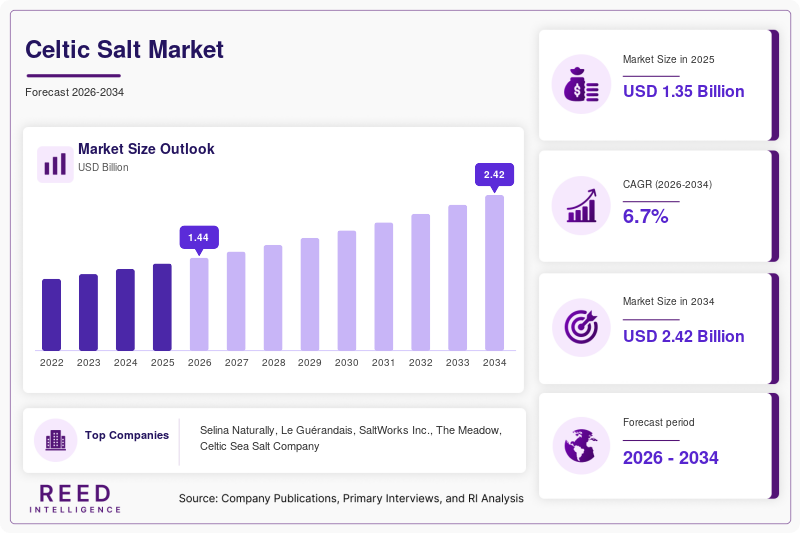
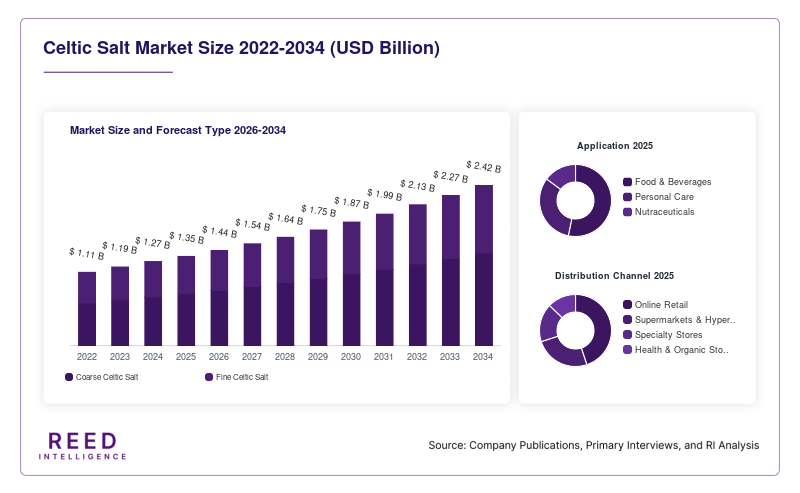
The Celtic Salt Market size was valued at approximately USD 1.35 billion in 2025 and is projected to reach USD 2.42 billion by 2034, expanding at a CAGR of 6.7% during the forecast period (2025–2034). The market growth is primarily supported by increasing consumer preference for natural, unrefined, and mineral-rich salts as part of a broader shift toward clean-label and health-conscious food consumption patterns.
Celtic salt, known for its grayish color and high trace mineral content, has gained traction across culinary, wellness, and personal care applications. Unlike refined table salt, it undergoes minimal processing, preserving essential nutrients such as magnesium, potassium, and calcium. This differentiation has significantly contributed to its rising demand in premium food products and dietary supplements.
Key Highlights
- Europe dominated the market with a 38.4% share in 2025, while Asia Pacific is expected to register the fastest growth at a CAGR of 7.9%.
- By type, coarse Celtic salt led with a 54.6% share, while fine Celtic salt is projected to grow fastest at a 7.4% CAGR.
- In application, food & beverages dominated with 62.1% share, whereas personal care is anticipated to grow at a 7.6% CAGR.
- The United States accounted for USD 410 million in 2025 and is estimated to reach USD 438 million in 2026.
Market Trends
Rising Demand for Clean-Label and Natural Ingredients
The Celtic Salt Market is witnessing increasing demand driven by the clean-label movement. Consumers are prioritizing transparency in ingredient sourcing and processing methods, leading to a shift away from heavily refined salts. Celtic salt, harvested traditionally and minimally processed, aligns well with this preference. Food manufacturers are incorporating it into premium and organic product lines, enhancing product differentiation and brand positioning.
Expansion in Wellness and Personal Care Applications
Another notable trend shaping the Celtic Salt Market is its growing use in wellness and personal care products. The mineral-rich composition of Celtic salt has made it popular in bath salts, exfoliants, and spa therapies. Consumers are increasingly associating natural salts with detoxification and skin health benefits. This trend is further supported by the expansion of wellness-focused brands and the rise of at-home self-care routines, which is driving consistent demand beyond traditional culinary applications.
Market Drivers
Increasing Health Awareness and Dietary Shifts
A key driver of the Celtic Salt Market is the rising awareness regarding healthy dietary practices. Consumers are actively reducing intake of processed foods and refined additives, including iodized table salt. Celtic salt, perceived as a more natural and nutrient-rich alternative, is gaining acceptance among health-conscious individuals. Its trace mineral content and artisanal harvesting process enhance its appeal, particularly among consumers seeking functional food ingredients.
Growth of Premium and Gourmet Food Segments
The expansion of premium and gourmet food markets is another significant growth driver. Celtic salt is widely used by chefs and culinary professionals for its distinct flavor profile and texture. High-end restaurants and specialty food brands are increasingly incorporating it into their offerings, thereby elevating demand. Additionally, the proliferation of cooking shows and social media food content has influenced consumers to experiment with gourmet ingredients at home, further supporting market growth.
Market Restraint
High Cost Compared to Conventional Salt
One of the major restraints affecting the Celtic Salt Market is its relatively high cost compared to conventional table salt and other alternatives. The traditional harvesting process, limited production regions, and labor-intensive methods contribute to higher pricing. As a result, price-sensitive consumers, particularly in developing economies, may be reluctant to adopt Celtic salt on a regular basis.
Furthermore, the lack of widespread awareness regarding its benefits in certain regions limits market expansion. While premium consumers are willing to pay for quality and authenticity, the mass market remains dominated by affordable and widely available refined salts. This price disparity poses a challenge for manufacturers aiming to achieve large-scale penetration.
In addition, regulatory variations regarding labeling and mineral content claims can create barriers for international trade. These factors collectively restrict the growth potential of the Celtic Salt Market, especially in price-sensitive and emerging markets.
Market Opportunities
Expansion into Functional Food and Nutraceutical Products
The integration of Celtic salt into functional food and nutraceutical products presents a promising opportunity. Manufacturers are exploring its use in mineral-enriched beverages, dietary supplements, and electrolyte formulations. As consumers seek natural sources of essential nutrients, Celtic salt offers a unique value proposition. This trend is expected to drive innovation and open new revenue streams within the market.
Growth of E-commerce and Direct-to-Consumer Channels
The rapid growth of e-commerce platforms has significantly improved the accessibility of niche products such as Celtic salt. Direct-to-consumer models allow brands to educate customers about product benefits and sourcing practices, enhancing consumer trust. Online platforms also enable global reach, allowing manufacturers to tap into previously underserved markets. Subscription-based models and bundled offerings further support repeat purchases and customer retention, creating long-term growth opportunities.
Segmental Analysis
By Type
Coarse Celtic salt dominated the market, accounting for 54.6% of the share in 2025. Its widespread use in cooking and finishing dishes has contributed to its strong demand. The larger crystal size enhances flavor and texture, making it a preferred choice among chefs and culinary enthusiasts.
Fine Celtic salt is expected to be the fastest-growing segment, registering a CAGR of 7.4%. Its ease of use in everyday cooking and compatibility with packaged food products will drive its growth. Additionally, increasing demand from food manufacturers for uniform texture and solubility will further support its adoption.
By Application
The food & beverages segment led the Celtic Salt Market with a 62.1% share in 2025. Its extensive use in cooking, seasoning, and food preservation has driven demand. The growing popularity of gourmet and organic food products has further strengthened this segment.
The personal care segment is projected to grow at a CAGR of 7.6%. The use of Celtic salt in bath salts, scrubs, and skincare products is expected to increase due to rising consumer interest in natural and mineral-rich personal care solutions. The expansion of wellness brands will also contribute to segment growth.
By Distribution Channel
Offline channels dominated the market with a 68.3% share in 2025, driven by the strong presence of supermarkets, specialty stores, and health food outlets. Consumers prefer physical stores for product inspection and immediate purchase, supporting this segment’s dominance.
Online distribution is expected to grow at a CAGR of 8.1%, making it the fastest-growing channel. The convenience of online shopping, coupled with the availability of detailed product information, will drive this growth. Subscription models and targeted marketing strategies will further enhance online sales.
By End-Use
Household consumption accounted for the largest share of 57.8% in 2025, driven by increasing adoption of natural ingredients in home cooking. Consumers are experimenting with premium salts to enhance flavor and nutritional value.
The commercial segment is anticipated to grow at a CAGR of 7.2%, supported by rising demand from restaurants, hotels, and catering services. The expansion of the hospitality industry and the increasing popularity of gourmet cuisine will drive growth in this segment.
Regional Analysis
North America
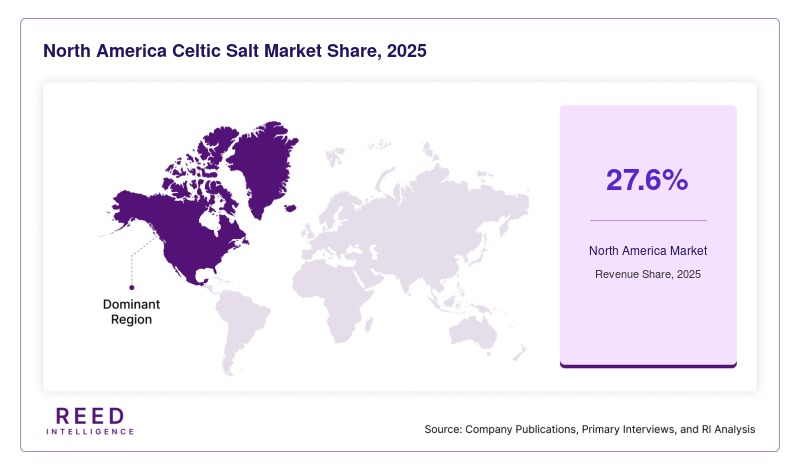
North America accounted for 27.6% of the Celtic Salt Market share in 2025 and is projected to grow at a CAGR of 6.3% through 2034. The region’s growth is expected to be supported by increasing demand for organic and natural food ingredients, along with a strong presence of specialty food retailers and wellness brands.
The United States dominated the regional market due to high consumer awareness and the popularity of clean-label products. The growing adoption of alternative salts in gourmet cooking and dietary practices has been a key factor driving demand. Additionally, the expansion of health-focused retail chains and online platforms has facilitated widespread availability, supporting steady market growth.
Europe
Europe held the largest share of 38.4% in 2025 and is anticipated to grow at a CAGR of 6.5% during the forecast period. The region’s dominance can be attributed to its historical association with Celtic salt production and strong consumer preference for artisanal food products.
France emerged as the leading country, benefiting from established salt harvesting traditions and high-quality production standards. The presence of traditional salt marshes and skilled labor has ensured consistent supply and product authenticity. This has reinforced Europe’s position as a key exporter and consumer of Celtic salt.
Asia Pacific
Asia Pacific represented 18.9% of the market share in 2025 and is expected to register the fastest growth at a CAGR of 7.9%. Rising disposable incomes and increasing awareness of natural food products are anticipated to drive regional demand.
China dominated the region due to its large population and growing middle class. The increasing adoption of Western dietary trends and premium food ingredients has supported demand for Celtic salt. Additionally, the expansion of e-commerce platforms has enhanced product accessibility across urban and semi-urban areas.
Middle East & Africa
The Middle East & Africa accounted for 8.7% of the market share in 2025 and is projected to grow at a CAGR of 6.1%. The region’s growth is expected to be driven by rising interest in health and wellness products, particularly in urban centers.
The United Arab Emirates led the regional market, supported by a strong hospitality sector and high demand for premium food ingredients. The presence of luxury hotels and fine dining establishments has contributed to increased consumption of Celtic salt in culinary applications.
Latin America
Latin America held 6.4% of the market share in 2025 and is anticipated to grow at a CAGR of 6.0%. The region’s growth is expected to be influenced by increasing awareness of natural and organic products.
Brazil emerged as the dominant country due to its expanding food processing industry and growing consumer base for premium ingredients. The rising popularity of health-focused diets and natural products has supported demand for Celtic salt in the region.
Competitive Landscape
The Celtic Salt Market is moderately fragmented, with a mix of established players and regional producers. Key companies are focusing on product quality, sustainable harvesting practices, and brand positioning to strengthen their market presence.
Selina Naturally is recognized as a leading player, known for its extensive product portfolio and strong distribution network. The company recently expanded its product line to include flavored Celtic salts, catering to evolving consumer preferences.
Other players are emphasizing organic certifications and eco-friendly packaging to attract environmentally conscious consumers. Strategic partnerships with retailers and e-commerce platforms are also being adopted to enhance market reach.
Key Players
- Selina Naturally
- Le Guérandais
- The Meadow
- SaltWorks Inc.
- Celtic Sea Salt Company
- San Francisco Salt Company
- Saltverk
- Maldon Crystal Salt Company
- Halen Môn
- Cornish Sea Salt Co.
- Amagansett Sea Salt
- Hawaii Sea Salt Company
- Maine Sea Salt Company
- Jacobsen Salt Co.
- Artisan Salt Company
Recent Developments
- In 2024, Selina Naturally introduced new flavored variants to diversify its product portfolio.
- In 2025, Le Guérandais expanded its export operations to Asia Pacific markets.
- In 2024, SaltWorks Inc. invested in sustainable packaging solutions to reduce environmental impact.
- In 2025, Jacobsen Salt Co. launched a new line of gourmet salts targeting premium consumers.
- In 2024, Cornish Sea Salt Co. enhanced its digital presence through e-commerce platform partnerships.
Celtic Salt Market Segments
Type
- Coarse Celtic Salt
- Fine Celtic Salt
Application
- Food & Beverages
- Personal Care
- Nutraceuticals
Distribution Channel
- Online Retail
- Supermarkets & Hypermarkets
- Specialty Stores
- Health & Organic Stores
End-Use
- Household Consumption
- Commercial (Restaurants, Hotels, Catering)
By Region
- North America
- Europe
- APAC
- Middle East and Africa
- LATAM