Cemetery Software Market Size, Share & Demand Report By Deployment Type (Cloud-Based, On-Premise, Mobile-Enabled), By Application (Burial Plot Management, Record Management, Genealogy Tracking, Mapping & GIS), By End-Use (Cemeteries, Funeral Homes, Municipal Authorities) By Region & Segment Forecasts, 2026–2034
USD 3950
Market Overview
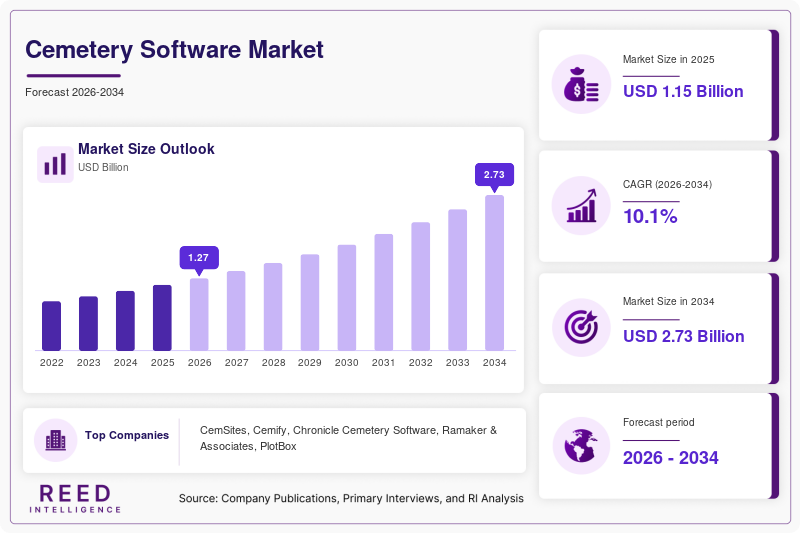
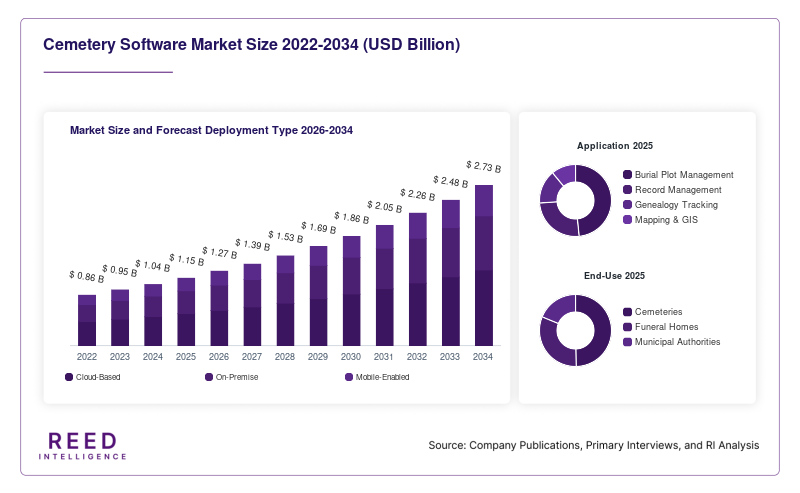
The Cemetery Software Market size was valued at USD 1.15 billion in 2026 and is projected to reach USD 2.48 billion by 2034, expanding at a CAGR of 10.1% during the forecast period. The market continues to evolve as cemetery operators, funeral homes, and municipal authorities increasingly adopt digital solutions to manage records, automate operations, and improve customer service. The transition from manual record-keeping to cloud-based cemetery management platforms has become a central theme, particularly in regions where land utilization, compliance requirements, and customer expectations are rising.
A key global factor supporting market growth is the steady increase in digital transformation across public administration and death care services. Governments and private operators are investing in modern infrastructure that includes database management, mapping tools, and customer relationship management systems. These solutions help reduce administrative errors, streamline burial plot management, and enable long-term data preservation. The growing need for transparent and traceable record systems has also reinforced demand for cemetery software solutions globally.
Key Highlights
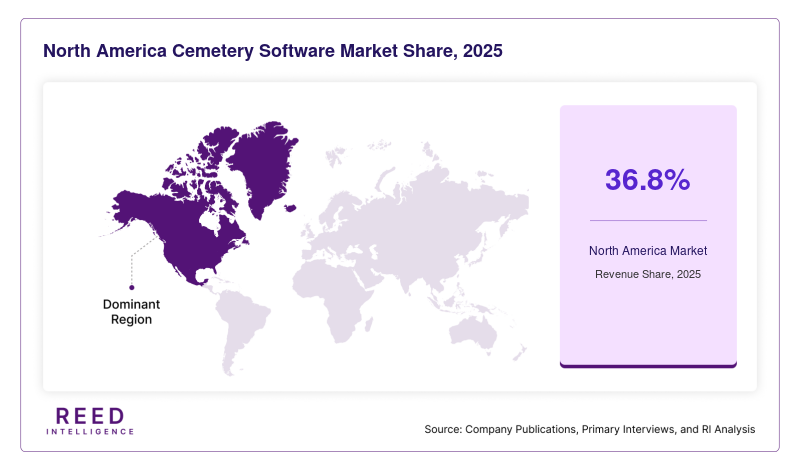
- North America dominated the market with a 36.8% share in 2025.
- Asia Pacific is expected to grow at the fastest CAGR of 11.6% during 2026–2034.
- By deployment type, cloud-based solutions accounted for the largest share of 42.3%, while mobile-enabled platforms are projected to grow at a CAGR of 12.8%.
- By application, burial plot management led with a 39.5% share, whereas genealogy tracking is expected to expand at a CAGR of 11.9%.
- The United States remained the dominant country, with market values of USD 420 million in 2024 and USD 455 million in 2025.
Market Trends
Increasing adoption of cloud-based cemetery management platforms
The adoption of cloud-based cemetery software is becoming a defining trend in the market. Organizations are shifting away from legacy systems toward scalable and centralized platforms that allow real-time data access and remote management. Cloud solutions provide advantages such as automatic updates, improved cybersecurity, and reduced upfront infrastructure costs. Cemetery operators are leveraging these systems to digitize burial records, manage plot inventories, and integrate mapping tools for easier navigation.
This trend is particularly strong in developed regions where digital infrastructure is well established. However, emerging markets are also witnessing increased adoption as cloud solutions become more affordable and accessible. Vendors are focusing on user-friendly interfaces and customizable modules to meet the diverse needs of small and large cemetery operators. The growing integration of mobile applications with cloud platforms further enhances accessibility, allowing staff and customers to retrieve information instantly.
Integration of GIS and mapping technologies
Another notable trend is the integration of Geographic Information Systems (GIS) and advanced mapping technologies into cemetery software solutions. These tools enable precise visualization of burial plots, pathways, and available spaces, improving operational efficiency and customer experience. GIS-based platforms allow users to locate graves easily, plan future allocations, and maintain accurate spatial records.
The demand for digital mapping is increasing as cemeteries face space constraints and require better land management strategies. Operators are using these technologies to optimize plot utilization and provide interactive maps to visitors. In addition, integration with augmented reality features is emerging, offering enhanced user engagement. Vendors are investing in advanced mapping capabilities to differentiate their offerings and address the growing demand for visualization tools in cemetery management.
Market Drivers
Rising demand for efficient record management systems
The need for efficient and accurate record management is a major driver of the cemetery software market. Traditional paper-based systems are prone to errors, data loss, and inefficiencies, which can create operational challenges. Cemetery software provides a centralized database that ensures secure storage and easy retrieval of records, including burial details, ownership information, and maintenance schedules.
As regulatory requirements become stricter, organizations are required to maintain accurate and transparent records. Digital systems help meet compliance standards while reducing administrative workload. The ability to generate reports and track historical data enhances decision-making and operational planning. This growing emphasis on data accuracy and compliance is encouraging cemetery operators to invest in advanced software solutions.
Growth in digital transformation across funeral services
The broader digital transformation within the funeral and memorial services industry is another key driver. Funeral homes and cemetery operators are adopting integrated software solutions to streamline operations and enhance customer interactions. These systems support online booking, payment processing, and communication, improving overall service quality.
Consumers are increasingly expecting digital convenience, including access to online memorials and genealogy information. Cemetery software providers are responding by offering features that cater to these expectations. The integration of customer-facing tools with backend management systems creates a seamless experience for both operators and clients. This shift toward digital engagement is driving the adoption of cemetery software across various regions.
Market Restraint
High implementation costs and resistance to technological change
One of the primary restraints in the cemetery software market is the high cost associated with implementation and system integration. Small and medium-sized cemetery operators often face budget constraints, making it challenging to invest in advanced software solutions. Costs related to software licensing, customization, training, and maintenance can be significant, especially for organizations transitioning from manual systems.
In addition to financial barriers, resistance to technological change remains a challenge. Many operators rely on traditional methods and may lack the technical expertise required to adopt new systems. This reluctance can slow the pace of digital transformation in the industry. For example, older cemeteries with decades of paper records may find it difficult to digitize their data and integrate it into modern platforms. These challenges can limit market growth, particularly in regions with limited digital infrastructure.
Market Opportunities
Expansion of mobile and customer-facing applications
The growing use of mobile technology presents a significant opportunity for the cemetery software market. Mobile applications enable users to access information, navigate cemetery grounds, and manage services conveniently. Operators can offer features such as grave location search, virtual tours, and online memorial pages, enhancing customer engagement.
This trend is particularly relevant as younger generations seek digital solutions for memorial services. Mobile-enabled platforms also support operational efficiency by allowing staff to update records and manage tasks on the go. Vendors are increasingly focusing on developing mobile-friendly solutions that cater to both operators and end-users. The expansion of mobile applications is expected to drive market growth by improving accessibility and user experience.
Increasing demand for data analytics and predictive insights
The integration of data analytics into cemetery software solutions offers substantial growth opportunities. Advanced analytics tools enable operators to analyze trends, forecast demand, and optimize resource allocation. These insights help improve decision-making and long-term planning.
For instance, predictive analytics can assist in estimating future burial needs based on demographic trends. This capability is valuable for managing land resources and planning expansions. Additionally, analytics can enhance customer service by identifying preferences and improving service offerings. As organizations recognize the value of data-driven insights, the demand for analytics-enabled cemetery software is expected to increase significantly.
Segmental Analysis
By Deployment Type
Cloud-based solutions dominated the market in 2024, accounting for 42.3% of the total share. These solutions are widely adopted due to their scalability, cost-effectiveness, and ease of implementation. Organizations prefer cloud platforms as they eliminate the need for extensive on-premise infrastructure and provide real-time data access. The ability to integrate with other systems, such as customer relationship management and payment gateways, further enhances their appeal.
Cloud-based solutions also support remote access, enabling operators to manage operations from multiple locations. This capability is particularly valuable for organizations with multiple cemetery sites. Vendors are continuously improving cloud platforms by incorporating advanced security features and user-friendly interfaces. The dominance of this subsegment reflects the growing preference for flexible and efficient software solutions in the cemetery management industry.
Mobile-enabled platforms are the fastest-growing subsegment, with a projected CAGR of 12.8% during the forecast period. The growth is driven by the increasing use of smartphones and the demand for on-the-go access to information. Mobile applications allow staff to update records, manage tasks, and communicate with customers in real time. This enhances operational efficiency and improves service delivery.
The integration of mobile features with cloud platforms creates a seamless user experience. Customers can use mobile applications to locate graves, access memorial information, and make payments. This convenience is driving the adoption of mobile-enabled solutions across various regions. Vendors are focusing on developing intuitive mobile interfaces to cater to the evolving needs of users.
By Application
Burial plot management held the largest share in 2024, accounting for 39.5% of the market. This subsegment is essential for organizing and tracking burial spaces, ensuring efficient land utilization. Software solutions provide tools for mapping, inventory management, and record-keeping, enabling operators to manage plots effectively.
The demand for burial plot management solutions is driven by the need to optimize limited land resources. Cemeteries are using advanced software to plan layouts, track occupancy, and manage reservations. These systems also support compliance with regulatory requirements by maintaining accurate records. The dominance of this subsegment highlights its critical role in cemetery operations.
Genealogy tracking is the fastest-growing subsegment, with a CAGR of 11.9%. The increasing interest in family history and ancestry research is driving demand for genealogy features in cemetery software. These tools allow users to access historical records, trace family connections, and create digital memorials.
The integration of genealogy tracking with online platforms enhances user engagement and provides additional value to customers. Operators are leveraging these features to attract a broader audience and differentiate their services. The growing popularity of ancestry research is expected to support the expansion of this subsegment.
By End-Use
Cemeteries accounted for the largest share in 2024, representing 44.1% of the market. These organizations rely on software solutions to manage daily operations, including record-keeping, maintenance scheduling, and customer interactions. The adoption of cemetery software helps improve efficiency and reduce administrative workload.
Large cemeteries, in particular, benefit from advanced software solutions that support complex operations. These systems enable operators to manage multiple sites, track resources, and generate reports. The dominance of this subsegment reflects the widespread adoption of software solutions among cemetery operators.
Funeral homes are the fastest-growing subsegment, with a CAGR of 10.7%. The growth is driven by the increasing integration of funeral services with cemetery management systems. Funeral homes are adopting software solutions to streamline operations and enhance customer experience.
The ability to offer integrated services, such as online booking and payment processing, is driving the adoption of software solutions in this subsegment. Vendors are developing tailored solutions for funeral homes, focusing on features that support customer engagement and operational efficiency. This trend is expected to contribute to market growth.
Regional Analysis
North America
North America held the largest share of the cemetery software market in 2025, accounting for 36.8%, and is projected to grow at a CAGR of 9.4% during the forecast period. The region’s dominance is attributed to the early adoption of digital technologies and the presence of established software providers. Cemetery operators in the United States and Canada are increasingly investing in cloud-based platforms to improve operational efficiency and customer experience.
The United States remains the dominant country in the region, driven by strong digital infrastructure and regulatory requirements. A unique growth factor is the increasing demand for genealogy services, which has led to the integration of historical data and family records into cemetery software systems. This trend supports the development of comprehensive platforms that cater to both operational and consumer needs.
Europe
Europe accounted for a significant share of the market in 2025 and is expected to grow at a CAGR of 9.1% through 2034. The region’s growth is supported by government initiatives aimed at digitizing public services and improving record management systems. Countries such as Germany, the United Kingdom, and France are leading the adoption of cemetery software solutions.
Germany stands out as the dominant country, with a strong focus on sustainability and efficient land use. A unique growth factor in the region is the emphasis on environmental compliance, which drives the adoption of software solutions for managing green burials and optimizing land utilization. This approach aligns with broader sustainability goals and supports market growth.
Asia Pacific
Asia Pacific is expected to witness the fastest growth, with a projected CAGR of 11.6% during the forecast period. The region accounted for a growing share in 2025, driven by rapid urbanization and increasing awareness of digital solutions. Countries such as China, India, and Japan are adopting cemetery software to address challenges related to land scarcity and population growth.
China is the dominant country in the region, benefiting from large-scale urban development and government initiatives. A unique growth factor is the rising demand for smart city solutions, which includes the integration of cemetery management systems into broader urban planning frameworks. This trend supports the adoption of advanced technologies in the region.
Middle East & Africa
The Middle East & Africa region is experiencing steady growth, with a CAGR of 8.7% during the forecast period. The market share in 2025 was moderate, supported by increasing investments in digital infrastructure and public administration systems. Countries in the Gulf Cooperation Council are leading the adoption of cemetery software solutions.
The United Arab Emirates is the dominant country, driven by its focus on smart governance and digital transformation. A unique growth factor is the integration of cemetery management systems with municipal services, enabling centralized data management and improved service delivery. This approach enhances efficiency and supports market expansion.
Latin America
Latin America accounted for a smaller share of the market in 2025 but is expected to grow at a CAGR of 9.0% through 2034. The region’s growth is driven by increasing awareness of digital solutions and the need for efficient record management systems. Countries such as Brazil and Mexico are leading the adoption of cemetery software.
Brazil is the dominant country in the region, supported by urbanization and the modernization of public services. A unique growth factor is the growing demand for online memorial services, which encourages the adoption of customer-facing software features. This trend enhances user engagement and contributes to market growth.
Competitive Landscape
The cemetery software market is moderately fragmented, with several players competing on the basis of technology, features, and pricing. Key companies are focusing on innovation, strategic partnerships, and product development to strengthen their market position. The competitive environment is characterized by the introduction of cloud-based platforms and mobile applications that enhance user experience.
One of the leading companies in the market is CemSites, which has established a strong presence through its comprehensive cemetery management solutions. The company recently launched an upgraded platform with enhanced mapping and analytics features, aimed at improving operational efficiency. Other major players are also investing in research and development to introduce advanced functionalities and expand their customer base. The market is expected to witness increased competition as new entrants introduce innovative solutions.
Key Players
- CemSites
- Cemify
- Chronicle Cemetery Software
- Ramaker & Associates
- Cemetery Management Services
- PlotBox
- Grave Discover Software
- Cemify Systems
- BurialVault Solutions
- CemTrack
- Memorial Business Systems
- CemeteryPro
- EverArk Software
- StoneMor Technology
- FuneralTech Solutions
Recent Developments
- A major software provider introduced a cloud-based platform with integrated GIS mapping to enhance cemetery navigation and management capabilities.
- A leading company launched a mobile application that allows users to access burial records and memorial information remotely.
- A strategic partnership between a software vendor and a municipal authority resulted in the implementation of a centralized cemetery management system.
Cemetery Software Market Segments
Deployment Type
- Cloud-Based
- On-Premise
- Mobile-Enabled
Application
- Burial Plot Management
- Record Management
- Genealogy Tracking
- Mapping & GIS
End-Use
- Cemeteries
- Funeral Homes
- Municipal Authorities
By Region
- North America
- Europe
- APAC
- Middle East and Africa
- LATAM