Centrifuge Tube Market Size, Share & Demand Report By Product Type (Conical Centrifuge Tubes, Microcentrifuge Tubes, Self-Standing Centrifuge Tubes), By Capacity (Below 15 ml, 15 ml–50 ml, Above 50 ml), By Material (Polypropylene, Polycarbonate), By End Use (Pharmaceutical and Biotechnology Companies, Diagnostic Laboratories, Academic and Research Institutes, Hospitals and Clinics), By Region & Segment Forecasts, 2026–2034
USD 3950
Market Overview
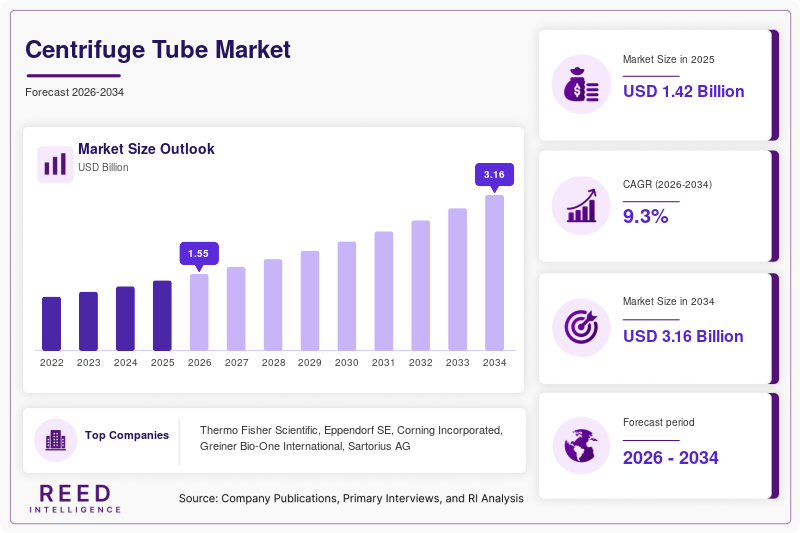
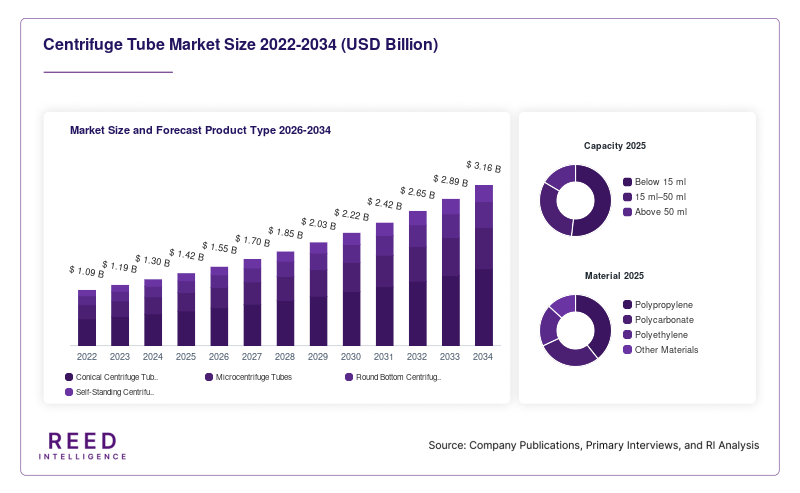
The global Centrifuge Tube Market size was valued at approximately USD 1.42 billion in 2026 and is projected to reach nearly USD 2.89 billion by 2034, expanding at a CAGR of 9.3%during the forecast period from 2026 to 2034. Growing investments in life sciences research, molecular diagnostics, and clinical laboratory infrastructure continue to support demand for centrifuge tubes across developed and emerging economies. Increasing adoption of advanced diagnostic testing, biotechnology applications, and pharmaceutical research has accelerated the use of disposable laboratory consumables, particularly high-performance centrifuge tubes designed for sample integrity and contamination control.
The expansion of biopharmaceutical manufacturing and genomic testing has also strengthened market growth. Research laboratories and healthcare institutions increasingly require centrifuge tubes with enhanced chemical resistance, temperature stability, and automation compatibility. Demand for sterile and leak-proof products has risen due to growing laboratory safety standards and strict regulatory compliance requirements. In addition, the increasing number of academic research collaborations and public health testing initiatives has created sustained procurement demand for laboratory plasticware products.
Key Highlights
- North America dominated the market with a 36.4% share in 2025.
- Asia Pacific is expected to grow at the fastest CAGR of 11.1% during 2026–2034.
- By product type, conical centrifuge tubes accounted for the largest share of 44.8%.
- while microcentrifuge tubes are projected to grow at a CAGR of 10.8%.
- By capacity, 15 ml–50 ml tubes led with a 47.2% share, whereas below 15 ml tubes are expected to expand at a CAGR of 10.4%.
- By end use, pharmaceutical and biotechnology companies held the largest share of 39.6%.
- while diagnostic laboratories are projected to grow at a CAGR of 10.9%.
- The United States remained the dominant country, with market values of USD 438 million in 2024 and USD 482 million in 2025.
Market Trends
Integration of Sustainable and Recyclable Laboratory Consumables
Sustainability has become an important trend influencing the Centrifuge Tube Market as laboratories and healthcare institutions seek to reduce plastic waste and improve environmental compliance. Manufacturers are increasingly developing centrifuge tubes using recyclable polypropylene materials and low-emission production methods. Research facilities in North America and Europe are implementing sustainability procurement guidelines that prioritize reusable packaging and reduced single-use plastic generation. This trend has encouraged suppliers to introduce eco-friendly tube designs with thinner yet durable walls that reduce material consumption without affecting performance. Several laboratory procurement departments are also selecting suppliers that offer closed-loop recycling programs for plastic consumables.
Growing awareness regarding environmental impact within pharmaceutical manufacturing and academic research institutions continues to support this transition. Companies are investing in advanced molding technologies that maintain product strength while lowering raw material usage. Sustainable product labeling and environmental certifications are becoming purchasing considerations for laboratories managing large-scale sample testing. As clinical testing volumes rise globally, the demand for environmentally responsible centrifuge tube solutions is expected to increase steadily throughout the forecast period.
Rising Adoption of Automation-Compatible Centrifuge Tubes
Automation integration across laboratories is reshaping product development strategies in the Centrifuge Tube Market. High-throughput testing facilities and pharmaceutical research centers increasingly rely on automated liquid handling systems and robotic sample preparation equipment. This shift has increased demand for centrifuge tubes designed with barcode tracking, precision dimensions, and secure sealing mechanisms compatible with automated workflows. Laboratories processing large numbers of biological samples require products that minimize handling errors and improve operational efficiency.
Automation-compatible centrifuge tubes are gaining traction in genomic sequencing, molecular diagnostics, and vaccine development applications. Manufacturers are introducing tubes with enhanced dimensional accuracy to ensure consistent robotic gripping and centrifugation stability. Demand for automation-ready consumables has grown significantly in hospital laboratories managing large-scale infectious disease testing and personalized medicine programs. In addition, pharmaceutical companies are investing in smart laboratory infrastructure that requires digitally trackable consumables. The expansion of automated laboratory ecosystems is expected to create sustained opportunities for premium centrifuge tube manufacturers over the next decade.
Market Drivers
Expansion of Biopharmaceutical and Genomic Research Activities
The rapid expansion of biopharmaceutical manufacturing and genomic research activities is a major factor supporting growth in the Centrifuge Tube Market. Pharmaceutical companies and biotechnology firms are investing heavily in cell culture research, vaccine development, and molecular biology applications that require reliable laboratory consumables. Centrifuge tubes play a critical role in sample storage, separation, purification, and transportation processes across research workflows. Increasing research funding from public and private institutions has strengthened laboratory procurement volumes globally.
Growing demand for personalized medicine and gene sequencing technologies has further accelerated product usage in molecular diagnostics laboratories. Research organizations require centrifuge tubes with high chemical resistance and contamination protection to maintain sample accuracy. Demand has also increased due to the expansion of biologics production facilities and clinical trial activities. Emerging economies are investing in biotechnology innovation hubs and advanced research infrastructure, which is creating additional opportunities for manufacturers supplying premium laboratory consumables.
Increasing Diagnostic Testing and Clinical Laboratory Workloads
The growing volume of diagnostic testing worldwide continues to drive demand in the Centrifuge Tube Market. Hospitals, pathology laboratories, and diagnostic centers are processing rising numbers of blood, urine, and molecular testing samples due to increased disease surveillance and preventive healthcare initiatives. Centrifuge tubes are widely used in routine diagnostics, infectious disease screening, and sample preparation processes. Expanding healthcare access in developing countries has contributed to higher laboratory testing volumes and stronger demand for laboratory consumables.
The increase in chronic disease prevalence and aging populations has also supported growth in clinical testing activities. Laboratories are focusing on operational efficiency and contamination prevention, leading to greater adoption of sterile and leak-resistant centrifuge tubes. Government-supported healthcare modernization programs in Asia Pacific and Latin America are encouraging laboratory infrastructure development, which further strengthens market demand. The shift toward decentralized diagnostics and rapid testing services is expected to continue supporting long-term industry expansion.
Market Restraint
Fluctuating Raw Material Costs and Environmental Concerns
Fluctuating prices of polypropylene and other petroleum-based raw materials remain a significant restraint affecting the Centrifuge Tube Market. Manufacturers depend heavily on plastic resins for large-scale production, and volatility in crude oil prices directly influences production costs and profit margins. Sudden increases in raw material pricing can disrupt supply chain stability and create pricing pressure for laboratory distributors and healthcare institutions. Smaller manufacturers often face challenges in maintaining competitive pricing while complying with stringent product quality standards.
Environmental concerns associated with single-use laboratory plastics also create operational and regulatory challenges for market participants. Research laboratories and healthcare facilities generate substantial volumes of plastic waste, leading to growing scrutiny from environmental agencies and sustainability-focused procurement organizations. Several institutions are implementing waste reduction targets, which may affect demand for conventional disposable consumables. Manufacturers are therefore required to invest in recyclable materials, sustainable packaging, and environmentally responsible production systems. These additional investments can increase operational costs and slow adoption among price-sensitive buyers, particularly in emerging economies where procurement budgets remain limited.
Market Opportunities
Growth Potential in Emerging Healthcare Infrastructure Markets
Emerging economies present significant opportunities for the Centrifuge Tube Market due to expanding healthcare infrastructure and rising investments in laboratory modernization. Countries across Asia Pacific, the Middle East, and Latin America are increasing spending on diagnostic laboratories, biotechnology research centers, and pharmaceutical production facilities. Government initiatives supporting domestic healthcare manufacturing and disease surveillance programs are creating strong demand for laboratory consumables, including centrifuge tubes.
The growing presence of multinational pharmaceutical companies in developing regions is also contributing to market expansion. Many global healthcare organizations are establishing research and manufacturing facilities in countries with lower operational costs and improving scientific infrastructure. This trend is increasing procurement requirements for high-quality laboratory plasticware products. Rising educational investments in life sciences and biotechnology research institutions are expected to further strengthen long-term growth opportunities for centrifuge tube manufacturers operating in emerging markets.
Increasing Adoption of Precision Medicine and Molecular Diagnostics
The expansion of precision medicine and molecular diagnostics is creating new growth opportunities within the Centrifuge Tube Market. Personalized healthcare approaches require extensive genetic testing, biomarker analysis, and sample processing procedures, all of which depend on reliable laboratory consumables. Molecular diagnostic laboratories increasingly require centrifuge tubes capable of preserving sample quality under varying temperature and centrifugation conditions.
Advancements in genomic sequencing technologies and cancer diagnostics are expected to increase testing volumes significantly during the forecast period. Pharmaceutical companies involved in targeted therapy development are investing in sophisticated laboratory systems that require specialized centrifuge tubes for high-sensitivity applications. In addition, public health agencies are expanding genomic surveillance capabilities to improve infectious disease monitoring. These developments are likely to create sustained demand for premium centrifuge tubes designed for molecular biology and clinical research applications.
Segmental Analysis
By Product Type
Conical centrifuge tubes accounted for the largest share of the Centrifuge Tube Market in 2024, representing nearly 44.8% of total revenue. These tubes are widely used in clinical diagnostics, pharmaceutical research, and biological sample processing due to their high versatility and compatibility with laboratory centrifuges. Laboratories prefer conical tubes because they support efficient pellet formation and sample separation processes. Their durable construction and leak-resistant sealing mechanisms make them suitable for handling biological fluids, chemical reagents, and molecular samples across multiple testing environments.
The microcentrifuge tubes segment is projected to register the fastest CAGR of 10.8% during the forecast period. Growing demand for genomic sequencing, molecular biology applications, and precision medicine research is driving adoption of smaller-capacity centrifuge tubes designed for high-sensitivity sample handling. Biotechnology companies and academic laboratories increasingly use microcentrifuge tubes for DNA extraction, RNA analysis, and protein isolation applications. Manufacturers are introducing advanced tube materials with enhanced temperature resistance and contamination protection to support evolving molecular diagnostic workflows and automated laboratory systems.
By Capacity
The 15 ml–50 ml segment dominated the Centrifuge Tube Market in 2024 with a revenue share of approximately 47.2%. These tubes are extensively used in routine laboratory procedures, blood sample processing, cell culture applications, and pharmaceutical testing environments. Their ability to handle moderate sample volumes makes them suitable for hospitals, research institutions, and industrial laboratories. Demand for this segment remains strong because these tubes are compatible with standard centrifugation equipment commonly used in diagnostic and research settings.
The below 15 ml segment is anticipated to expand at the fastest CAGR of 10.4% throughout the forecast period. Growth is primarily driven by increasing use in molecular diagnostics, genomic sequencing, and personalized medicine applications that require small-volume sample handling. Research laboratories involved in high-throughput screening and biomarker analysis prefer compact tubes that reduce reagent usage while maintaining sample accuracy. Advancements in microfluidics technologies and automated sample preparation systems are also contributing to increased demand for smaller-capacity centrifuge tubes across pharmaceutical and biotechnology research facilities.
By End Use
Pharmaceutical and biotechnology companies held the largest share of the Centrifuge Tube Market in 2024, accounting for approximately 39.6% of total revenue. These organizations require large volumes of laboratory consumables for drug discovery, vaccine development, biologics manufacturing, and quality control testing. Centrifuge tubes are essential for sample preparation, cell separation, and molecular analysis procedures conducted throughout pharmaceutical research workflows. Increasing investment in biologics and gene therapy development has further strengthened procurement demand among biotechnology manufacturers.
Diagnostic laboratories are expected to witness the fastest CAGR of 10.9% during the forecast period. Rising disease surveillance activities, expanding preventive healthcare programs, and increasing clinical testing volumes continue to drive growth within this segment. Diagnostic centers increasingly require sterile and high-performance centrifuge tubes to ensure accurate sample handling and contamination prevention. The growing adoption of molecular diagnostic techniques, infectious disease testing, and automated laboratory systems is supporting strong product demand. Healthcare providers are also expanding decentralized testing services, creating additional procurement opportunities for centrifuge tube manufacturers.
Regional Analysis
North America
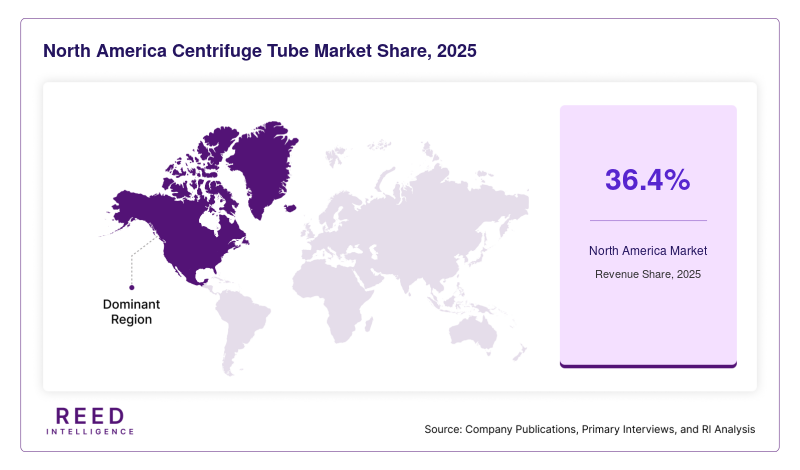
North America accounted for the largest share of the Centrifuge Tube Market in 2025, representing approximately 36.4% of global revenue. The region is projected to maintain steady growth at a CAGR of 8.6% during the forecast period due to strong healthcare infrastructure and extensive research spending. High adoption of advanced laboratory technologies and the presence of major biotechnology companies continue to support product demand. Pharmaceutical research organizations and clinical diagnostic laboratories across the United States and Canada consistently procure premium centrifuge tubes designed for high-throughput testing and contamination prevention.
The United States remained the dominant country in the regional market due to extensive investments in pharmaceutical research and molecular diagnostics. The country benefits from a well-established biotechnology ecosystem, increasing genomic testing activities, and strong academic research funding. Demand for automation-compatible centrifuge tubes is rising as laboratories integrate robotic sample handling systems. In addition, increasing clinical trial activity and biologics manufacturing capacity continue to strengthen long-term procurement demand for laboratory consumables across the country.
Europe
Europe represented nearly 27.1% of the global Centrifuge Tube Market in 2025 and is anticipated to expand at a CAGR of 8.4% through 2034. The region benefits from advanced healthcare systems, stringent laboratory safety regulations, and strong public investment in scientific research. Demand for centrifuge tubes has increased steadily among pharmaceutical manufacturers, university research centers, and diagnostic laboratories. Growing emphasis on sustainable laboratory practices is also influencing purchasing behavior across several European countries.
Germany emerged as the leading country within the European market due to its strong pharmaceutical manufacturing base and extensive research infrastructure. The country hosts numerous biotechnology companies and research institutions that require high-quality laboratory consumables for molecular biology and clinical testing applications. Demand for recyclable and environmentally compliant centrifuge tubes has increased significantly in Germany as research organizations adopt sustainability-focused procurement standards. Expansion of precision medicine programs further supports regional market growth.
Asia Pacific
Asia Pacific held approximately 23.5% of the global Centrifuge Tube Market in 2025 and is projected to register the fastest CAGR of 11.1% during the forecast period. Rapid healthcare infrastructure development, increasing laboratory investments, and rising pharmaceutical manufacturing activities continue to support strong regional growth. Countries including China, India, Japan, and South Korea are expanding diagnostic capabilities and biotechnology research facilities, leading to higher demand for laboratory consumables.
China dominated the regional market due to significant investments in biotechnology innovation and pharmaceutical manufacturing expansion. The country has witnessed rapid growth in molecular diagnostics, vaccine production, and genomic research activities. Government initiatives supporting domestic healthcare production and laboratory modernization continue to strengthen demand for centrifuge tubes. In addition, increasing academic research collaborations and rising healthcare spending are contributing to broader adoption of advanced laboratory consumables across the country.
Middle East & Africa
The Middle East & Africa region accounted for nearly 6.5% of the global Centrifuge Tube Market in 2025 and is expected to grow at a CAGR of 8.9% through 2034. The region is experiencing gradual improvements in healthcare infrastructure and diagnostic laboratory capacity. Governments across Gulf countries are increasing healthcare investments to reduce dependence on imported medical services and improve domestic testing capabilities. Demand for laboratory consumables has increased in clinical diagnostics, pharmaceutical research, and public health laboratories.
Saudi Arabia remained the dominant country in the regional market due to extensive healthcare modernization initiatives and growing pharmaceutical investments. The country continues to expand hospital infrastructure and research capabilities under long-term healthcare development programs. Rising focus on infectious disease monitoring and preventive healthcare testing has strengthened laboratory procurement activities. In addition, the establishment of biotechnology research partnerships and advanced medical laboratories is supporting steady growth in centrifuge tube demand.
Latin America
Latin America represented approximately 6.5% of the global Centrifuge Tube Market in 2025 and is projected to expand at a CAGR of 8.7% during the forecast period. Growing healthcare access and increasing diagnostic testing volumes continue to support regional market growth. Governments and private healthcare providers are investing in laboratory modernization projects to improve testing accuracy and operational efficiency. Pharmaceutical manufacturing activities in Brazil and Mexico are also contributing to increased demand for laboratory consumables.
Brazil dominated the Latin American market due to its expanding healthcare network and growing pharmaceutical production sector. The country has experienced increasing investments in diagnostic laboratories and biotechnology research centers, particularly in urban healthcare hubs. Rising prevalence of chronic diseases and infectious conditions has contributed to higher laboratory testing demand. In addition, government-supported vaccination and disease surveillance programs continue to strengthen procurement requirements for centrifuge tubes and related laboratory products.
Competitive Landscape
The Centrifuge Tube Market remains moderately consolidated, with global manufacturers competing through product quality, distribution expansion, and laboratory automation compatibility. Leading companies continue investing in research and development to improve material durability, contamination prevention, and sustainable product design. Market participants are also focusing on strategic partnerships with pharmaceutical companies, hospitals, and research institutions to strengthen long-term supply agreements.
Thermo Fisher Scientific remains a leading player in the market due to its broad laboratory consumables portfolio, global distribution network, and extensive biotechnology customer base. The company recently expanded its laboratory plastics manufacturing capabilities to support rising demand for molecular diagnostic consumables and high-throughput testing solutions. Other major companies are introducing recyclable centrifuge tubes and automation-compatible designs to strengthen competitive positioning.
Eppendorf SE, Corning Incorporated, Greiner Bio-One International, and Sartorius AG continue to maintain strong market presence through continuous product innovation and regional expansion strategies. Several manufacturers are investing in production automation and digital inventory management systems to improve operational efficiency. Increasing focus on precision medicine and pharmaceutical research is expected to intensify competition among established global suppliers and regional laboratory consumables manufacturers.
Key Players
- Thermo Fisher Scientific
- Eppendorf SE
- Corning Incorporated
- Greiner Bio-One International
- Sartorius AG
- DWK Life Sciences
- Cardinal Health
- VWR International
- SARSTEDT AG & Co.
- QIAGEN
- Bio-Rad Laboratories
- SPL Life Sciences
- Labcon North America
- TPP Techno Plastic Products AG
- Crystalgen Inc.
Recent Developments
- Thermo Fisher Scientific expanded its laboratory consumables production facility in 2025 to increase manufacturing capacity for sterile centrifuge tubes used in molecular diagnostics applications.
- Eppendorf SE introduced a new line of recyclable centrifuge tubes in 2024 designed for automated laboratory workflows and reduced plastic waste generation.
- Corning Incorporated launched advanced high-clarity centrifuge tubes with enhanced chemical resistance in 2025 to support pharmaceutical and biotechnology research applications.
- Greiner Bio-One International expanded its distribution partnership network across Asia Pacific in 2024 to strengthen laboratory consumables availability in emerging healthcare markets.
Centrifuge Tube Market Segments
Product Type
- Conical Centrifuge Tubes
- Microcentrifuge Tubes
- Round Bottom Centrifuge Tubes
- Self-Standing Centrifuge Tubes
Capacity
- Below 15 ml
- 15 ml–50 ml
- Above 50 ml
Material
- Polypropylene
- Polycarbonate
- Polyethylene
- Other Materials
End Use
- Pharmaceutical and Biotechnology Companies
- Diagnostic Laboratories
- Academic and Research Institutes
- Hospitals and Clinics
- Contract Research Organizations
By Region
- North America
- Europe
- APAC
- Middle East and Africa
- LATAM