Ceramic Flap Disc Market Size, Share & Demand Report By Product Type (Flat Flap Discs, Conical Flap Discs), By Application (Metal Fabrication, Automotive Finishing, Weld Grinding, Surface Preparation, Polishing and Deburring), By End-Use Industry (Manufacturing, Automotive, Aerospace and Defense, Construction, Shipbuilding, Energy and Power), By Region & Segment Forecasts, 2026–2034
USD 3950
Market Overview
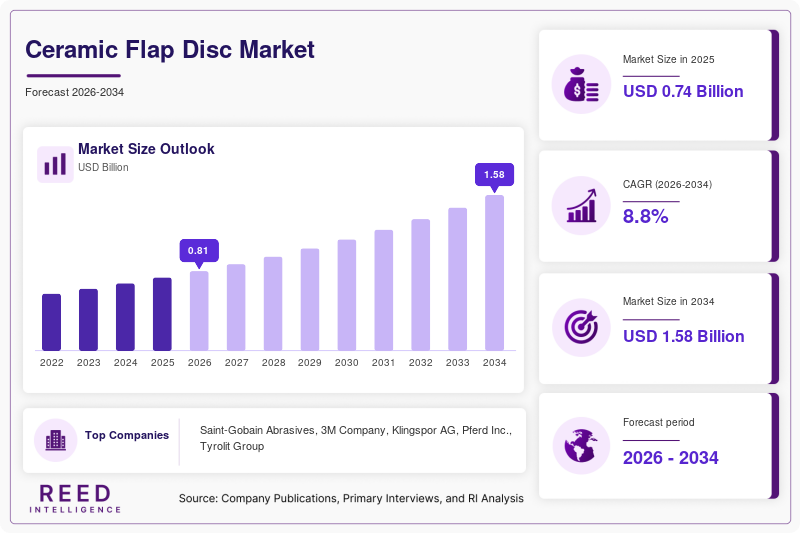
The global Ceramic Flap Disc Market size was valued at approximately USD 0.742 billion in 2026 and is projected to reach nearly USD 1.46 billion by 2034, expanding at a CAGR of 8.8% during the forecast period from 2026 to 2034. Ceramic flap discs are widely used in grinding, blending, finishing, and polishing applications across metal fabrication, automotive, aerospace, construction, and heavy machinery industries. These abrasive tools are gaining broader adoption because of their longer lifespan, high cutting efficiency, and improved heat resistance compared to conventional abrasive discs. Manufacturers are increasingly investing in advanced abrasive technologies to improve productivity and reduce operational downtime in industrial grinding processes.
A major global factor supporting the growth of the Ceramic Flap Disc Market is the expansion of industrial automation and precision manufacturing activities across developed and emerging economies. Industries are focusing on achieving higher production efficiency while reducing labor-intensive finishing operations. Ceramic abrasives deliver consistent performance under high-pressure conditions, making them suitable for automated robotic grinding systems used in automotive plants, shipbuilding facilities, and metal processing workshops. The increasing use of stainless steel, titanium, and alloy-based materials in industrial production has also strengthened the demand for durable abrasive solutions capable of maintaining high cutting performance over extended operating cycles.
Key Highlights
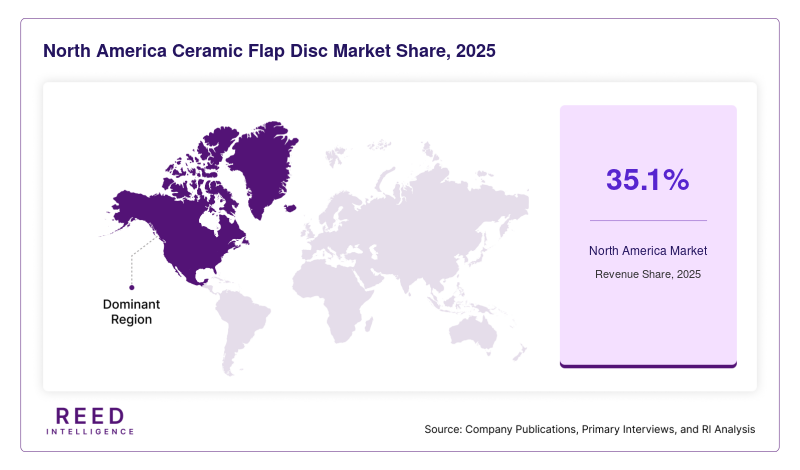
- North America dominated the market with a 35.1% share in 2025, while Asia Pacific is expected to grow at the fastest CAGR of 10.9% during 2026–2034.
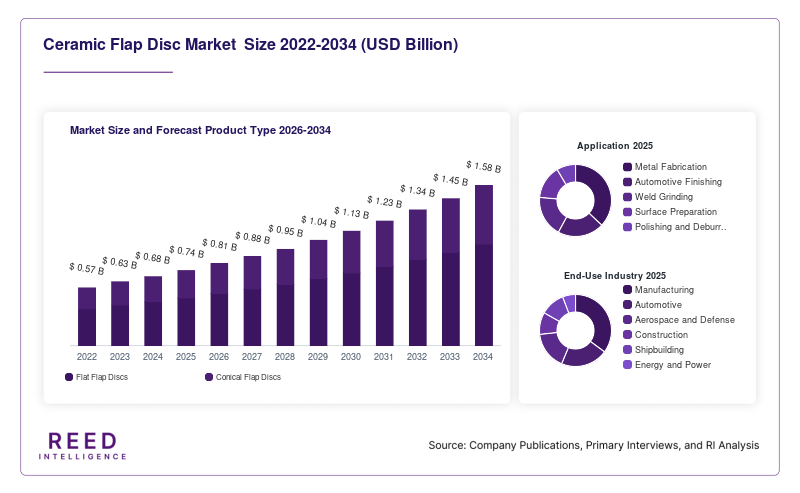
- By product type, flat flap discs accounted for the largest share of 57.4%, while conical flap discs are projected to grow at a CAGR of 9.8%.
- By application, metal fabrication led with a 43.8% share, whereas automotive finishing is expected to expand at a CAGR of 10.2%.
- By end-use industry, manufacturing accounted for the largest market share of 46.2%, while aerospace and defense are expected to grow at a CAGR of 9.7%.
- The United States remained the dominant country, with market values of USD 188 million in 2024 and USD 206 million in 2025.
Market Trends
Growing Integration of Robotic Grinding Systems
Industrial manufacturers are increasingly integrating robotic grinding and automated finishing systems into production facilities, creating stronger demand for high-performance ceramic flap discs. Automated systems require abrasive products that can maintain stable cutting efficiency, generate consistent surface finishes, and withstand continuous operational cycles without frequent replacement. Ceramic flap discs are becoming preferred solutions because they provide superior durability and lower heat generation compared to traditional aluminum oxide products. Automotive assembly plants, heavy machinery facilities, and industrial fabrication workshops are deploying robotic arms equipped with advanced abrasive tools to improve throughput and reduce labor costs. This transition toward automated grinding operations is also encouraging manufacturers to develop flap discs optimized for robotic applications with enhanced flexibility, precision, and wear resistance.
Increasing Preference for High-Efficiency Abrasive Materials
Industrial buyers are showing greater preference for high-efficiency abrasive materials that reduce total operating costs and improve worker productivity. Ceramic flap discs are gaining traction because they deliver faster material removal rates and longer service life, which minimizes downtime during grinding and finishing tasks. End users in aerospace, metalworking, and energy industries are increasingly adopting premium abrasives to support the machining of heat-resistant alloys and advanced metals. Manufacturers are also introducing hybrid abrasive technologies combining ceramic grains with specialized coatings to improve cutting performance under demanding conditions. This trend is supporting product innovation across the Ceramic Flap Disc Market as suppliers compete to deliver solutions capable of handling complex industrial applications while maintaining cost efficiency and operational consistency.
Market Drivers
Expansion of Metal Fabrication and Infrastructure Projects
The expansion of global metal fabrication activities and infrastructure development projects is driving demand for ceramic flap discs across industrial sectors. Governments and private investors are increasing spending on transportation networks, industrial plants, energy facilities, and commercial construction projects, creating higher consumption of fabricated metal components. Ceramic flap discs are widely used in weld blending, edge grinding, rust removal, and surface preparation tasks during infrastructure and fabrication operations. Construction equipment manufacturers and steel processing facilities are also investing in advanced abrasive solutions to improve production speed and achieve higher-quality finishes. As industrial fabrication standards continue to evolve, the need for durable grinding tools capable of operating under intensive workloads is expected to support long-term market growth.
Rising Demand from Automotive and Aerospace Manufacturing
Automotive and aerospace manufacturers are increasingly relying on ceramic flap discs for precision grinding and finishing applications involving advanced materials. Vehicle manufacturers are using lightweight metals and alloy components to improve fuel efficiency and structural performance, which requires abrasive products capable of handling harder surfaces without excessive wear. In aerospace manufacturing, ceramic flap discs are extensively used for finishing turbine components, aircraft frames, and titanium parts that demand high dimensional accuracy and smooth surface quality. The growth of electric vehicle production and commercial aircraft expansion is further strengthening the adoption of premium abrasive technologies. Manufacturers are therefore expanding production capacities and introducing specialized ceramic abrasive products designed for high-speed industrial finishing applications.
Market Restraint
Fluctuating Raw Material Prices and High Product Costs
Fluctuating raw material prices and the comparatively high cost of ceramic abrasives continue to restrain broader market penetration in price-sensitive regions. Ceramic grains, resin bonding materials, and reinforced backing components involve higher manufacturing costs than conventional abrasive materials, resulting in premium pricing for ceramic flap discs. Small-scale workshops and independent fabrication businesses often prefer lower-cost abrasive solutions despite shorter operational life cycles because of budget limitations. Volatility in global supply chains for industrial minerals and specialty materials can also affect production costs and profit margins for abrasive manufacturers. In addition, rising transportation and energy costs have increased operational expenses across the abrasive industry. These factors may limit adoption rates in developing economies where end users prioritize lower upfront purchasing costs over long-term productivity benefits. Manufacturers are attempting to address this challenge by improving production efficiency and introducing mid-range ceramic abrasive products targeted at cost-conscious industrial buyers.
Market Opportunities
Development of Sustainable and Low-Dust Abrasive Solutions
The growing emphasis on workplace safety and environmental sustainability is creating opportunities for manufacturers to develop low-dust and eco-friendly ceramic flap discs. Industrial facilities are increasingly implementing stricter occupational safety regulations related to airborne particles, noise reduction, and operator health. Abrasive manufacturers are therefore investing in cleaner grinding technologies and advanced disc designs that reduce dust generation during operation. Sustainable manufacturing practices, including recyclable backing materials and reduced chemical emissions, are also becoming important purchasing considerations for industrial buyers. Companies capable of delivering environmentally responsible abrasive solutions while maintaining strong grinding performance are expected to gain competitive advantages. This opportunity is particularly significant in Europe and North America, where environmental compliance standards are becoming more stringent across manufacturing industries.
Growth Potential in Emerging Manufacturing Economies
Emerging manufacturing economies across Asia Pacific, Latin America, and the Middle East are presenting substantial growth opportunities for the Ceramic Flap Disc Market. Countries such as India, Vietnam, Indonesia, Brazil, and Saudi Arabia are witnessing rising industrialization, infrastructure investment, and automotive production activities. Local manufacturers are modernizing production facilities and adopting advanced metalworking equipment to improve competitiveness in export markets. This industrial transition is increasing the demand for efficient abrasive tools capable of supporting higher production volumes and improved finishing quality. International abrasive companies are expanding distribution networks and establishing regional manufacturing partnerships to strengthen market presence in these developing economies. The combination of industrial expansion, rising construction activity, and increasing metal processing capacity is expected to create favorable long-term opportunities for ceramic flap disc suppliers.
Segmental Analysis
By Product Type
Flat flap discs accounted for the largest share of the Ceramic Flap Disc Market, representing approximately 57.4% of total revenue in 2024. These products are widely used for surface finishing, blending, and smooth grinding applications across automotive workshops, fabrication plants, and industrial maintenance facilities. Flat flap discs provide greater contact area with the work surface, allowing operators to achieve uniform finishing quality and improved control during grinding operations. Their popularity is also linked to reduced vibration and operator fatigue compared to conventional abrasive wheels. Manufacturers continue to introduce advanced flat ceramic flap discs with improved grain structures and heat-resistant coatings to increase productivity in high-speed industrial applications. Demand remains particularly strong in metal fabrication industries where smooth surface finishing and weld blending are essential for quality control.
By Application
Metal fabrication emerged as the dominant application segment, accounting for nearly 43.8% of the Ceramic Flap Disc Market share in 2024. Fabrication workshops rely heavily on ceramic flap discs for grinding welds, preparing metal surfaces, removing burrs, and achieving consistent finishing quality across steel and alloy components. The increasing use of stainless steel and hardened metals in industrial production has strengthened the need for high-performance abrasive solutions capable of maintaining stable cutting efficiency. Ceramic flap discs are preferred because they generate less heat and provide longer operational life compared to standard abrasive products. Demand from construction equipment manufacturing, industrial machinery production, and structural steel fabrication continues to support segment expansion. The growth of infrastructure development projects worldwide is also contributing to increased consumption of grinding and finishing tools within fabrication environments.
By End-Use Industry
The manufacturing sector accounted for the largest market share of 46.2% in 2024 due to the widespread use of ceramic flap discs in industrial production and metal processing activities. Manufacturing facilities require reliable abrasive solutions for machinery maintenance, component finishing, welding operations, and equipment fabrication. Ceramic flap discs are particularly valued in this sector because they reduce downtime by offering longer operational life and improved grinding consistency. Industries such as heavy machinery, industrial equipment, rail transportation, and fabricated metal products rely extensively on abrasive tools for daily operations. The increasing emphasis on production efficiency and cost optimization is encouraging manufacturers to adopt premium abrasive products that improve workflow productivity and reduce overall maintenance expenses. Rising automation levels across manufacturing facilities are also contributing to stronger demand for high-performance grinding tools.
Regional Analysis
North America
North America accounted for approximately 35.1% of the global Ceramic Flap Disc Market share in 2025 and is expected to maintain stable growth at a CAGR of 7.9% during the forecast period. The region benefits from a well-established industrial manufacturing base, high adoption of automation technologies, and strong demand from automotive and aerospace sectors. Industrial operators across the United States and Canada are increasingly replacing conventional abrasive products with ceramic-based grinding tools because of their durability and productivity advantages. The presence of advanced fabrication facilities and large-scale metal processing operations continues to support market expansion throughout the region.
The United States remains the dominant country within North America due to its extensive automotive production, aerospace manufacturing capacity, and industrial infrastructure projects. One unique growth factor in the country is the rapid modernization of industrial workshops with robotic grinding systems and automated surface finishing equipment. Manufacturers are investing heavily in advanced abrasive technologies to reduce labor dependency and improve production consistency. In addition, increasing defense-related manufacturing and energy sector investments are creating additional demand for high-performance grinding tools across multiple industrial applications.
Europe
Europe represented nearly 27.4% of the global Ceramic Flap Disc Market in 2025 and is projected to grow at a CAGR of 8.1% through 2034. The region’s growth is supported by strong automotive engineering capabilities, industrial machinery manufacturing, and increasing demand for precision finishing solutions. Germany, Italy, and France remain key markets for ceramic abrasives because of their advanced metalworking industries and focus on high-quality production standards. European manufacturers are also emphasizing worker safety and environmental compliance, encouraging the adoption of low-dust abrasive technologies and premium grinding solutions.
Germany dominates the European market owing to its extensive industrial machinery and automotive manufacturing ecosystem. A unique growth factor supporting the country is the increasing adoption of Industry 4.0 technologies in metal fabrication and industrial automation facilities. German manufacturers are integrating digitally controlled grinding systems and robotic polishing equipment into production lines, which requires durable abrasive products capable of consistent performance. The country’s strong export-oriented manufacturing sector and focus on engineering efficiency continue to strengthen demand for ceramic flap discs in precision finishing applications.
Asia Pacific
Asia Pacific held approximately 24.6% of the global Ceramic Flap Disc Market in 2025 and is expected to register the fastest CAGR of 10.9% during the forecast period. Rapid industrialization, urban infrastructure expansion, and increasing automotive production are driving demand for abrasive products across the region. Countries including China, India, Japan, and South Korea are investing heavily in industrial manufacturing and transportation projects, leading to higher consumption of grinding and finishing tools. Rising awareness regarding productivity benefits associated with ceramic abrasives is also supporting market penetration among small and medium-sized industrial operators.
China remains the leading country in the Asia Pacific market because of its large-scale steel processing, shipbuilding, and heavy equipment manufacturing industries. One distinct growth factor in the country is the expansion of export-oriented fabrication facilities producing industrial components for global supply chains. Chinese manufacturers are increasingly adopting advanced abrasive solutions to improve production quality and meet international manufacturing standards. In addition, the government’s continued investment in infrastructure and industrial modernization projects is generating significant demand for metal grinding and surface preparation equipment.
Middle East & Africa
The Middle East & Africa region accounted for nearly 6.5% of the global Ceramic Flap Disc Market share in 2025 and is projected to expand at a CAGR of 8.4% during 2026–2034. Growth in the region is supported by ongoing investments in industrial diversification, construction activities, and energy infrastructure projects. Countries across the Gulf Cooperation Council are developing local manufacturing capabilities and expanding industrial processing facilities to reduce reliance on imports. This transition is increasing the use of abrasive tools in fabrication, welding, and equipment maintenance applications.
Saudi Arabia dominates the regional market due to extensive industrial infrastructure investments and expanding metal processing operations. A unique growth factor driving demand in the country is the rapid development of industrial cities and large-scale energy projects under long-term economic diversification programs. Manufacturing and construction companies are increasingly using high-performance abrasive products for structural steel fabrication and industrial maintenance work. Additionally, investments in transportation networks and industrial logistics hubs are contributing to sustained demand for ceramic flap discs across heavy industrial sectors.
Latin America
Latin America represented around 6.4% of the global Ceramic Flap Disc Market in 2025 and is expected to grow at a CAGR of 7.8% through 2034. The market is gradually expanding due to increasing industrialization, mining operations, and construction activities across the region. Brazil, Mexico, and Argentina are among the key contributors to abrasive product demand because of their automotive assembly facilities and metal fabrication industries. Industrial operators are increasingly adopting ceramic abrasives to improve operational efficiency and reduce tool replacement frequency during grinding operations.
Brazil remains the dominant country within Latin America owing to its strong industrial manufacturing and mining equipment sectors. One unique growth factor supporting the Brazilian market is the modernization of domestic metalworking workshops and automotive component manufacturing facilities. Local companies are upgrading production technologies to improve competitiveness in regional export markets, resulting in higher demand for advanced grinding and finishing tools. Furthermore, infrastructure rehabilitation projects and growth in renewable energy installations are supporting increased consumption of ceramic flap discs for fabrication and maintenance applications.
Competitive Landscape
The Ceramic Flap Disc Market is moderately fragmented, with global and regional abrasive manufacturers competing through product innovation, distribution expansion, and strategic industrial partnerships. Companies are increasingly focusing on developing high-performance ceramic abrasive products capable of delivering improved durability, faster material removal, and enhanced operator safety. Market participants are also investing in automated manufacturing technologies and sustainable abrasive solutions to strengthen competitiveness in industrial markets.
Saint-Gobain Abrasives remains one of the leading companies in the market because of its extensive product portfolio, strong distribution network, and continuous investment in advanced abrasive technologies. The company recently introduced an upgraded range of ceramic flap discs designed for robotic grinding applications in automotive and industrial fabrication facilities. Other major players are emphasizing regional expansion strategies and collaborations with industrial distributors to increase product accessibility across emerging manufacturing economies.
Key Players
- Saint-Gobain Abrasives
- 3M Company
- Klingspor AG
- Pferd Inc.
- Tyrolit Group
- Walter Surface Technologies
- Weiler Abrasives Group
- DEWALT Industrial Tool Company
- Camel Grinding Wheels
- Sia Abrasives Industries AG
- Rhodius Abrasives
- Fujimi Incorporated
- Mirka Ltd.
- ARC Abrasives Inc.
- Nippon Resibon Corporation
Recent Developments
- In February 2025, Saint-Gobain Abrasives launched a new ceramic flap disc series designed for robotic grinding systems used in automotive assembly operations.
- In August 2024, Klingspor AG expanded its abrasive manufacturing facility in Eastern Europe to strengthen supply capacity for industrial metalworking customers.
- In May 2025, 3M Company introduced an upgraded ceramic abrasive technology featuring improved heat resistance and longer grinding life for aerospace applications.
- In November 2024, Tyrolit Group partnered with regional industrial distributors in Southeast Asia to expand access to premium ceramic abrasive products.
- In January 2025, Walter Surface Technologies developed a low-dust ceramic flap disc solution targeted at fabrication workshops operating under stricter workplace safety regulations.
Ceramic Flap Disc Market Segments
Product Type
- Flat Flap Discs
- Conical Flap Discs
Application
- Metal Fabrication
- Automotive Finishing
- Weld Grinding
- Surface Preparation
- Polishing and Deburring
End-Use Industry
- Manufacturing
- Automotive
- Aerospace and Defense
- Construction
- Shipbuilding
- Energy and Power
By Region
- North America
- Europe
- APAC
- Middle East and Africa
- LATAM