Ceramic Paper Market Size, Share & Demand Report By Product Type (Alumina Ceramic Paper, Silica Ceramic Paper), By Application (Thermal Insulation, Electrical Insulation), By End-Use Industry (Metallurgy, Petrochemical, Aerospace and Defense), By Temperature Range (Below 1000°C, 1000°C to 1400°C, Above 1400°C), By Distribution Channel (Direct Industrial Sales, Industrial Distributors), By Region & Segment Forecasts, 2026–2034
USD 3950
Market Overview
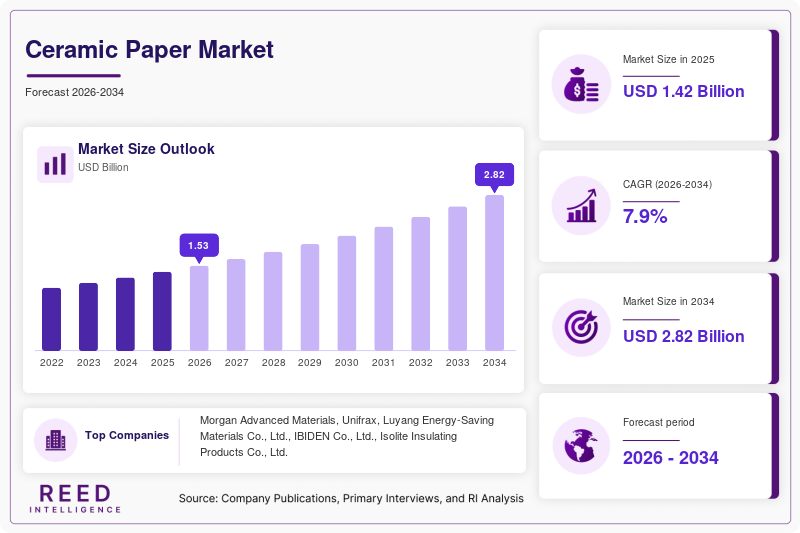
The global Ceramic Paper Market size was valued at USD 1.42 billion in 2026 and is projected to reach USD 2.61 billion by 2034, expanding at a CAGR of 7.9% during the forecast period (2026–2034). The market growth has been supported by rising industrial demand for high-temperature insulation materials across steel manufacturing, petrochemical processing, power generation, aerospace, and automotive industries. Increasing emphasis on thermal efficiency and energy conservation in industrial operations has accelerated the adoption of ceramic paper products globally.
Ceramic paper is a lightweight refractory insulation material manufactured using ceramic fibers and binders. It offers excellent thermal stability, low thermal conductivity, high-temperature resistance, and chemical durability. Ceramic paper is widely used in industrial furnace linings, gaskets, expansion joints, heat shields, and thermal insulation systems. Growing industrial modernization and stricter energy efficiency regulations have contributed significantly to market demand.
Key Highlights
- Asia Pacific accounted for 38.6% of the global Ceramic Paper Market share in 2025, while Middle East & Africa is projected to register the fastest CAGR of 8.5% during the forecast period.
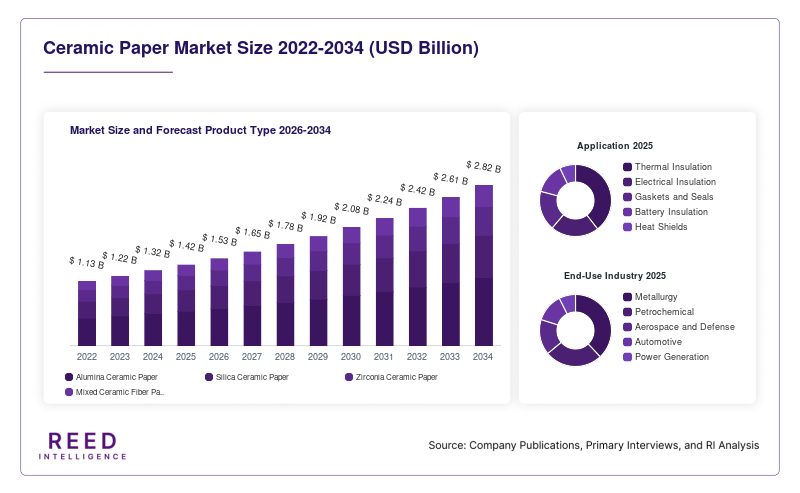
- By product type, alumina ceramic paper dominated with a 44.3% market share in 2025, whereas zirconia ceramic paper is anticipated to grow at a CAGR of 8.8% through 2034.
- By application, thermal insulation held the largest market share of 47.2% in 2025, while battery insulation applications are expected to expand at a CAGR of 9.1%.
- By end-use industry, metallurgy captured 31.4% of the market in 2025, whereas aerospace and defense is forecast to grow at a CAGR of 8.7%.
- China remained the dominant country market, valued at USD 228.7 million in 2024 and USD 245.1 million in 2025.
Market Trends
Increasing Adoption of Lightweight Thermal Insulation Materials
Industries are increasingly adopting lightweight thermal insulation materials to improve energy efficiency and operational performance. Ceramic paper products provide high-temperature resistance while reducing equipment weight and heat loss. Manufacturers are focusing on lightweight insulation systems for industrial furnaces, automotive thermal barriers, and aerospace components. This trend is expected to support steady growth in the Ceramic Paper Market during the forecast period.
Growing Demand for Electric Vehicle Battery Insulation
The rapid expansion of electric vehicle production is influencing demand for advanced ceramic insulation materials. Ceramic paper is increasingly used in electric vehicle battery systems to improve thermal management and fire resistance. Automotive manufacturers are investing in advanced battery safety technologies, which is expected to increase the utilization of ceramic paper products in battery insulation applications.
Market Drivers
Expansion of High-Temperature Industrial Manufacturing
The expansion of high-temperature industrial manufacturing activities has significantly supported the Ceramic Paper Market. Steel plants, petrochemical facilities, glass manufacturing operations, and cement production industries increasingly require thermal insulation materials capable of withstanding extreme operating conditions. Ceramic paper products are widely utilized to improve thermal efficiency and reduce energy consumption in industrial systems.
Increasing Focus on Energy Efficiency Regulations
Governments and industrial organizations are implementing stricter energy efficiency regulations to reduce industrial emissions and energy losses. Ceramic paper materials help industries improve insulation performance and optimize thermal energy management. Rising investments in energy-efficient industrial infrastructure are expected to support market growth throughout the forecast period.
Market Restraint
Health and Environmental Concerns Related to Ceramic Fibers
Certain ceramic fiber materials may pose health and environmental concerns due to airborne fiber exposure during installation and maintenance activities. Regulatory agencies in several countries are implementing stricter workplace safety standards for refractory ceramic fiber products. Compliance with evolving environmental regulations may increase operational and manufacturing costs for market participants.
Market Opportunities
Expansion of Aerospace Thermal Protection Systems
The aerospace industry is creating growth opportunities for ceramic paper manufacturers through increasing demand for advanced thermal protection systems. Ceramic paper materials are increasingly utilized in aircraft insulation systems, engine components, and heat shields due to their lightweight structure and thermal resistance properties.
Rising Investments in Renewable Energy Infrastructure
The growing development of renewable energy infrastructure is expected to create new opportunities for the Ceramic Paper Market. Solar thermal plants, hydrogen processing facilities, and advanced energy storage systems require reliable high-temperature insulation materials. Ceramic paper products are anticipated to witness increasing adoption in renewable energy applications during the forecast period.
Segmental Analysis
By Product Type
Alumina Ceramic Paper Dominated the Market
Alumina ceramic paper accounted for 44.3% of the Ceramic Paper Market share in 2025. The segment maintained dominance because of its superior thermal stability, high-temperature resistance, and widespread utilization in industrial furnace insulation applications. Industries increasingly adopted alumina ceramic paper for heat shielding, refractory lining, and thermal barrier systems.
Zirconia Ceramic Paper to Witness Fastest Growth
Zirconia ceramic paper is projected to expand at a CAGR of 8.8% during the forecast period. The segment is expected to gain traction due to rising demand for advanced high-temperature insulation materials in aerospace and energy storage applications. Manufacturers are anticipated to increase investments in zirconia-based insulation technologies to support demanding industrial operations.
By Application
Thermal Insulation Held the Largest Share
Thermal insulation represented 47.2% of the global Ceramic Paper Market share in 2025. The segment dominated because ceramic paper products are extensively utilized in industrial heat management systems, furnace linings, and thermal processing equipment. Increasing industrial demand for energy-efficient insulation solutions supported segment growth.
Battery Insulation Applications Expected to Grow Rapidly
Battery insulation applications are anticipated to register a CAGR of 9.1% during the forecast period. The rapid expansion of electric vehicle manufacturing and advanced energy storage systems is expected to increase demand for ceramic paper products with enhanced thermal resistance and fire protection properties.
By End-Use Industry
Metallurgy Industry Led the Market
The metallurgy industry accounted for 31.4% of the Ceramic Paper Market share in 2025. The segment benefited from extensive utilization of ceramic paper in steel processing, metal casting, and high-temperature furnace operations. Growing demand for thermal management materials in heavy industrial operations supported segment expansion.
Aerospace and Defense Industry to Register Strong Growth
The aerospace and defense industry segment is projected to grow at a CAGR of 8.7% through 2034. Increasing production of lightweight aircraft components and advanced thermal protection systems will support segment growth. Aerospace manufacturers are expected to increase utilization of ceramic paper materials in insulation and heat shielding applications.
By Temperature Range
1000°C to 1400°C Segment Dominated the Market
The 1000°C to 1400°C segment held 42.6% of the Ceramic Paper Market share in 2025. The segment maintained dominance because most industrial heating and thermal processing systems operate within this temperature range. Ceramic paper products designed for medium-to-high-temperature applications witnessed broad industrial adoption.
Above 1400°C Segment to Expand Significantly
The above 1400°C segment is expected to grow at a CAGR of 8.3% during the forecast period. Increasing demand for ultra-high-temperature insulation systems in aerospace, petrochemical, and advanced metallurgy applications is expected to support segment expansion.
Regional Analysis
Asia Pacific
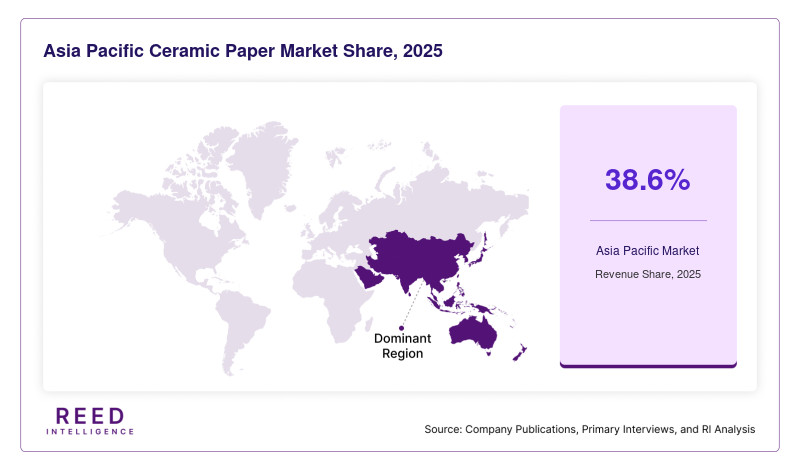
Asia Pacific accounted for 38.6% of the global Ceramic Paper Market share in 2025 and is projected to grow at a CAGR of 8.2% during the forecast period. The regional market benefited from expanding industrial manufacturing activities and rising investments in steel, cement, and petrochemical industries. China dominated the regional market due to large-scale industrial production and increasing deployment of high-temperature processing systems. Expanding electric vehicle manufacturing activities also contributed to regional market demand.
North America
North America held 24.7% of the global Ceramic Paper Market share in 2025 and is anticipated to expand at a CAGR of 7.5% through 2034. The regional market was supported by increasing demand for advanced industrial insulation systems and aerospace thermal materials. The United States emerged as the leading country market due to strong aerospace manufacturing capabilities and growing investments in energy-efficient industrial infrastructure. Rising adoption of ceramic insulation materials in battery systems also supported market growth.
Europe
Europe represented 21.5% of the global Ceramic Paper Market share in 2025 and is forecast to grow at a CAGR of 7.4% during the forecast period. Germany dominated the regional market due to advanced industrial engineering capabilities and increasing utilization of energy-efficient manufacturing systems. The regional market also benefited from stringent environmental regulations and growing investments in industrial modernization activities.
Middle East & Africa
The Middle East & Africa accounted for 9.1% of the global Ceramic Paper Market share in 2025 and is projected to register the fastest CAGR of 8.5% between 2026 and 2034. Saudi Arabia led the regional market owing to expanding petrochemical processing infrastructure and increasing investments in industrial energy management systems. Growing industrial diversification activities are expected to support market expansion across the region.
Latin America
Latin America captured 6.1% of the global Ceramic Paper Market share in 2025 and is expected to grow at a CAGR of 6.9% during the forecast period. Brazil dominated the regional market due to increasing industrial manufacturing activities and expanding steel production infrastructure. Rising demand for industrial thermal insulation materials is anticipated to contribute to regional market growth.
Competitive Landscape
The Ceramic Paper Market remains moderately fragmented with the presence of refractory material manufacturers, industrial insulation providers, and advanced ceramic technology companies. Market participants are focusing on product innovation, sustainable insulation materials, and high-temperature performance enhancement to strengthen their market position.
Morgan Advanced Materials emerged as a leading market participant due to its broad portfolio of high-temperature ceramic insulation products and global industrial presence. The company recently expanded its advanced ceramic fiber insulation manufacturing capacity to address growing industrial demand.
Unifrax strengthened its ceramic insulation solutions portfolio through advanced low-emission refractory materials.
Luyang Energy-Saving Materials Co., Ltd. focused on lightweight ceramic paper products for industrial energy management applications.
IBIDEN Co., Ltd. expanded its advanced ceramic fiber technologies for aerospace and automotive thermal protection systems.
Isolite Insulating Products Co., Ltd. invested in environmentally compliant ceramic insulation material development.
Key Players List
- Morgan Advanced Materials
- Unifrax
- Luyang Energy-Saving Materials Co., Ltd.
- IBIDEN Co., Ltd.
- Isolite Insulating Products Co., Ltd.
- Rath Group
- Nutec Incorporated
- Yeso Insulating Products Co., Ltd.
- 3M
- BNZ Materials Inc.
- Thermal Ceramics
- Lewco Specialty Products, Inc.
- Pyrotek Inc.
- Shandong Luyang Share Co., Ltd.
- Hi-Temp Insulation Inc.
Recent Developments
- In 2025, Morgan Advanced Materials expanded its ceramic fiber insulation production capacity for industrial thermal applications.
- In 2024, Unifrax introduced low-bio-persistent ceramic paper products designed for energy-efficient industrial systems.
- In 2025, Luyang Energy-Saving Materials Co., Ltd. launched lightweight ceramic insulation solutions for electric vehicle battery systems.
- In 2024, IBIDEN Co., Ltd. expanded its aerospace thermal protection material technologies.
- In 2025, Isolite Insulating Products Co., Ltd. invested in environmentally compliant ceramic insulation product development.
Ceramic Paper Market Segments
Product Type
- Alumina Ceramic Paper
- Silica Ceramic Paper
- Zirconia Ceramic Paper
- Mixed Ceramic Fiber Paper
Application
- Thermal Insulation
- Electrical Insulation
- Gaskets and Seals
- Battery Insulation
- Heat Shields
End-Use Industry
- Metallurgy
- Petrochemical
- Aerospace and Defense
- Automotive
- Power Generation
Temperature Range
- Below 1000°C
- 1000°C to 1400°C
- Above 1400°C
Distribution Channel
- Direct Industrial Sales
- Industrial Distributors
- Online Industrial Platforms
- Specialty Insulation Suppliers
- OEM Supply Contracts
By Region
- North America
- Europe
- APAC
- Middle East and Africa
- LATAM