Ceramic Setter Plates Market Size, Share & Demand Report By Material Type (Alumina Ceramic Setter Plates, Silicon Carbide Setter Plates, Zirconia Setter Plates, Cordierite Setter Plates, Others), By Application (Electronics and Semiconductor Processing, Lithium-Ion Battery Manufacturing, Industrial Ceramics Production, Glass Manufacturing, Metallurgy and Heat Treatment), By End-Use Industry (Industrial Manufacturing, Electronics Industry, Automotive Industry, Renewable Energy Equipment, Aerospac
USD 3950
Market Overview
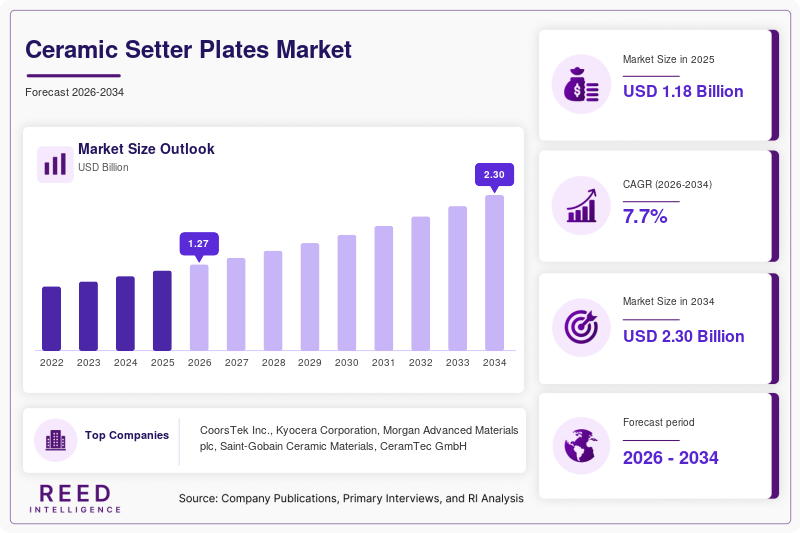
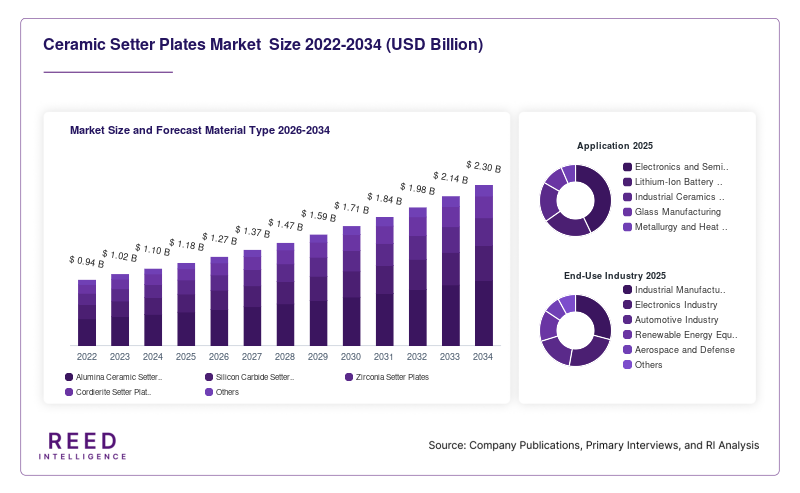
The global Ceramic Setter Plates Market size was valued at USD 1.18 billion in 2026 and is projected to reach USD 2.14 billion by 2034, expanding at a CAGR of 7.7% during the forecast period from 2026 to 2034. Ceramic setter plates are widely used in high-temperature industrial processing applications, particularly in technical ceramics, electronics, metallurgy, glass manufacturing, and advanced battery component production. These plates support products during sintering and firing operations while maintaining dimensional stability under elevated thermal conditions. Rising industrial automation and the increasing demand for high-performance ceramic components are contributing to market expansion across multiple manufacturing sectors.
One major factor supporting market growth is the rapid expansion of electric vehicle battery manufacturing worldwide. Ceramic setter plates are increasingly utilized in lithium-ion battery component processing due to their thermal resistance, durability, and low contamination characteristics. Growing investments in semiconductor fabrication plants and advanced ceramic production facilities are also creating steady demand for setter plates with enhanced mechanical strength and thermal conductivity. Manufacturers are introducing alumina-based, silicon carbide-based, and zirconia-based products designed for longer operational life and reduced maintenance cycles. Additionally, stricter quality standards in electronics and aerospace manufacturing are encouraging the adoption of precision-engineered ceramic processing equipment.
Key Highlights
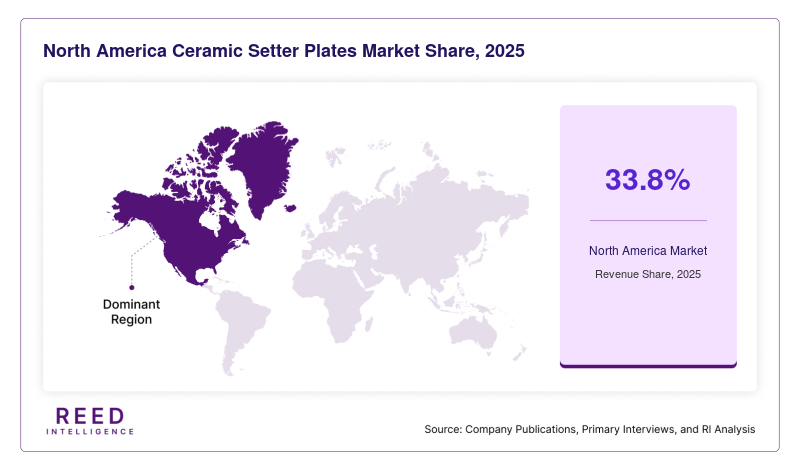
- North America dominated the market with a 33.8% share in 2025.
- Asia Pacific is expected to grow at the fastest CAGR of 9.4% during 2026–2034.
- By material type, alumina ceramic setter plates accounted for the largest share of 42.6%, while silicon carbide setter plates are projected to grow at a CAGR of 9.8%.
- By application, electronics and semiconductor processing led with a 39.1% share, whereas lithium-ion battery manufacturing is expected to expand at a CAGR of 10.3%.
- By end-use industry, industrial manufacturing held the dominant share of 36.7%, while renewable energy equipment production is projected to grow at a CAGR of 9.9%.
- The United States remained the dominant country, with market values of USD 302 million in 2024 and USD 329 million in 2025.
Market Trends
Rising Integration of Advanced Ceramics in Semiconductor Manufacturing
The increasing complexity of semiconductor manufacturing processes is creating substantial demand for advanced ceramic setter plates with superior thermal shock resistance and dimensional accuracy. Semiconductor fabs require highly stable firing and sintering environments to ensure defect-free chip packaging and substrate manufacturing. Ceramic setter plates made from high-purity alumina and silicon carbide are becoming preferred materials because they can withstand repeated thermal cycles without deformation. Manufacturers are investing in precision machining technologies to produce ultra-flat setter plates suitable for advanced electronic applications. The trend is particularly visible in East Asian countries where semiconductor production capacity continues to expand rapidly. Growing demand for consumer electronics, artificial intelligence hardware, and automotive electronics is further strengthening the requirement for high-performance thermal processing equipment.
Increasing Adoption of Energy-Efficient Kiln Furniture Solutions
Industrial manufacturers are focusing on reducing energy consumption and operational downtime in high-temperature production environments. As a result, lightweight and thermally efficient ceramic setter plates are gaining popularity across ceramics, metallurgy, and glass processing industries. Modern setter plate designs are engineered to improve heat distribution while minimizing thermal mass, enabling shorter firing cycles and lower fuel usage. Companies are also adopting recyclable and long-life ceramic materials to reduce maintenance expenses and production interruptions. This trend is encouraging suppliers to develop customized kiln furniture solutions tailored to specific industrial applications. In addition, stricter environmental regulations related to industrial emissions are motivating manufacturers to adopt energy-efficient furnace components that support sustainable production operations.
Market Drivers
Expansion of Electric Vehicle Battery Manufacturing Facilities
The rapid growth of electric vehicle production is significantly increasing demand for ceramic setter plates used in lithium-ion battery component manufacturing. High-temperature sintering processes involved in cathode and separator production require durable and contamination-resistant support materials. Ceramic setter plates provide excellent thermal stability and mechanical integrity, making them suitable for continuous production environments. Governments across North America, Europe, and Asia Pacific are investing heavily in battery gigafactories to support energy transition initiatives. This expansion is creating long-term opportunities for ceramic processing equipment suppliers. In addition, rising demand for energy storage systems used in renewable power infrastructure is supporting the growth of advanced battery manufacturing facilities, further strengthening the adoption of high-performance setter plates.
Growing Demand for Precision Manufacturing in Electronics Industry
The electronics industry increasingly relies on advanced ceramic materials for producing substrates, insulators, sensors, and microelectronic components. Ceramic setter plates play an important role in maintaining dimensional consistency and thermal uniformity during production processes. As electronic devices become smaller and more complex, manufacturers require highly reliable kiln furniture capable of operating under strict temperature tolerances. Demand for 5G infrastructure, wearable electronics, and automotive sensors is accelerating the production of technical ceramics globally. Manufacturers are responding by introducing setter plates with improved thermal conductivity and enhanced wear resistance. The ongoing shift toward automated and high-volume production systems is also contributing to market growth, as industries prioritize durable processing equipment that supports operational efficiency and product quality.
Market Restraint
High Production Costs and Material Processing Challenges
The Ceramic Setter Plates Market faces challenges associated with high manufacturing costs and complex raw material processing requirements. Producing advanced ceramic setter plates involves precision engineering, high-temperature sintering, and the use of premium raw materials such as alumina, zirconia, and silicon carbide. These factors increase overall production expenses and can limit market penetration among small and medium-sized industrial manufacturers. In addition, fluctuations in raw material prices often affect profit margins for suppliers operating in highly competitive markets. The manufacturing process also requires specialized equipment and skilled labor to maintain strict dimensional tolerances and mechanical properties. In industries with cost-sensitive operations, some manufacturers continue using traditional kiln furniture materials despite lower operational efficiency. For example, certain regional ceramic tile manufacturers in developing economies still rely on lower-cost refractory products instead of advanced ceramic setter plates due to budget limitations. This pricing challenge may slow adoption rates in emerging industrial sectors.
Market Opportunities
Increasing Investments in Renewable Energy Equipment Manufacturing
The global transition toward renewable energy systems is generating new opportunities for ceramic setter plate manufacturers. Components used in solar panels, fuel cells, and energy storage systems often require high-temperature processing supported by durable kiln furniture solutions. Ceramic setter plates help maintain structural integrity and thermal consistency during the production of photovoltaic materials and advanced energy devices. Governments and private investors are expanding renewable energy manufacturing infrastructure to reduce dependence on fossil fuels. This industrial expansion is expected to create sustained demand for high-performance ceramic processing equipment. Additionally, renewable energy manufacturers are emphasizing operational efficiency and product reliability, encouraging the use of premium setter plates with extended service life and reduced contamination risk.
Development of Customized High-Performance Setter Plate Solutions
Industries increasingly demand application-specific ceramic setter plates designed for unique thermal processing environments. This requirement is creating opportunities for manufacturers specializing in customized product development. Companies are focusing on engineered ceramic compositions with enhanced thermal conductivity, lightweight structures, and superior chemical resistance. Aerospace, medical device manufacturing, and specialty electronics production facilities require tailored kiln furniture capable of supporting complex component geometries and sensitive processing conditions. Advances in computer-aided design and precision ceramic forming technologies are enabling suppliers to develop customized solutions more efficiently. The growing preference for automated production systems also supports demand for setter plates optimized for robotic handling and continuous processing operations. These developments are expected to create new revenue streams for companies investing in research and development activities.
Segmental Analysis
By Material Type
Alumina ceramic setter plates accounted for the largest market share of 42.6% in 2024 due to their excellent thermal stability, mechanical strength, and cost efficiency. These setter plates are widely used in electronics, technical ceramics, and industrial furnace applications where consistent thermal performance is essential. Alumina-based products offer high resistance to thermal shock and chemical corrosion, making them suitable for repeated firing cycles. Manufacturers prefer alumina materials because they provide reliable performance across diverse processing conditions while maintaining relatively lower production costs compared to zirconia-based alternatives. Growing demand for advanced ceramic substrates and electronic components is further supporting the widespread use of alumina setter plates in semiconductor and industrial manufacturing operations.
Silicon carbide setter plates are projected to grow at the fastest CAGR of 9.8% during the forecast period due to their superior thermal conductivity and lightweight properties. These products are increasingly adopted in industries requiring rapid heating and cooling cycles, including lithium-ion battery manufacturing and advanced electronics processing. Silicon carbide materials help improve furnace efficiency by enabling better heat transfer and reducing overall energy consumption. Manufacturers are also developing high-strength silicon carbide formulations capable of withstanding extreme operating temperatures and heavy industrial loads. Rising focus on energy-efficient manufacturing systems and automated production environments is expected to further accelerate the demand for silicon carbide setter plates across global industrial sectors.
By Application
Electronics and semiconductor processing held the dominant market share of 39.1% in 2024 owing to the growing production of electronic substrates, insulators, and semiconductor packaging materials. Ceramic setter plates are essential in maintaining dimensional accuracy and thermal consistency during firing and sintering processes. The increasing complexity of semiconductor devices and the expansion of global chip manufacturing capacity are driving demand for high-purity setter plates capable of operating in contamination-sensitive environments. Manufacturers are introducing precision-machined ceramic plates with enhanced flatness and thermal resistance to support advanced semiconductor fabrication technologies. Growth in consumer electronics, automotive sensors, and telecommunications equipment continues to strengthen the importance of this application segment.
Lithium-ion battery manufacturing is anticipated to register the fastest CAGR of 10.3% through 2034 due to expanding electric vehicle production and rising investments in energy storage infrastructure. Ceramic setter plates are extensively used during cathode material sintering and separator processing because they provide excellent thermal durability and low contamination characteristics. Battery manufacturers are increasingly focusing on production efficiency and quality consistency, creating demand for advanced kiln furniture solutions optimized for automated processing lines. The establishment of new battery gigafactories across Asia Pacific, Europe, and North America is expected to significantly increase consumption of high-performance ceramic setter plates during the forecast period.
By End-Use Industry
Industrial manufacturing accounted for the largest share of 36.7% in 2024 due to widespread use of ceramic setter plates in metallurgy, technical ceramics, glass processing, and heavy industrial operations. High-temperature manufacturing environments require durable support materials capable of maintaining structural integrity during prolonged thermal exposure. Ceramic setter plates help improve product quality and operational efficiency by minimizing deformation and contamination during firing cycles. Industrial manufacturers are increasingly adopting advanced kiln furniture systems to reduce downtime and improve energy efficiency. Growing industrial automation and modernization activities across developed and emerging economies continue to support the dominant position of this end-use segment in the global market.
Renewable energy equipment production is expected to witness the fastest CAGR of 9.9% during the forecast period driven by increasing global investments in clean energy technologies. Solar panels, fuel cells, and advanced energy storage systems require high-temperature processing of ceramic and composite materials, creating demand for reliable setter plate solutions. Manufacturers in the renewable energy sector are prioritizing precision processing and contamination control to improve product performance and manufacturing yields. Ceramic setter plates designed for high thermal stability and extended operational life are becoming essential components within renewable energy manufacturing facilities. The continued expansion of solar energy and battery storage industries is expected to strengthen demand for advanced kiln furniture products globally.
Regional Analysis
North America
North America accounted for 33.8% of the global Ceramic Setter Plates Market in 2025 and is projected to expand at a CAGR of 7.1% during the forecast period. The region benefits from strong demand across semiconductor manufacturing, aerospace production, and industrial ceramics processing industries. The presence of advanced manufacturing infrastructure and increasing investments in electric vehicle battery facilities are contributing to steady market growth. Manufacturers in the region are also focusing on energy-efficient kiln systems, supporting the adoption of lightweight and thermally stable ceramic setter plates designed for continuous high-temperature operations.
The United States remains the dominant country in the regional market due to its extensive semiconductor manufacturing investments and growing battery production capacity. Federal support for domestic electronics manufacturing and renewable energy infrastructure is driving demand for advanced ceramic processing components. The country is also witnessing increased adoption of automation technologies in industrial furnaces, creating demand for precision-engineered setter plates with enhanced durability and thermal shock resistance. In addition, collaboration between ceramic material suppliers and electronics manufacturers is strengthening regional product innovation capabilities.
Europe
Europe represented 27.4% of the global market in 2025 and is expected to grow at a CAGR of 6.8% through 2034. Demand for ceramic setter plates in the region is supported by strong industrial ceramics manufacturing activities and expanding renewable energy equipment production. European industries are emphasizing sustainability and energy efficiency, encouraging manufacturers to adopt advanced kiln furniture solutions capable of reducing operational energy consumption. The growing use of technical ceramics in automotive electronics and medical applications is also contributing to regional market expansion.
Germany continues to dominate the European market due to its strong engineering sector and established industrial manufacturing base. The country is a major producer of advanced ceramics and precision industrial components, creating stable demand for high-temperature processing equipment. German manufacturers are increasingly investing in automated sintering technologies that require durable ceramic setter plates with superior dimensional stability. Additionally, the country’s focus on electric vehicle manufacturing and industrial modernization programs is supporting long-term demand for advanced ceramic processing materials.
Asia Pacific
Asia Pacific held 24.9% of the global Ceramic Setter Plates Market in 2025 and is anticipated to register the fastest CAGR of 9.4% during the forecast period. Rapid industrialization, rising electronics production, and large-scale investments in battery manufacturing are driving market growth across the region. Countries such as China, Japan, South Korea, and India are expanding semiconductor fabrication and technical ceramics production facilities, increasing demand for advanced kiln furniture materials. The availability of cost-effective manufacturing infrastructure also supports regional production capacity expansion.
China remains the leading country in Asia Pacific due to its dominant electronics manufacturing sector and rapidly growing electric vehicle battery industry. The country continues to invest heavily in semiconductor self-sufficiency initiatives and renewable energy manufacturing infrastructure. These developments are increasing the use of ceramic setter plates in high-temperature processing applications. In addition, the expansion of domestic ceramic material suppliers and improvements in industrial automation technologies are strengthening China’s competitive position within the regional market.
Middle East & Africa
The Middle East & Africa region accounted for 7.2% of the global market in 2025 and is projected to grow at a CAGR of 6.5% during the forecast period. Industrial diversification programs across Gulf countries are supporting investments in advanced manufacturing and materials processing industries. Ceramic setter plates are increasingly utilized in specialty glass manufacturing, industrial ceramics, and metallurgical applications. Rising infrastructure development activities are also supporting regional demand for technical ceramic products processed using high-temperature kiln systems.
Saudi Arabia remains the dominant market within the region due to its expanding industrial development initiatives and growing investment in non-oil manufacturing sectors. Government-backed industrial projects aimed at strengthening local production capabilities are creating opportunities for advanced ceramic processing equipment suppliers. The country is also witnessing increasing adoption of energy-efficient industrial technologies to support sustainability targets. These factors are encouraging the use of durable ceramic setter plates in high-temperature manufacturing environments across multiple industrial sectors.
Latin America
Latin America captured 6.7% of the global Ceramic Setter Plates Market in 2025 and is expected to expand at a CAGR of 6.2% during the forecast period. Regional growth is supported by rising investments in industrial manufacturing, glass production, and ceramic tile processing industries. Manufacturers are gradually adopting advanced kiln furniture solutions to improve operational efficiency and reduce production losses associated with thermal deformation. The growing emphasis on product quality and export competitiveness is also contributing to the adoption of high-performance ceramic setter plates.
Brazil dominates the Latin American market due to its extensive ceramics and industrial manufacturing sectors. The country has a large ceramic tile production industry that increasingly requires durable kiln support systems capable of maintaining stable processing conditions. Brazilian manufacturers are investing in modern furnace technologies to improve production efficiency and reduce energy consumption. Furthermore, the expansion of industrial automation across manufacturing facilities is creating demand for setter plates designed for continuous high-temperature production environments.
Competitive Landscape
The Ceramic Setter Plates Market is moderately consolidated with the presence of global ceramic material manufacturers and specialized kiln furniture suppliers competing through product innovation, thermal performance improvements, and customized engineering solutions. Companies are focusing on developing lightweight and energy-efficient setter plates capable of supporting automated high-temperature manufacturing environments. Strategic partnerships with semiconductor manufacturers, battery producers, and industrial furnace suppliers are becoming increasingly common as companies aim to strengthen long-term supply relationships.
CoorsTek Inc. remains one of the leading companies in the market due to its extensive portfolio of advanced ceramic products and strong global manufacturing presence. The company recently expanded its engineered ceramics production capabilities to support growing demand from electronics and energy storage industries. Other major participants are investing in advanced sintering technologies and high-purity ceramic formulations to improve product durability and operational efficiency. Market competition is also influenced by investments in regional production facilities aimed at reducing supply chain risks and improving customer responsiveness across industrial manufacturing sectors.
Key Players
- CoorsTek Inc.
- Kyocera Corporation
- Morgan Advanced Materials plc
- Saint-Gobain Ceramic Materials
- CeramTec GmbH
- Rauschert GmbH
- IPS Ceramics Ltd.
- Blasch Precision Ceramics Inc.
- McDanel Advanced Ceramic Technologies
- NGK Insulators Ltd.
- Elan Technology
- Superior Technical Ceramics
- Carborundum Universal Limited
- Ferro-Ceramic Grinding Inc.
- Nishimura Advanced Ceramics
Recent Developments
- In February 2026, CoorsTek Inc. expanded its advanced ceramics manufacturing facility in the United States to increase production capacity for semiconductor-grade setter plates.
- In September 2025, Kyocera Corporation introduced a new silicon carbide setter plate series designed for high-efficiency lithium-ion battery manufacturing applications.
- In June 2025, Morgan Advanced Materials plc announced the development of lightweight ceramic kiln furniture products focused on reducing industrial furnace energy consumption.
- In January 2026, CeramTec GmbH partnered with a European battery equipment manufacturer to develop customized setter plate solutions for automated battery processing lines.
- In November 2025, Saint-Gobain Ceramic Materials invested in high-purity alumina processing technology to improve thermal durability and contamination resistance in industrial ceramic applications.
Ceramic Setter Plates Market Segments
Material Type
- Alumina Ceramic Setter Plates
- Silicon Carbide Setter Plates
- Zirconia Setter Plates
- Cordierite Setter Plates
- Others
Application
- Electronics and Semiconductor Processing
- Lithium-Ion Battery Manufacturing
- Industrial Ceramics Production
- Glass Manufacturing
- Metallurgy and Heat Treatment
End-Use Industry
- Industrial Manufacturing
- Electronics Industry
- Automotive Industry
- Renewable Energy Equipment
- Aerospace and Defense
- Others
By Region
- North America
- Europe
- APAC
- Middle East and Africa
- LATAM