Cerebral Somatic Oximeters Market Size, Share & Demand Report By Type (Cerebral Oximeters, Somatic Oximeters), By Application (Cardiac Surgery, Neurological Surgery, Neonatal Care, Trauma & Emergency Care), By End-Use (Hospitals, Ambulatory Surgical Centers, Specialty Clinics), By Technology (Near-Infrared Spectroscopy (NIRS), Hybrid Monitoring Technologies), By Region & Segment Forecasts, 2025–2034
USD 3950
Market Overview
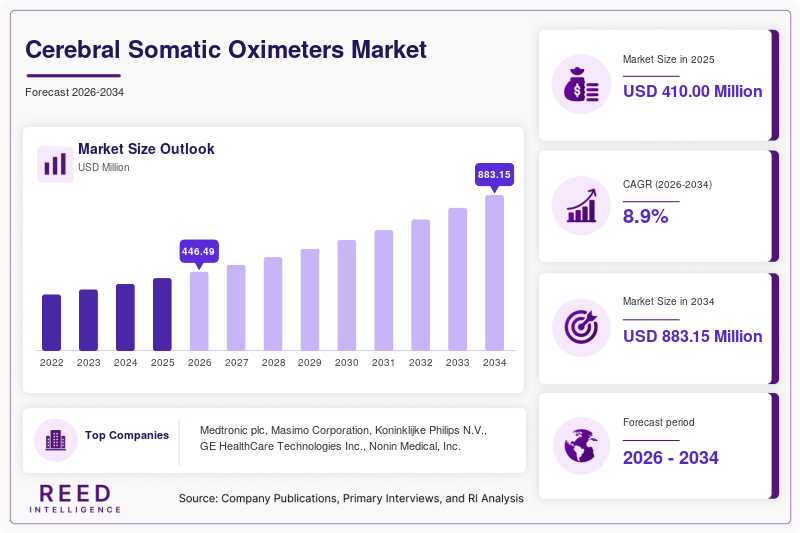
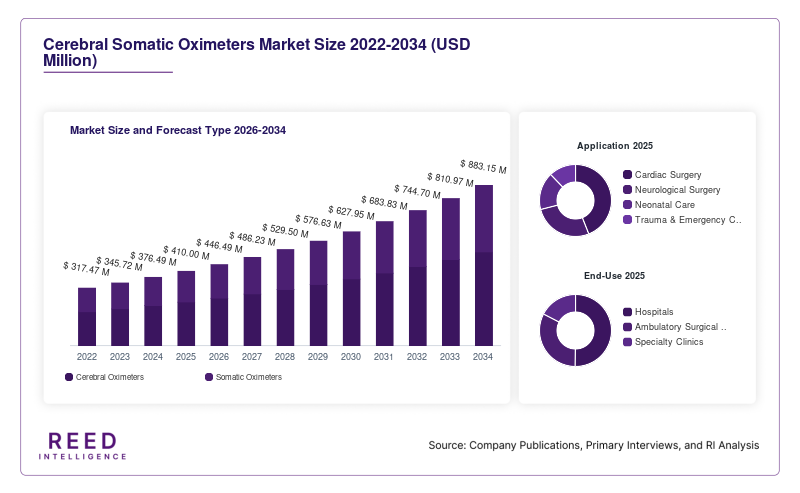
The Cerebral Somatic Oximeters Market size was valued at approximately USD 410 million in 2025 and is projected to reach USD 885 million by 2034, expanding at a CAGR of 8.9% during the forecast period (2025–2034). The market growth is supported by the increasing demand for non-invasive monitoring technologies across critical care, surgical procedures, and neonatal applications. The rising burden of chronic diseases, coupled with advancements in near-infrared spectroscopy (NIRS)-based monitoring systems, has strengthened adoption across hospitals and ambulatory care settings.
A major global factor driving the Cerebral Somatic Oximeters Market is the growing emphasis on patient safety and real-time monitoring during complex surgical interventions. Healthcare providers are increasingly adopting cerebral and somatic oximetry systems to reduce postoperative complications, particularly in cardiovascular and neurological surgeries. These devices enable continuous oxygen saturation monitoring in brain and tissue, helping clinicians make timely decisions.
Key Highlights
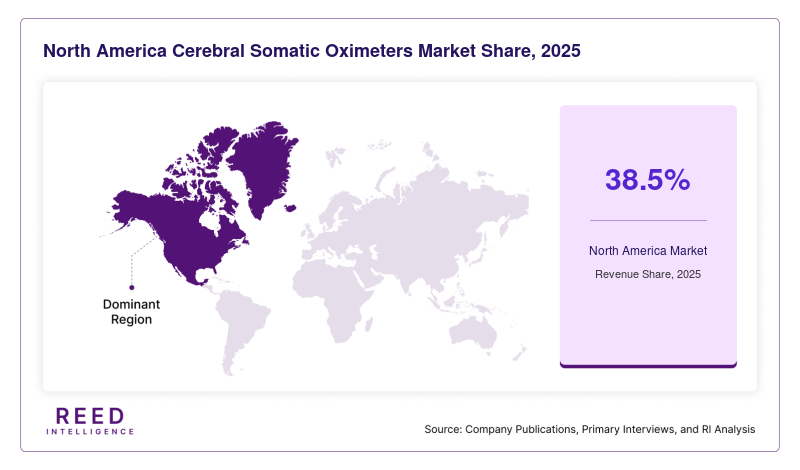
- North America dominated the market with a share of 38.5% in 2025, while Asia Pacific is expected to register the fastest CAGR of 10.4% during the forecast period.
- By type, cerebral oximeters held the largest share (62.3%) in 2025, whereas somatic oximeters are projected to grow at the fastest CAGR of 9.6%.
- By application, cardiac surgery was the leading segment (41.2%), while neonatal care is anticipated to grow at a CAGR of 10.1%.
- The U.S. remained the dominant country, with market values of USD 150 million in 2025 and USD 162 million in 2026.
Market Trends
Integration of Advanced Monitoring Technologies
The Cerebral Somatic Oximeters Market is witnessing a shift toward integrated monitoring platforms that combine cerebral oximetry with other vital parameters such as EEG and hemodynamic monitoring. This integration enhances clinical efficiency by providing a comprehensive view of patient status. Healthcare facilities are increasingly investing in multi-parameter systems to streamline workflows and improve patient outcomes. Technological advancements in sensor accuracy and wireless connectivity are also contributing to improved usability and data interpretation.
Rising Adoption in Neonatal and Pediatric Care
There is a growing trend toward the use of cerebral and somatic oximeters in neonatal intensive care units (NICUs). These devices are being utilized to monitor oxygen saturation in premature infants, reducing the risk of hypoxia-related complications. Increased awareness among healthcare professionals regarding early detection of oxygen imbalance is driving adoption. Furthermore, the expansion of specialized pediatric healthcare infrastructure is supporting the uptake of these monitoring solutions globally.
Market Drivers
Increasing Number of Surgical Procedures
The global rise in surgical interventions, particularly cardiac and neurological procedures, is significantly contributing to the growth of the Cerebral Somatic Oximeters Market. These procedures require precise monitoring of oxygen saturation levels to prevent complications such as ischemia. The increasing prevalence of cardiovascular diseases and aging populations is further driving demand for advanced monitoring systems in operating rooms.
Technological Advancements in Non-Invasive Monitoring
Continuous innovation in non-invasive monitoring technologies is accelerating the adoption of cerebral and somatic oximeters. Improvements in NIRS technology have enhanced measurement accuracy and reduced signal interference. The development of portable and user-friendly devices has expanded their application beyond traditional hospital settings. These advancements are enabling clinicians to monitor patients more effectively, thereby improving clinical outcomes and operational efficiency.
Market Restraint
High Cost of Devices and Limited Reimbursement
The high cost associated with cerebral somatic oximeters and their consumables remains a significant barrier to market growth. Advanced monitoring systems require substantial initial investment, making them less accessible to smaller healthcare facilities, particularly in developing regions. Additionally, limited reimbursement policies for these devices in certain countries restrict their widespread adoption. Healthcare providers often face budget constraints, leading to delayed procurement decisions. The lack of standardized reimbursement frameworks further impacts market penetration. As a result, despite technological advancements and clinical benefits, cost-related challenges continue to hinder the growth of the Cerebral Somatic Oximeters Market.
Market Opportunities
Expansion in Emerging Markets
Emerging economies present significant growth opportunities for the Cerebral Somatic Oximeters Market. Increasing healthcare expenditure, improving hospital infrastructure, and rising awareness about advanced monitoring technologies are driving demand in these regions. Governments are investing in healthcare modernization, which is expected to create favorable conditions for market expansion.
Development of Portable and Wearable Devices
The growing demand for portable and wearable medical devices offers new opportunities for market players. Manufacturers are focusing on developing compact, lightweight oximeters that can be used in ambulatory settings and home care. These innovations are expected to enhance patient convenience and broaden the application scope of cerebral somatic oximeters. The shift toward remote patient monitoring is further supporting the adoption of such devices.
Segmental Analysis
By Type
Cerebral oximeters dominated the Cerebral Somatic Oximeters Market in 2025, accounting for 62.3% of the total share. These devices were widely used in surgical and critical care settings due to their ability to monitor brain oxygenation effectively. Their established clinical relevance and widespread adoption in cardiac and neurological procedures contributed to their leading position.
Somatic oximeters are expected to grow at the fastest CAGR of 9.6% during the forecast period. This growth will be driven by increasing applications in tissue oxygen monitoring and expanding use in postoperative care. The ability to detect localized oxygen deficits is expected to support their growing adoption.
By Application
Cardiac surgery held the largest share of 41.2% in 2025, as cerebral somatic oximeters are extensively used to monitor oxygen saturation during complex procedures. The high risk associated with cardiac surgeries necessitates continuous monitoring, driving the demand for these devices.
Neonatal care is projected to grow at a CAGR of 10.1%, supported by increasing focus on infant health and the need for advanced monitoring in NICUs. Early detection of oxygen imbalance in infants will continue to drive adoption in this segment.
By End-Use
Hospitals accounted for the largest share of 68.5% in 2025, driven by the high volume of surgical procedures and availability of advanced infrastructure. Hospitals remain the primary users of cerebral somatic oximeters due to their comprehensive care capabilities.
Ambulatory surgical centers are expected to grow at a CAGR of 9.2%, supported by the increasing shift toward outpatient procedures. The demand for cost-effective and efficient monitoring solutions in these settings is expected to drive growth.
By Technology
Near-infrared spectroscopy (NIRS) technology dominated the market in 2025, accounting for 74.8% of the share. Its non-invasive nature and ability to provide continuous monitoring made it the preferred choice across healthcare settings.
Advanced hybrid technologies are expected to grow at a CAGR of 9.8%, driven by innovations that combine multiple monitoring parameters. These technologies will enhance diagnostic capabilities and improve clinical outcomes.
Regional Analysis
North America
North America accounted for 38.5% of the Cerebral Somatic Oximeters Market share in 2025 and is expected to grow at a CAGR of 8.1% during the forecast period. The region’s growth is supported by advanced healthcare infrastructure and widespread adoption of innovative medical technologies. The presence of well-established hospitals and increasing demand for patient monitoring systems contribute to sustained market expansion.
The United States dominated the regional market due to the high volume of surgical procedures and strong focus on patient safety. The country benefits from a robust healthcare system and continuous investment in advanced monitoring technologies, which supports the adoption of cerebral somatic oximeters.
Europe
Europe held a market share of 26.7% in 2025 and is projected to grow at a CAGR of 7.8% through 2034. The region’s growth is influenced by increasing healthcare expenditure and a growing emphasis on improving clinical outcomes. Adoption of non-invasive monitoring devices is steadily increasing across hospitals and specialized care centers.
Germany emerged as the leading country in Europe, driven by its strong medical device industry and focus on technological innovation. The country’s well-established healthcare system and emphasis on quality care contribute to the adoption of advanced monitoring solutions.
Asia Pacific
Asia Pacific represented 21.4% of the market share in 2025 and is anticipated to register the fastest CAGR of 10.4% during the forecast period. The region is experiencing rapid growth due to increasing healthcare investments and expanding hospital infrastructure. Rising awareness about advanced monitoring technologies is also contributing to market expansion.
China dominated the regional market, supported by its large patient population and ongoing healthcare reforms. The country’s focus on improving healthcare accessibility and infrastructure development is driving demand for cerebral somatic oximeters.
Middle East & Africa
The Middle East & Africa accounted for 7.1% of the market share in 2025 and is expected to grow at a CAGR of 8.5%. The region is witnessing gradual growth due to improving healthcare infrastructure and increasing investments in medical technologies.
Saudi Arabia led the regional market, driven by government initiatives aimed at healthcare modernization. The country’s focus on enhancing healthcare services is supporting the adoption of advanced monitoring systems.
Latin America
Latin America held a 6.3% market share in 2025 and is projected to grow at a CAGR of 8.2% during the forecast period. The region’s growth is supported by increasing healthcare awareness and expanding access to medical services.
Brazil dominated the market in Latin America, supported by its large healthcare sector and growing investment in medical technology. The country’s efforts to improve healthcare delivery are contributing to the adoption of cerebral somatic oximeters.
Competitive Landscape
The Cerebral Somatic Oximeters Market is moderately competitive, with several global and regional players focusing on product innovation and strategic collaborations. Leading companies are investing in research and development to enhance device accuracy and expand application areas.
Medtronic plc emerged as a key market leader due to its strong product portfolio and global presence. The company has recently introduced advanced oximetry systems with improved sensor technology, strengthening its position in the market. Other prominent players are also focusing on expanding their distribution networks and developing cost-effective solutions to increase market penetration.
Strategic partnerships, mergers, and acquisitions are common in this market as companies aim to enhance their technological capabilities and geographic reach. Continuous innovation remains a critical factor for maintaining competitiveness.
Key Players List
- Medtronic plc
- Masimo Corporation
- Koninklijke Philips N.V.
- GE HealthCare Technologies Inc.
- Nonin Medical, Inc.
- Edwards Lifesciences Corporation
- NIRO (Hamamatsu Photonics)
- ISS Inc.
- Artinis Medical Systems
- CAS Medical Systems (Edwards Lifesciences)
- Medcaptain Medical Technology
- Shenzhen Mindray Bio-Medical Electronics Co., Ltd.
- OSYPKA Medical
- SenSmart (Nonin Medical)
- Biox Systems Ltd.
Recent Developments
- Medtronic plc launched an upgraded cerebral oximetry platform with enhanced real-time analytics capabilities.
- Masimo Corporation introduced a new generation of wearable oximetry sensors for continuous monitoring.
- GE HealthCare expanded its patient monitoring portfolio with integrated oximetry solutions.
- Philips Healthcare developed advanced multi-parameter monitoring systems incorporating cerebral oximetry.
- Mindray announced expansion into emerging markets with cost-effective monitoring solutions.
Cerebral Somatic Oximeters Market Segments
Type
- Cerebral Oximeters
- Somatic Oximeters
Application
- Cardiac Surgery
- Neurological Surgery
- Neonatal Care
- Trauma & Emergency Care
End-Use
- Hospitals
- Ambulatory Surgical Centers
- Specialty Clinics
Technology
- Near-Infrared Spectroscopy (NIRS)
- Hybrid Monitoring Technologies
By Region
- North America
- Europe
- APAC
- Middle East and Africa
- LATAM