Cerium IV Oxide Market Size, Share & Demand Report By Application (Catalysts, Polishing, Energy Storage, Glass Additives, Others), By Purity Level (Low Purity, High Purity (>99.9%), Ultra-High Purity), By Form (Powder, Granules, Dispersion/Suspension), By End-Use Industry (Automotive, Electronics, Energy, Glass & Optics, Chemical), By Region & Segment Forecasts, 2025–2034
USD 3950
Market Overview
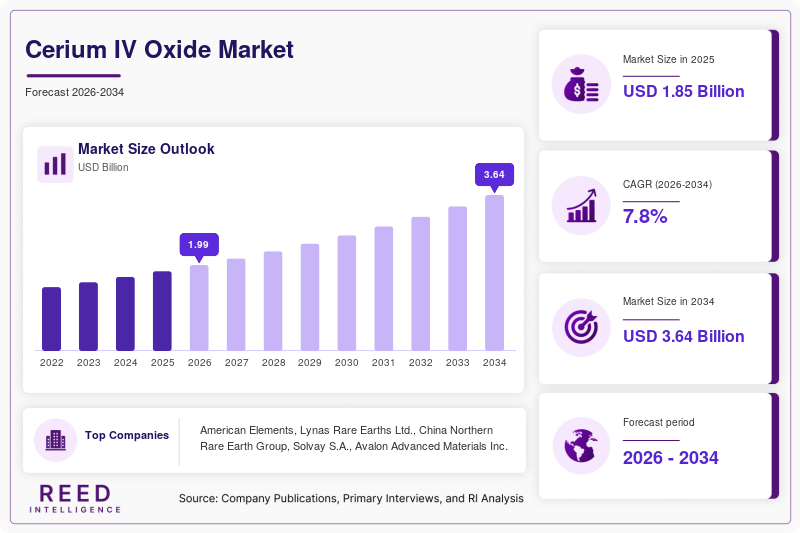
The Cerium IV Oxide Market size was valued at approximately USD 1.85 billion in 2025 and is projected to reach USD 3.62 billion by 2034, expanding at a CAGR of 7.8% during the forecast period (2025–2034). The market growth has been supported by the increasing global emphasis on emission control technologies, particularly in automotive and industrial applications where cerium oxide plays a critical role as a catalyst.
A key global factor driving the market is the rapid expansion of environmental regulations aimed at reducing air pollution. Cerium IV oxide, widely used in catalytic converters and fuel additives, has become essential in improving fuel efficiency and lowering emissions. The rising production of automobiles, along with stricter emission norms across major economies, has contributed significantly to sustained demand.
Key Highlights
- Asia Pacific dominated the market with a 42.6% share in 2025 and will grow at the fastest CAGR of 8.5% through 2034.
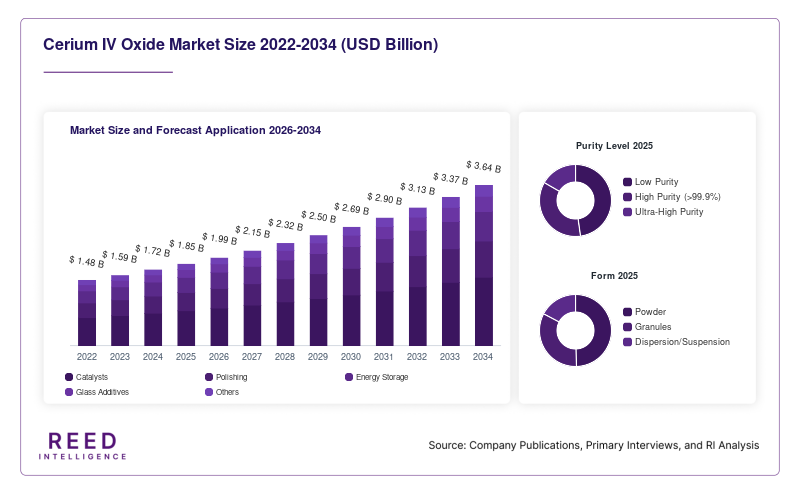
- By application, catalysts led with a 34.2% share, while energy storage applications will register the fastest CAGR of 9.1%.
- By purity, high-purity cerium oxide (>99.9%) dominated with 46.8% share, whereas ultra-high purity grades will grow fastest at 9.4% CAGR.
- China remained the dominant country, with market values of USD 620 million in 2025 and USD 665 million in 2026.
Market Trends
Rising Adoption in Advanced Electronics Manufacturing
The increasing miniaturization of electronic devices has led to higher demand for precision polishing materials. Cerium IV oxide is widely used in chemical mechanical planarization (CMP) processes for semiconductors. As semiconductor fabrication becomes more complex, manufacturers are relying on high-purity cerium oxide to achieve defect-free surfaces. This trend is particularly prominent in Asia Pacific, where electronics manufacturing hubs are expanding rapidly.
Growing Integration in Renewable Energy Systems
Cerium IV oxide is gaining traction in renewable energy applications, including solid oxide fuel cells (SOFCs) and solar energy systems. Its oxygen storage capacity and thermal stability make it suitable for enhancing efficiency in energy conversion technologies. With global investments in clean energy increasing, the use of cerium oxide in next-generation energy systems is becoming more widespread. This trend is expected to contribute to the diversification of the Cerium IV Oxide Market beyond traditional automotive applications.
Market Drivers
Increasing Demand for Emission Control Technologies
The implementation of stringent emission regulations across developed and developing economies has increased the demand for catalytic converters. Cerium IV oxide plays a vital role in these systems due to its ability to store and release oxygen, improving combustion efficiency and reducing harmful emissions. As governments continue to enforce stricter norms, the demand for cerium-based catalysts is expected to rise steadily.
Expansion of Glass Polishing and Optical Applications
Cerium IV oxide is extensively used in polishing glass surfaces, including precision optics, LCD screens, and photovoltaic panels. The expansion of the consumer electronics industry and the rising demand for high-quality optical components have driven the adoption of cerium oxide-based polishing compounds. Its superior polishing efficiency compared to alternative materials has made it a preferred choice in high-end manufacturing processes.
Market Restraint
Volatility in Rare Earth Supply Chain
The Cerium IV Oxide Market faces a significant challenge due to fluctuations in the supply of rare earth elements. Cerium is primarily sourced from limited geographic regions, making the supply chain vulnerable to geopolitical tensions, trade restrictions, and mining regulations. Price volatility in rare earth materials directly impacts production costs, creating uncertainty for manufacturers and end-users.
Additionally, the environmental impact of rare earth mining has led to stricter regulations, further constraining supply. Companies are increasingly focusing on recycling and alternative sourcing strategies; however, these solutions are still in the early stages of adoption. This restraint is expected to influence pricing dynamics and limit market expansion in the short term.
Market Opportunities
Development of Nanostructured Cerium Oxide
Nanotechnology is opening new avenues for cerium IV oxide applications. Nanostructured cerium oxide exhibits enhanced catalytic and antioxidant properties, making it suitable for advanced biomedical, environmental, and industrial uses. The development of nano-ceria is expected to create opportunities in drug delivery systems, fuel additives, and environmental remediation.
Growth in Electric Vehicle Infrastructure
The expansion of electric vehicle (EV) infrastructure presents indirect opportunities for cerium IV oxide. While EVs reduce reliance on traditional catalytic converters, cerium oxide is being explored for use in battery systems and energy storage solutions. Its role in improving thermal stability and performance of battery components could open new revenue streams as the EV ecosystem evolves.
Segmental Analysis
By Application
The catalysts segment dominated the Cerium IV Oxide Market, accounting for 34.2% of the share in 2025. This dominance was attributed to the widespread use of cerium oxide in automotive catalytic converters and industrial emission control systems. Its oxygen storage capacity and ability to enhance catalytic efficiency made it indispensable in reducing emissions.
The energy storage segment will grow at the fastest CAGR of 9.1% during the forecast period. This growth will be driven by the increasing adoption of cerium oxide in fuel cells and battery technologies. Its role in improving energy efficiency and stability will support its expansion in next-generation energy systems.
By Purity Level
High-purity cerium oxide (>99.9%) dominated the market with a 46.8% share in 2025. This segment was widely used in precision applications such as electronics and optics, where high material quality is essential.
Ultra-high purity cerium oxide will register the fastest CAGR of 9.4% through 2034. The growth factor will be the rising demand for advanced semiconductor manufacturing processes, which require extremely pure materials to ensure performance and reliability.
By Form
Powder form dominated the Cerium IV Oxide Market, accounting for 52.3% of the share in 2025. Its ease of handling and versatility in applications such as polishing, catalysts, and coatings contributed to its widespread adoption.
Dispersion and suspension forms will grow at the fastest CAGR of 8.8%. These forms will gain traction due to their improved performance in precision polishing and coating applications, particularly in electronics manufacturing.
By End-Use Industry
The automotive industry dominated with a 31.7% share in 2025, driven by the extensive use of cerium oxide in catalytic converters and fuel additives. The increasing production of vehicles globally supported this segment’s growth.
The electronics industry will grow at the fastest CAGR of 9.0% during the forecast period. The growth factor will be the rising demand for high-performance electronic devices, which require advanced polishing materials and components.
Regional Analysis
North America
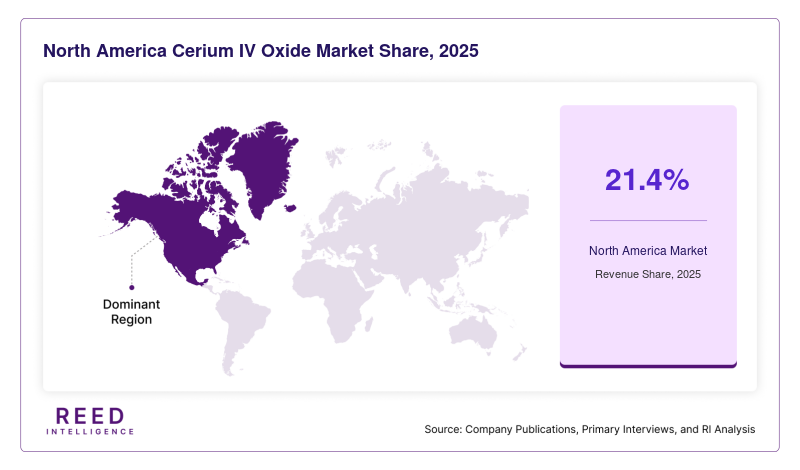
North America accounted for 21.4% of the Cerium IV Oxide Market share in 2025 and will grow at a CAGR of 7.2% through 2034. The region’s established automotive and aerospace industries contributed to consistent demand for cerium-based catalysts and polishing materials. Additionally, strong research and development capabilities supported the adoption of advanced materials in industrial applications.
The United States dominated the regional market due to its focus on technological innovation. The growth factor in the country is the increasing investment in semiconductor manufacturing, which requires high-purity cerium oxide for polishing applications.
Europe
Europe held a 19.8% market share in 2025 and will expand at a CAGR of 7.0% during the forecast period. The region’s strict environmental policies have driven the adoption of emission control technologies, supporting the demand for cerium IV oxide in catalytic converters.
Germany led the market, supported by its strong automotive manufacturing base. The key growth factor is the country’s emphasis on sustainable manufacturing practices, which has increased the use of cerium oxide in eco-friendly industrial processes.
Asia Pacific
Asia Pacific dominated the Cerium IV Oxide Market with a 42.6% share in 2025 and will register the fastest CAGR of 8.5% through 2034. Rapid industrialization, expanding electronics manufacturing, and increasing automotive production have driven regional demand.
China emerged as the leading country due to its abundant rare earth resources and large-scale production capabilities. The growth factor is the country’s dominance in rare earth mining and processing, which ensures a stable supply of cerium oxide for domestic and international markets.
Middle East & Africa
The Middle East & Africa region accounted for 8.3% of the market share in 2025 and will grow at a CAGR of 6.8%. The region’s growing industrial base and investments in infrastructure development have contributed to moderate demand for cerium oxide.
Saudi Arabia dominated the region, driven by its focus on diversifying its economy. The key growth factor is the expansion of industrial manufacturing sectors, which require advanced materials such as cerium oxide.
Latin America
Latin America held a 7.9% share of the Cerium IV Oxide Market in 2025 and is expected to grow at a CAGR of 6.9% through 2034. The region’s automotive and mining industries have supported steady demand.
Brazil led the market due to its growing industrial sector. The growth factor is the increasing adoption of advanced materials in manufacturing processes, which has boosted the use of cerium oxide in polishing and catalytic applications.
Competitive Landscape
The Cerium IV Oxide Market is moderately consolidated, with key players focusing on product innovation, capacity expansion, and strategic partnerships. Leading companies are investing in high-purity and nano-scale cerium oxide to cater to emerging applications.
A prominent market leader is American Elements, known for its extensive portfolio of rare earth materials and strong global distribution network. The company recently expanded its production capacity for high-purity cerium oxide to meet growing demand from the electronics sector.
Other major players are focusing on strengthening their supply chains and enhancing product quality to remain competitive. The market also features regional players that leverage local rare earth resources to maintain cost advantages.
Key Players
- American Elements
- Lynas Rare Earths Ltd.
- China Northern Rare Earth Group
- Solvay S.A.
- Avalon Advanced Materials Inc.
- Arafura Resources Limited
- Indian Rare Earths Limited
- Neo Performance Materials Inc.
- Metall Rare Earth Limited
- Baotou Rare Earth Hi-Tech Co.
- Treibacher Industrie AG
- Ganzhou Rare Earth Group
- Jiangxi Rare Earth & Rare Metals Tungsten Group
- Hefa Rare Earth Canada Co. Ltd.
- Shenzhen Chuanyan Technology Co. Ltd.
Recent Developments
- In 2024, American Elements expanded its nano-ceria production capacity to address increasing demand in biomedical and energy applications.
- In 2023, Lynas Rare Earths Ltd. announced investments in refining capabilities to strengthen supply chain resilience.
- In 2024, Solvay S.A. introduced advanced cerium oxide polishing compounds for semiconductor applications.
- In 2023, Neo Performance Materials launched high-purity cerium oxide products targeting electronics manufacturers.
- In 2024, Indian Rare Earths Limited enhanced its production facilities to increase output for domestic consumption.
Cerium IV Oxide Market Segments
Application
- Catalysts
- Polishing
- Energy Storage
- Glass Additives
- Others
Purity Level
- Low Purity
- High Purity (>99.9%)
- Ultra-High Purity
Form
- Powder
- Granules
- Dispersion/Suspension
End-Use Industry
- Automotive
- Electronics
- Energy
- Glass & Optics
- Chemical
By Region
- North America
- Europe
- APAC
- Middle East and Africa
- LATAM