Cetane Improver Additive Market Size, Share & Demand Report By Type (Nitrate-Based Cetane Improvers, Peroxide-Based Additives), By Fuel Type (Diesel Fuel, Biodiesel, Renewable Diesel), By Application (Automotive, Marine, Industrial Machinery), By End-Use Industry (Transportation, Energy & Utilities, Mining), By Distribution Channel (Direct Sales, Distributor Networks) By Region & Segment Forecasts, 2026–2034
USD 3950
Market Overview
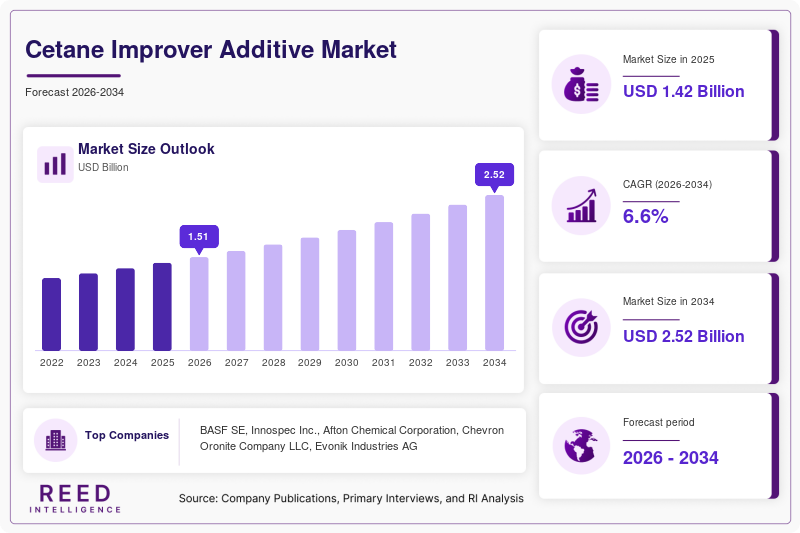
The global Cetane Improver Additive Market was valued at USD 1.42 billion in 2026 and is projected to reach USD 2.36 billion by 2034, expanding at a CAGR of 6.6% during the forecast period from 2026 to 2034. The market growth has been supported by the increasing global demand for cleaner-burning diesel fuels and improved fuel combustion efficiency across transportation, industrial, marine, and agricultural sectors. Cetane improver additives are widely used to enhance ignition quality in diesel fuel, reduce engine knocking, improve cold-start performance, and minimize emissions.
Rising regulatory pressure regarding fuel efficiency and emission reduction has accelerated the adoption of advanced fuel additives worldwide. Governments across developed and emerging economies are implementing stricter diesel fuel quality standards, encouraging refiners and fuel suppliers to integrate cetane enhancement additives into fuel formulations. The growing commercial vehicle fleet, expansion of logistics operations, and rising diesel consumption in industrial applications have further contributed to market growth.
Key Highlights
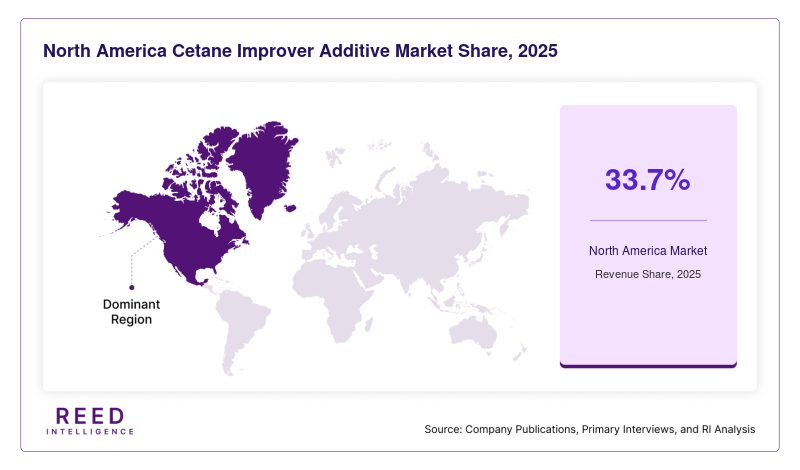
- North America accounted for 33.7% of the global Cetane Improver Additive Market share in 2025, while Asia Pacific is projected to register the fastest CAGR of 7.8% during the forecast period.
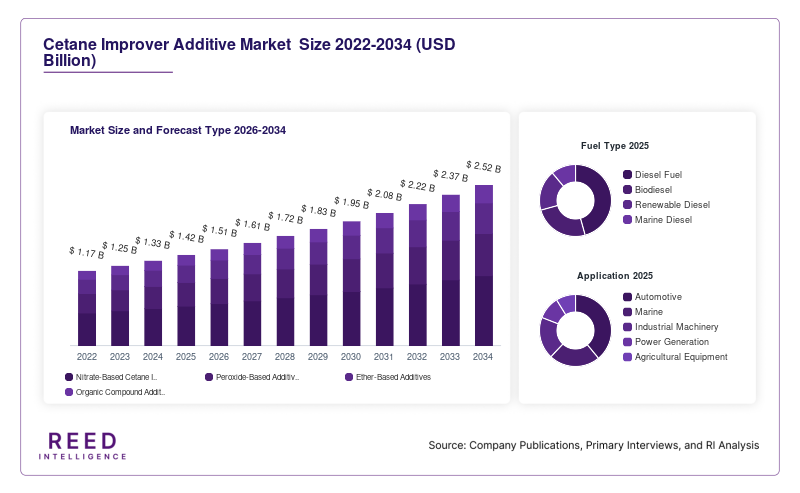
- By type, nitrate-based cetane improvers held the leading share of 46.3% in 2025, while peroxide-based additives are expected to witness the fastest CAGR of 7.4% through 2034.
- By fuel type, diesel fuel applications dominated with 71.8% market share in 2025, whereas biodiesel applications are anticipated to grow at a CAGR of 8.1%.
- By application, automotive applications represented 39.4% of the market in 2025, while marine applications are projected to expand at a CAGR of 7.9%.
- By end-use industry, transportation remained the dominant segment with 36.8% share in 2025, while power generation is expected to grow at a CAGR of 7.5%.
- The United States Cetane Improver Additive Market was valued at USD 318 million in 2024 and reached USD 336 million in 2025 due to increasing diesel fuel optimization requirements.
Market Trends
Growing Adoption of Multifunctional Fuel Additives
The Cetane Improver Additive Market is witnessing increased demand for multifunctional fuel additives that combine ignition enhancement with deposit cleaning, corrosion inhibition, and lubricity improvement. Fuel suppliers and fleet operators are increasingly preferring integrated additive packages to improve engine performance and reduce maintenance intervals. These advanced formulations are gaining popularity in commercial transportation and heavy-duty industrial applications.
Shift Toward Bio-Based Additive Formulations
Manufacturers are focusing on developing environmentally compatible cetane improver additives derived from renewable feedstocks. Bio-based formulations are being introduced to align with sustainability goals and emission reduction initiatives. The increasing use of biodiesel blends has further encouraged the development of additives capable of improving oxidation stability and combustion efficiency in renewable fuel applications.
Market Drivers
Expansion of Commercial Transportation Fleets
The rapid expansion of commercial transportation and freight movement activities is a major factor driving the Cetane Improver Additive Market. Heavy-duty diesel vehicles require optimized fuel combustion to maintain engine performance and operational efficiency. Cetane improvers help reduce ignition delay and improve fuel burn characteristics, which supports smoother engine operation and lower exhaust emissions.
The increasing demand for logistics services, cross-border freight transportation, and industrial supply chain activities has accelerated diesel fuel consumption globally. This has created stable demand for advanced fuel additive solutions across trucking and transportation sectors.
Stringent Fuel Quality and Emission Regulations
The implementation of strict fuel quality regulations is supporting growth in the Cetane Improver Additive Market. Regulatory authorities are introducing low-emission fuel standards that require refiners to enhance fuel ignition quality and combustion efficiency. Cetane improver additives help fuel suppliers comply with these standards while maintaining engine reliability.
The adoption of ultra-low sulfur diesel fuel in several countries has also increased the need for ignition-enhancing additives to compensate for performance changes caused by sulfur reduction processes.
Market Restraint
Volatility in Crude Oil and Chemical Feedstock Prices
Fluctuating crude oil prices and instability in chemical raw material costs remain significant restraints for the Cetane Improver Additive Market. Manufacturers depend on petrochemical-derived compounds for additive production, and sudden price increases can impact production costs and profit margins. Market participants also face challenges in maintaining long-term pricing stability in highly competitive fuel additive markets.
Market Opportunities
Rising Demand for Biodiesel Blending Solutions
The growing adoption of biodiesel fuels is creating new opportunities in the Cetane Improver Additive Market. Biodiesel blends often require ignition enhancement to improve cold-weather performance and combustion stability. Additive manufacturers are developing customized cetane improver solutions specifically designed for renewable diesel and biodiesel fuel formulations.
Increasing Marine Fuel Optimization Programs
The marine industry is increasingly investing in fuel optimization strategies to improve vessel efficiency and reduce operational costs. Cetane improver additives are gaining traction in marine diesel engines due to their ability to enhance combustion quality and reduce fuel consumption. Expanding global shipping activities are expected to create long-term growth opportunities for marine fuel additive suppliers.
Segmental Analysis
By Type
Nitrate-Based Cetane Improvers: Nitrate-based cetane improvers accounted for 46.3% of the Cetane Improver Additive Market share in 2025. Their dominance was driven by strong ignition enhancement efficiency and compatibility with conventional diesel fuel formulations. These additives remained widely used in transportation and industrial diesel applications.
Peroxide-Based Additives: Peroxide-based additives are projected to grow at a CAGR of 7.4% through 2034. Increasing demand for cleaner combustion technologies and advanced fuel formulations will support segment expansion. Manufacturers are expected to invest in peroxide chemistries that improve combustion efficiency while minimizing emissions.
By Fuel Type
Diesel Fuel: Diesel fuel applications held the largest share of 71.8% in 2025 due to widespread use across commercial vehicles, industrial machinery, marine engines, and power generation systems. Cetane improver additives remained essential for maintaining diesel engine performance and reducing ignition delays.
Biodiesel: Biodiesel applications are expected to register a CAGR of 8.1% during the forecast period. The increasing use of renewable fuel blends and government support for low-carbon fuels will accelerate additive demand. Cetane improvers are anticipated to play a significant role in improving biodiesel combustion stability and cold-weather operation.
By Application
Automotive Applications: Automotive applications accounted for 39.4% of the Cetane Improver Additive Market in 2025. The segment benefited from high diesel fuel consumption across freight transportation, commercial trucking, and passenger diesel vehicles.
Marine Applications: Marine applications are projected to grow at a CAGR of 7.9% through 2034. Expanding global trade routes and increasing focus on marine fuel efficiency will support adoption of cetane enhancement additives in shipping operations.
By End-Use Industry
Transportation:The transportation segment held 36.8% of the global Cetane Improver Additive Market share in 2025. Demand remained high due to increasing diesel consumption in trucking, rail transport, and fleet operations.
Power Generation:Power generation is expected to witness the fastest CAGR of 7.5% during the forecast period. Rising use of diesel generators in industrial facilities and backup energy systems will strengthen demand for fuel performance additives.
By Distribution Channel
Direct Sales: Direct sales accounted for 64.5% of the Cetane Improver Additive Market share in 2025. Large fuel suppliers and industrial consumers preferred direct procurement agreements to ensure consistent additive supply and pricing stability.
Distributor Networks: Distributor networks are projected to expand at a CAGR of 7.2% through 2034. Growth in regional fuel additive demand and expanding aftermarket fuel treatment solutions will support segment expansion.
Regional Analysis
North America
North America accounted for 33.7% of the global Cetane Improver Additive Market share in 2025 and is expected to grow at a CAGR of 6.1% through 2034. The regional market benefited from advanced refining infrastructure and high diesel fuel consumption across transportation and industrial sectors.
The United States dominated the regional market due to increasing demand for fuel-efficient commercial vehicle operations. The country experienced higher adoption of cetane improver additives in heavy-duty trucking and agricultural machinery applications to improve fuel ignition quality and operational reliability.
Europe
Europe represented 27.2% of the Cetane Improver Additive Market in 2025 and is projected to expand at a CAGR of 6.3% during the forecast period. The market was supported by strict environmental regulations and widespread use of advanced diesel engine technologies.
Germany emerged as the leading country in the region owing to its large automotive manufacturing sector and emphasis on fuel efficiency standards. Refiners and fuel distributors increasingly incorporated cetane enhancement additives into premium diesel fuel products.
Asia Pacific
Asia Pacific held 24.8% of the Cetane Improver Additive Market share in 2025 and is anticipated to witness the fastest CAGR of 7.8% from 2026 to 2034. Industrial expansion, growing commercial transportation activities, and increasing diesel fuel consumption contributed to regional market growth.
China dominated the regional market due to rising infrastructure development and rapid expansion of industrial transportation networks. The country witnessed increasing use of fuel additives in mining equipment, logistics fleets, and construction machinery.
Middle East & Africa
The Middle East & Africa accounted for 8.1% of the Cetane Improver Additive Market in 2025 and is forecast to grow at a CAGR of 6.5% through 2034. The market benefited from expanding refinery operations and rising industrial fuel consumption.
Saudi Arabia emerged as the dominant country in the region because of increasing investments in fuel quality enhancement programs and refining modernization projects. Industrial diesel engine applications supported steady demand for cetane improver additives.
Latin America
Latin America captured 6.2% of the Cetane Improver Additive Market share in 2025 and is expected to grow at a CAGR of 6.0% during the forecast period. The region experienced increasing demand for diesel performance additives across agricultural and transportation industries.
Brazil led the regional market owing to expanding biodiesel production and rising adoption of fuel optimization technologies in agricultural equipment and freight transportation fleets.
Competitive Landscape
The Cetane Improver Additive Market remains moderately consolidated with the presence of multinational chemical companies and specialized fuel additive manufacturers. Companies are focusing on advanced additive formulations, strategic refinery partnerships, and product innovation to strengthen their competitive position.
BASF SE remained a leading participant in the Cetane Improver Additive Market due to its broad fuel additive portfolio and strong refining industry partnerships. The company recently introduced an advanced multifunctional cetane improver designed to improve diesel combustion efficiency while reducing injector deposits in commercial vehicle engines.
Innospec Inc. focused on expanding additive solutions for marine and industrial diesel applications. Afton Chemical Corporation strengthened its fuel performance additive business through refinery collaborations. Chevron Oronite Company LLC invested in advanced diesel additive technologies targeting emission reduction goals. Evonik Industries AG emphasized sustainable additive chemistries compatible with renewable fuel blends.
Key Players List
- BASF SE
- Innospec Inc.
- Afton Chemical Corporation
- Chevron Oronite Company LLC
- Evonik Industries AG
- Dorf Ketal Chemicals
- TotalEnergies Additives and Fuels Solutions
- Clariant AG
- Lubrizol Corporation
- Infineum International Limited
- Eurenco
- LANXESS AG
- Croda International Plc
- Baker Hughes Company
- Cummins Inc.
Recent Developments
- In February 2026, BASF SE launched a multifunctional cetane improver additive designed for ultra-low sulfur diesel applications in commercial transportation fleets.
- In November 2025, Innospec Inc. expanded its marine fuel additive production capacity to address increasing global shipping demand.
- In September 2025, Chevron Oronite Company LLC introduced a new cetane improver formulation compatible with biodiesel blending requirements.
- In July 2025, Evonik Industries AG announced research investments focused on sustainable fuel additive technologies derived from renewable feedstocks.
- In April 2025, Afton Chemical Corporation partnered with regional fuel distributors to strengthen additive supply networks across Asia Pacific.
Cetane Improver Additive Market Segments
Type
- Nitrate-Based Cetane Improvers
- Peroxide-Based Additives
- Ether-Based Additives
- Organic Compound Additives
Fuel Type
- Diesel Fuel
- Biodiesel
- Renewable Diesel
- Marine Diesel
Application
- Automotive
- Marine
- Industrial Machinery
- Power Generation
- Agricultural Equipment
End-Use Industry
- Transportation
- Energy & Utilities
- Mining
- Construction
- Agriculture
- Marine Industry
Distribution Channel
- Direct Sales
- Distributor Networks
- Online Procurement
By Region
- North America
- Europe
- APAC
- Middle East and Africa
- LATAM