Cetostearyl Alcohol Market Size, Share & Demand Report By Type (Synthetic, Bio-Based), By Application (Personal Care & Cosmetics, Pharmaceuticals, Industrial), By Form (Solid, Liquid), By End-Use Industry (Cosmetics, Pharmaceuticals, Chemical Manufacturing), By Region & Segment Forecasts, 2026–2034
USD 3950
Market Overview
The global Cetostearyl Alcohol Market size was valued at USD 5.1 billion in 2026 and is projected to reach USD 8.7 billion by 2034, expanding at a CAGR of 6.8% during the forecast period (2026–2034). Cetostearyl alcohol, a fatty alcohol blend primarily composed of cetyl and stearyl alcohols, is widely used as an emollient, emulsifier, and thickening agent in cosmetics, pharmaceuticals, and personal care formulations. Its multifunctional properties and compatibility with a broad range of ingredients have positioned it as a critical component in product formulations.
A key global factor supporting the growth of the Cetostearyl Alcohol Market is the rising demand for multifunctional and stable ingredients in personal care formulations. Manufacturers are increasingly focusing on improving product texture, shelf life, and sensory performance, which has driven the adoption of cetostearyl alcohol across diverse applications.
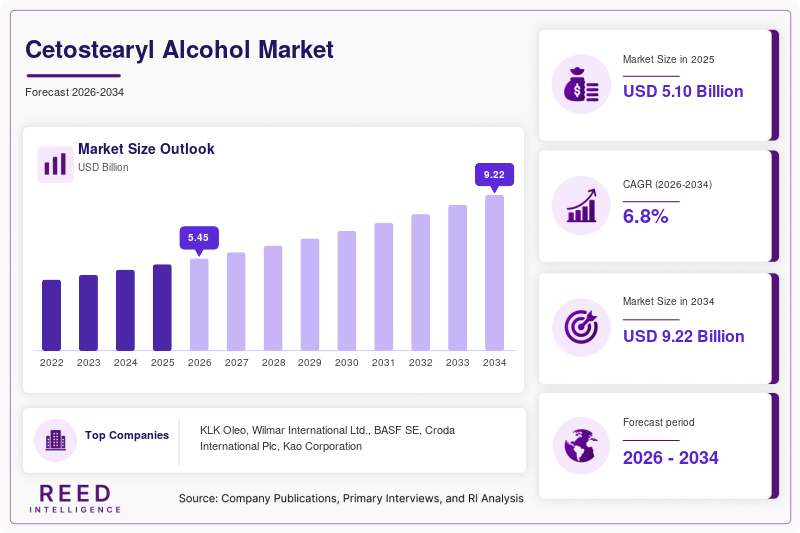
Key Highlights:
- Asia Pacific dominated the market with a 38.5% share in 2025, while it is projected to be the fastest-growing region with a CAGR of 7.5%.
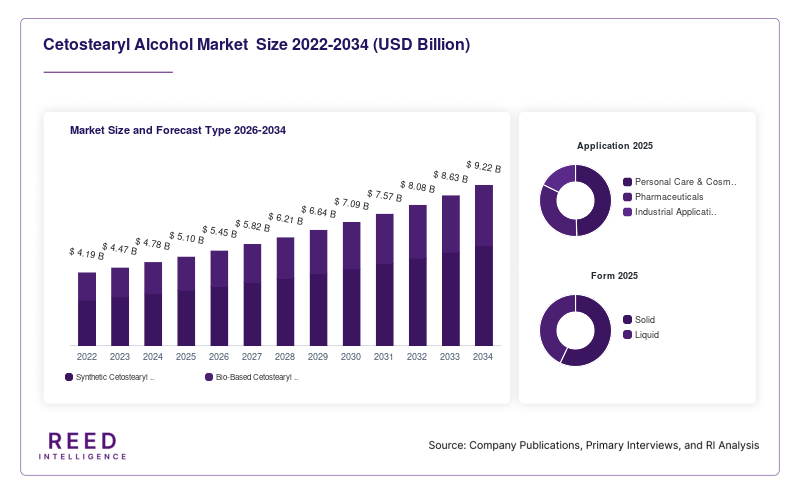
- By type, synthetic cetostearyl alcohol accounted for the largest share at 61.2%, whereas bio-based variants are expected to grow at the fastest CAGR of 8.3%.
- By application, personal care and cosmetics led with 54.6% share, while pharmaceutical applications are projected to grow at a CAGR of 7.9%.
- The U.S. remained the dominant country, with market values of USD 1.1 billion in 2024 and USD 1.2 billion in 2025.
Market Trends
Shift Toward Bio-Based and Sustainable Ingredients
The Cetostearyl Alcohol Market is witnessing a transition toward bio-based and sustainably sourced ingredients. Consumers are becoming more conscious about ingredient origins, pushing manufacturers to adopt plant-derived cetostearyl alcohol sourced from coconut or palm oils certified under sustainable frameworks. This trend is influencing product innovation, with companies reformulating existing offerings to align with eco-conscious consumer preferences. The increased use of biodegradable and renewable raw materials is also helping brands strengthen their sustainability credentials and comply with evolving environmental standards.
Expansion of Multifunctional Personal Care Formulations
Another notable trend in the Cetostearyl Alcohol Market is the growing demand for multifunctional personal care products. Consumers are seeking products that offer hydration, stability, and improved texture in a single formulation. Cetostearyl alcohol plays a vital role as a stabilizer and emulsifier, enabling the development of creams, lotions, and conditioners with enhanced performance. This trend is particularly evident in premium skincare and haircare segments, where product differentiation is driven by formulation efficiency and sensory attributes. As a result, manufacturers are investing in advanced formulation technologies to maximize the functional benefits of cetostearyl alcohol.
Market Drivers
Rising Demand from Personal Care Industry
The expanding personal care industry is a major driver of the Cetostearyl Alcohol Market. The increasing consumption of skincare, haircare, and cosmetic products has led to higher demand for effective emulsifiers and stabilizers. Cetostearyl alcohol is widely used in creams, lotions, and conditioners due to its ability to improve product consistency and enhance user experience. The growing focus on grooming and appearance across both developed and emerging markets continues to support sustained demand for cetostearyl alcohol.
Growth in Pharmaceutical Formulations
The pharmaceutical sector is another key contributor to market growth. Cetostearyl alcohol is extensively used in topical formulations such as ointments and creams due to its emulsifying and thickening properties. The rising prevalence of dermatological conditions and increasing demand for topical drug delivery systems are driving its adoption in pharmaceutical applications. Additionally, advancements in drug formulation technologies are encouraging the use of cetostearyl alcohol to improve drug stability and efficacy.
Market Restraint
Volatility in Raw Material Prices
One of the primary restraints in the Cetostearyl Alcohol Market is the fluctuation in raw material prices. The production of cetostearyl alcohol largely depends on fatty alcohols derived from natural oils such as palm and coconut. Price volatility in these raw materials, driven by climatic conditions, supply chain disruptions, and geopolitical factors, can significantly impact production costs. This volatility creates uncertainty for manufacturers and affects profit margins.
Additionally, the dependency on agricultural commodities introduces risks related to sustainability and regulatory compliance. Variations in supply can lead to inconsistent pricing, making it challenging for manufacturers to maintain stable pricing strategies. This factor may hinder market growth, particularly for smaller players with limited access to diversified supply chains.
Market Opportunities
Growth in Emerging Markets
Emerging economies present significant growth opportunities for the Cetostearyl Alcohol Market. Rapid urbanization, increasing disposable incomes, and changing consumer lifestyles are driving the demand for personal care and pharmaceutical products. Countries in Asia Pacific, Latin America, and Africa are witnessing a surge in demand for affordable and high-quality personal care products, which is expected to boost the consumption of cetostearyl alcohol. Manufacturers can leverage these opportunities by expanding their distribution networks and tailoring products to regional preferences.
Innovation in Green Chemistry
Advancements in green chemistry offer promising opportunities for market expansion. The development of eco-friendly production processes and bio-based alternatives is gaining traction in the industry. Companies investing in sustainable production technologies can differentiate themselves and capture a larger market share. The increasing regulatory focus on environmental sustainability is also encouraging the adoption of greener manufacturing practices, creating new avenues for growth in the Cetostearyl Alcohol Market.
Segmental Analysis
By Type
Synthetic cetostearyl alcohol dominated the Cetostearyl Alcohol Market in 2025, accounting for 61.2% of the total share. Its cost-effectiveness and consistent quality have made it a preferred choice among manufacturers. The widespread availability and ease of production have further supported its dominance.
Bio-based cetostearyl alcohol is expected to witness the fastest growth, with a projected CAGR of 8.3%. The increasing demand for sustainable and eco-friendly ingredients is driving this segment. Manufacturers are focusing on developing bio-based alternatives to meet consumer preferences and regulatory requirements.
By Application
The personal care and cosmetics segment held the largest share of 54.6% in 2025. The extensive use of cetostearyl alcohol in creams, lotions, and conditioners has driven its demand in this segment. The growing emphasis on product quality and performance has further supported its adoption.
The pharmaceutical segment is projected to grow at a CAGR of 7.9%. The increasing use of cetostearyl alcohol in topical formulations and drug delivery systems is driving this growth. The rising prevalence of skin-related conditions is also contributing to segment expansion.
By Form
Solid form dominated the Cetostearyl Alcohol Market in 2025, with a significant share due to its ease of handling and storage. The solid form is widely used in manufacturing processes, making it a preferred choice among producers.
Liquid form is expected to grow at the fastest CAGR of 7.2%. Its ease of incorporation into formulations and improved processing efficiency are key factors driving its growth. Manufacturers are increasingly adopting liquid forms to enhance production efficiency.
By End-Use Industry
The cosmetics industry accounted for the largest share in 2025, driven by high demand for skincare and haircare products. Cetostearyl alcohol's ability to enhance texture and stability has made it a key ingredient in cosmetic formulations.
The pharmaceutical industry is expected to grow at a CAGR of 7.6%. The increasing demand for topical medications and advancements in drug formulation technologies are driving this segment.
<
Regional Analysis
North America
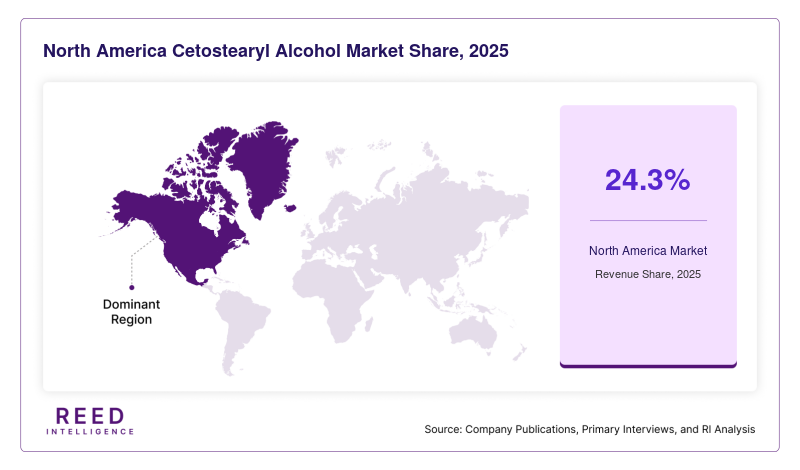
North America accounted for 24.3% of the Cetostearyl Alcohol Market share in 2025 and is expected to grow at a CAGR of 6.2% during the forecast period. The region's established personal care and pharmaceutical industries have contributed to steady demand for cetostearyl alcohol. High consumer awareness and preference for premium products have supported market growth.
The United States dominated the regional market due to strong demand for advanced skincare and pharmaceutical products. The presence of well-established manufacturers and continuous innovation in formulation technologies have driven market expansion in the country.
Europe
Europe held a 21.7% share of the Cetostearyl Alcohol Market in 2025 and is projected to grow at a CAGR of 6.0%. The region's stringent regulatory framework and emphasis on sustainable ingredients have influenced market dynamics. The demand for eco-friendly and bio-based products has driven the adoption of cetostearyl alcohol derived from renewable sources.
Germany emerged as the dominant country in Europe, supported by its strong cosmetics and pharmaceutical industries. The country's focus on high-quality formulations and compliance with environmental standards has contributed to market growth.
Asia Pacific
Asia Pacific led the Cetostearyl Alcohol Market with a 38.5% share in 2025 and is anticipated to grow at the fastest CAGR of 7.5%. The region's expanding population, rising disposable incomes, and increasing demand for personal care products have fueled market growth.
China dominated the regional market due to its large manufacturing base and growing consumer demand. The country's expanding middle-class population and increasing focus on personal grooming have significantly boosted the demand for cetostearyl alcohol.
Middle East & Africa
The Middle East & Africa region accounted for 8.1% of the Cetostearyl Alcohol Market in 2025 and is expected to grow at a CAGR of 6.5%. The region's growing urban population and increasing awareness of personal care products have supported market growth.
The United Arab Emirates emerged as a key market, driven by rising consumer spending and a growing preference for premium personal care products. The expansion of retail and distribution channels has further contributed to market development.
Latin America
Latin America held a 7.4% share of the Cetostearyl Alcohol Market in 2025 and is projected to grow at a CAGR of 6.7%. The region's increasing focus on personal grooming and expanding cosmetics industry have driven demand for cetostearyl alcohol.
Brazil dominated the regional market due to its large consumer base and strong presence of personal care manufacturers. The country's growing demand for skincare and haircare products has significantly contributed to market growth.
Competitive Landscape
The Cetostearyl Alcohol Market is characterized by the presence of several global and regional players focusing on product innovation and strategic expansion. Leading companies are investing in sustainable production methods and expanding their product portfolios to meet evolving consumer demands.
KLK Oleo emerged as a market leader, leveraging its strong supply chain and extensive product offerings. The company recently expanded its production capacity to meet growing demand for bio-based cetostearyl alcohol.
Other key players are focusing on partnerships, acquisitions, and technological advancements to strengthen their market position. The competitive landscape remains moderately fragmented, with companies competing on product quality, pricing, and sustainability initiatives.
Key Players List
- KLK Oleo
- Wilmar International Ltd.
- BASF SE
- Croda International Plc
- Kao Corporation
- Godrej Industries Limited
- Emery Oleochemicals
- VVF LLC
- Sasol Limited
- Musim Mas Holdings
- Oleon NV
- Ecogreen Oleochemicals
- Procter & Gamble Chemicals
- AAK AB
- IOI Oleochemical
Recent Developments
- KLK Oleo expanded its bio-based product portfolio in 2025 to cater to rising sustainability demand.
- BASF SE introduced a new grade of cetostearyl alcohol for high-performance skincare formulations.
- Croda International Plc invested in green chemistry technologies to enhance sustainable production.
- Wilmar International Ltd. increased its production capacity in Asia Pacific to meet growing regional demand.
- Kao Corporation focused on developing eco-friendly formulations using renewable raw materials.
Cetostearyl Alcohol Market Segments
Type
- Synthetic Cetostearyl Alcohol
- Bio-Based Cetostearyl Alcohol
Application
- Personal Care & Cosmetics
- Pharmaceuticals
- Industrial Applications
Form
- Solid
- Liquid
End-Use Industry
- Cosmetics Industry
- Pharmaceutical Industry
- Chemical Manufacturing
By Region
- North America
- Europe
- APAC
- Middle East and Africa
- LATAM