Chaff Cutter Market Size, Share & Demand Report By Product Type (Electric Chaff Cutter, Manual Chaff Cutter, Automatic Chaff Cutter), By Application (Livestock Farms, Dairy Farms, Poultry Farms), By End-Use (Commercial Farms, Smallholder Farms, Cooperative Farms), By Region & Segment Forecasts, 2026–2034
USD 3950
Market Overview
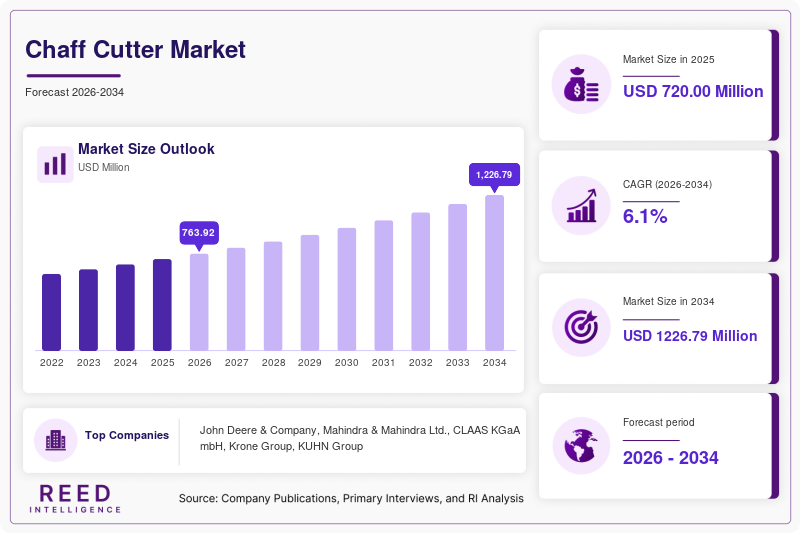
The global Chaff Cutter Market size was valued at approximately USD 720 million in 2026 and is projected to reach USD 1150 million by 2034, expanding at a CAGR of 6.1% during the forecast period (2026–2034). The market demonstrates steady growth driven by increasing mechanization in agriculture and the rising need for efficient livestock feed processing. Chaff cutters, which are widely used to cut straw, hay, and fodder into smaller pieces, have become essential equipment in both small-scale and commercial farming operations. The demand is particularly strong in regions with high livestock density, where feed efficiency directly impacts productivity and profitability.
One global factor supporting market growth is the increasing emphasis on livestock productivity and dairy output. Governments and agricultural bodies are promoting mechanized solutions to enhance feed utilization and reduce wastage. This has led to higher adoption of chaff cutters, especially in emerging economies where traditional feeding practices are being replaced with modern techniques.
Technological improvements such as electric and automatic chaff cutters are also contributing to market expansion. Manufacturers are focusing on durable designs, energy efficiency, and safety features to meet evolving user demands. Additionally, the integration of portable and compact designs is expanding the product’s accessibility among smallholder farmers.
Key Highlights
- North America dominated the market with a 32.8% share in 2025.
- Asia Pacific is expected to grow at the fastest CAGR of 7.4% during 2026–2034.
- By product type, electric chaff cutters accounted for the largest share of 42.6%, while automatic chaff cutters are projected to grow at a CAGR of 7.9%.
- By application, livestock farms led with a 46.3% share, whereas dairy farms are expected to expand at a CAGR of 7.2%.
- India remained the dominant country, with market values of USD 145 million in 2024 and USD 158 million in 2025.
Market Trends
Rising adoption of electric and automated equipment
The shift toward electric and automated chaff cutters is becoming a prominent trend in the market. Farmers are increasingly adopting electric-powered machines due to their efficiency, reduced labor dependency, and consistent output quality. Unlike manual or diesel-operated equipment, electric chaff cutters provide smoother operations with lower maintenance requirements. This is particularly beneficial in regions where labor shortages are affecting agricultural productivity. Automation features such as adjustable cutting sizes and safety mechanisms further enhance usability and reliability.
Additionally, the growing availability of rural electrification programs is supporting this transition. Governments in emerging economies are investing in infrastructure development, making electricity more accessible in remote agricultural areas. This enables farmers to upgrade their equipment without significant operational challenges. As a result, manufacturers are focusing on developing cost-effective electric models tailored to small and medium-scale farms, which is expected to strengthen market penetration over the forecast period.
Increasing demand for compact and portable designs
Another notable trend shaping the Chaff Cutter Market is the growing preference for compact and portable machines. Smallholder farmers, who constitute a significant portion of the agricultural workforce in developing regions, require equipment that is easy to transport and store. Portable chaff cutters address these needs by offering lightweight designs without compromising performance. This trend is particularly evident in Asia Pacific and Africa, where farm sizes are relatively small and mobility is a key requirement.
Manufacturers are responding by introducing foldable structures, detachable components, and ergonomic designs. These features improve operational convenience and reduce physical strain during usage. Moreover, portable models often come with multi-functional capabilities, allowing farmers to process different types of fodder using a single machine. This versatility enhances cost efficiency and encourages adoption. As demand for flexible and user-friendly equipment continues to rise, compact chaff cutters are expected to gain significant traction in the coming years.
Market Drivers
Growing livestock population and feed demand
The increasing global livestock population is a major factor driving the growth of the Chaff Cutter Market. As demand for dairy products, meat, and other animal-based goods continues to rise, farmers are under pressure to improve feed efficiency and animal nutrition. Chaff cutters play a critical role in this process by reducing fodder size, which enhances digestibility and minimizes wastage. This leads to better feed conversion rates and improved livestock productivity.
In developing regions, the expansion of dairy farming and poultry industries is particularly significant. Governments are encouraging farmers to adopt mechanized solutions to meet rising consumption needs. Financial incentives, subsidies, and training programs are being introduced to promote the use of modern agricultural equipment. As a result, the adoption of chaff cutters is increasing steadily, especially among small and medium-scale farmers who aim to optimize their operations and increase output.
Advancements in agricultural mechanization
Technological advancements in agricultural machinery are also fueling market growth. The development of high-performance chaff cutters with improved cutting efficiency, durability, and safety features is attracting a wider customer base. Modern machines are designed to handle various types of fodder, including dry and wet materials, making them suitable for diverse farming conditions. These innovations are enhancing operational efficiency and reducing manual effort.
Furthermore, the integration of user-friendly features such as automatic feeding systems and adjustable blade settings is improving productivity. Manufacturers are investing in research and development to create energy-efficient models that reduce operational costs. This aligns with the growing focus on sustainable farming practices. As mechanization becomes a priority across the agricultural sector, the demand for advanced chaff cutters is expected to increase significantly during the forecast period.
Market Restraint
High initial cost and limited awareness in rural areas
One of the key challenges restraining the growth of the Chaff Cutter Market is the high initial cost associated with advanced equipment. While modern electric and automatic chaff cutters offer numerous benefits, their upfront investment can be a barrier for small-scale farmers, particularly in low-income regions. Many farmers continue to rely on traditional methods due to budget constraints, which limits the adoption of mechanized solutions.
In addition, limited awareness about the advantages of chaff cutters further restricts market growth. In several rural areas, farmers are not fully informed about the efficiency gains and long-term cost savings offered by these machines. This lack of knowledge reduces willingness to invest in new technologies. For example, in parts of Africa and South Asia, manual fodder cutting remains common despite the availability of more efficient alternatives. Addressing this issue requires targeted awareness campaigns, training programs, and financial support initiatives. Without these efforts, market expansion may face challenges in reaching its full potential.
Market Opportunities
Expansion in emerging agricultural economies
Emerging economies present significant growth opportunities for the Chaff Cutter Market. Countries in Asia Pacific, Africa, and Latin America are experiencing rapid agricultural development, driven by population growth and increasing food demand. Governments in these regions are investing in modern farming equipment to improve productivity and ensure food security. This creates a favorable environment for the adoption of chaff cutters.
The growing number of smallholder farmers transitioning to commercial farming practices is also contributing to market expansion. These farmers are seeking efficient solutions to enhance their operations and increase profitability. As a result, demand for affordable and durable chaff cutters is rising. Manufacturers have the opportunity to tap into these markets by offering cost-effective products and establishing strong distribution networks. Local partnerships and after-sales support can further strengthen market presence and drive long-term growth.
Integration of smart technologies and IoT
The integration of smart technologies and IoT into agricultural equipment is opening new avenues for market growth. Advanced chaff cutters equipped with sensors and monitoring systems can provide real-time data on performance and maintenance requirements. This enables farmers to optimize operations and reduce downtime. Smart features such as automated feeding and remote control enhance efficiency and convenience.
Additionally, data-driven insights can help farmers improve feed management and reduce wastage. This aligns with the increasing focus on precision agriculture and sustainable practices. As digitalization continues to transform the agricultural sector, the demand for technologically advanced chaff cutters is expected to rise. Companies that invest in innovation and offer smart solutions will be well-positioned to capitalize on this opportunity and gain a competitive edge in the market.
Segmental Analysis
By Product Type
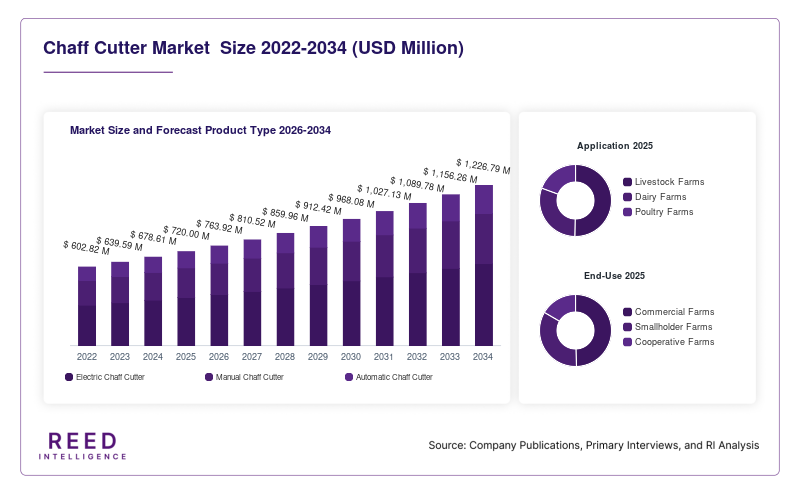
Electric chaff cutters dominated the market, accounting for approximately 42.6% of the share in 2024. These machines are widely preferred due to their efficiency, ease of operation, and lower maintenance requirements compared to manual or diesel-powered alternatives. Electric models provide consistent cutting performance, which is essential for ensuring uniform feed quality. They are particularly popular in regions with reliable electricity supply, where farmers can benefit from reduced labor costs and improved productivity. The increasing focus on energy efficiency and sustainability is further driving the adoption of electric chaff cutters. Manufacturers are also introducing advanced features such as safety mechanisms and adjustable cutting settings, enhancing their appeal among users.
Automatic chaff cutters are the fastest-growing subsegment, with a projected CAGR of 7.9%. The growth is driven by the increasing demand for labor-saving solutions in agriculture. Automatic machines offer features such as self-feeding systems and programmable settings, which improve efficiency and reduce manual effort. These machines are particularly beneficial for large-scale farming operations, where high throughput is required. The integration of advanced technologies, including sensors and automation, is further enhancing their performance. As farmers seek to optimize operations and increase productivity, the demand for automatic chaff cutters is expected to rise significantly.
By Application
Livestock farms accounted for the largest share of the market, with 46.3% in 2024. The high demand for efficient feed processing solutions in livestock farming is a key factor driving this segment. Chaff cutters help improve feed digestibility and reduce wastage, leading to better animal health and productivity. The increasing global demand for meat and dairy products is encouraging farmers to adopt modern equipment to enhance efficiency. In addition, government initiatives promoting livestock development are supporting the growth of this segment. Farmers are increasingly recognizing the benefits of mechanized feed processing, which is driving the adoption of chaff cutters.
Dairy farms represent the fastest-growing subsegment, with a CAGR of 7.2%. The growth is driven by the rising demand for milk and dairy products worldwide. Dairy farmers are focusing on improving feed quality to enhance milk production and animal health. Chaff cutters play a crucial role in this process by ensuring uniform feed size and reducing wastage. Technological advancements in dairy farming, including automated feeding systems, are further supporting the adoption of chaff cutters. As the dairy industry continues to expand, the demand for efficient feed processing equipment is expected to increase.
By End-Use
Commercial farms dominated the market, accounting for a significant share in 2024. These farms require high-capacity equipment to manage large volumes of fodder efficiently. Chaff cutters are essential tools in commercial farming operations, where productivity and efficiency are critical. The increasing adoption of mechanized solutions in large-scale farming is driving the growth of this segment. Commercial farms are also more likely to invest in advanced equipment, including automatic and electric chaff cutters, to optimize operations and reduce labor costs.
Smallholder farms are the fastest-growing subsegment, with a CAGR of 7.0%. The growth is driven by increasing awareness about the benefits of mechanization among small-scale farmers. Government subsidies and financial support programs are encouraging these farmers to adopt modern equipment. Portable and affordable chaff cutters are particularly popular in this segment, as they meet the specific needs of smallholder farms. As agricultural practices continue to evolve, the adoption of chaff cutters among small-scale farmers is expected to increase significantly.
Regional Analysis
North America
North America held a significant share of the Chaff Cutter Market, accounting for approximately 32.8% in 2025. The region is expected to grow at a CAGR of 5.4% during the forecast period. High levels of agricultural mechanization and the presence of large-scale livestock farms are key factors supporting market growth. Farmers in this region prioritize efficiency and productivity, leading to increased adoption of advanced chaff cutters.
The United States dominates the regional market due to its well-established agricultural infrastructure. A unique growth factor is the strong focus on precision farming, which encourages the use of technologically advanced equipment. Government support and access to financing options further facilitate the adoption of modern machinery, driving market expansion.
Europe
Europe accounted for a substantial share of the market in 2025 and is projected to grow at a CAGR of 5.1%. The region benefits from advanced farming practices and a strong emphasis on sustainability. Farmers are increasingly adopting energy-efficient chaff cutters to reduce environmental impact and improve operational efficiency.
Germany leads the European market, supported by its robust agricultural sector. A key growth factor is the increasing adoption of eco-friendly equipment. Regulations promoting sustainable farming practices are encouraging farmers to invest in modern machinery, including electric chaff cutters, which is driving market growth.
Asia Pacific
Asia Pacific is the fastest-growing region, with a projected CAGR of 7.4% during the forecast period. The region’s large agricultural base and rising livestock population are major drivers of demand. Increasing government initiatives to promote farm mechanization are also contributing to market growth.
India dominates the regional market due to its extensive dairy farming sector. A unique growth factor is the rising adoption of mechanized tools among smallholder farmers. Subsidies and training programs are encouraging farmers to shift from manual methods to modern equipment, boosting market expansion.
Middle East & Africa
The Middle East & Africa region is expected to grow at a moderate CAGR of 5.8%. The market is driven by increasing investments in agriculture and the need to improve food security. Livestock farming is gaining importance, leading to higher demand for efficient feed processing equipment.
South Africa is a key market in the region. A notable growth factor is the expansion of commercial farming operations. Farmers are adopting chaff cutters to enhance productivity and reduce feed wastage, which supports market growth.
Latin America
Latin America is projected to grow at a CAGR of 5.9% during the forecast period. The region’s agricultural sector is evolving, with increasing adoption of mechanized equipment. Growing livestock production is a major factor driving demand for chaff cutters.
Brazil leads the regional market, supported by its large agricultural economy. A unique growth factor is the rising focus on export-oriented farming. Farmers are investing in efficient machinery to meet international standards, which is boosting the adoption of chaff cutters.

Competitive Landscape
The Chaff Cutter Market is moderately fragmented, with several regional and global players competing based on product innovation, pricing, and distribution networks. Key companies are focusing on expanding their product portfolios and enhancing technological capabilities to gain a competitive edge. Strategic partnerships and mergers are also common, enabling companies to strengthen their market presence.
Among the leading players, John Deere & Company holds a prominent position due to its strong brand reputation and extensive product range. The company has recently introduced advanced agricultural equipment with improved efficiency and safety features, reinforcing its leadership in the market. Other major players are investing in research and development to introduce innovative solutions tailored to the needs of different farming segments. The competitive landscape is expected to intensify as companies continue to focus on innovation and market expansion.
Key Players
- John Deere & Company
- Mahindra & Mahindra Ltd.
- CLAAS KGaA mbH
- Krone Group
- KUHN Group
- New Holland Agriculture
- Fieldking
- Trident Engineers
- Jaswant Agro Engineers
- Bhoomi Agro Industries
- Kirloskar Brothers Limited
- Maschio Gaspardo
- AGRITECH Industries
- Balaji Agro Engineering
- Sonalika International Tractors Ltd.
Recent Developments
- Several manufacturers have introduced electric chaff cutters with enhanced safety features and energy-efficient motors to cater to evolving customer needs.
- A leading agricultural equipment company launched a portable automatic chaff cutter designed for smallholder farmers, focusing on affordability and ease of use.
- Strategic collaborations between equipment manufacturers and agricultural cooperatives have been established to expand distribution networks and improve product accessibility in rural areas.
Chaff Cutter Market Segments
Product Type
- Electric Chaff Cutter
- Manual Chaff Cutter
- Automatic Chaff Cutter
Application
- Livestock Farms
- Dairy Farms
- Poultry Farms
End-Use
- Commercial Farms
- Smallholder Farms
- Cooperative Farms
By Region
- North America
- Europe
- APAC
- Middle East and Africa
- LATAM