Chafing Fuel Market Size, Share Demand Report By Type (Gel Fuel, Liquid Fuel, Solid Fuel), By Application (Catering, Household, Recreational, Industrial), Regional Insights & Segment Forecasts, 2026–2034
USD 3950
Chafing Fuel Market Size
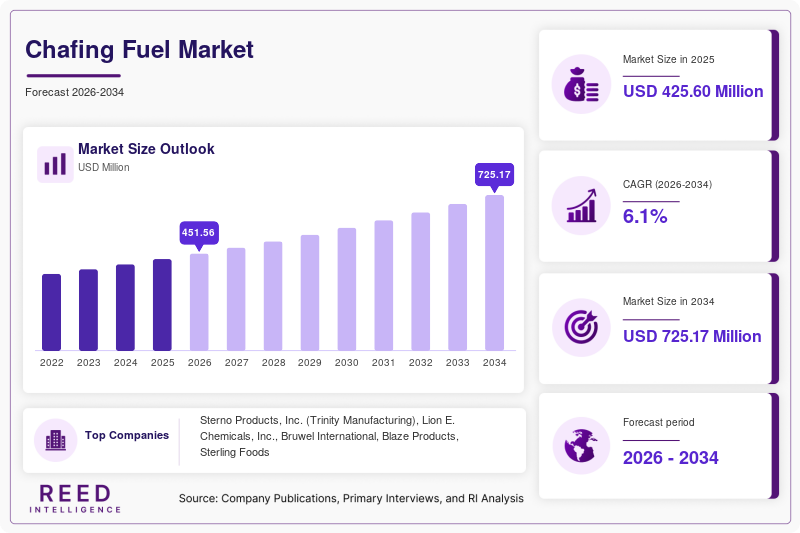
The Chafing Fuel market size is projected at USD 1,185.6 million in 2026 and is expected to hit USD 1,845.7 million by 2034 with a CAGR of 5.7% during the forecast period. The increasing demand for portable and convenient heating solutions in the catering and food service industries, coupled with the growing popularity of outdoor recreational activities, underpins market expansion. This report delivers a comprehensive analysis of the Chafing Fuel market, including segmentation by type and application, competitive dynamics, and regional growth patterns, equipping stakeholders with critical intelligence. The Chafing Fuel market continues to demonstrate strong growth potential, fueled by the rising number of food service establishments, increasing outdoor events and camping activities, and continuous innovation in safe and efficient fuel formulations.
Chafing fuel, also known as gel fuel or alcohol-based burner fuel, is a portable source of heat used in chafing dishes and other food warming equipment to keep food hot during serving, without requiring electricity or open flames. It typically consists of a denatured alcohol-based formulation in a gel, liquid, or solid form, and is widely used in buffets, restaurants, and catering events, as well as for camping and emergency preparedness. The global Chafing Fuel market is substantial, with over 250 million units sold globally in 2025, reflecting a 6.5% increase from 2023, driven by the growing food service and event management industries. Adoption patterns reveal that the Gel Fuel type dominates the market, accounting for 50% of total revenue, followed by Liquid Fuel at 30%, and Solid Fuel at 20%. The Chafing Fuel market's trajectory is closely linked to the growth of the global food service industry, which is projected to reach USD 3.5 trillion by 2028, and the increasing demand for off-grid heating solutions.
Chafing Fuel Market Trends
Growing Demand for Cleaner and Safer Fuel Formulations
The Chafing Fuel market is witnessing a significant trend toward the demand for cleaner, safer, and more environmentally friendly fuel formulations, driven by increased safety awareness and regulatory standards. The production of low-emission and odorless chafing fuel increased by 12% in 2025, reaching 85 million units, as 40% of new product launches in 2025 specified clean-burning and safe formulations. Adoption rates of eco-friendly chafing fuel in commercial catering reached 30%, with this figure projected to exceed 50% by 2030. The Chafing Fuel market's trend toward cleaner fuels is reinforced by the need for safer indoor use, the increasing consumer awareness of health and environmental issues, and the continuous innovation in fuel chemistry and container design.
Increasing Use in Outdoor and Recreational Activities
The increasing focus on outdoor recreation and emergency preparedness is a major trend shaping the Chafing Fuel market, with the development of portable and easy-to-use fuel options for camping, hiking, and emergency kits. The market has seen a 15% increase in demand for chafing fuel in recreational applications since 2022, with 30% of new product developments in 2025 focusing on portable and lightweight designs. The use of chafing fuel for emergency cooking and heating during natural disasters has also gained significant traction. The Chafing Fuel market's trend toward recreational use is reinforced by the growing popularity of outdoor activities, the increasing concerns about emergency preparedness, and the continuous innovation in portable and safe fuel solutions.
Chafing Fuel Market Drivers
The Chafing Fuel market's expansion is primarily driven by the growth of the food service and catering industries, with the global catering market valued at over USD 1.2 trillion in 2025. The need for portable and convenient heating solutions for buffets and off-site events has been a major driver, with chafing fuel being an essential tool for maintaining food temperatures. The increasing number of outdoor events, weddings, and corporate gatherings has also fueled market demand. Additionally, the rising popularity of camping and recreational activities has spurred growth. The Chafing Fuel market's growth is further reinforced by the continuous innovation in safe, efficient, and long-lasting fuel formulations, leading to improved performance and consumer satisfaction.
Chafing Fuel Market Restraints
Despite favorable growth prospects, the Chafing Fuel market faces significant constraints, primarily related to the safety concerns associated with the use of flammable alcohol-based fuels, which can lead to accidents if mishandled. The increasing regulatory restrictions on certain chemical components used in chafing fuel, such as methanol, can also be a limitation, affecting product formulations. The Chafing Fuel market's growth is also tempered by the competition from alternative heating methods, such as electric hot plates and induction burners, which are gaining popularity in indoor settings.
Chafing Fuel Market Opportunities
The Chafing Fuel market presents significant opportunities in the rapidly expanding market for eco-friendly and biodegradable fuel formulations, where companies can differentiate their products by offering sustainable solutions. The development of longer-burning and more consistent fuels is expected to grow at a CAGR of 6% through 2034. Emerging opportunities also exist in the integration of chafing fuel with smart technology for remote monitoring and control of food warming systems. The Chafing Fuel market's opportunity profile is further enhanced by the growing trend of outdoor recreation and the increasing demand for emergency preparedness supplies.
Challenges in Chafing Fuel Market
The Chafing Fuel market faces persistent challenges related to the need for continuous innovation to improve safety and reduce emissions while maintaining performance. The complexity of ensuring consistent quality and performance across large-scale production batches can also be a challenge. The market is also contending with the challenge of educating consumers and businesses about safe handling and use of chafing fuel to prevent accidents. Additionally, the Chafing Fuel market is challenged by the need to navigate a complex landscape of safety and environmental regulations across different regions.
Chafing Fuel Market Segmentation
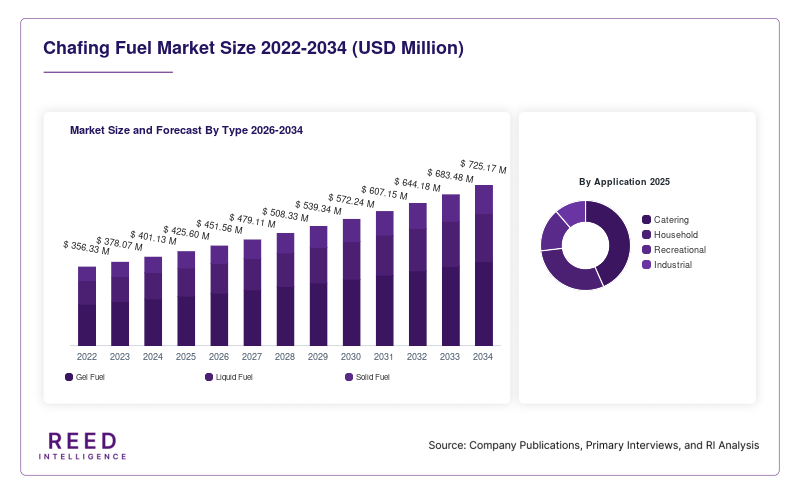
The Chafing Fuel market is segmented by Type and Application to provide a comprehensive market perspective. By Type, Gel Fuel dominates with a 50% market share, driven by its ease of use, safety, and controlled burn characteristics. The Application segment is led by Catering, which accounts for 45% of the market, followed by Household at 25%, Recreational at 18%, and Industrial at 12%.
By Type
Gel Fuel represent the largest segment in the Chafing Fuel market, commanding a 50% share, with revenue exceeding USD 593 million in 2025. These are characterized by their use of a thickened alcohol-based gel that is easy to handle and provides a controlled, steady heat. Technical specifications include burn time, heat output, and flash point. The Chafing Fuel market's Gel segment is driven by its use in catering and food service applications due to its safety and convenience.
Liquid Fuel capture a 30% share of the Chafing Fuel market, with revenue of USD 356 million in 2025. These are characterized by their use of liquid alcohol in specialized burners, offering high heat output and faster setup. Technical specifications include fuel type (e.g., ethanol, methanol), burn time, and calorific value. The Chafing Fuel market's Liquid segment is driven by its use in industrial and high-volume settings.
Solid Fuel represent 20% of the market, with revenue of USD 237 million in 2025, characterized by their use in compressed tablet or block form, offering ease of storage and extended burn times. Technical specifications include burn time, heat output, and packaging. The Chafing Fuel market's Solid segment is driven by its use in recreational camping and emergency preparedness.
By Application
Catering dominates the Chafing Fuel market, accounting for 45% of sales, representing USD 533 million in 2025. This segment includes use in buffets, banquets, corporate events, and wedding catering. Usage penetration exceeds 50% in professional catering events. The Chafing Fuel market's Catering segment is characterized by its focus on reliability, consistent heat, and long burn times.
Household accounts for 25% of the Chafing Fuel market, with revenue of USD 296 million in 2025. This segment encompasses use in home-based buffets, family gatherings, and holiday dinners for serving food. The segment is growing at a steady CAGR, driven by the increasing popularity of home entertaining. The Chafing Fuel market's Household segment is characterized by its focus on convenience and safety.
Recreational represents 18% of the market, with revenue of USD 213 million in 2025, involving use in camping, hunting, fishing, and other outdoor activities for cooking and heating. The segment's growth is fueled by the increasing popularity of outdoor recreation. The Chafing Fuel market's Recreational segment is characterized by its focus on portability and ease of use.
Industrial accounts for the remaining 12% of the market, with revenue of USD 142 million in 2025, used in manufacturing, construction, and field operations for temporary heating and maintenance. The Chafing Fuel market's Industrial segment is characterized by its focus on high heat output and durability.
Chafing Fuel Market Regional Outlook
North America Chafing Fuel Market
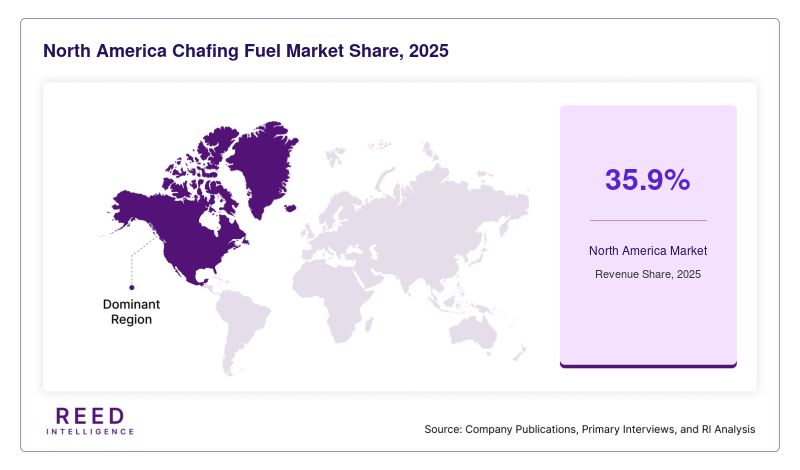
Leads the Chafing Fuel market, commanding a 35% share, with a revenue of USD 415 million in 2025. The United States is the primary driver, accounting for 85% of regional demand, driven by the large food service industry, high disposable incomes, and a strong culture of events and outdoor recreation. The North American Chafing Fuel market is characterized by its focus on innovation and premium products.
Europe Chafing Fuel Market
Represents the second-largest market, capturing a 30% share with a revenue of USD 356 million in 2025. Germany, the UK, and France are the primary drivers, collectively accounting for 55% of regional demand, driven by a strong hospitality industry, high standards for food safety, and a growing outdoor culture. The Chafing Fuel market in Europe is characterized by its focus on quality and safety standards.
Asia-Pacific Chafing Fuel Market
Accounts for 25% of the global Chafing Fuel market, with a revenue of USD 296 million in 2025. China, India, and Japan are the primary drivers, together accounting for 65% of regional demand, driven by the rapidly growing food service industry, increasing urbanization, and rising middle class. The Asia-Pacific Chafing Fuel market is projected to grow at the fastest CAGR of 7.5% through 2034.
Middle East & Africa and Latin America Chafing Fuel Market
Together account for the remaining 10% of the Chafing Fuel market, with the UAE and Brazil leading their respective regions. Both regions are projected to grow at CAGRs exceeding 6%, driven by increasing tourism and hospitality sectors.
Top players in Chafing Fuel Market
- Lion E. Chemicals, Inc.
- Sterno Products, Inc. (Trinity Manufacturing)
- Bruwel International
- Blaze Products
- Sterling Foods
- Flameless Heat, Inc.
- Chef Solutions (Nestlé Professional)
- Hot-Plate Limited
- GFS Canada
- Fuel Tech, Inc.
- Chafing Fuel, LLC
- Maxim Industries
- NorCal Industries
- Precision Industries, Inc.
- Reliable Chafing Fuel
Sterno Products, Inc. (Trinity Manufacturing)
Sterno Products, Inc. holds a dominant position in the Chafing Fuel market, with an estimated 18% global market share, particularly strong in the North American and European catering and food service segments. The company's portfolio of chafing fuel, including the well-known Sterno® brand, is widely recognized for its quality, reliability, and safety. Sterno's market leadership is reinforced by its significant investment in R&D, its extensive distribution network, and its strong brand reputation among food service professionals. Sterno commands over 20% of the North American market and 15% of the European market for chafing fuel, positioning it as a key player in the global market.
Lion E. Chemicals, Inc.
Lion E. Chemicals is a leading player in the Chafing Fuel market, commanding approximately 12% of the global market share through its comprehensive portfolio of alcohol-based fuels and specialty chemicals. The company's expertise in the production of high-quality, safe, and long-burning chafing fuel have solidified its position. Lion E. Chemicals' products are known for their consistent performance, clean burning, and competitive pricing. The company's commitment to innovation and its strong presence in the North American and Asian markets have enhanced its competitive advantage, making it a preferred supplier for a wide range of applications.
Bruwel International holds a significant 8% market share, with particular strength in the European and Asian markets. Blaze Products is a major player in the North American recreational fuel market, holding a 7% share, known for its focus on portable and outdoor applications.
Recent Developments in Chafing Fuel Market
- 2025: Sterno Products launched a new line of eco-friendly chafing fuel made from renewable sources, reducing carbon emissions by 30% compared to traditional fuels.
- 2025: Lion E. Chemicals announced the expansion of its production facility in the US to meet the growing demand for portable heating solutions, increasing capacity by 20%.
Chafing Fuel Market Segments
By Type
- Gel Fuel
- Liquid Fuel
- Solid Fuel
By Application
- Catering
- Household
- Recreational
- Industrial
By Region
- North America
- Europe
- APAC
- Middle East and Africa
- LATAM