Charcoal Infused Food Market Size, Share & Demand Report By Product Type (Bakery Products, Beverages, Confectionery, Frozen Desserts, Snacks, Others), By Distribution Channel (Supermarkets & Hypermarkets, Convenience Stores, Specialty Stores, Online Retail, Others), By End User (Commercial Foodservice, Household Consumption, Institutional Buyers), By Region & Segment Forecasts, 2026–2034
USD 3950
Market Overview
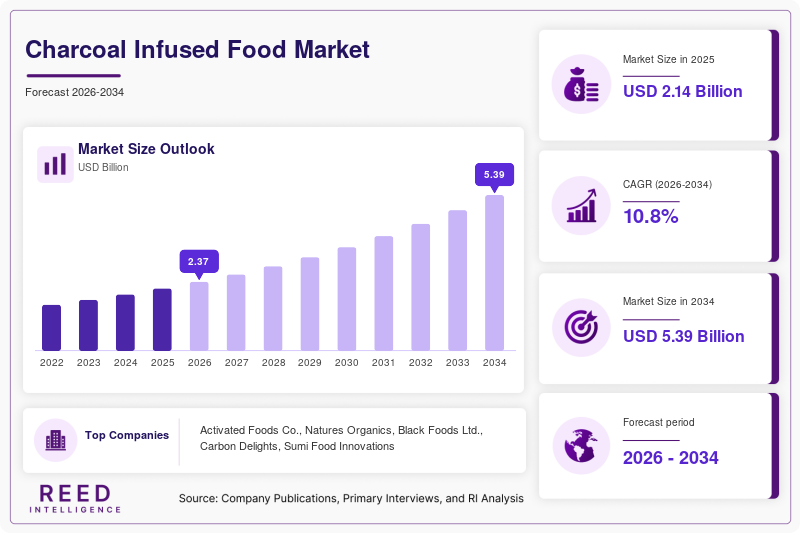
The global Charcoal Infused Food Market size was valued at USD 2.14 billion in 2026 and is projected to reach USD 4.87 billion by 2034, expanding at a CAGR of 10.8% during the forecast period from 2026 to 2034. The market continues to gain traction due to increasing consumer demand for visually distinctive food products, premium dining experiences, and wellness-oriented ingredients. Activated charcoal has evolved from a niche functional ingredient into a mainstream addition across bakery, confectionery, beverages, frozen desserts, and gourmet snacks. Food manufacturers are incorporating charcoal into product formulations to enhance visual appeal, support premium branding, and address changing consumer preferences for experimental culinary products.
The growing influence of social media-driven food culture has supported the adoption of charcoal-infused products globally. Restaurants, cafes, and packaged food brands have increasingly launched black-colored burgers, pizzas, pastries, ice creams, beverages, and confectionery products to attract younger consumers seeking novel food experiences. In addition, the expansion of artisanal bakery chains and specialty beverage outlets has accelerated demand for activated charcoal ingredients in commercial food applications. Market growth has also benefited from improvements in food-grade charcoal processing technologies that enable better texture stability, safer ingredient integration, and improved flavor compatibility.
Key Highlights
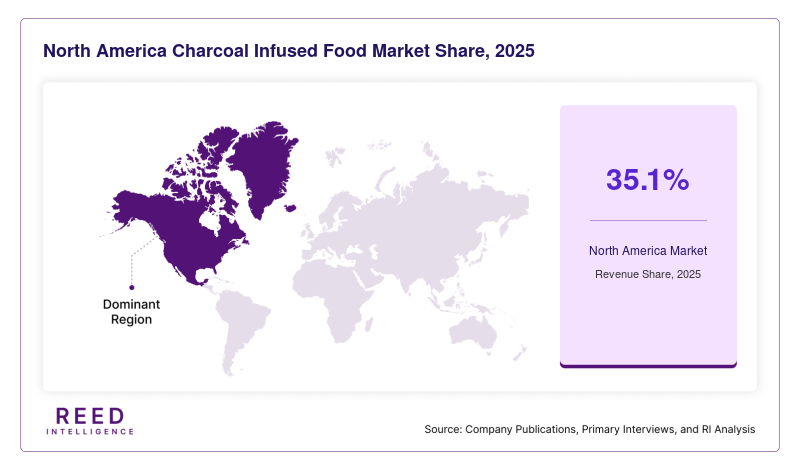
- North America dominated the market with a 35.1% share in 2025.
- Asia Pacific is expected to grow at the fastest CAGR of 11.9% during 2026–2034.
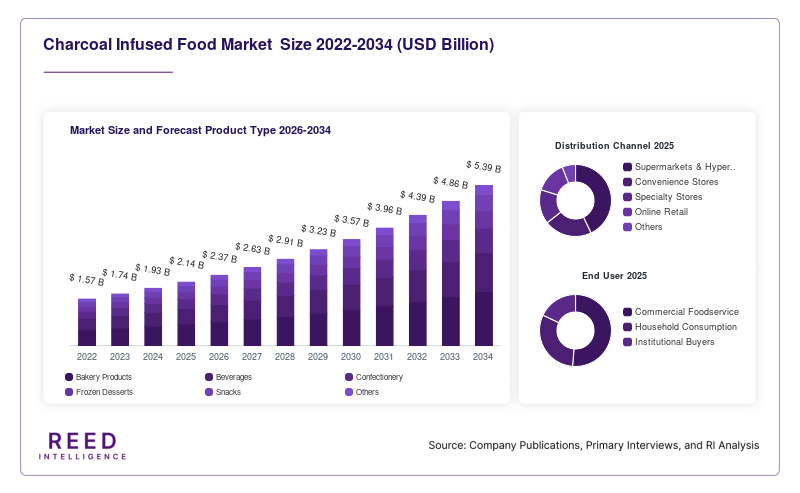
- By product type, bakery products accounted for the largest share of 39.4%.
- while charcoal-infused beverages are projected to grow at a CAGR of 12.8%.
- By distribution channel, supermarkets and hypermarkets led with a 43.6% share.
- whereas online retail is expected to expand at a CAGR of 13.1%.
- The United States remained the dominant country, with market values of USD 520 million in 2024 and USD 578 million in 2025.
Market Trends
Growing Preference for Visually Distinctive Food Products
The increasing consumer preference for visually unique and aesthetically appealing food products has emerged as a major trend supporting the Charcoal Infused Food Market. Foodservice operators and packaged food manufacturers are focusing on product appearance as an important purchasing factor, especially among younger consumers influenced by social media content. Activated charcoal creates deep black coloration in food products without the use of synthetic dyes, making it attractive for premium bakery items, beverages, desserts, and snack products. Restaurants and cafes continue to introduce charcoal burgers, black pizza crusts, pastries, waffles, and smoothies to differentiate menus and improve customer engagement. This trend has expanded across urban markets where consumers increasingly associate innovative food presentation with premium quality and culinary creativity. The rise of food photography culture and digital marketing campaigns has further strengthened demand for visually distinctive charcoal-infused products.
Expansion of Functional and Wellness-Oriented Food Innovation
Manufacturers are increasingly positioning charcoal-infused products within the broader functional food and wellness category. Consumers are showing greater interest in food products perceived to support digestive wellness, detoxification, and clean-label lifestyles. Although scientific opinions remain mixed regarding detoxification claims, charcoal ingredients continue to attract wellness-focused buyers seeking alternative health-oriented food options. Companies are responding by launching charcoal-infused juices, lemonades, protein bars, herbal beverages, and dietary snacks targeted toward health-conscious urban populations. Premium cafes and wellness-focused restaurant chains are integrating activated charcoal into menu offerings to appeal to consumers interested in experiential and functional eating habits. Product innovation is also expanding through combinations of charcoal with plant-based ingredients, probiotics, botanical extracts, and low-sugar formulations. This convergence between wellness trends and premium food experiences is expected to support sustained market growth during the forecast period.
Market Drivers
Rising Demand for Premium Bakery and Beverage Products
The growing global demand for premium bakery products and specialty beverages is significantly contributing to the growth of the Charcoal Infused Food Market. Consumers are increasingly willing to spend on artisanal and visually differentiated food products that offer novelty and premium presentation. Activated charcoal has become popular in bakery applications such as bread, pastries, donuts, cakes, and cookies due to its ability to create bold visual contrast. Beverage companies are also introducing charcoal lemonades, coffees, cocktails, smoothies, and milkshakes targeted at younger urban consumers. The expansion of specialty cafes, gourmet bakeries, and boutique foodservice establishments has accelerated ingredient demand across commercial food sectors. Food brands are leveraging charcoal-infused formulations to strengthen premium positioning, attract social media attention, and improve product differentiation in competitive retail environments. This premiumization trend is expected to continue driving consistent market expansion globally.
Growth of Social Media and Influencer-Driven Food Consumption
Social media platforms have become a major driver influencing consumer purchasing behavior within the global food industry. Charcoal-infused food products gained visibility through influencer marketing, food blogging, and visually engaging digital content. Black-colored food products generate strong visual impact on image-based platforms, encouraging restaurants and food manufacturers to introduce innovative charcoal-infused offerings. Younger consumers increasingly seek unique dining experiences that can be shared online, creating higher demand for experimental food concepts. Quick-service restaurants, cafes, and packaged food brands are actively designing products that align with digital consumer engagement trends. In addition, food delivery platforms have enabled rapid exposure for visually distinctive menu items, helping charcoal-infused products expand beyond niche urban markets. This strong relationship between digital marketing trends and food innovation continues to support global market growth and broader consumer awareness.
Market Restraint
Regulatory Concerns and Consumer Safety Perceptions
Regulatory uncertainty regarding the use of activated charcoal in food products remains a major restraint for the Charcoal Infused Food Market. Several food safety authorities have imposed restrictions on charcoal usage levels or required additional labeling standards due to concerns surrounding ingredient interactions and health claims. Activated charcoal may interfere with the absorption of certain medications, creating caution among healthcare professionals and regulatory agencies. This has limited the ability of some companies to market charcoal-infused products using detoxification or wellness-related claims. Regulatory inconsistencies across countries also create operational challenges for multinational food manufacturers seeking standardized product formulations. Smaller companies may face difficulties managing ingredient approvals, compliance testing, and packaging modifications across different regions. Consumer awareness regarding potential health risks has also increased in some markets, affecting purchasing confidence for certain product categories. These challenges could slow adoption rates and increase compliance costs for manufacturers operating in the global charcoal-infused food industry.
Market Opportunities
Expansion of Plant-Based and Vegan Food Applications
The rapid growth of plant-based and vegan food consumption presents significant opportunities for the Charcoal Infused Food Market. Manufacturers are increasingly combining activated charcoal with vegan ingredients to create visually differentiated meat substitutes, bakery items, dairy alternatives, and functional beverages. Consumers seeking plant-based lifestyles are often interested in innovative food concepts that align with premium wellness positioning. Activated charcoal complements this demand by enabling brands to create distinctive product appearances while supporting clean-label marketing strategies. Foodservice chains and specialty retailers are introducing charcoal-infused vegan burger buns, dairy-free desserts, and plant-based snack products to strengthen menu diversity. The increasing availability of vegan ingredients and natural coloring solutions is expected to encourage additional product innovation. As plant-based food markets continue expanding globally, charcoal-infused applications are likely to gain broader acceptance across retail and commercial food channels.
Growth Potential Across Emerging Urban Food Markets
Emerging economies are creating strong growth opportunities for charcoal-infused food manufacturers due to rising urbanization, changing dietary habits, and expanding middle-class populations. Consumers in developing countries are increasingly exposed to global food trends through social media, international restaurant chains, and digital food delivery platforms. This exposure has increased interest in premium and experimental food concepts, including charcoal-infused bakery products, desserts, and beverages. Urban cafes and quick-service restaurants across Asia Pacific, Latin America, and the Middle East are rapidly adopting visually distinctive menu items to attract younger consumers. Additionally, improving retail infrastructure and expanding e-commerce food distribution networks are enabling wider product accessibility in emerging markets. Local food manufacturers are also entering the market with regionally adapted charcoal-infused products, creating new revenue opportunities for ingredient suppliers and branded food companies during the forecast period.
Segmental Analysis
By Product Type
Bakery products accounted for the largest share of the Charcoal Infused Food Market in 2024, representing 39.4% of total revenue. This dominance was primarily driven by strong consumer demand for visually unique bread, pastries, cakes, donuts, and cookies across premium bakery chains and artisanal foodservice outlets. Activated charcoal has become highly popular in bakery applications because it provides strong visual contrast without significantly altering texture or flavor when properly formulated. Consumers increasingly associate charcoal-infused bakery items with premium quality and innovative food presentation. Commercial bakeries and café chains continue expanding product portfolios to include charcoal croissants, burger buns, sandwich bread, and specialty desserts. In addition, bakery manufacturers are benefiting from rising social media exposure, as visually striking baked products generate strong online engagement. These factors collectively continue supporting the segment’s leading market position globally.
Charcoal-infused beverages are projected to register the fastest CAGR of 12.8% during the forecast period due to increasing consumer demand for functional and experiential drink products. Beverage companies are introducing activated charcoal into smoothies, lemonades, coffees, cocktails, juices, and protein drinks targeted toward health-conscious urban consumers. The segment benefits from rising café culture, wellness-oriented branding strategies, and strong consumer interest in visually distinctive beverages suitable for digital sharing. Manufacturers are also experimenting with low-sugar and plant-based charcoal beverage formulations to attract broader customer groups. Premium restaurants and boutique beverage chains continue investing in innovative drink concepts that improve menu differentiation. In addition, the growing popularity of functional beverages globally is expected to accelerate product launches and support higher consumption rates within the charcoal-infused beverage segment throughout the forecast period.
By Distribution Channel
Supermarkets and hypermarkets held the dominant share of 43.6% in the global Charcoal Infused Food Market in 2024 due to strong consumer preference for organized retail purchasing. Large retail chains provide broad product visibility, competitive pricing, and convenient accessibility for charcoal-infused bakery items, snacks, beverages, and confectionery products. Major retailers increasingly allocate shelf space to premium and experimental food categories to attract younger urban consumers. Supermarkets also support product discovery through in-store promotions, premium food sections, and seasonal marketing campaigns. The growth of private-label premium food products has further strengthened charcoal-infused product availability across organized retail channels. Consumers often prefer purchasing innovative food products through trusted retail environments where ingredient transparency and product labeling are easily accessible. These advantages continue to reinforce the dominant market position of supermarkets and hypermarkets globally.
Online retail is expected to witness the fastest CAGR of 13.1% during 2026–2034 due to the rapid expansion of digital grocery platforms and direct-to-consumer food sales. E-commerce channels provide food manufacturers with greater flexibility to market premium charcoal-infused products to targeted consumer groups. Younger consumers increasingly rely on online grocery services and food delivery applications for convenience and access to specialty products unavailable in traditional retail outlets. Digital marketing campaigns and influencer collaborations also play a major role in driving online product awareness and purchase behavior. Subscription-based wellness food services are further supporting online sales growth for charcoal-infused snacks and beverages. Additionally, improvements in cold-chain logistics and packaged food delivery infrastructure are expected to strengthen e-commerce penetration across developed and emerging markets during the forecast period.
By End User
Commercial foodservice accounted for the largest share of the Charcoal Infused Food Market in 2024 with 48.2% of total revenue. Restaurants, cafes, bakeries, dessert parlors, and quick-service chains have become major adopters of activated charcoal ingredients due to strong consumer interest in premium dining experiences. Foodservice operators use charcoal-infused menu items to improve product differentiation, strengthen social media engagement, and attract younger customer groups. Black burger buns, charcoal waffles, specialty desserts, and activated charcoal drinks have become increasingly common across urban foodservice establishments. The commercial segment also benefits from higher flexibility in menu innovation compared to packaged retail products. In addition, experiential dining trends continue encouraging restaurants to invest in visually appealing food concepts that support premium pricing strategies and stronger customer engagement.
Household consumption is anticipated to register the fastest CAGR of 11.6% during the forecast period due to rising consumer interest in home baking and premium food experimentation. Consumers are increasingly purchasing charcoal baking mixes, beverage powders, dessert kits, and specialty ingredients through retail and online channels. Social media recipes and digital cooking tutorials have accelerated awareness regarding charcoal-infused home food preparation. Household buyers are particularly interested in creating visually distinctive desserts, beverages, and baked products for social gatherings and personal culinary experiences. Manufacturers are responding by introducing user-friendly packaged ingredients and small-format charcoal food kits targeted toward home consumers. The increasing popularity of home café culture and premium cooking experiences is expected to continue supporting household segment expansion globally.
Regional Analysis
North America
North America accounted for 35.1% of the global Charcoal Infused Food Market share in 2025 and maintained its position as the leading regional market. The region continues to benefit from strong consumer demand for premium bakery products, specialty beverages, and visually distinctive food experiences. The market is projected to expand at a CAGR of 9.8% during 2026–2034 due to rising product innovation among cafes, artisanal bakeries, and packaged food companies. Consumer familiarity with wellness-oriented food trends has further supported charcoal-infused product adoption across retail and foodservice sectors.
The United States remained the dominant country within North America due to high consumer spending on premium food products and the rapid expansion of experiential dining culture. Foodservice operators across major urban centers increasingly use activated charcoal ingredients to differentiate menus and attract younger consumers. The presence of established food innovation companies and advanced retail distribution systems has strengthened market penetration. In addition, social media-driven food marketing continues to influence product visibility and consumer purchasing behavior throughout the country.
Europe
Europe represented 27.4% of the global Charcoal Infused Food Market in 2025 and is expected to register a CAGR of 9.5% during the forecast period. Consumer demand for artisanal bakery products and gourmet confectionery has significantly contributed to regional market growth. Food manufacturers across Europe are increasingly focusing on clean-label ingredients and premium visual presentation to strengthen product differentiation. The region has also witnessed increasing adoption of charcoal-infused beverages and desserts among urban consumers seeking experimental culinary experiences and premium café culture.
Germany emerged as the dominant country in the European market due to strong bakery consumption patterns and increasing demand for innovative premium foods. German food manufacturers are actively introducing charcoal-infused bread, pastries, and snack products across supermarkets and specialty retail channels. The country’s advanced food processing industry and growing preference for functional ingredients have further supported market development. Additionally, the expansion of premium café chains and urban dining establishments has encouraged continuous product innovation within the charcoal-infused food segment.
Asia Pacific
Asia Pacific is projected to witness the fastest CAGR of 11.9% during 2026–2034 due to rapid urbanization, changing consumer lifestyles, and expanding premium food consumption. The region accounted for 22.8% of the global market share in 2025 and continues to attract significant investment from food manufacturers and café chains. Younger consumers across major Asian cities increasingly seek visually distinctive and social media-friendly food products, supporting the growth of charcoal-infused bakery, beverage, and dessert applications. Rising disposable income levels are also contributing to greater spending on premium dining experiences.
China remained the leading country within the Asia Pacific market due to its large urban consumer base and rapidly expanding café culture. Domestic and international food brands are introducing charcoal-infused beverages, baked goods, and desserts across metropolitan areas to attract younger consumers. The strong influence of digital food marketing and food delivery platforms has accelerated product visibility and accessibility. In addition, the expansion of premium retail stores and specialty bakery chains continues to strengthen demand for activated charcoal ingredients in commercial food applications.
Middle East & Africa
The Middle East & Africa region accounted for 7.2% of the global Charcoal Infused Food Market share in 2025 and is expected to grow at a CAGR of 8.7% through 2034. Market expansion is primarily supported by the increasing popularity of premium café culture and luxury dining experiences across urban areas. Restaurants and dessert chains are increasingly introducing charcoal-infused menu items to attract younger consumers and tourists seeking visually appealing food products. The growing hospitality sector has also contributed to rising demand for innovative bakery and beverage offerings.
The United Arab Emirates emerged as the dominant country within the region due to its rapidly growing hospitality industry and strong demand for premium food concepts. Luxury cafes, hotels, and restaurants in cities such as Dubai and Abu Dhabi actively incorporate charcoal-infused desserts, beverages, and bakery products into menus. The country’s strong tourism sector and high consumer spending on premium dining experiences have supported market growth. Furthermore, increasing international food brand presence continues to encourage culinary experimentation across the regional foodservice industry.
Latin America
Latin America held 7.5% of the global Charcoal Infused Food Market share in 2025 and is projected to grow at a CAGR of 8.9% during the forecast period. The region is experiencing gradual growth due to expanding urban foodservice sectors and increasing exposure to international food trends. Consumers are becoming more interested in premium bakery items, specialty beverages, and visually differentiated desserts offered through cafés and quick-service restaurants. Food manufacturers are also introducing charcoal-infused snack products to strengthen product diversity and attract younger customer groups.
Brazil dominated the Latin American market due to its large foodservice industry and expanding café culture across major metropolitan areas. Brazilian consumers increasingly engage with social media-driven food trends, supporting demand for innovative bakery and dessert products. Local restaurants and specialty beverage outlets are integrating charcoal-infused offerings into premium menu categories to improve customer engagement. Additionally, the growing influence of digital food delivery applications has improved product visibility and supported broader consumer accessibility throughout urban markets.
Competitive Landscape
The global Charcoal Infused Food Market remains moderately fragmented, with established food manufacturers, specialty ingredient suppliers, artisanal bakery chains, and beverage companies competing across regional and international markets. Companies are focusing on premium product innovation, clean-label ingredient sourcing, and visually distinctive branding strategies to strengthen market positioning. Product diversification across bakery, beverages, confectionery, and frozen desserts has become a common competitive strategy among leading participants.
The market leader, Activated Foods Co., maintained strong market visibility through its broad portfolio of activated charcoal bakery and beverage products distributed across Asia Pacific and North America. The company recently expanded its premium beverage product line with plant-based charcoal wellness drinks targeting urban consumers. Other major companies continue investing in partnerships with specialty cafés, restaurant chains, and online retail platforms to improve distribution reach and customer engagement.
Leading players are also increasing investments in sustainable ingredient sourcing and food-grade charcoal processing technologies to comply with evolving regulatory standards. Product innovation focusing on vegan formulations, low-sugar recipes, and functional ingredient combinations is expected to intensify competitive rivalry during the forecast period.
Key Players
- Activated Foods Co.
- Natures Organics
- Black Foods Ltd.
- Carbon Delights
- Sumi Food Innovations
- Midnight Bakery Group
- Pure Char Ingredients
- Urban Black Café Foods
- Dark Crust Foods
- CharBite Snacks
- Noir Beverage Labs
- Wellness Kitchen Foods
- Black Bean Gourmet
- Natural Detox Foods
- Artesian Charcoal Bakery
Recent Developments
- In February 2026, Noir Beverage Labs launched a charcoal-infused sparkling wellness drink range targeting premium urban retail markets across Europe.
- In August 2025, Activated Foods Co. expanded its production facility in Melbourne to increase activated charcoal bakery ingredient output by 28%.
- In November 2025, Wellness Kitchen Foods introduced charcoal-infused vegan dessert mixes for online retail distribution across India and Southeast Asia.
- In March 2026, Dark Crust Foods partnered with regional café chains to supply premium charcoal burger buns and bakery products across Latin America.
Charcoal Infused Food Market Segments
Product Type
- Bakery Products
- Beverages
- Confectionery
- Frozen Desserts
- Snacks
- Others
Distribution Channel
- Supermarkets & Hypermarkets
- Convenience Stores
- Specialty Stores
- Online Retail
- Others
End User
- Commercial Foodservice
- Household Consumption
- Institutional Buyers
By Region
- North America
- Europe
- APAC
- Middle East and Africa
- LATAM