Chemical Indicator Inks Market Size, Share Demand Report By Type (Reversible Indicator Inks, Irreversible Indicator Inks), By Application (Sterilization Indicators, Smart Packaging Indicators, Process Monitoring Labels), By End Use (Healthcare and Medical Devices, Food Safety Packaging, Industrial Manufacturing), By Region & Segment Forecasts, 2026–2034
USD 3950
Market Overview
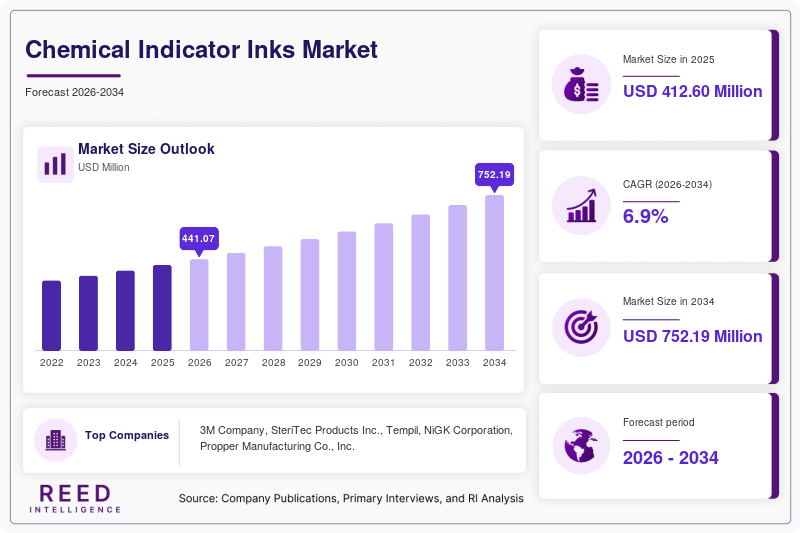
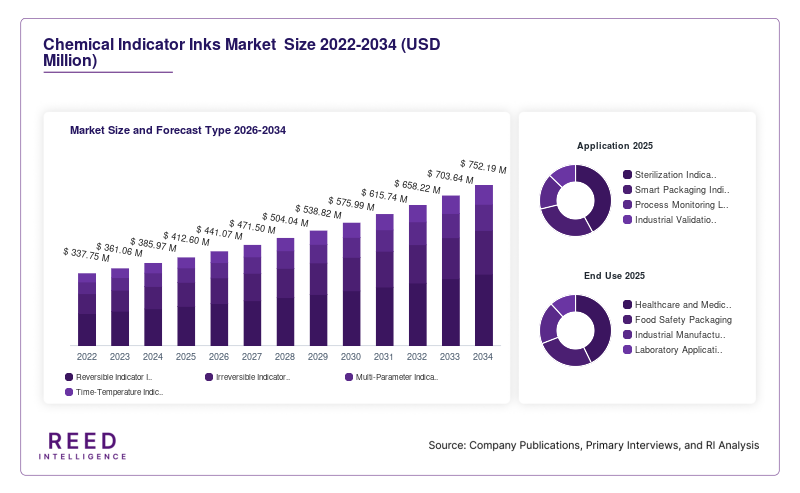
The global Chemical Indicator Inks Market size was valued at USD 412.6 million in 2026 and is projected to reach USD 703.8 million by 2034, expanding at a CAGR of 6.9% during the forecast period (2026–2034). The market growth has been supported by increasing demand for process validation, sterilization monitoring, and quality assurance solutions across healthcare, food packaging, pharmaceuticals, and industrial processing.
One global factor supporting expansion has been the increasing emphasis on compliance-driven monitoring technologies. As manufacturers and healthcare facilities strengthen process validation protocols, chemical indicator inks are seeing wider adoption in labels, tapes, pouches, and printed monitoring systems. Rising industrial output and packaging innovation have also contributed to demand growth.
Key Highlights
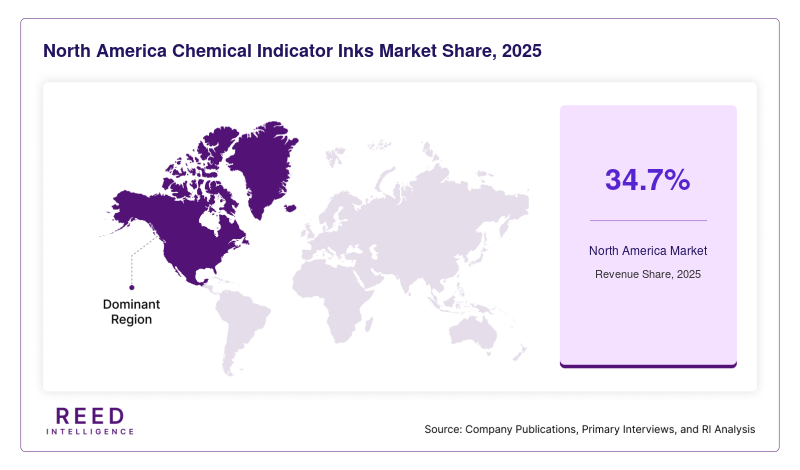
- North America held the dominant market share of 34.7% in 2025, while Asia Pacific is projected to register the fastest CAGR of 8.2% through 2034.
- By type, reversible indicator inks accounted for the leading share at 41.3% in 2025, while multi-parameter indicator inks are expected to expand at 8.7% CAGR.
- By application, sterilization indicators led with 38.5% share in 2025, while smart packaging indicators are forecast to grow at 8.9% CAGR.
- By end use, healthcare and medical devices held the dominant share of 36.8%, while food safety packaging is projected to record 8.4% CAGR.
- The United States, the dominant country, recorded a market value of USD 98.4 million in 2024, rising to USD 104.1 million in 2025.
Market Trends
Smart Functional Inks for Intelligent Packaging
A major trend shaping the Chemical Indicator Inks Market is the expansion of smart functional inks in intelligent packaging applications. Manufacturers are integrating chemical-responsive inks into labels and packaging materials to monitor temperature exposure, contamination, and freshness conditions. This trend is supporting product innovation in food, logistics, and pharmaceutical supply chains.
These inks are increasingly designed to deliver visual color shifts or irreversible responses that indicate process deviations. Demand for responsive packaging solutions is also contributing to higher adoption across export-oriented packaging sectors.
Shift Toward Multi-Parameter Indicator Technologies
Another notable trend is the development of multi-parameter chemical indicator inks capable of responding to combinations of pressure, humidity, time, and temperature. Traditional single-response inks are gradually being supplemented by formulations that improve monitoring precision.
This trend is supporting demand from high-specification sterilization environments, laboratory systems, and specialty industrial processes where multi-condition verification is required. Product differentiation in this segment is expected to influence market competitiveness over the forecast period.
Market Drivers
Rising Demand for Sterilization Monitoring in Healthcare
Increasing demand for sterilization monitoring solutions is a major growth driver for the Chemical Indicator Inks Market. Hospitals, diagnostic centers, and medical device processors rely on indicator inks in sterilization tapes, pouches, and labels to confirm exposure conditions.
Growing procedural volumes and increased instrument reprocessing needs are supporting demand for advanced indicator formulations. Expansion of healthcare infrastructure in emerging economies is also contributing to long-term growth.
Growth in Industrial Quality Assurance Applications
The growing use of chemical indicator inks in industrial quality assurance processes is another major driver. These inks are increasingly used to validate heat exposure, chemical contact, or process conditions in manufacturing operations.
As industries adopt stricter production monitoring protocols, demand is increasing for inks that support visible verification and process reliability. This has strengthened use across electronics, chemical processing, and industrial packaging operations.
Market Restraint
Performance Variability Under Complex Conditions
A key restraint in the Chemical Indicator Inks Market is performance variability under highly complex environmental conditions. Some indicator formulations may face limitations in maintaining consistent response behavior when exposed to multiple variables beyond calibrated parameters.
This can affect adoption in highly regulated applications and may require additional validation, increasing operational complexity for end users.
Market Opportunities
Expansion in Smart Food Safety Packaging
An emerging opportunity lies in chemical indicator inks designed for food safety packaging. Freshness monitoring and contamination-responsive indicators are gaining attention from packaging developers seeking value-added solutions.
Growing interest in shelf-life transparency and product condition monitoring is expected to support growth opportunities in this segment.
Development of Sustainable Indicator Ink Formulations
The development of low-toxicity and sustainable indicator ink chemistries presents another growth opportunity. Demand for environmentally aligned materials is encouraging innovation in water-based formulations and alternative pigment systems.
This opportunity may support adoption among manufacturers prioritizing sustainability compliance and material transition strategies.
Segmental Analysis
By Type
Reversible Indicator Inks Dominated the Market: Reversible indicator inks accounted for 41.3% of the Chemical Indicator Inks Market in 2025 due to widespread use in reusable monitoring systems and condition-sensitive labels.
Multi-Parameter Indicator Inks Will Be the Fastest-Growing: Multi-parameter indicator inks are projected to grow at 8.7% CAGR through 2034. Growth will be driven by rising demand for advanced formulations capable of verifying multiple process variables in specialized monitoring environments.
By Formulation
Solvent-Based Inks Held the Largest Share: Solvent-based chemical indicator inks represented 44.6% market share in 2025 due to compatibility with diverse substrates and broad industrial usage.
Water-Based Inks Will Record the Fastest Growth: Water-based formulations are projected to expand at 8.1% CAGR. Growth will be supported by rising demand for environmentally aligned alternatives and advancements in formulation performance.
By Application
Sterilization Indicators Led the Segment: Sterilization indicators held 38.5% share in 2025 due to established use in medical packaging, tapes, and instrument monitoring products.
Smart Packaging Indicators Will Expand Rapidly: Smart packaging indicators are projected to grow at 8.9% CAGR. Growth will be supported by demand for product-condition monitoring and intelligent packaging technologies.
By End Use
Healthcare and Medical Devices Dominated: Healthcare and medical device applications accounted for 36.8% share in 2025 due to high use of process indicator materials in sterilization verification systems.
Food Safety Packaging Will Be Fastest Growing: Food safety packaging is projected to grow at 8.4% CAGR through 2034. Growth will be driven by increasing interest in freshness and contamination-monitoring solutions.
By Distribution Channel
Direct Industrial Supply Held Leading Share: Direct industrial supply accounted for 52.2% of the market in 2025, supported by bulk procurement by manufacturers and institutional buyers.
Specialized Technical Distribution Will Grow Faster: Specialized technical distribution channels are expected to expand at 7.8% CAGR due to increasing demand for customized formulations and value-added technical support.
Regional Analysis
North America
North America accounted for 34.7% of the Chemical Indicator Inks Market in 2025. The region benefited from established sterilization validation practices and broad adoption across medical packaging systems.
The market in this region is projected to grow at 6.4% CAGR through 2034. The United States remained the dominant country, supported by growing investment in advanced medical packaging technologies and expanding use of process verification materials in healthcare supply chains.
Europe
Europe held 27.1% market share in 2025. The region benefited from demand for compliance-oriented indicator technologies across industrial and healthcare applications.
The regional market is forecast to expand at 6.6% CAGR during the forecast period. Germany led the regional market due to growth in specialty chemical manufacturing and increasing demand for process-monitoring materials integrated into industrial workflows.
Asia Pacific
Asia Pacific captured 24.5% of the global market in 2025. The region showed strong adoption across packaging, healthcare, and industrial processing sectors.
The market in Asia Pacific is expected to grow at 8.2% CAGR, making it the fastest-growing region. China is projected to remain dominant due to rising specialty ink production capacity and increasing use of indicator technologies across expanding manufacturing industries.
Middle East & Africa
Middle East & Africa represented 7.2% share in 2025. The region showed steady demand for indicator solutions in healthcare and industrial applications.
The regional market is expected to register 6.1% CAGR through 2034. Saudi Arabia is projected to lead growth due to investments in industrial diversification and modernization of healthcare-related processing systems.
Latin America
Latin America accounted for 6.5% of the global market in 2025. Demand in the region was supported by packaging applications and process validation requirements.
The market is forecast to grow at 6.3% CAGR over the forecast period. Brazil is expected to remain the dominant country, supported by growth in specialty packaging materials and increasing industrial demand for process indicator solutions.
Competitive Landscape
The Chemical Indicator Inks Market remains moderately consolidated, with established specialty chemical companies and niche formulation providers competing through product innovation and application-specific offerings. Leading participants focus on responsive formulations, regulatory alignment, and strategic expansion in packaging and sterilization applications.
3M Company maintained a leading market position through its broad sterilization indicator portfolio and established healthcare distribution network. A recent development involved expansion of advanced chemical indicator products designed for enhanced process verification.
SteriTec Products, Tempil, NiGK Corporation, and Propper Manufacturing continued strengthening market positions through specialized indicator technologies, product upgrades, and targeted application expansion. Competition is increasingly centered on performance consistency, sustainable formulations, and multi-condition response technologies.
Market participants are also investing in research related to smart packaging-compatible indicator chemistries and advanced functional printing solutions to expand commercial opportunities.
Key Players List
- 3M Company
- SteriTec Products Inc.
- Tempil
- NiGK Corporation
- Propper Manufacturing Co. Inc.
- GKE GmbH
- Terragene S.A.
- Crosstex International
- STERIS plc
- Mesa Laboratories Inc.
- Getinge AB
- Hu-Friedy Group
- Anderson Products Inc.
- ETIGAM B.V.
- Cardinal Health Inc.
Recent Developments
- In 2025, several suppliers introduced advanced multi-parameter chemical indicator inks designed for integrated response to temperature and exposure duration.
- Specialty ink manufacturers expanded water-based indicator formulations aimed at sustainability-focused packaging applications.
- Market participants increased investments in indicator inks compatible with smart labels and intelligent packaging systems.
- New product launches in sterilization monitoring focused on improved color-transition stability for high-specification healthcare applications.
- Strategic collaborations between specialty chemical firms and packaging converters increased development of condition-monitoring printed substrates.
- Companies expanded regional manufacturing footprints in Asia Pacific to support growing demand for industrial and packaging indicator solutions.
- Research initiatives focused on extending substrate compatibility for chemical indicator inks across flexible films and specialty papers.
Chemical Indicator Inks Market Segments
Type
- Reversible Indicator Inks
- Irreversible Indicator Inks
- Multi-Parameter Indicator Inks
- Time-Temperature Indicator Inks
Application
- Sterilization Indicators
- Smart Packaging Indicators
- Process Monitoring Labels
- Industrial Validation Printing
End Use
- Healthcare and Medical Devices
- Food Safety Packaging
- Industrial Manufacturing
- Laboratory Applications
By Region
- North America
- Europe
- APAC
- Middle East and Africa
- LATAM