Chicken Gizzards Market Size, Share & Demand Report By Type (Fresh Chicken Gizzards, Frozen Chicken Gizzards, Processed Chicken Gizzards), By Application (Food Processing, Food Service, Retail, Animal Feed) By Region & Segment Forecasts, 2026–2034
USD 3950
Chicken Gizzards Market Size
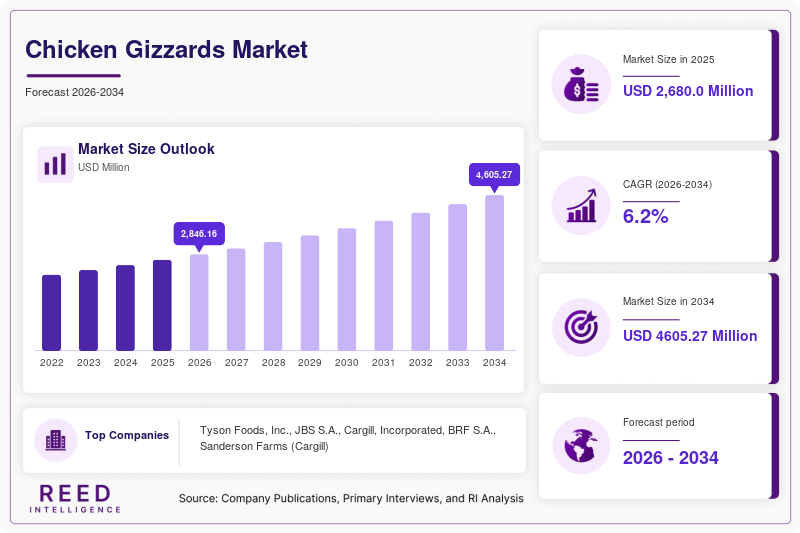
The chicken gizzards market size is projected at USD 2,850.0 million in 2026 and is expected to hit USD 4,620.0 million by 2034 with a CAGR of 6.2% during the forecast period. The increasing demand for protein-rich and affordable meat products, the growing popularity of ethnic cuisines featuring organ meats, and the rising awareness about the nutritional benefits of chicken gizzards underpin market expansion. This report delivers a comprehensive analysis of the chicken gizzards market, including segmentation by type and application, competitive dynamics, and regional growth patterns, equipping stakeholders with critical intelligence to navigate this specialized protein market landscape.
Chicken Gizzards Market Key Takeaways
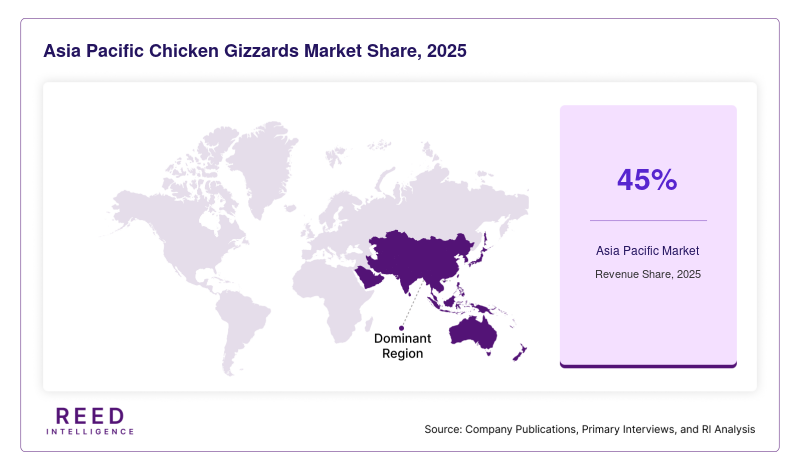
- Dominant Region: Asia-Pacific leads the chicken gizzards market with a 45% share, while North America is the fastest-growing region with a projected CAGR of 7.8% through 2034.
- Dominant Segment: The Frozen Chicken Gizzards type dominates the market with a 52% share, while the Food Processing application is the leading segment with a 38% share.
- Emerging Country: China is projected to reach USD 1,250.0 million by 2034, expanding at a CAGR of 8.5%.
- Key Drivers: The increasing demand for affordable protein sources, the growing popularity of ethnic foods, and the rising utilization of chicken gizzards in processed meat products are driving market growth.
The chicken gizzards market encompasses the production, processing, distribution, and consumption of chicken gizzards, which are the muscular stomachs of chickens used for grinding food. These products are rich in protein, vitamins, and minerals, making them a valuable component of various cuisines and food products worldwide. Globally, the production of chicken gizzards has grown steadily, with an estimated 4.2 million metric tons produced in 2025 as a byproduct of poultry processing. In terms of revenue, Frozen Chicken Gizzards accounted for roughly 52% of the total market share, driven by their extended shelf life and ease of transportation, while Fresh Chicken Gizzards followed with 28% share, particularly utilized in local markets and traditional cuisines. The market is further characterized by a penetration rate exceeding 65% in Asian and Latin American cuisines, where gizzards are considered a delicacy, whereas Western markets represent a growing adoption frontier due to increasing interest in nose-to-tail eating and ethnic foods. The Processed Chicken Gizzards segment, representing 20% of the market, is gaining traction as food manufacturers incorporate gizzards into value-added products such as sausages, pates, and ready-to-eat meals.
Chicken Gizzards Market Trends
Growing Demand for Nose-to-Tail Eating and Sustainable Protein Sources
The chicken gizzards market is witnessing a significant trend toward nose-to-tail eating and the utilization of all parts of the animal, driven by growing awareness about food waste and sustainability. This shift is particularly prominent in Western markets where consumers are increasingly open to trying organ meats and offal products. The adoption of chicken gizzards in mainstream restaurants and retail has increased by 25% year-over-year, with over 35% of new poultry product launches including organ meats. This chicken gizzards market trend is supported by the growing popularity of ethnic cuisines and the increasing demand for affordable, nutrient-dense protein sources. The utilization of gizzards in pet food and animal feed is also gaining traction, further driving demand.
Expansion of Processed and Value-Added Gizzard Products
The increasing expansion of processed and value-added gizzard products is a major trend shaping the chicken gizzards market. The development of marinated, breaded, and pre-cooked gizzard products is gaining traction, driven by the need for convenience and the growing demand for ready-to-eat and ready-to-cook options. The emergence of gizzard-based snacks and ethnic specialty products is particularly prominent in Asian and Latin American markets. This chicken gizzards market growth is supported by the increasing investment in food processing technology and the growing retail distribution of processed poultry products. The utilization of gizzards in sausages, meatballs, and pates is also expanding, creating new market opportunities.
Chicken Gizzards Market Drivers
The chicken gizzards market's expansion is primarily driven by the increasing global demand for affordable protein sources, with chicken gizzards offering a cost-effective alternative to traditional cuts of meat. The growing popularity of ethnic cuisines featuring organ meats, particularly in Asian, Latin American, and African communities, has been a major driver, with gizzards being a staple ingredient in dishes such as curries, stews, and stir-fries. The rising awareness about the nutritional benefits of chicken gizzards, including their high protein content and rich vitamin and mineral profile, has further fueled market demand. The increasing utilization of gizzards in processed meat products and pet food has also supported market growth. Additionally, the growing focus on reducing food waste and utilizing all parts of the animal has expanded the market opportunity for gizzards.
Chicken Gizzards Market Restraints
Despite favorable growth prospects, the chicken gizzards market faces significant constraints, primarily related to the perception of organ meats as inferior or less desirable in Western markets, which can limit consumption. The market's growth is further tempered by the challenges associated with the texture and preparation of gizzards, which require specific cooking techniques to achieve optimal tenderness. Additionally, the competition from other protein sources and the availability of alternative organ meats can limit market growth. The variability in supply and prices due to poultry production cycles and disease outbreaks can also create challenges for market stability.
Chicken Gizzards Market Opportunities
The chicken gizzards market presents significant opportunities in the rapidly expanding segment of value-added and convenience-focused gizzard products that cater to modern consumer lifestyles. The development of gizzard-based snacks and protein-rich ready-to-eat products represents another promising avenue. Emerging opportunities also exist in the application of gizzards in pet food and animal feed, driven by the growing pet food industry. Furthermore, the untapped potential in Western markets, driven by the increasing interest in ethnic cuisines and nose-to-tail eating, offers a fertile ground for market expansion.
Challenges in Chicken Gizzards Market
The chicken gizzards market grapples with persistent challenges related to the need for continuous innovation to improve the texture, taste, and convenience of gizzard products to appeal to broader consumer segments. The complexity of managing supply chains for fresh and frozen gizzards while ensuring food safety and quality presents ongoing operational challenges. The market is also contending with the challenge of overcoming consumer biases against organ meats and the need for effective marketing and education. Moreover, the need for efficient processing and distribution infrastructure to handle perishable products poses challenges for market participants.
Chicken Gizzards Market Segmentation Analysis
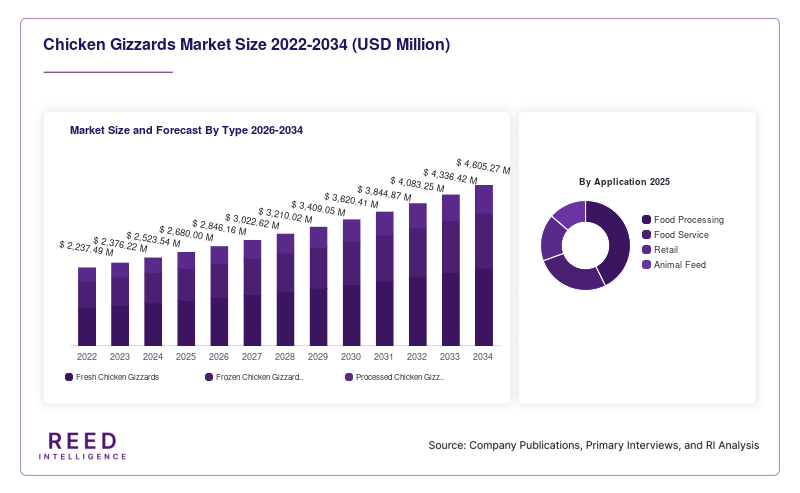
The chicken gizzards market is segmented by Type and Application to provide a comprehensive market perspective. By Type, Frozen Chicken Gizzards dominate with a 52% market share, driven by their extended shelf life and ease of distribution. The Application segment is led by Food Processing, which accounts for 38% of the market, followed by Food Service at 28%, Retail at 22%, and Animal Feed at 12%.
By Type
Frozen Chicken Gizzards represent the largest segment in the chicken gizzards market, commanding a 52% share, with revenue exceeding USD 1,482 million in 2025. These gizzards are cleaned, blanched, and frozen for extended shelf life and convenient storage. Technical specifications include freezing temperature, packaging type, and shelf life. The market's Frozen Chicken Gizzards segment is driven by their use in food processing, food service, and retail, where convenience and long shelf life are prioritized.
Fresh Chicken Gizzards capture a 28% share of the chicken gizzards market, with revenue of USD 798 million in 2025. These gizzards are sold fresh, typically within 24-48 hours of processing. Technical specifications include freshness indicators, packaging, and refrigeration requirements. The market's Fresh Chicken Gizzards segment is driven by their use in local markets, traditional cuisines, and restaurants that prioritize freshness and quality.
Processed Chicken Gizzards represent 20% of the market, with revenue of USD 570 million in 2025, characterized by marinated, breaded, cooked, or otherwise value-added gizzard products. Technical specifications include processing method, flavor profile, and packaging. The market's Processed Chicken Gizzards segment is driven by their use in convenience foods, ready-to-eat meals, and specialty products, appealing to consumers seeking easy and flavorful options.
By Application
Food Processing dominates the chicken gizzards market, accounting for 38% of sales, representing USD 1,083 million in 2025. This segment includes the use of gizzards in processed meat products such as sausages, pates, meatballs, and ready-to-eat meals. Usage penetration exceeds 55% in processed poultry product manufacturing. The market's Food Processing segment is characterized by its focus on cost-effectiveness, consistent quality, and functionality in product formulations.
Food Service accounts for 28% of the chicken gizzards market, with revenue of USD 798 million in 2025. This segment encompasses the use of gizzards in restaurants, catering, and institutional food service, particularly in ethnic cuisine establishments. The segment is growing at a significant rate, driven by the increasing popularity of ethnic dishes featuring gizzards. The market's Food Service segment is characterized by its focus on quality, consistency, and supply reliability.
Retail represents 22% of the market, with revenue of USD 627 million in 2025, involving the sale of gizzards through supermarkets, butcher shops, and online platforms. The segment's growth is fueled by the increasing demand for organ meats among consumers. The market's Retail segment is characterized by its focus on packaging, labeling, and consumer education, with a focus on convenience and food safety.
Animal Feed accounts for 12% of the market, with revenue of USD 342 million in 2025, encompassing the use of gizzards in pet food and animal feed. The market's Animal Feed segment is driven by the growing pet food industry and the increasing demand for protein-rich feed ingredients, with a focus on nutritional value and cost-effectiveness.
Chicken Gizzards Market Regional Analysis
Asia-Pacific Chicken Gizzards Market
Leads the chicken gizzards market, commanding a 45% share, with revenue of USD 1,283 million in 2025. China, Japan, and Southeast Asian countries are the primary drivers, together accounting for 70% of regional demand, driven by the high consumption of organ meats in traditional cuisines, large poultry production, and growing urban demand. The Asia-Pacific market is characterized by its focus on freshness, variety, and traditional preparation methods.
North America Chicken Gizzards Market
Represents the fastest-growing market, capturing a 22% share with revenue of USD 627 million in 2025. The United States is the primary driver, accounting for 85% of regional demand, driven by the growing interest in ethnic cuisines, nose-to-tail eating, and affordable protein sources. The North American market is projected to grow at the fastest CAGR of 7.8% through 2034, supported by increasing consumer acceptance and product innovation.
Europe Chicken Gizzards Market
Accounts for 18% of the global chicken gizzards market, with revenue of USD 513 million in 2025. France, Germany, and the United Kingdom are the primary drivers, accounting for 58% of regional demand, driven by traditional consumption in certain cuisines and growing interest in sustainable eating. The European market is projected to grow at a steady CAGR, supported by growing demand for ethnic foods and value-added products.
Latin America and Middle East & Africa Chicken Gizzards Market
Together account for the remaining 15% of the chicken gizzards market, with Brazil, Mexico, and South Africa leading their respective regions. Both regions are projected to grow at CAGRs exceeding 6.5%, driven by traditional consumption patterns, growing poultry production, and increasing urbanization.
Top players in Chicken Gizzards Market
- Tyson Foods, Inc.
- JBS S.A.
- Cargill, Incorporated
- BRF S.A.
- Sanderson Farms (Cargill)
- Pilgrim's Pride Corporation
- Perdue Farms, Inc.
- Koch Foods, Inc.
- Mountaire Farms
- Wayne Farms LLC
- Seaboard Corporation
- PHW Group
- LDC (Lambert Dodard Chancereul)
- Grupo Bachoco
- Astral Foods
Recent Developments in Chicken Gizzards Market
- April 2026 – Tyson Foods, Inc. launched a new line of marinated and ready-to-cook chicken gizzards for retail and food service markets in the United States.
- June 2025 – JBS S.A. announced an expansion of its poultry processing capacity in Brazil to meet growing demand for chicken gizzards in domestic and export markets.
- August 2025 – BRF S.A. introduced a new range of frozen chicken gizzard products for the Middle Eastern market, targeting the growing demand for organ meats in the region.
- February 2026 – Cargill, Incorporated announced a new partnership with a leading food service distributor to expand the availability of chicken gizzards in North American restaurants.
- October 2025 – Pilgrim's Pride Corporation launched a new line of value-added chicken gizzard products, including breaded and pre-cooked options, for retail and food service.
Chicken Gizzards Market Segments
By Type
- Fresh Chicken Gizzards
- Frozen Chicken Gizzards
- Processed Chicken Gizzards
By Application
- Food Processing
- Food Service
- Retail
- Animal Feed
By Region
- North America
- Europe
- APAC
- Middle East and Africa
- LATAM