Chlorinated Polyethylene Resins Elastomer Market Size, Share & Demand Report By Product Type (Chlorinated Polyethylene Elastomer), By Chlorine Content (Below 35%, 35%–40%, Above 40%), By Application (Wire and Cable Compounds, Impact Modification for PVC), By End-Use Industry (Automotive, Building and Construction, Electrical and Electronics), By Region & Segment Forecasts, 2026–2034
USD 3950
Market Overview
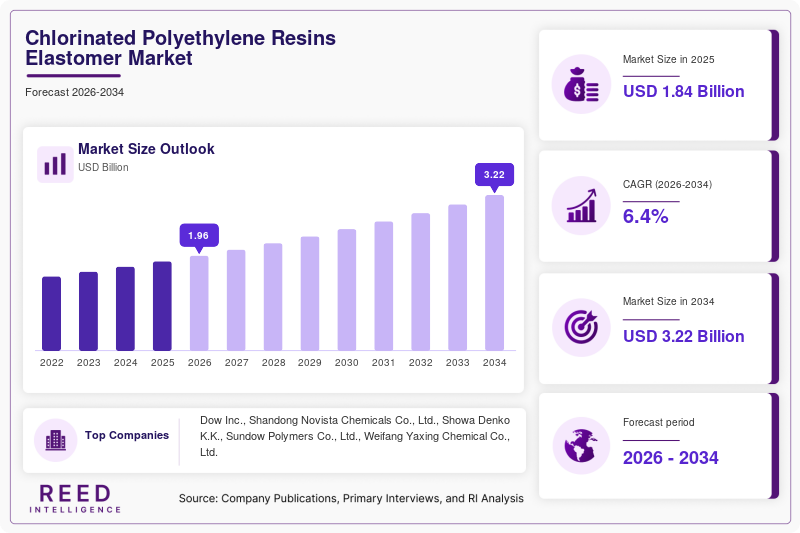
The Chlorinated Polyethylene Resins Elastomer Market size was valued at USD 1.84 billion in 2026 and is projected to reach USD 3.02 billion by 2034, expanding at a CAGR of 6.4% during 2026–2034. The global Chlorinated Polyethylene Resins Elastomer Market growth has been supported by increasing global demand for high-performance polymer materials across automotive, wire & cable, construction, industrial rubber, and plastics processing industries. Chlorinated polyethylene (CPE) resins elastomers are widely used because of their superior weather resistance, flame retardancy, flexibility, chemical stability, and impact strength.
The expansion of infrastructure development and industrial manufacturing activities has accelerated product demand globally. Manufacturers are increasingly using chlorinated polyethylene resins elastomers in roofing membranes, cable jacketing, hoses, automotive parts, and impact modifiers for PVC compounds. The material’s ability to enhance durability and resistance to harsh environmental conditions has increased its adoption in industrial applications.
Key Highlights
- Asia Pacific accounted for 41.6% of the global Chlorinated Polyethylene Resins Elastomer Market share in 2025, while North America is projected to register the fastest CAGR of 6.9% during 2026–2034.
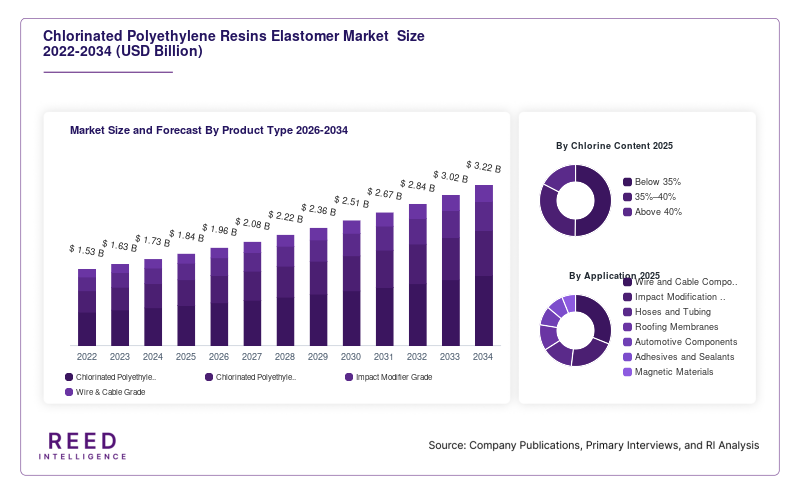
- By type, CPE impact modifier grade held the dominant market share of 39.4% in 2025, while CPE elastomer grade is anticipated to grow at the fastest CAGR of 7.1%.
- By application, wire & cable applications accounted for 31.2% of the market share in 2025, whereas automotive components are expected to witness a CAGR of 7.3% through 2034.
- By end-use industry, construction dominated the market with a 34.6% share in 2025, while renewable energy infrastructure is projected to expand at a CAGR of 7.5%.
- China remained the leading country market, valued at USD 402.8 million in 2024 and USD 429.3 million in 2025.
Market Trends
Growing Adoption in Wire and Cable Insulation
The use of chlorinated polyethylene resins elastomers in wire and cable insulation has increased significantly due to rising investments in energy infrastructure and industrial electrification. Manufacturers prefer CPE materials because of their flame resistance, thermal stability, and weather durability. The growing deployment of industrial cables, renewable energy transmission systems, and high-performance electrical components has accelerated product demand globally.
Increasing Development of High-Performance PVC Impact Modifiers
Producers are increasingly developing advanced CPE impact modifier grades for rigid PVC applications. These materials improve impact resistance, flexibility, and processing efficiency in pipes, fittings, siding, and construction materials. The trend has gained momentum as construction manufacturers seek durable and lightweight polymer solutions for modern infrastructure projects.
Market Drivers
Rising Demand from the Automotive Industry
The automotive sector has become a major consumer of chlorinated polyethylene elastomers due to the growing requirement for lightweight and durable materials. CPE materials are widely used in seals, hoses, wire harnesses, underbody coatings, and molded components. Increasing production of passenger and commercial vehicles has positively influenced the Chlorinated Polyethylene Resins Elastomer Market.
Expansion of Construction and Infrastructure Activities
Large-scale infrastructure projects and urbanization have accelerated the use of chlorinated polyethylene resins in roofing membranes, waterproofing systems, and PVC-based construction products. The material’s resistance to chemicals, UV exposure, and harsh weather conditions has strengthened its adoption across residential and commercial construction applications.
Market Restraint
Environmental Concerns Related to Chlorinated Polymers
Stringent environmental regulations regarding chlorinated compounds and polymer disposal practices have created challenges for manufacturers. Regulatory pressure related to emissions and waste management may increase production compliance costs and limit market expansion in certain regions.
Market Opportunities
Increasing Use in Renewable Energy Cable Systems
Renewable energy projects require durable cable insulation materials capable of withstanding harsh environmental conditions. Chlorinated polyethylene elastomers are gaining traction in solar and wind energy cable applications because of their excellent thermal and weather resistance properties. The expansion of clean energy infrastructure is expected to create new growth opportunities.
Development of Specialty Industrial Elastomer Grades
Manufacturers are investing in advanced elastomer formulations designed for high-performance industrial applications. Specialty grades with improved flexibility, oil resistance, and processing efficiency are expected to gain demand in industrial machinery, transportation, and advanced manufacturing sectors.
Segmental Analysis
By Type
CPE Impact Modifier Grade
CPE impact modifier grade accounted for the largest market share of 39.4% in 2025. The segment dominated because of increasing use in rigid PVC pipes, window profiles, and construction materials. The material improves impact resistance and product durability, making it suitable for infrastructure applications.
CPE Elastomer Grade
CPE elastomer grade is projected to witness the fastest CAGR of 7.1% during the forecast period. The segment is expected to expand due to rising use in automotive parts, industrial hoses, and cable jacketing applications. Its superior flexibility and resistance properties are anticipated to drive demand.
By Application
Wire & Cable
Wire & cable applications held the dominant market share of 31.2% in 2025. The segment benefited from increasing investments in industrial electrification and power transmission systems. CPE elastomers are widely used for insulation and jacketing because of their flame resistance and durability.
Automotive Components
Automotive components are expected to register the fastest CAGR of 7.3% during 2026–2034. The segment will grow due to increasing vehicle production and rising adoption of lightweight polymer materials in automotive systems. The transition toward electric vehicles is also expected to support demand.
By End-Use Industry
Construction
The construction segment accounted for 34.6% of the Chlorinated Polyethylene Resins Elastomer Market share in 2025. Growing use of impact modifiers, waterproofing systems, and roofing membranes supported segment dominance. Infrastructure modernization projects contributed significantly to product demand.
Renewable Energy Infrastructure
Renewable energy infrastructure is anticipated to witness the fastest CAGR of 7.5% during the forecast period. The segment is expected to benefit from increasing installation of solar and wind energy systems requiring durable cable insulation materials.
By Processing Method
Extrusion Processing
Extrusion processing dominated the market with a 46.8% share in 2025. The segment benefited from high utilization in wire insulation, piping systems, and industrial profiles. Continuous advancements in extrusion technologies improved processing efficiency and product consistency.
Injection Molding
Injection molding is forecast to grow at a CAGR of 6.8% through 2034. Increasing production of molded automotive and industrial components is expected to accelerate segment demand. Improved design flexibility and manufacturing precision will further support growth.
By Distribution Channel
Direct Sales
Direct sales accounted for 58.3% of the market share in 2025. Large industrial manufacturers preferred direct procurement agreements to maintain supply stability and customized product specifications.
Specialty Chemical Distributors
Specialty chemical distributors are projected to register the fastest CAGR of 6.7% during the study period. Growing demand from medium-scale manufacturers and regional industrial processors is expected to strengthen distribution channel growth.
Regional Analysis
Asia Pacific
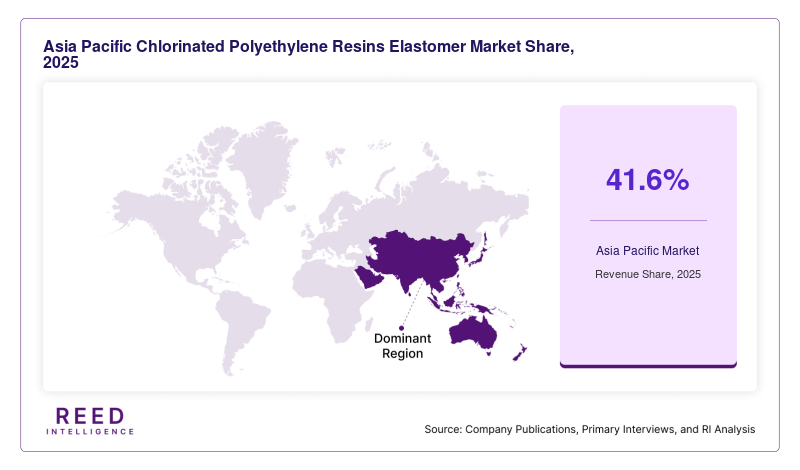
Asia Pacific held 41.6% of the global Chlorinated Polyethylene Resins Elastomer Market share in 2025 and is expected to expand at a CAGR of 6.6% during the forecast period. The region benefited from rapid industrialization, growing construction activities, and expanding automotive manufacturing operations. China dominated the regional market because of large-scale polymer production capacity and increasing investments in infrastructure development. The country also witnessed rising demand for PVC processing additives and wire insulation materials.
North America
North America accounted for 24.7% of the global market share in 2025 and is projected to grow at the fastest CAGR of 6.9% during 2026–2034. The region experienced strong demand from automotive manufacturing and industrial cable applications. The United States remained the dominant country market due to increasing investments in electric vehicle production and modernization of energy infrastructure. Expanding renewable energy installations further supported demand for advanced elastomer materials.
Europe
Europe represented 20.8% of the global Chlorinated Polyethylene Resins Elastomer Market share in 2025 and will grow at a CAGR of 6.1% during the forecast period. The market growth was supported by increasing adoption of high-performance polymer materials in construction and transportation industries. Germany led the regional market because of its advanced automotive manufacturing sector and strong industrial polymer research capabilities.
Middle East & Africa
The Middle East & Africa accounted for 6.7% of the market share in 2025 and is anticipated to register a CAGR of 5.7% through 2034. Infrastructure modernization projects and expanding industrial manufacturing activities supported regional market growth. Saudi Arabia dominated the region due to ongoing investments in petrochemical production and industrial diversification initiatives.
Latin America
Latin America held 6.2% of the global market share in 2025 and is forecast to grow at a CAGR of 5.9% during the study period. Brazil emerged as the dominant country market due to increasing demand for construction materials and industrial rubber products. Rising investments in transportation infrastructure also contributed to regional product consumption.
Competitive Landscape
The Chlorinated Polyethylene Resins Elastomer Market remains moderately consolidated with the presence of global polymer manufacturers and regional specialty chemical suppliers. Companies are focusing on product innovation, expansion of manufacturing capacities, and development of high-performance elastomer grades to strengthen their market positions.
Dow Inc. maintained a strong position in the market due to its extensive polymer materials portfolio and advanced research capabilities. The company recently expanded its specialty elastomer production operations to support increasing industrial demand.
Shandong Novista Chemicals Co., Ltd. focused on strengthening its PVC additive and impact modifier product portfolio for infrastructure applications. Sundow Polymers Co., Ltd. expanded its production capacity to meet growing demand from wire and cable manufacturers.
DuPont continued investing in high-performance elastomer materials for automotive and industrial applications, while Showa Denko K.K. emphasized advanced polymer processing technologies to improve product efficiency and thermal resistance.
Key Players List
- Dow Inc.
- DuPont
- Shandong Novista Chemicals Co., Ltd.
- Sundow Polymers Co., Ltd.
- Showa Denko K.K.
- Hangzhou Keli Chemical Co., Ltd.
- Weifang Yaxing Chemical Co., Ltd.
- Jiangsu Tianteng Chemical Industry Co., Ltd.
- Shandong Xuye New Materials Co., Ltd.
- INEOS Group Holdings S.A.
- Arkema S.A.
- BASF SE
- Lubrizol Corporation
- PolyOne Corporation
- Tosoh Corporation
Recent Developments
- In March 2025, Dow Inc. expanded its specialty elastomer production facility to support rising industrial polymer demand.
- In July 2024, Sundow Polymers Co., Ltd. introduced advanced CPE impact modifier grades for PVC construction materials.
- In September 2024, DuPont launched new elastomer formulations designed for electric vehicle cable systems.
- In January 2025, Showa Denko K.K. enhanced its polymer processing technologies to improve thermal resistance properties.
- In November 2024, Shandong Novista Chemicals Co., Ltd. expanded its distribution network across Southeast Asia to strengthen regional market presence.
Chlorinated Polyethylene Resins Elastomer Market Segments
By Product Type
- Chlorinated Polyethylene Elastomer
- Chlorinated Polyethylene Resin
- Impact Modifier Grade
- Wire & Cable Grade
By Chlorine Content
- Below 35%
- 35%–40%
- Above 40%
By Application
- Wire and Cable Compounds
- Impact Modification for PVC
- Hoses and Tubing
- Roofing Membranes
- Automotive Components
- Adhesives and Sealants
- Magnetic Materials
By End-Use Industry
- Automotive
- Building and Construction
- Electrical and Electronics
- Industrial Manufacturing
- Consumer Goods
By Distribution Channel
- Direct Sales
- Distributors and Wholesalers
- Online Industrial Platforms
By Region
- North America
- Europe
- APAC
- Middle East and Africa
- LATAM