Choroid Plexus Disorder Treatment Market Size, Share Demand Report By Treatment Type (Pharmaceutical Therapy, Surgical Treatment, Radiation Therapy, Targeted Biologics), By Disorder Type (Choroid Plexus Tumors, Choroid Plexus Cysts, Inflammatory Disorders), By End-Use (Hospitals, Specialty Neurology Clinics, Research Institutes), By Distribution Channel (Hospital Pharmacies, Retail Pharmacies, Online Pharmacies), By Region & Segment Forecasts, 2025–2034
USD 3950
Market Overview
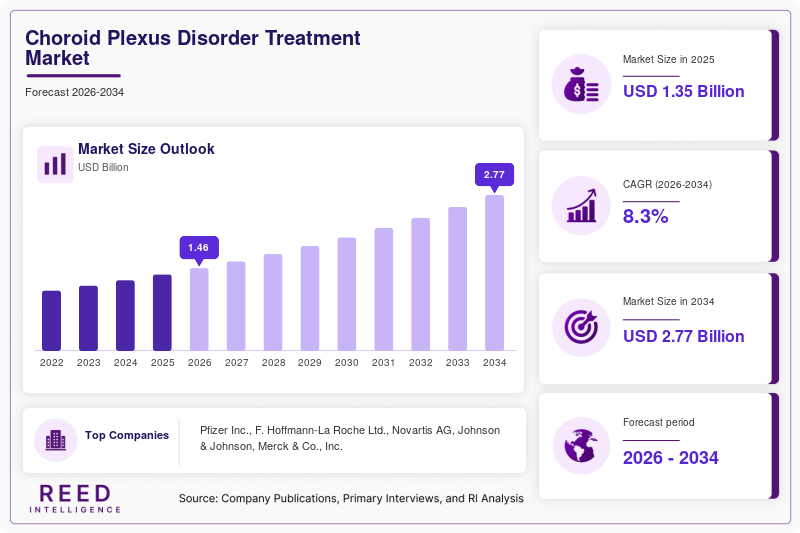
The Choroid Plexus Disorder Treatment Market was valued at approximately USD 1.35 billion in 2025 and is projected to reach USD 2.78 billion by 2034, expanding at a CAGR of 8.3% during the forecast period (2025–2034). The market growth is being supported by increasing global awareness of rare neurological disorders and improved access to specialized diagnostic and treatment facilities. Advancements in neuroimaging and early diagnosis have also enabled timely identification of choroid plexus disorders, which has contributed to the steady demand for targeted therapies.
A key global factor supporting the growth of the Choroid Plexus Disorder Treatment Market is the rising investment in neuroscience research and rare disease therapeutics. Governments and private organizations are allocating funding toward orphan drug development, which is improving treatment availability and expanding the therapeutic landscape.
Key Highlights:
- North America dominated the market with a 38.6% share in 2025, while Asia Pacific is expected to register the fastest CAGR of 9.6% during the forecast period.
- Among treatment types, pharmaceutical therapy accounted for the largest share (54.2%) in 2024, while targeted biologics are projected to be the fastest-growing subsegment with a CAGR of 10.2%.
- In end-use, hospitals held the dominant share (61.5%) in 2024, whereas specialty neurology clinics are expected to grow at a CAGR of 9.1%.
- The United States remained the dominant country, with market values of USD 0.42 billion in 2024 and USD 0.45 billion in 2025.
Market Trends
Increasing Adoption of Targeted Therapies
The Choroid Plexus Disorder Treatment Market is witnessing a shift toward targeted therapies, particularly biologics and precision medicines. These treatments are designed to act on specific molecular pathways associated with choroid plexus tumors and related disorders. This trend is supported by advancements in genomics and biomarker identification, enabling more effective and personalized treatment approaches. As a result, healthcare providers are increasingly adopting these therapies to improve patient outcomes and reduce side effects associated with conventional treatments.
Integration of Advanced Diagnostic Technologies
Another key trend shaping the Choroid Plexus Disorder Treatment Market is the integration of advanced imaging and diagnostic tools such as high-resolution MRI and AI-based diagnostic platforms. These technologies enhance early detection and improve diagnostic accuracy, which is critical for effective treatment planning. The growing use of digital health solutions is also streamlining patient management and facilitating remote consultations, particularly in emerging markets. This trend is expected to support better clinical outcomes and drive long-term market growth.
Market Drivers
Rising Prevalence of Neurological Disorders
The increasing prevalence of neurological disorders, including rare conditions affecting the choroid plexus, is a major driver of the Choroid Plexus Disorder Treatment Market. Growing aging populations and improved diagnostic capabilities have led to higher detection rates. This has increased the demand for effective treatment solutions, particularly in developed regions where healthcare infrastructure supports early diagnosis and intervention.
Growth in Healthcare Expenditure and Infrastructure
Expanding healthcare expenditure across both developed and developing economies is another significant driver. Governments are investing in specialized neurological care facilities and research programs, which is improving access to advanced treatment options. In addition, private sector involvement and the expansion of health insurance coverage are making treatments more accessible, thereby supporting the overall growth of the Choroid Plexus Disorder Treatment Market.
Market Restraint
High Cost of Treatment and Limited Accessibility
One of the primary restraints in the Choroid Plexus Disorder Treatment Market is the high cost associated with advanced therapies and surgical procedures. Treatments such as targeted biologics, neurosurgical interventions, and long-term care require significant financial resources, which can limit accessibility, particularly in low- and middle-income countries. Additionally, the rarity of these disorders often results in limited availability of specialized healthcare professionals and treatment centers.
The lack of reimbursement policies for rare disease treatments in certain regions further restricts patient access. This financial burden can delay treatment initiation and negatively impact patient outcomes. Moreover, the high cost of research and development for orphan drugs contributes to elevated pricing, creating challenges for both healthcare systems and patients. These factors collectively act as a barrier to the widespread adoption of advanced therapies in the Choroid Plexus Disorder Treatment Market.
Market Opportunities
Expansion of Orphan Drug Development Programs
The increasing focus on orphan drug development presents a significant opportunity for the Choroid Plexus Disorder Treatment Market. Regulatory incentives such as tax credits, market exclusivity, and accelerated approval pathways are encouraging pharmaceutical companies to invest in rare disease therapeutics. This is expected to lead to the introduction of innovative treatment options, thereby expanding the market landscape.
Emerging Markets and Untapped Patient Population
Emerging economies in Asia Pacific, Latin America, and the Middle East & Africa offer substantial growth opportunities due to improving healthcare infrastructure and rising awareness. These regions have a large untapped patient population and increasing government initiatives aimed at enhancing access to healthcare services. As diagnostic capabilities improve and treatment options become more accessible, the Choroid Plexus Disorder Treatment Market is expected to witness strong growth in these regions.
Segmental Analysis
By Treatment Type
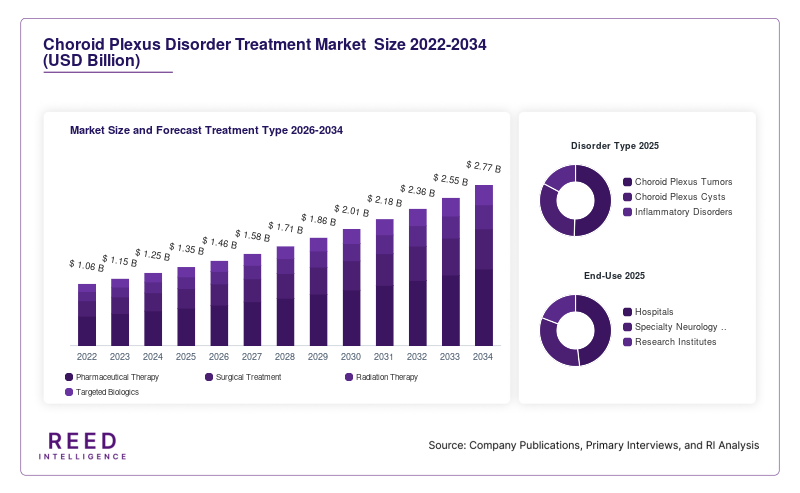
Pharmaceutical therapy dominated the Choroid Plexus Disorder Treatment Market, accounting for 54.2% of the share in 2024. This dominance was attributed to the widespread use of medications such as chemotherapy agents and corticosteroids in managing symptoms and controlling disease progression.
Targeted biologics are expected to be the fastest-growing subsegment, with a projected CAGR of 10.2%. The growth will be driven by advancements in molecular biology and the development of therapies that specifically target disease pathways, offering improved efficacy and reduced side effects.
By Disorder Type
Choroid plexus tumors represented the dominant subsegment, holding a 48.7% share in 2024. The higher prevalence of these tumors compared to other choroid plexus disorders contributed to their leading position.
Choroid plexus cysts are anticipated to grow at the fastest CAGR of 9.4% due to increasing detection rates through improved imaging technologies. Early diagnosis will drive demand for monitoring and treatment solutions.
By End-Use
Hospitals accounted for the largest share of 61.5% in 2024, supported by their ability to provide comprehensive care, including diagnosis, surgery, and post-treatment management.
Specialty neurology clinics are projected to be the fastest-growing segment, with a CAGR of 9.1%. Their growth will be fueled by increasing patient preference for specialized care and shorter treatment timelines.
By Distribution Channel
Hospital pharmacies dominated the market with a 52.3% share in 2024 due to their direct integration with treatment facilities and access to specialized medications.
Online pharmacies are expected to grow at a CAGR of 10.5%, driven by increasing digital adoption and improved accessibility to medications, particularly in remote areas.
Regional Analysis
North America
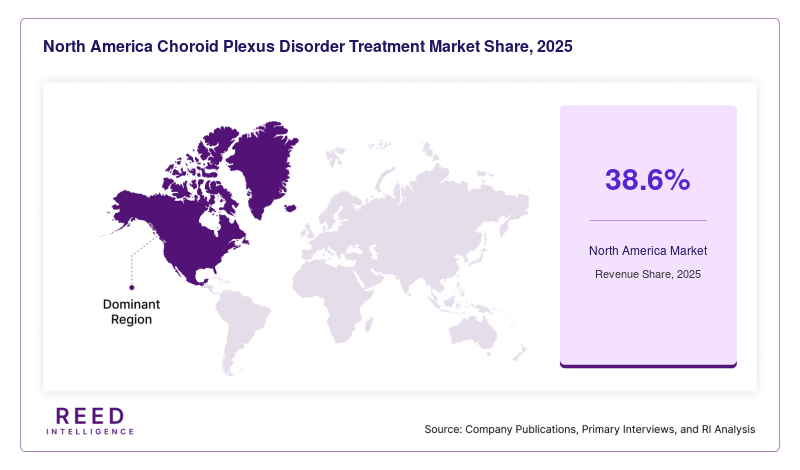
North America accounted for 38.6% of the Choroid Plexus Disorder Treatment Market share in 2025 and is expected to grow at a CAGR of 7.9% during the forecast period. The region’s established healthcare infrastructure and availability of advanced treatment options supported its leading position.
The United States dominated the regional market due to strong clinical research activity and the presence of specialized neurology centers. The country’s growth was influenced by increased funding for rare disease research and a higher adoption rate of advanced therapies, contributing to sustained market expansion.
Europe
Europe held a 27.4% share of the Choroid Plexus Disorder Treatment Market in 2025 and will grow at a CAGR of 7.6% through 2034. The region benefited from well-developed healthcare systems and strong regulatory support for orphan drugs.
Germany emerged as the dominant country, supported by its robust healthcare infrastructure and emphasis on early diagnosis. Government initiatives promoting research and development in neurological disorders contributed to steady market growth.
Asia Pacific
Asia Pacific captured 19.8% of the Choroid Plexus Disorder Treatment Market share in 2025 and is projected to grow at the fastest CAGR of 9.6%. Rapid improvements in healthcare infrastructure and increasing awareness of neurological conditions drove regional growth.
China led the region due to its expanding healthcare system and growing investment in medical research. The country’s focus on improving access to specialized treatments and increasing healthcare spending supported its dominant position.
Middle East & Africa
The Middle East & Africa accounted for 7.1% of the Choroid Plexus Disorder Treatment Market in 2025 and is expected to grow at a CAGR of 8.4%. The region showed gradual progress due to improving healthcare infrastructure and rising awareness.
Saudi Arabia dominated the regional market, driven by government investments in healthcare modernization and the establishment of advanced medical facilities. Efforts to improve access to specialized care contributed to market growth.
Latin America
Latin America held a 7.1% share of the Choroid Plexus Disorder Treatment Market in 2025 and will grow at a CAGR of 8.1% during the forecast period. Increasing healthcare expenditure and expanding access to medical services supported regional development.
Brazil emerged as the leading country, supported by its growing healthcare sector and rising focus on rare disease management. Government initiatives aimed at improving healthcare accessibility played a key role in market expansion.
Competitive Landscape
The Choroid Plexus Disorder Treatment Market is moderately competitive, with key players focusing on research and development, strategic collaborations, and product innovation. Leading companies are investing in targeted therapies and expanding their portfolios to address rare neurological conditions.
A major market leader is Pfizer Inc., which has been actively involved in developing advanced therapies and expanding its rare disease portfolio. The company recently announced progress in clinical trials for a targeted biologic aimed at improving treatment outcomes for rare neurological disorders.
Other prominent players are also strengthening their market presence through partnerships and regional expansion strategies. Continuous innovation and increased focus on personalized medicine are expected to shape the competitive dynamics of the Choroid Plexus Disorder Treatment Market over the forecast period.
Key Players
- Pfizer Inc.
- F. Hoffmann-La Roche Ltd.
- Novartis AG
- Johnson & Johnson
- Merck & Co., Inc.
- Bristol-Myers Squibb Company
- Sanofi S.A.
- GlaxoSmithKline plc
- AstraZeneca plc
- Eli Lilly and Company
Recent Developments
- In 2024, Pfizer Inc. initiated a Phase II clinical trial for a novel biologic therapy targeting rare neurological tumors.
- Novartis AG expanded its neuroscience research division to accelerate innovation in rare disease treatments.
- Roche launched an advanced diagnostic platform to improve early detection of neurological disorders.
- AstraZeneca entered a strategic collaboration to develop targeted therapies for brain-related conditions.
- Johnson & Johnson increased its investment in AI-based diagnostic tools for neurological disorders.
Choroid Plexus Disorder Treatment Market Segments
Treatment Type
- Pharmaceutical Therapy
- Surgical Treatment
- Radiation Therapy
- Targeted Biologics
Disorder Type
- Choroid Plexus Tumors
- Choroid Plexus Cysts
- Inflammatory Disorders
End-Use
- Hospitals
- Specialty Neurology Clinics
- Research Institutes
Distribution Channel
- Hospital Pharmacies
- Retail Pharmacies
- Online Pharmacies
By Region
- North America
- Europe
- APAC
- Middle East and Africa
- LATAM