Chrome Lignite Market Size, Share Demand Report By Type (Sulfonated Chrome Lignite, Modified Low-Chrome Lignite, Standard Chrome Lignite), By Application (Oilfield Drilling Fluids, Industrial Water Treatment, Foundry Binders, Process Additives), By End Use (Oil & Gas, Foundry & Metallurgy, Specialty Chemicals, Industrial Manufacturing), By Region & Segment Forecasts, 2026–2034
USD 3950
Market Overview
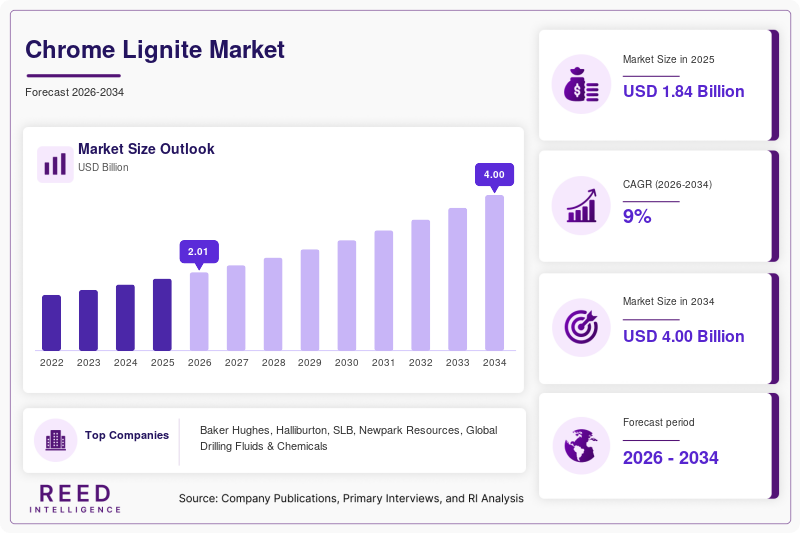
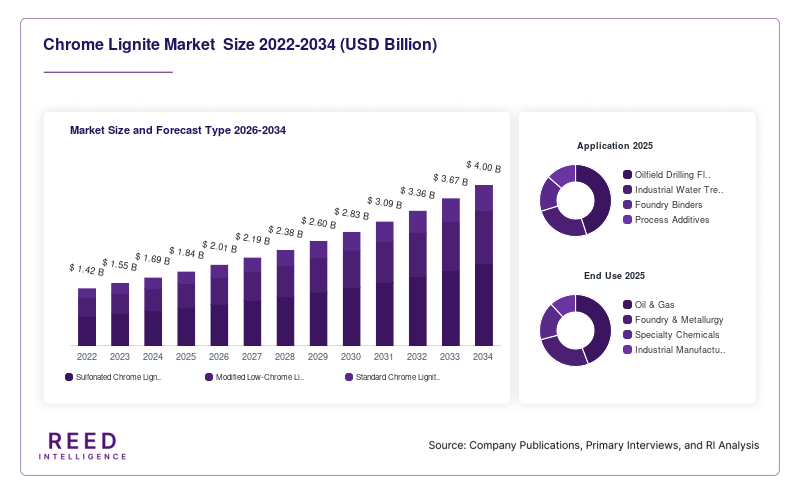
The Chrome Lignite Market size was valued at USD 1.84 billion in 2026 and is projected to reach USD 3.67 billion by 2034, expanding at a CAGR of 9.0% during the forecast period. Chrome lignite, widely used as a drilling fluid additive, binder, and industrial processing agent, continues to gain traction across oil & gas, foundry, and specialty chemical applications. Rising global energy exploration activity, particularly in unconventional reservoirs and deep-well drilling operations, has been a major factor supporting market expansion. Demand has also been reinforced by the need for cost-efficient fluid-loss control agents that improve drilling performance under high-temperature and high-pressure conditions. Increasing investments in infrastructure and metallurgical processing in emerging economies are further supporting long-term market growth.
Key Highlights
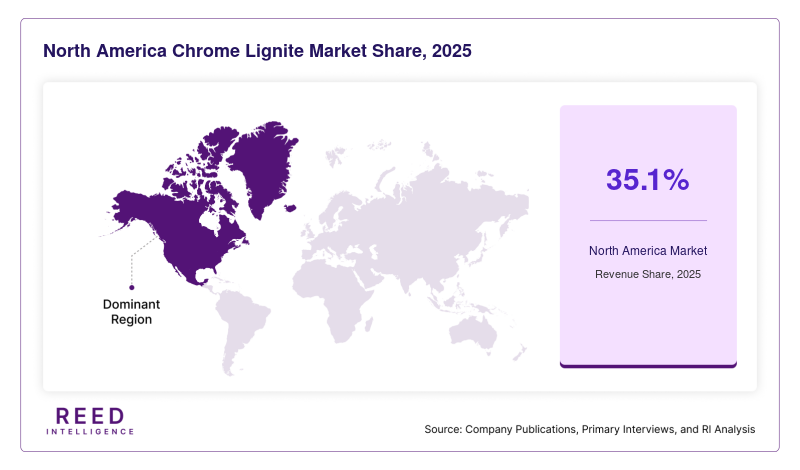
- North America dominated the market with a 35.1% share in 2025.
- Asia Pacific is expected to grow at the fastest CAGR of 10.8% during 2026–2034.
- By type, sulfonated chrome lignite accounted for the largest share of 42.6%, while modified low-chrome lignite is projected to grow at a CAGR of 10.9%.
- By application, oilfield drilling fluids led with a 46.8% share, whereas industrial water treatment additives are expected to expand at a CAGR of 10.4%.
- By end use, the oil & gas sector remained dominant at 48.3%, while specialty chemicals is forecast to grow at 10.2% CAGR.
- The United States remained the dominant country, with market values of USD 420 million in 2024 and USD 458 million in 2025.
Market Trends
Rising preference for high-performance drilling additives
A key trend shaping the Chrome Lignite Market is the increasing use of high-performance drilling additives in complex well environments. Operators are prioritizing drilling efficiency, borehole stability, and fluid-loss control, which has elevated the use of chrome lignite formulations in onshore and offshore projects. Enhanced formulations with improved thermal stability are gaining demand in deep-water and shale operations. Market participants are also developing blends compatible with water-based mud systems to improve operational flexibility. This trend is especially visible in North America and the Middle East, where advanced drilling programs continue to expand.
Shift toward environmentally optimized formulations
Another important trend is the transition toward lower-chrome and environmentally optimized lignite derivatives. Regulatory scrutiny around heavy metal content has encouraged manufacturers to innovate cleaner formulations without compromising performance. Producers are increasingly investing in modified chrome lignite products that reduce dosage requirements and improve biodegradability. This trend is generating interest from European industrial buyers and multinational oilfield service providers that seek compliance with environmental standards while maintaining cost-effective fluid systems.
Market Drivers
Expansion of oil and gas exploration activities
The primary driver of the Chrome Lignite Market is the expansion of global oil and gas exploration activities. Increased capital expenditure in upstream projects, particularly across shale basins, offshore blocks, and mature field redevelopment, continues to create steady demand for drilling additives. Chrome lignite plays an important role in controlling filtration loss and stabilizing wellbore conditions. Countries such as the U.S., Saudi Arabia, and China are increasing drilling activity, directly supporting market consumption volumes and long-term revenue growth.
Growth in foundry and industrial processing demand
A second major growth driver is the expanding use of chrome lignite in foundry binders and industrial processing systems. Rapid industrialization across Asia Pacific and Latin America is increasing demand for metallurgical products, castings, and industrial chemicals. Chrome lignite is valued for its thermal properties and cost efficiency in these processes. As manufacturing output rises in automotive, construction, and machinery sectors, downstream demand for lignite-based additives is expected to strengthen further.
Market Restraint
Environmental regulations and substitution risks
The Chrome Lignite Market faces a notable restraint from tightening environmental regulations related to chromium-based compounds. Several countries are enforcing stricter standards for industrial waste management and drilling fluid disposal, which can increase compliance costs for end users. In addition, substitution risk from non-chrome synthetic polymers and organic filtration-control additives is gradually increasing. These alternatives are often positioned as environmentally safer solutions, particularly in regions with mature regulatory frameworks. The impact is more pronounced in Europe, where industrial users are increasingly adopting alternative chemistries. This may limit market penetration for traditional chrome lignite products and create pricing pressure across mature markets.
Market Opportunities
Expansion in geothermal drilling projects
One emerging opportunity lies in geothermal drilling applications. With global investment in renewable energy infrastructure rising, geothermal projects require robust drilling fluid additives that can withstand elevated temperatures. Chrome lignite’s thermal stability makes it suitable for these applications. Countries such as Indonesia, Kenya, and Iceland are increasing geothermal exploration, creating new avenues for market participants beyond conventional oil and gas use.
Growth in Asia Pacific manufacturing ecosystems
A second significant opportunity is the rapid growth of industrial and manufacturing ecosystems across Asia Pacific. Rising steel production, foundry activity, and industrial wastewater treatment requirements are supporting diversified demand for chrome lignite derivatives. Companies expanding distribution networks in India, China, Vietnam, and Indonesia are likely to benefit from strong volume growth, especially as local industries seek cost-efficient processing additives.
Segmental Analysis
By Type
The sulfonated chrome lignite segment dominated the market with a 42.6% share in 2024. This subsegment remains the preferred choice across drilling fluid systems due to its superior ability to reduce fluid loss and stabilize borehole conditions under challenging temperature and pressure environments. Demand is particularly strong from offshore drilling projects and mature oilfields where enhanced mud performance is required. In addition to upstream applications, sulfonated variants are also being used in select industrial treatment systems where process stability and cost efficiency are priorities. The segment continues to benefit from broad commercial availability and well-established supplier networks across North America and the Middle East.
The modified low-chrome lignite segment is expected to grow at the fastest CAGR of 10.9% through 2034. Growth is being driven by rising environmental compliance requirements and customer preference for optimized heavy-metal content products. These formulations are increasingly adopted in Europe and Asia Pacific due to their improved regulatory compatibility and reduced environmental impact. Manufacturers are investing in product innovation to enhance thermal resistance and filtration performance while lowering chromium content, making this segment one of the most attractive growth areas in the overall market.
By Application
The oilfield drilling fluids segment accounted for the largest 46.8% share in 2024. Chrome lignite remains a widely used additive in water-based and oil-based mud systems due to its strong fluid-loss control performance. The segment benefits from continuous drilling operations in shale, offshore, and geothermal projects. Increasing complexity in well design has reinforced demand for additives capable of improving drilling stability and minimizing non-productive time. This segment is expected to maintain its leadership position throughout the forecast period.
The industrial water treatment additives segment is forecast to expand at a CAGR of 10.4%. Growth is being driven by rising industrial wastewater management needs across manufacturing hubs in Asia Pacific and Latin America. Chrome lignite derivatives are increasingly used in specialty treatment blends designed to improve process efficiency and sediment control. Expansion of industrial parks and stricter discharge norms are key factors supporting growth in this segment.
By End Use
The oil & gas segment held the dominant 48.3% share in 2024. This leadership is supported by consistent drilling activity and the essential role of chrome lignite in mud formulation systems. Demand from upstream operators, drilling contractors, and oilfield service companies continues to account for the majority of global revenue. Increased redevelopment of mature wells and enhanced recovery programs are also contributing to segment stability.
The specialty chemicals segment is projected to grow at the fastest CAGR of 10.2% through 2034. Growth is being driven by product diversification and the use of lignite-derived compounds in industrial formulations, binders, and process chemicals. Expansion of specialty manufacturing across China and India is expected to accelerate demand, especially from mid-sized industrial processors seeking cost-efficient input materials.
Regional Analysis
North America
North America accounted for 35.1% of the Chrome Lignite Market in 2025 and is expected to register a CAGR of 8.6% through 2034. The region continues to benefit from stable upstream energy investments and strong demand from shale drilling operations. High-volume drilling activity in unconventional basins supports consistent consumption of fluid-loss additives and wellbore stabilizers.
The United States remains the dominant country in the region. A unique growth factor is the continued expansion of horizontal drilling and hydraulic fracturing across the Permian and Eagle Ford basins. This sustained drilling intensity is supporting repeat demand from oilfield service providers and mud system manufacturers.
Europe
Europe held approximately 22.4% market share in 2025 and is forecast to grow at a CAGR of 7.8%. Demand in the region is driven by industrial processing, specialty chemicals, and selective oilfield applications in the North Sea. Stable demand from foundry and metallurgical operations also contributes to market resilience.
Germany remains the leading country market in Europe. A unique factor supporting growth is the country’s strong industrial chemicals and engineered materials sector, where chrome lignite derivatives are used in specialized processing systems. Regulatory-led product innovation is also shaping regional demand patterns.
Asia Pacific
Asia Pacific captured 24.8% of the market in 2025 and is expected to expand at the fastest CAGR of 10.8% during the forecast period. The region’s growth is driven by rapid industrialization, expanding drilling activity, and strong demand from manufacturing and water treatment sectors.
China leads the regional market, supported by large-scale industrial output and energy exploration investments. A unique growth factor is the expansion of domestic foundry production and steel-related manufacturing, which continues to increase consumption of lignite-based additives.
Middle East & Africa
The Middle East & Africa represented 11.3% share in 2025 and is projected to grow at a CAGR of 9.4%. Ongoing oilfield development and reservoir optimization projects across major hydrocarbon-producing countries continue to support market demand.
Saudi Arabia is the dominant country market. A unique growth factor is the region’s long-cycle upstream investment strategy focused on production optimization and enhanced drilling performance, which supports steady usage of high-temperature drilling additives.
Latin America
Latin America accounted for 6.4% share in 2025 and is expected to grow at a CAGR of 8.9%. Market demand is supported by energy projects, mining activity, and industrial applications across Brazil, Mexico, and Argentina.
Brazil leads the regional market. A unique growth factor is offshore energy exploration in pre-salt reserves, where drilling fluid performance remains a critical operational requirement, increasing the need for reliable chrome lignite formulations.
Competitive Landscape
The Chrome Lignite Market remains moderately consolidated, with leading participants focusing on product performance, supply reliability, and regional expansion. Key companies are strengthening partnerships with oilfield service providers and industrial distributors to improve market reach. Baker Hughes currently leads the market due to its strong product portfolio and established customer relationships in drilling chemicals.
A notable recent development includes the launch of a low-chrome high-temperature lignite additive by a major multinational supplier in early 2026, designed for geothermal and deep-well drilling environments. Other major companies are increasing production capacity in Asia Pacific to capture regional demand growth and reduce logistics costs.
Key Players
- Baker Hughes
- Halliburton
- SLB
- Newpark Resources
- Global Drilling Fluids & Chemicals
- Mudchem
- Milwhite Inc.
- Shandong Lignite Materials Co.
- Indian Drilling Chemicals Ltd.
- GEO Specialty Additives
- ChemSol Energy Materials
- Sino Industrial Minerals
- Arabian Drilling Chemicals
- PetroChem Process Solutions
- Universal Lignite Products
Recent Developments
- In January 2026, Baker Hughes introduced an enhanced low-chrome lignite additive for geothermal drilling systems.
- In August 2025, Halliburton expanded its drilling additives distribution network across Southeast Asia.
- In November 2025, SLB announced a strategic supply agreement with a Middle East drilling contractor for advanced mud additives.
Chrome Lignite Market Segments
Type
- Sulfonated Chrome Lignite
- Modified Low-Chrome Lignite
- Standard Chrome Lignite
Application
- Oilfield Drilling Fluids
- Industrial Water Treatment
- Foundry Binders
- Process Additives
End Use
- Oil & Gas
- Foundry & Metallurgy
- Specialty Chemicals
- Industrial Manufacturing
By Region
- North America
- Europe
- APAC
- Middle East and Africa
- LATAM