Chromoendoscopy Agents Market Size, Share & Demand Report By Type (Absorptive Agents, Contrast Agents, Reactive Agents), By Application (Colorectal Cancer Diagnosis, Inflammatory Bowel Disease Diagnosis, Barrett’s Esophagus, Gastric Cancer Detection), By End-Use (Hospitals, Ambulatory Surgical Centers, Specialty Clinics), By Distribution Channel (Direct Sales, Distributors, Online Sales) & Segment Forecasts, 2025–2034
USD 3950
Market Overview
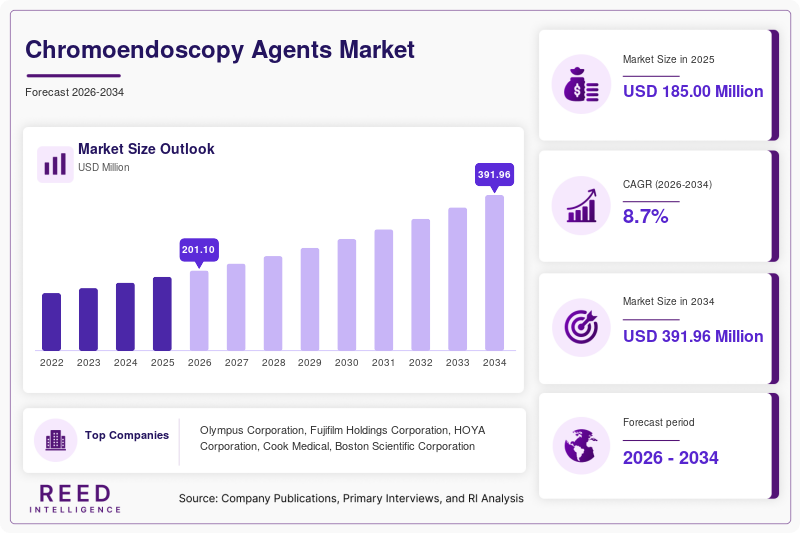
The global Chromoendoscopy Agents Market size was valued at approximately USD 185 million in 2025 and is projected to reach USD 392 million by 2034, expanding at a compound annual growth rate (CAGR) of 8.7% during the forecast period. The market is gaining momentum due to the increasing adoption of advanced diagnostic endoscopy techniques aimed at improving the detection of gastrointestinal abnormalities, including early-stage cancers and inflammatory diseases.
A major global factor supporting the growth of the Chromoendoscopy Agents Market is the rising burden of gastrointestinal disorders, particularly colorectal cancer, which continues to drive demand for enhanced visualization methods during endoscopic procedures. Chromoendoscopy agents, such as dyes and stains, significantly improve mucosal visualization, enabling clinicians to detect subtle lesions that may otherwise remain undiagnosed with conventional white-light endoscopy.
Key Highlights:
- North America dominated the market with a 38.5% share in 2025, while Asia Pacific is projected to register the fastest CAGR of 10.4% during 2025–2034.
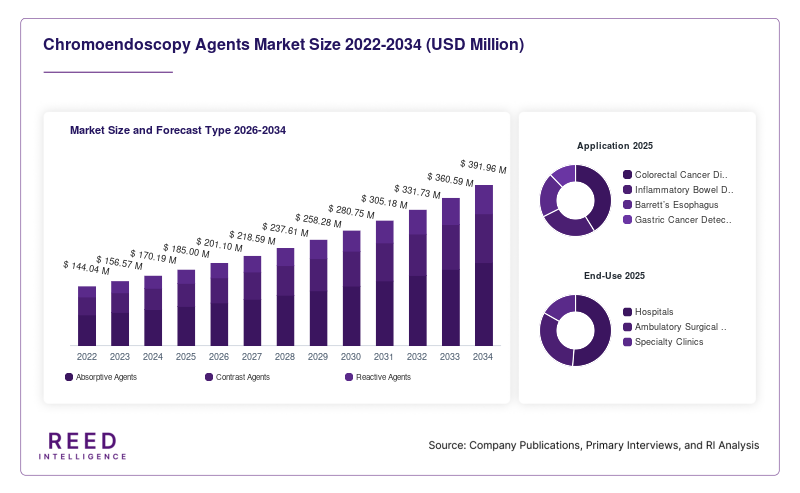
- Among types, absorptive agents led with a 44.2% share in 2024, while contrast agents are anticipated to grow fastest at a CAGR of 9.6%.
- In applications, colorectal cancer diagnosis held the largest share at 41.8% in 2024, whereas inflammatory bowel disease diagnosis is expected to grow at a CAGR of 9.2%.
- The U.S. remained the dominant country, with market values of USD 62 million in 2024 and USD 67 million in 2025.
Market Trends
Integration of Chromoendoscopy with Digital Imaging Technologies
The Chromoendoscopy Agents Market is witnessing a notable trend toward the integration of dye-based techniques with advanced digital imaging systems, such as narrow-band imaging and high-definition endoscopy. While digital chromoendoscopy methods are gaining traction, traditional dye-based agents continue to complement these technologies by enhancing mucosal contrast in complex cases. This hybrid approach is improving diagnostic precision, particularly in detecting dysplasia and early neoplastic lesions, thereby sustaining the demand for chromoendoscopy agents.
Increasing Preference for Targeted and Patient-Specific Diagnostics
Another significant trend shaping the Chromoendoscopy Agents Market is the growing emphasis on personalized diagnostics. Healthcare providers are increasingly selecting specific agents based on patient condition, lesion type, and anatomical considerations. This shift toward targeted application is enhancing clinical outcomes and optimizing procedural efficiency. Furthermore, the development of specialized agents designed for selective staining of abnormal tissues is expected to strengthen this trend, supporting more accurate and tailored diagnostic procedures across healthcare settings.
Market Drivers
Rising Prevalence of Gastrointestinal Diseases
The increasing global incidence of gastrointestinal disorders, including colorectal cancer, Barrett’s esophagus, and inflammatory bowel disease, is a key driver of the Chromoendoscopy Agents Market. As early detection becomes critical for improving patient outcomes, healthcare systems are adopting advanced diagnostic methods such as chromoendoscopy. The ability of these agents to enhance visualization of mucosal irregularities significantly contributes to their growing utilization in clinical practice.
Growing Adoption of Preventive Screening Programs
Expanding government and institutional initiatives focused on preventive healthcare and cancer screening are driving the demand for chromoendoscopy agents. Screening programs targeting high-risk populations have increased the number of endoscopic procedures performed globally. As chromoendoscopy improves detection rates of precancerous lesions, it is increasingly being incorporated into standard screening protocols, thereby fueling market growth.
Market Restraint
Availability of Alternative Imaging Techniques
One of the primary restraints impacting the Chromoendoscopy Agents Market is the increasing availability and adoption of alternative imaging technologies, such as virtual chromoendoscopy and artificial intelligence-assisted endoscopy. These techniques offer enhanced visualization without the need for dye application, reducing procedural complexity and time. As healthcare facilities aim to streamline workflows and improve efficiency, there is a gradual shift toward these advanced modalities.
Additionally, the requirement for specialized training to effectively use chromoendoscopy agents can limit their widespread adoption, particularly in resource-constrained settings. Variability in staining outcomes and potential procedural delays further contribute to the preference for non-invasive imaging alternatives. These factors collectively pose challenges to the sustained growth of the Chromoendoscopy Agents Market.
Market Opportunities
Emerging Markets Expansion
The Chromoendoscopy Agents Market presents significant opportunities in emerging economies across Asia Pacific, Latin America, and parts of the Middle East & Africa. Rapid improvements in healthcare infrastructure, increasing healthcare expenditure, and growing awareness of early disease detection are creating a favorable environment for market expansion. As endoscopy procedures become more accessible, the demand for chromoendoscopy agents is expected to rise substantially.
Development of Advanced and Safer Agents
Ongoing research and development efforts aimed at creating more effective, safer, and user-friendly chromoendoscopy agents offer considerable growth potential. Innovations such as targeted staining agents and formulations with reduced side effects are expected to enhance clinical adoption. These advancements will likely expand the scope of applications and improve patient outcomes, further strengthening the market outlook.
Segmental Analysis
By Type
Absorptive agents dominated the Chromoendoscopy Agents Market with a 44.2% share in 2024, owing to their effectiveness in highlighting mucosal patterns and detecting abnormal tissues. These agents are widely used in routine endoscopic procedures due to their reliability and ease of application.
Contrast agents are expected to grow at the fastest CAGR of 9.6% during the forecast period, driven by their ability to enhance surface topography and improve lesion detection. Their increasing use in complex diagnostic cases will support growth.
By Application
Colorectal cancer diagnosis accounted for the largest share of 41.8% in 2024, reflecting the high prevalence of the disease and the importance of early detection. Chromoendoscopy plays a crucial role in identifying precancerous lesions, making it a preferred technique in this application.
Inflammatory bowel disease diagnosis is projected to grow at a CAGR of 9.2%, supported by the increasing incidence of conditions such as Crohn’s disease and ulcerative colitis. The need for accurate assessment of disease severity will drive demand.
By End-Use
Hospitals held the dominant share of 52.6% in 2024 due to the high volume of endoscopic procedures performed in these settings. The availability of advanced equipment and skilled professionals contributes to their leading position.
Ambulatory surgical centers are expected to grow at a CAGR of 9.1%, driven by the shift toward outpatient procedures and cost-effective healthcare delivery models. Their convenience and shorter patient turnaround times will support growth.
By Distribution Channel
Direct sales dominated the Chromoendoscopy Agents Market with a 48.9% share in 2024, as manufacturers prefer direct engagement with healthcare providers to ensure product quality and training.
Online distribution channels are anticipated to grow at a CAGR of 10.1%, supported by the increasing adoption of digital procurement platforms and streamlined supply chain processes. This trend will enhance accessibility and reduce operational costs.
Regional Analysis
North America
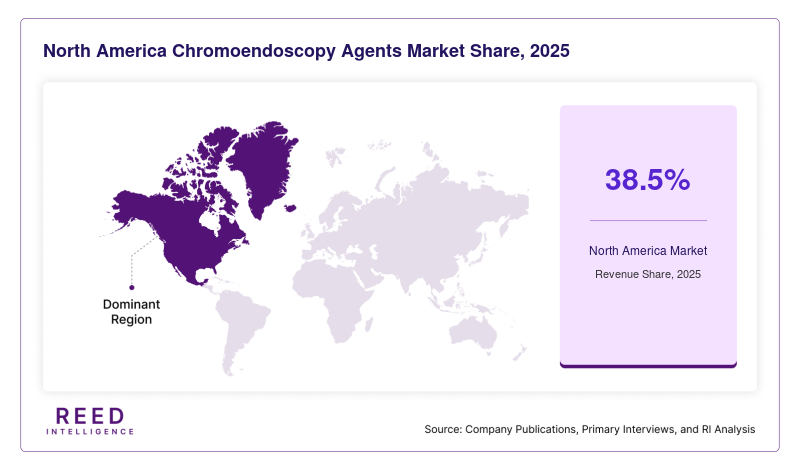
North America accounted for a 38.5% share of the Chromoendoscopy Agents Market in 2025 and will grow at a CAGR of 7.9% through 2034.
The United States dominated the regional market due to its well-established healthcare infrastructure and high adoption of advanced diagnostic technologies. A key growth factor in the country is the widespread implementation of colorectal cancer screening programs, which has significantly increased the volume of endoscopic procedures. The presence of skilled professionals and strong reimbursement frameworks further supports the adoption of chromoendoscopy agents.
Europe
Europe held a 27.3% share of the Chromoendoscopy Agents Market in 2025 and will expand at a CAGR of 8.2% during the forecast period.
Germany emerged as the leading country, driven by its robust healthcare system and emphasis on early disease diagnosis. The country’s strong focus on clinical research and adoption of innovative endoscopic techniques has contributed to increased utilization of chromoendoscopy agents. Additionally, favorable regulatory frameworks support market growth.
Asia Pacific
Asia Pacific represented 21.6% of the Chromoendoscopy Agents Market in 2025 and is projected to grow at the fastest CAGR of 10.4% through 2034.
China led the region, supported by rapid healthcare infrastructure development and a large patient population. The increasing prevalence of gastrointestinal diseases and rising awareness of early diagnosis are key growth factors. Government initiatives to improve healthcare access are further accelerating market expansion in the country.
Middle East & Africa
The Middle East & Africa accounted for 6.8% of the Chromoendoscopy Agents Market in 2025 and will grow at a CAGR of 7.5% over the forecast period.
Saudi Arabia dominated the region, driven by increasing investments in healthcare infrastructure and growing adoption of advanced medical technologies. The expansion of private healthcare facilities and rising focus on specialized diagnostic services are supporting market growth.
Latin America
Latin America held a 5.8% share of the Chromoendoscopy Agents Market in 2025 and is expected to grow at a CAGR of 7.8% during 2025–2034.
Brazil emerged as the leading country due to improving healthcare access and rising awareness of gastrointestinal health. The growing number of endoscopic procedures and increasing investment in healthcare facilities are key factors driving market growth in the country.
Competitive Landscape
The Chromoendoscopy Agents Market is moderately competitive, with several global and regional players focusing on product innovation and strategic collaborations. The market leader, Olympus Corporation, maintains a strong position through its extensive product portfolio and continuous advancements in endoscopic technologies. The company recently introduced enhanced imaging-compatible chromoendoscopy solutions to improve diagnostic accuracy.
Other key players are investing in research and development to introduce safer and more effective agents. Strategic partnerships, mergers, and acquisitions are common approaches adopted by companies to expand their market presence and strengthen distribution networks. The competitive landscape is characterized by ongoing innovation and efforts to address evolving clinical needs.
Key Players
- Olympus Corporation
- Fujifilm Holdings Corporation
- HOYA Corporation
- Cook Medical
- Boston Scientific Corporation
- Medtronic plc
- Conmed Corporation
- Erbe Elektromedizin GmbH
- Cantel Medical Corp.
- EndoChoice Inc.
Recent Developments
- In 2024, Olympus Corporation launched an upgraded chromoendoscopy solution compatible with high-definition imaging systems.
- In 2023, Fujifilm Holdings expanded its endoscopy portfolio with new dye-based visualization agents.
- In 2024, Cosmo Pharmaceuticals introduced a targeted staining agent designed for improved detection of colorectal lesions.
- In 2023, Boston Scientific Corporation strengthened its distribution network across emerging markets.
- In 2024, PENTAX Medical enhanced its product offerings with integrated chromoendoscopy-compatible systems.
Chromoendoscopy Agents Market Segments
Type
- Absorptive Agents
- Contrast Agents
- Reactive Agents
Application
- Colorectal Cancer Diagnosis
- Inflammatory Bowel Disease Diagnosis
- Barrett’s Esophagus
- Gastric Cancer Detection
End-Use
- Hospitals
- Ambulatory Surgical Centers
- Specialty Clinics
Distribution Channel
- Direct Sales
- Distributors
- Online Sales
By Region
- North America
- Europe
- APAC
- Middle East and Africa
- LATAM