Cigarette Vending Machine Market Size, Share & Demand Report By Machine Type (Fully Automated Cigarette Vending Machines, Semi-Automated Cigarette Vending Machines, Smart Touchscreen-Enabled Vending Machines), By Payment Mode (Cash Payment Systems, Cashless Payment Systems, Biometric Age-Verification Systems), By End Use (Bars and Nightlife Venues, Hotels and Resorts, Transportation Hubs, Casinos and Gaming Centers, Retail Convenience Facilities), By Region & Segment Forecasts, 2026–2034
USD 3950
Market Overview
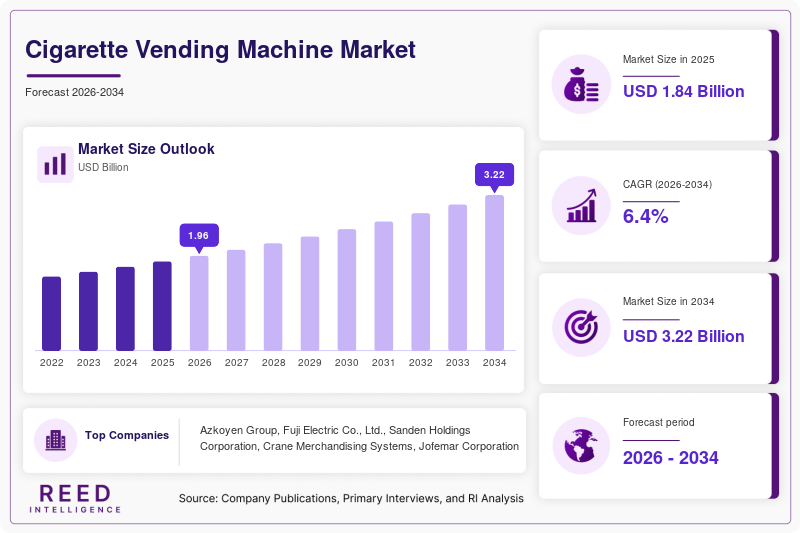
The global Cigarette Vending Machine Market size was valued at USD 1.84 billion in 2026 and is projected to reach USD 3.02 billion by 2034, expanding at a CAGR of 6.4% during the forecast period from 2026 to 2034. The market continues to evolve due to the rising adoption of automated retail infrastructure across hospitality venues, entertainment facilities, casinos, airports, and licensed smoking lounges. Businesses are increasingly deploying vending solutions to reduce labor dependency, improve inventory management, and maintain round-the-clock product accessibility in regulated environments. Modern cigarette vending systems now include age-verification technologies, cashless payment systems, digital displays, and cloud-based monitoring platforms, supporting operational efficiency and regulatory compliance.
One of the major global factors supporting market growth is the expansion of automated retail ecosystems across urban commercial centers. Retail operators are investing in unattended vending systems to improve consumer convenience and reduce operating costs. In regions where tobacco vending remains legally permitted under age-controlled conditions, machine manufacturers are integrating biometric scanners, ID verification systems, and AI-enabled monitoring features to comply with changing regulations. In addition, tourism recovery and increasing footfall across nightlife venues, transportation hubs, and hospitality establishments are contributing to stable machine deployment rates in both developed and emerging economies.
Key Highlights
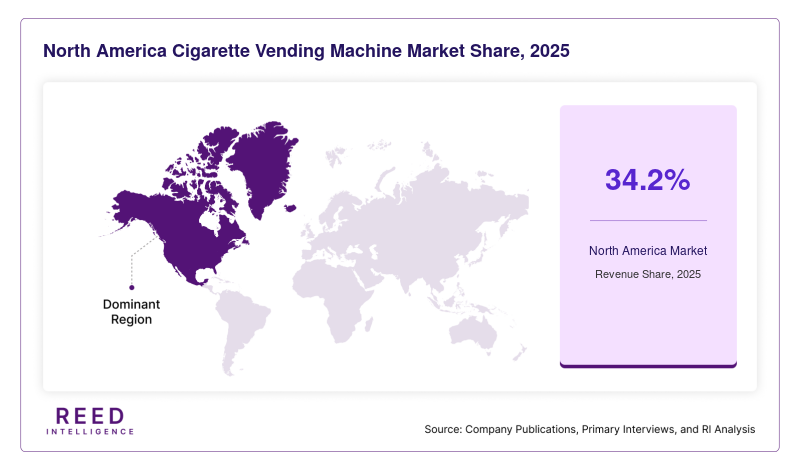
- North America dominated the market with a 34.2% share in 2025.
- Asia Pacific is expected to grow at the fastest CAGR of 8.9% during 2026–2034.
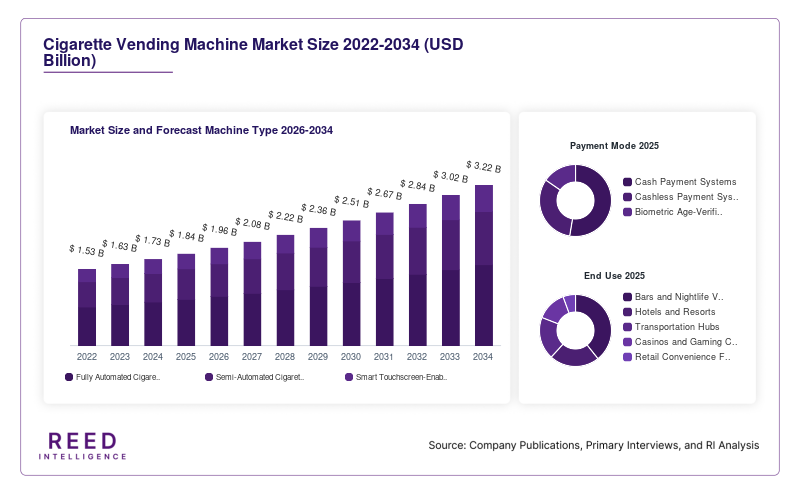
- By machine type, fully automated cigarette vending machines accounted for the largest share of 43.6%.
- while smart touchscreen-enabled vending machines are projected to grow at a CAGR of 9.8%.
- By payment mode, cashless payment systems led with a 48.4% share, whereas biometric age-verification systems are expected to expand at a CAGR of 10.2%.
- By end use, bars and nightlife venues held a 39.1% share, while transportation hubs are anticipated to register a CAGR of 9.1% during the forecast period.
- The United States remained the dominant country, with market values of USD 420 million in 2024 and USD 451 million in 2025.
Market Trends
Integration of Smart Age-Verification Technologies
The Cigarette Vending Machine Market is witnessing increasing integration of advanced age-verification technologies to address tightening tobacco control regulations across several countries. Machine manufacturers are deploying AI-enabled facial recognition systems, biometric authentication modules, ID card scanners, and digital verification software to reduce unauthorized purchases by underage consumers. These technologies help vending operators comply with legal frameworks while maintaining automated sales capabilities in licensed venues. Smart compliance solutions are becoming a core purchasing criterion among hospitality chains, casinos, and airport retailers seeking to avoid penalties and operational disruptions.
The growing use of cloud-connected monitoring systems is also improving machine transparency and regulatory oversight. Operators can now remotely monitor inventory movement, customer authentication records, payment transactions, and maintenance schedules in real time. This trend is encouraging larger commercial facilities to replace older mechanical vending systems with digital vending platforms that support software updates and remote diagnostics. The demand for secure and compliant vending infrastructure is expected to increase steadily as governments strengthen tobacco retail supervision policies in urban markets.
Expansion of Cashless and Contactless Vending Infrastructure
Cashless transaction capability has emerged as a significant trend shaping the Cigarette Vending Machine Market. Consumers increasingly prefer contactless payments through mobile wallets, QR codes, NFC-enabled cards, and digital banking applications. As a result, vending machine manufacturers are integrating multi-payment interfaces that improve convenience and transaction speed. This trend accelerated after the widespread adoption of digital payment ecosystems across retail environments and entertainment venues. Businesses are prioritizing vending solutions that support seamless customer experiences while reducing cash-handling risks and maintenance expenses.
In addition, smart vending terminals equipped with interactive touchscreen displays are becoming more common in premium hospitality environments. These systems provide digital advertising opportunities, multilingual interfaces, and customized promotions based on consumer preferences. Operators are also using data analytics tools to optimize product placement, restocking schedules, and purchasing patterns. The combination of digital payments and data-driven vending management is transforming cigarette vending operations from simple dispensing units into connected retail systems with improved profitability and operational control.
Market Drivers
Rising Adoption of Automated Retail Systems in Commercial Spaces
The increasing adoption of automated retail infrastructure across commercial establishments is supporting the growth of the Cigarette Vending Machine Market. Businesses operating in bars, casinos, hotels, entertainment centers, and transport terminals are seeking solutions that reduce dependency on manual retail staffing while ensuring uninterrupted product availability. Cigarette vending machines allow operators to provide 24-hour access in controlled environments without requiring additional personnel. This operational advantage is particularly valuable in nightlife venues and tourism-driven locations where customer traffic remains active beyond conventional retail hours.
The market is also benefiting from the growing preference for compact retail formats in urban areas where floor space efficiency is important. Modern vending systems occupy limited space while supporting multiple tobacco product categories, digital payment technologies, and inventory tracking capabilities. As commercial property operators focus on improving operational efficiency and customer convenience, demand for technologically advanced vending systems is increasing. Automated vending also helps reduce queue congestion during peak operational periods, improving customer satisfaction across hospitality and entertainment sectors.
Technological Advancements in Smart Vending Equipment
Rapid technological innovation in vending machine hardware and software is another major driver accelerating market expansion. Manufacturers are investing in touchscreen interfaces, IoT-enabled inventory monitoring, predictive maintenance systems, and remote management platforms to improve machine functionality. These technologies enhance operational reliability while lowering maintenance costs and minimizing downtime. Smart vending solutions also allow operators to track sales performance across multiple locations through centralized cloud-based dashboards, improving inventory planning and revenue forecasting.
The integration of energy-efficient refrigeration systems, anti-theft protection, digital advertising displays, and advanced dispensing mechanisms is further increasing product adoption among commercial buyers. Businesses prefer vending solutions that combine security, compliance, and modern customer engagement features. In several developed markets, technological improvements are helping cigarette vending operators maintain compliance with strict regulatory requirements through automated age screening and transaction recording systems. Continuous innovation is expected to create replacement demand for outdated vending equipment throughout the forecast period.
Market Restraint
Stringent Tobacco Control Regulations and Advertising Restrictions
The Cigarette Vending Machine Market faces substantial challenges from increasingly strict tobacco control regulations implemented across multiple countries. Governments and public health organizations continue to introduce policies restricting tobacco accessibility, advertising visibility, and automated retail sales. Several nations have either prohibited cigarette vending machines entirely or imposed strict licensing and age-verification requirements that increase operational complexity for vending operators. These regulatory frameworks limit market expansion opportunities, particularly in schools, public transportation areas, and open-access commercial environments.
Regulatory uncertainty also affects long-term investment decisions among vending machine manufacturers and venue operators. Businesses may hesitate to deploy large vending networks in markets where tobacco legislation changes frequently or where public health campaigns discourage smoking-related retail infrastructure. In Europe and parts of Asia, certain municipalities have introduced tighter controls on tobacco product displays, digital advertising screens, and machine placement locations. Compliance with these evolving regulations often requires additional investments in software upgrades, biometric systems, and monitoring technologies, increasing overall operating costs. The market also faces reputational pressure due to growing consumer awareness regarding health risks associated with tobacco consumption, which may reduce installation growth across family-oriented hospitality environments and public venues.
Market Opportunities
Growth Potential in Emerging Hospitality and Tourism Markets
Emerging economies with expanding tourism and hospitality sectors present strong opportunities for the Cigarette Vending Machine Market. Countries experiencing growth in nightlife entertainment, casino operations, international tourism, and premium hospitality infrastructure are increasingly adopting automated retail technologies to improve customer convenience. Hotels, resorts, and airport lounges are integrating vending systems to support round-the-clock product availability without expanding labor requirements. This trend is particularly visible in urban entertainment districts and international travel hubs where high customer traffic supports vending profitability.
The expansion of smart city initiatives and modern commercial infrastructure in developing economies is also creating favorable conditions for vending machine deployment. As digital payment penetration improves across Asia Pacific, Latin America, and parts of the Middle East, operators are introducing connected vending systems with multilingual interfaces and remote management capabilities. Manufacturers entering these regions through partnerships with hospitality chains and local distributors are expected to gain long-term growth opportunities. Increasing urbanization and rising disposable income levels are further supporting demand for premium automated retail experiences in commercial environments.
Adoption of Data Analytics and Remote Monitoring Platforms
The growing use of data analytics and remote monitoring technologies creates another major opportunity for market participants. Modern cigarette vending systems generate transaction data that can help operators optimize inventory allocation, identify purchasing trends, and improve operational planning. Businesses are increasingly investing in cloud-connected vending platforms that provide real-time performance insights, automated restocking alerts, and predictive maintenance notifications. These features improve machine uptime while reducing manual monitoring expenses across large vending networks.
Manufacturers are also introducing AI-enabled software platforms capable of analyzing customer purchasing behavior, payment preferences, and location-specific demand patterns. This information helps operators maximize profitability by customizing product assortments and promotional strategies. Remote diagnostics capabilities further reduce maintenance costs by enabling technical teams to identify operational issues before machine failures occur. As vending operators seek scalable and data-driven business models, demand for intelligent vending infrastructure is expected to increase significantly across both developed and emerging markets during the forecast period.
Segmental Analysis
By Machine Type
Fully automated cigarette vending machines accounted for the largest market share of 43.6% in 2024 due to their widespread adoption across bars, casinos, transportation terminals, and hospitality venues. These machines offer enhanced operational efficiency through automatic dispensing systems, integrated payment modules, and digital inventory management capabilities. Commercial operators prefer fully automated systems because they reduce labor requirements and improve customer convenience in high-traffic environments. Manufacturers are increasingly integrating touchscreen interfaces, anti-theft mechanisms, and energy-efficient components to improve machine functionality and long-term operational performance.
Smart touchscreen-enabled vending machines are projected to register the fastest CAGR of 9.8% during the forecast period. Growth in this subsegment is driven by rising demand for connected retail experiences and advanced consumer interaction capabilities. These machines support digital advertising displays, multilingual interfaces, mobile wallet integration, and remote management systems. Operators are investing in touchscreen-enabled solutions to enhance customer engagement while improving compliance monitoring and inventory visibility. The integration of AI-driven analytics and cloud-based monitoring software is also supporting adoption across modern hospitality and entertainment environments.
By Payment Mode
Cashless payment systems dominated the Cigarette Vending Machine Market in 2024 with a share of 48.4% due to increasing consumer preference for contactless transactions. Vending operators are rapidly integrating QR code payments, NFC-enabled cards, mobile wallets, and digital banking systems to improve transaction speed and convenience. The shift toward digital payments has significantly reduced cash-handling risks and maintenance expenses associated with traditional coin-operated vending machines. Commercial establishments also prefer cashless systems because they support centralized transaction tracking and improved operational transparency across multiple machine locations.
Biometric age-verification payment systems are expected to grow at the fastest CAGR of 10.2% during the forecast period. The increasing implementation of tobacco control regulations and age-restricted retail policies is driving demand for advanced authentication technologies. These systems combine payment authorization with biometric identity verification to ensure compliance with legal purchasing requirements. Businesses operating in highly regulated markets are increasingly adopting these solutions to reduce compliance risks and strengthen operational accountability. Technological advancements in facial recognition and digital identity verification software are expected to further accelerate subsegment growth.
By End Use
Bars and nightlife venues represented the dominant end-use segment in 2024, accounting for 39.1% of the global market share. These establishments generate strong demand for cigarette vending systems due to extended operating hours and high customer traffic. Automated vending solutions help venue operators improve service efficiency while minimizing staffing requirements during late-night operations. Many bars and clubs are also upgrading to smart vending systems equipped with digital payment compatibility, age-verification software, and touchscreen interfaces to improve customer convenience and operational compliance.
Transportation hubs are anticipated to register the fastest CAGR of 9.1% during the forecast period. Airports, railway stations, cruise terminals, and bus depots are increasingly adopting vending systems to support unattended retail operations and improve passenger convenience. Growth in international tourism and rising passenger traffic are encouraging transportation authorities and retail operators to invest in automated vending infrastructure. Modern transportation facilities prefer compact vending systems with multilingual interfaces, cloud-based monitoring platforms, and contactless payment functionality to support high-volume customer transactions and efficient inventory management.
Regional Analysis
North America
North America accounted for 34.2% of the global Cigarette Vending Machine Market share in 2025 and is expected to maintain a stable growth trajectory with a CAGR of 5.8% during the forecast period. The regional market benefits from the presence of established vending infrastructure, widespread adoption of cashless payment technologies, and high deployment across casinos, bars, and entertainment facilities. Commercial operators continue to modernize older vending equipment with digital systems featuring age-verification technologies and remote monitoring capabilities. Demand remains concentrated in regulated hospitality environments where automated tobacco retail is legally permitted.
The United States represents the dominant country within the regional market due to strong adoption across nightlife venues, airport lounges, and gaming establishments. One major growth factor supporting the country’s market expansion is the increasing deployment of smart vending systems integrated with biometric authentication and cloud-based inventory management software. Operators are prioritizing compliance-focused vending infrastructure to address state-level tobacco sales regulations while maintaining operational efficiency. Canada also contributes to regional demand through selective adoption in licensed entertainment facilities and hospitality centers.
Europe
Europe held a significant share of the Cigarette Vending Machine Market in 2025 and is projected to grow at a CAGR of 5.3% through 2034. The market remains highly regulated, with vending deployment concentrated in countries permitting tobacco vending under strict age-control conditions. Modernization of vending infrastructure is supporting demand across hospitality venues and transport terminals. Businesses are increasingly replacing traditional mechanical machines with smart digital systems capable of supporting cashless transactions and automated compliance verification. Western European countries continue to account for the largest revenue contribution within the region.
Germany emerged as the leading country in the European market due to its established vending culture and broad commercial deployment of automated retail systems. A unique growth factor driving market demand in Germany is the widespread integration of electronic identification technologies that support age-restricted product sales. Machine operators are increasingly investing in touchscreen interfaces, mobile payment compatibility, and remote diagnostics platforms to improve operational efficiency. Italy and Spain are also witnessing gradual adoption across tourism-oriented entertainment establishments and hospitality facilities.
Asia Pacific
Asia Pacific is expected to register the fastest CAGR of 8.9% during the forecast period due to rapid urbanization, expanding hospitality infrastructure, and increasing digital payment penetration. The region is witnessing rising demand for automated retail systems across airports, entertainment districts, hotels, and premium nightlife venues. Growing consumer acceptance of self-service technologies is encouraging commercial property operators to invest in connected vending infrastructure. Manufacturers are also expanding regional distribution networks to capitalize on rising demand for technologically advanced vending solutions in urban commercial centers.
Japan remains the dominant country within the Asia Pacific Cigarette Vending Machine Market because of its long-standing vending machine culture and advanced automated retail ecosystem. A major growth factor supporting the Japanese market is the country’s extensive adoption of smart vending technologies equipped with IC card authentication and real-time monitoring capabilities. China and South Korea are also experiencing increasing adoption across hospitality and transportation sectors due to expanding digital commerce ecosystems and rising investment in smart retail infrastructure.
Middle East & Africa
The Middle East & Africa region is projected to experience moderate growth in the Cigarette Vending Machine Market, supported by rising tourism activity and increasing development of premium hospitality infrastructure. Countries with expanding entertainment sectors are witnessing gradual adoption of automated vending technologies across hotels, casinos, lounges, and airport terminals. Businesses are increasingly exploring unattended retail systems to improve operational efficiency and customer convenience in high-footfall commercial environments. Growth remains selective due to varying tobacco regulations across different countries within the region.
The United Arab Emirates dominates the regional market due to its advanced tourism ecosystem and strong investment in luxury hospitality projects. One significant growth factor driving market expansion is the increasing deployment of smart retail technologies across international airports, hotels, and nightlife venues catering to international travelers. Commercial establishments in Dubai and Abu Dhabi are investing in cashless vending systems integrated with multilingual interfaces and digital payment compatibility. South Africa also contributes to regional demand through adoption in licensed entertainment and gaming establishments.
Latin America
Latin America continues to show gradual development in the Cigarette Vending Machine Market, with a projected CAGR of 6.1% during the forecast period. The market is supported by the modernization of hospitality infrastructure and growing adoption of automated retail systems in urban entertainment districts. Bars, casinos, and tourism-oriented venues are increasingly investing in vending machines to improve service accessibility while reducing labor costs. Demand for compact vending systems with digital payment support is also increasing across metropolitan commercial centers throughout the region.
Brazil remains the leading country within the Latin American market due to its large hospitality sector and expanding nightlife economy. A unique growth factor supporting market growth in Brazil is the increasing adoption of contactless payment technologies across urban retail and entertainment environments. Vending machine operators are focusing on modern digital systems equipped with inventory monitoring and customer authentication features to improve operational reliability. Mexico is also experiencing moderate demand growth across tourism hubs and airport retail environments.
Competitive Landscape
The Cigarette Vending Machine Market is moderately fragmented, with manufacturers focusing on technological innovation, compliance integration, and strategic regional expansion to strengthen market presence. Leading companies are investing in smart vending systems equipped with biometric authentication, cashless payment support, and cloud-connected inventory monitoring technologies. Market participants are also expanding partnerships with hospitality operators, transportation hubs, and entertainment venues to increase machine deployment across high-footfall commercial environments.
Azkoyen Group remains one of the leading companies in the market due to its extensive portfolio of automated retail solutions and strong European distribution network. The company recently introduced advanced vending systems with integrated remote diagnostics and energy-efficient operating components to improve operational performance. Other major players are focusing on touchscreen-enabled vending machines, AI-driven analytics platforms, and digital compliance technologies to differentiate their product offerings. Competitive intensity is expected to increase further as manufacturers prioritize smart retail innovation and expansion into emerging hospitality markets.
Key Players
- Azkoyen Group
- Fuji Electric Co., Ltd.
- Sanden Holdings Corporation
- Crane Merchandising Systems
- Jofemar Corporation
- Royal Vendors Inc.
- Seaga Manufacturing Inc.
- FAS International S.p.A.
- Bianchi Industry S.p.A.
- Westomatic Vending Services Ltd.
- Selecta Group
- Vendekin Technologies
- Glory Ltd.
- Automated Merchandising Systems
- Orasesta S.p.A.
Recent Developments
- Azkoyen Group launched a smart cigarette vending platform in 2025 featuring AI-based inventory management and enhanced biometric age verification.
- Fuji Electric Co., Ltd. expanded its digital payment-enabled vending machine portfolio across selected Asia Pacific hospitality markets in 2024.
- Jofemar Corporation introduced cloud-connected vending systems with predictive maintenance software for transportation hubs and entertainment venues in 2025.
Cigarette Vending Machine Market Segments
Machine Type
- Fully Automated Cigarette Vending Machines
- Semi-Automated Cigarette Vending Machines
- Smart Touchscreen-Enabled Vending Machines
Payment Mode
- Cash Payment Systems
- Cashless Payment Systems
- Biometric Age-Verification Systems
End Use
- Bars and Nightlife Venues
- Hotels and Resorts
- Transportation Hubs
- Casinos and Gaming Centers
- Retail Convenience Facilities
By Region
- North America
- Europe
- APAC
- Middle East and Africa
- LATAM