Cinnamic Acid Market Size, Share & Demand Report By Source (Natural, Synthetic), By Application (Flavor & Fragrance, Pharmaceutical Intermediates, Chemical Intermediates, UV Filters), By End-Use Industry (Food & Beverage, Pharmaceuticals, Cosmetics & Personal Care, Chemicals) By Region & Segment Forecasts, 2025–2034
USD 3950
Market Overview
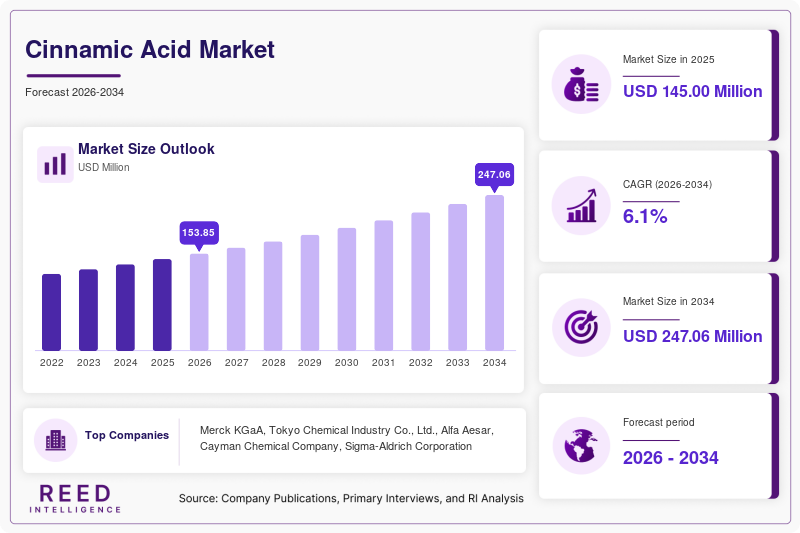
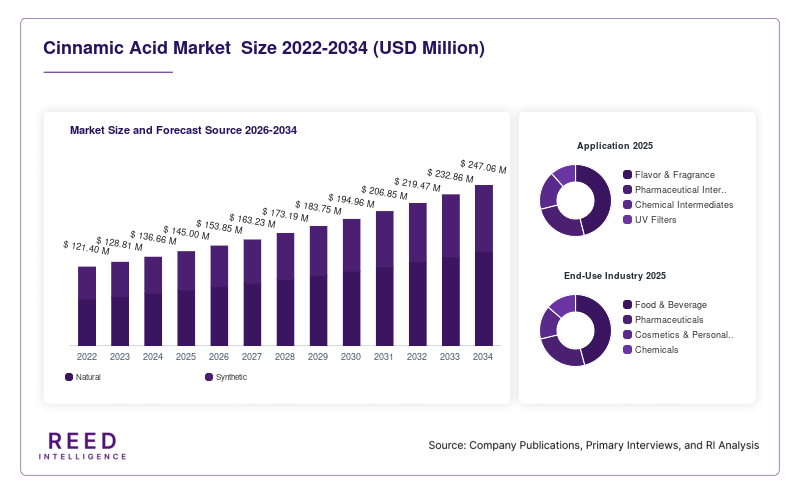
The global Cinnamic Acid Market size was valued at approximately USD 145 million in 2025 and is projected to reach USD 248 million by 2034, expanding at a CAGR of 6.1% during the forecast period (2025–2034). The market growth has been influenced by the increasing demand for naturally derived aromatic compounds across multiple industries, including food, cosmetics, and pharmaceuticals. Cinnamic acid, known for its fragrance-enhancing and antimicrobial properties, continues to gain traction as industries shift toward bio-based ingredients.
One of the key global factors supporting market growth is the rising preference for plant-based and sustainable chemical intermediates. Manufacturers are actively transitioning away from petrochemical derivatives toward naturally sourced compounds such as cinnamic acid, driven by regulatory pressure and evolving consumer preferences for clean-label products. This transition has strengthened demand across developed and emerging economies alike.
Key Highlights
- Asia Pacific dominated the market with a share of 38.5% in 2025, while it is expected to remain the fastest-growing region with a CAGR of 6.8%.
- By application, flavor & fragrance emerged as the leading subsegment with a 42.3% share, whereas pharmaceutical intermediates are projected to grow at the fastest CAGR of 7.1%.
- By source, synthetic cinnamic acid accounted for the largest share at 63.7%, while natural cinnamic acid is expected to expand at a CAGR of 6.9%.
- China, the dominant country, recorded a market value of USD 32 million in 2025, which is estimated to reach USD 34.1 million in 2026.
Market Trends
Rising Adoption of Natural and Bio-Based Ingredients
A notable trend shaping the Cinnamic Acid Market is the increasing adoption of natural and bio-based ingredients across industries. Consumers are becoming more aware of product composition, especially in food, cosmetics, and personal care products. This has led manufacturers to replace synthetic additives with naturally derived compounds such as cinnamic acid extracted from cinnamon oil and balsams.
The clean-label movement has encouraged companies to reformulate their products using plant-based chemicals. This trend is particularly visible in the fragrance and flavor industry, where cinnamic acid serves as a key intermediate in producing esters and aromatic compounds. Additionally, regulatory bodies are encouraging the use of safe and environmentally friendly ingredients, further accelerating this shift.
Expansion in Pharmaceutical and Functional Applications
Another important trend is the growing use of cinnamic acid in pharmaceutical and functional applications. The compound exhibits antimicrobial, anti-inflammatory, and antioxidant properties, making it suitable for drug formulation and therapeutic research. Pharmaceutical companies are increasingly exploring cinnamic acid derivatives for use in treatments targeting infections and chronic conditions.
Beyond pharmaceuticals, cinnamic acid is also being incorporated into functional products such as nutraceuticals and active cosmetic formulations. Its role in UV protection and skin conditioning has led to its inclusion in sunscreens and anti-aging products. As research into its bioactive properties continues, the market is expected to see broader adoption across advanced healthcare and wellness applications.
Market Drivers
Growing Demand from the Flavor and Fragrance Industry
The expanding flavor and fragrance industry is a major driver of the Cinnamic Acid Market. Cinnamic acid is widely used as a precursor for esters such as methyl cinnamate and ethyl cinnamate, which are key ingredients in perfumes, cosmetics, and food flavorings. As consumer demand for unique and appealing sensory experiences increases, manufacturers are focusing on enhancing product formulations using aromatic compounds.
The rise in disposable income and urbanization has also led to higher consumption of personal care and packaged food products, further boosting demand. Additionally, the trend toward premiumization in cosmetics and fragrances has encouraged the use of high-quality ingredients like cinnamic acid.
Increasing Industrial Applications in Chemical Synthesis
Another key driver is the growing use of cinnamic acid as an intermediate in chemical synthesis. It plays an essential role in the production of various industrial chemicals, including pharmaceuticals, dyes, and UV filters. The compound’s versatility and chemical stability make it a preferred choice for manufacturers.
Industries are increasingly investing in research and development to explore new applications of cinnamic acid derivatives. This has expanded its usage beyond traditional sectors into advanced materials and specialty chemicals. As industrial production continues to grow globally, the demand for cinnamic acid as a reliable intermediate is expected to rise steadily.
Market Restraint
Fluctuating Raw Material Availability and Price Volatility
One of the primary challenges facing the Cinnamic Acid Market is the fluctuating availability of raw materials and associated price volatility. Natural cinnamic acid is derived from plant sources such as cinnamon bark and balsamic resins, which are subject to seasonal variations and agricultural uncertainties. Factors such as climate change, crop diseases, and supply chain disruptions can significantly impact raw material supply.
Even in the case of synthetic production, dependence on petrochemical feedstocks exposes manufacturers to price fluctuations linked to crude oil markets. These variations can affect production costs and profit margins, particularly for small and medium-scale producers.
Additionally, maintaining consistent quality in natural extraction processes can be challenging, which may limit scalability. Regulatory requirements related to sourcing and processing also add complexity, increasing operational costs. As a result, price instability and supply uncertainties remain key restraints that could hinder market growth over the forecast period.
Market Opportunities
Growth in Green Chemistry and Sustainable Manufacturing
The increasing focus on green chemistry presents a significant opportunity for the Cinnamic Acid Market. Manufacturers are adopting eco-friendly production methods to reduce environmental impact and comply with regulatory standards. This includes the use of bio-based feedstocks and energy-efficient processes.
Cinnamic acid, being a naturally occurring compound, aligns well with sustainability goals. Companies that invest in green manufacturing technologies are likely to gain a competitive advantage. The development of cost-effective and scalable bio-based production methods is expected to open new growth avenues.
Expansion in Emerging Markets
Emerging economies offer strong growth potential for the cinnamic acid market. Rapid industrialization, increasing consumer awareness, and rising demand for processed foods and personal care products are driving market expansion in these regions.
Countries in Asia Pacific, Latin America, and the Middle East are witnessing increased investment in manufacturing and infrastructure. This creates opportunities for market players to establish production facilities and expand their distribution networks. As these markets continue to develop, demand for cinnamic acid is expected to rise significantly.
Segmental Analysis
By Source
Synthetic cinnamic acid dominated the Cinnamic Acid Market with a share of 63.7% in 2025. Its widespread use can be attributed to cost-effectiveness, consistent quality, and scalability in production. Industries prefer synthetic variants for large-scale applications where uniformity and reliability are critical.
Natural cinnamic acid is expected to grow at the fastest CAGR of 6.9% during the forecast period. This growth is driven by increasing consumer preference for natural and organic products. The rising demand for clean-label ingredients in food and cosmetics is encouraging manufacturers to shift toward natural sources.
By Application
The flavor and fragrance segment held the largest share of 42.3% in 2025. Cinnamic acid is widely used in this segment for its aromatic properties and as a precursor to various esters. The growing demand for enhanced sensory experiences in consumer products has driven this segment’s dominance.
The pharmaceutical intermediates segment is projected to grow at a CAGR of 7.1%. This growth is supported by increasing research into the therapeutic properties of cinnamic acid and its derivatives. The expanding pharmaceutical industry is expected to drive demand in this segment.
By End-Use Industry
The food & beverage industry accounted for the largest share of 34.8% in 2025. Cinnamic acid is used as a flavoring agent and preservative, making it a key ingredient in processed foods and beverages.
The cosmetics & personal care segment is anticipated to grow at a CAGR of 6.7%. The increasing demand for natural and functional ingredients in skincare and beauty products is driving growth. Cinnamic acid’s role in UV protection and fragrance enhancement is contributing to its rising adoption.
Regional Analysis
North America
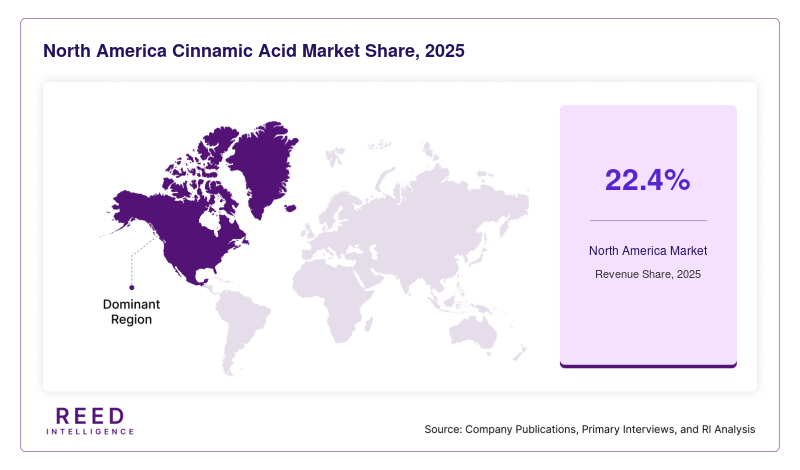
North America accounted for approximately 22.4% of the global Cinnamic Acid Market share in 2025 and is expected to grow at a CAGR of 5.6% during the forecast period. The region’s growth is supported by the presence of well-established industries such as pharmaceuticals, cosmetics, and food processing. Advanced research capabilities and technological innovation also contribute to steady market expansion.
The United States dominated the regional market due to its strong demand for high-quality flavoring agents and cosmetic ingredients. The country’s focus on product innovation and regulatory compliance has encouraged the adoption of cinnamic acid in various applications. Increasing investments in sustainable production methods are further supporting market growth.
Europe
Europe held a market share of 20.1% in 2025 and is projected to grow at a CAGR of 5.4%. The region is characterized by stringent environmental regulations and a strong emphasis on sustainability. This has driven the demand for bio-based chemicals, including cinnamic acid.
Germany emerged as the leading country in the region, supported by its robust chemical manufacturing industry. The country’s focus on innovation and high-quality production standards has facilitated the adoption of cinnamic acid in industrial applications. Additionally, the growing demand for natural cosmetics is contributing to market growth.
Asia Pacific
Asia Pacific dominated the global market with a share of 38.5% in 2025 and is expected to grow at the fastest CAGR of 6.8%. The region benefits from abundant raw material availability, low production costs, and a rapidly expanding industrial base.
China led the market in Asia Pacific due to its large-scale production capacity and strong export network. The country’s well-developed chemical industry and increasing demand from end-use sectors such as food and pharmaceuticals have driven market growth. Government initiatives supporting industrial development are further enhancing market prospects.
Middle East & Africa
The Middle East & Africa region accounted for 9.3% of the market share in 2025 and is projected to grow at a CAGR of 5.2%. The market in this region is driven by increasing industrialization and growing demand for personal care products.
Saudi Arabia dominated the regional market, supported by its expanding chemical sector and investments in manufacturing infrastructure. The country’s focus on economic diversification has encouraged the development of downstream industries, creating opportunities for cinnamic acid applications.
Latin America
Latin America held a share of 9.7% in 2025 and is expected to grow at a CAGR of 5.5%. The region is experiencing steady growth due to increasing consumer demand and improving economic conditions.
Brazil emerged as the leading country in the region, driven by its strong agricultural base and growing food processing industry. The availability of natural raw materials and increasing investment in manufacturing are supporting market expansion.
Competitive Landscape
The Cinnamic Acid Market is moderately fragmented, with several global and regional players competing based on product quality, pricing, and innovation. Key companies are focusing on expanding production capacity and developing sustainable manufacturing processes.
A leading player in the market is Merck KGaA, which has established a strong presence through its high-quality product portfolio and global distribution network. The company recently invested in expanding its specialty chemicals segment, including cinnamic acid derivatives, to meet growing demand.
Other prominent players are emphasizing research and development to explore new applications and improve product efficiency. Strategic partnerships and mergers are also common, enabling companies to strengthen their market position and expand their geographic reach.
Key Players
- Merck KGaA
- Tokyo Chemical Industry Co., Ltd.
- Alfa Aesar
- Cayman Chemical Company
- Sigma-Aldrich Corporation
- LANXESS AG
- BASF SE
- Eastman Chemical Company
- Haihang Industry Co., Ltd.
- Henan Tianfu Chemical Co., Ltd.
- Aurora Fine Chemicals LLC
- Finetech Industry Limited
- Parchem Fine & Specialty Chemicals
- Santa Cruz Biotechnology, Inc.
- Advanced Synthesis Technologies
Recent Developments
- In 2024, several manufacturers expanded their production capacities to meet rising demand from the flavor and fragrance sector.
- A leading chemical company introduced a bio-based cinnamic acid production process aimed at reducing carbon emissions.
- Strategic collaborations between pharmaceutical firms and chemical manufacturers have increased research on cinnamic acid derivatives.
- Investments in emerging markets have led to the establishment of new manufacturing facilities, enhancing regional supply chains.
- Product innovation in cosmetics has driven the inclusion of cinnamic acid in advanced skincare formulations.
Cinnamic Acid Market Segments
Source
- Natural
- Synthetic
Application
- Flavor & Fragrance
- Pharmaceutical Intermediates
- Chemical Intermediates
- UV Filters
End-Use Industry
- Food & Beverage
- Pharmaceuticals
- Cosmetics & Personal Care
- Chemicals
By Region
- North America
- Europe
- APAC
- Middle East and Africa
- LATAM