Circular Dichroism Spectrometers Market Size, Share & Demand Report By Type (Benchtop CD Spectrometers, Stopped-Flow CD Spectrometers), By Application (Pharmaceutical & Biotechnology, Academic Research, Others), By End-Use (Research Laboratories, Contract Research Organizations, Others), By Wavelength Range (Far-UV, Near-UV), By Region & Segment Forecasts, 2025–2034
USD 3950
Market Overview
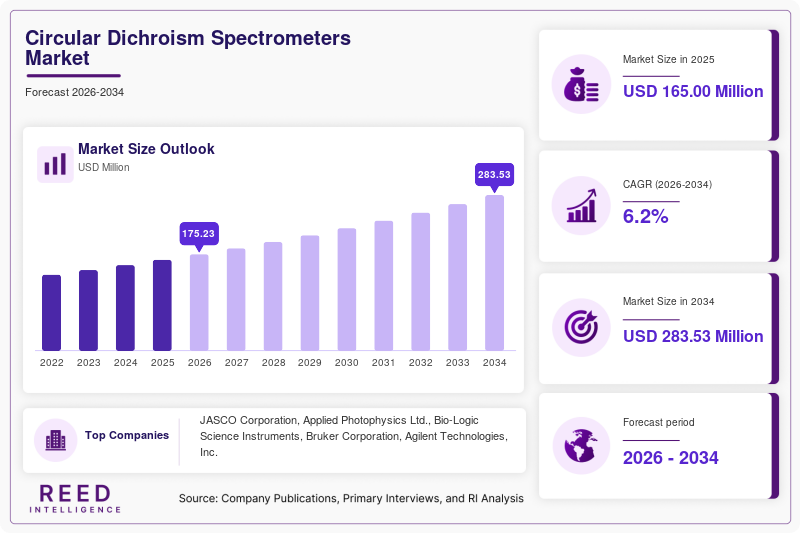
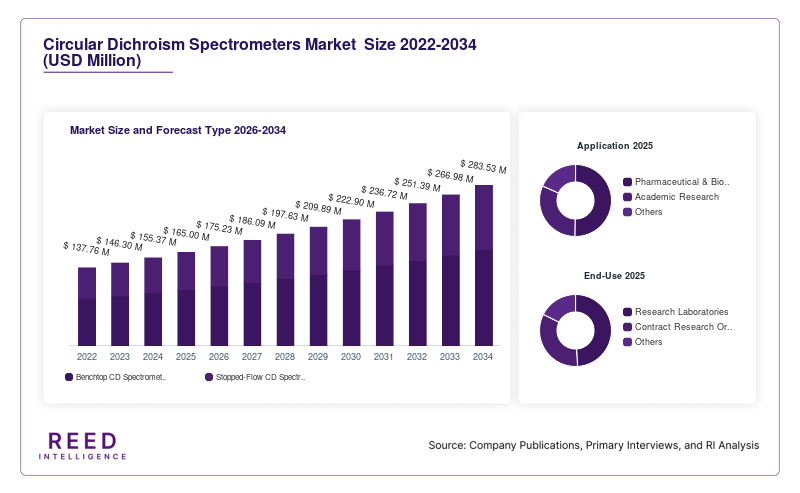
The global Circular Dichroism Spectrometers Market size was valued at approximately USD 165 million in 2025 and is projected to reach USD 285 million by 2034, expanding at a CAGR of 6.2% during the forecast period (2025–2034). The market growth is supported by the increasing emphasis on structural biology and protein characterization across pharmaceutical and biotechnology industries. Circular dichroism (CD) spectrometers play a critical role in analyzing biomolecular structures, particularly proteins and nucleic acids, which has become essential for drug discovery and quality control processes.
A major global factor driving the market is the rising investment in biopharmaceutical research and development. As biologics and biosimilars gain prominence, there is a growing need for advanced analytical techniques that can accurately determine secondary and tertiary protein structures, thereby supporting regulatory compliance and product efficacy.
Key Highlights
- North America dominated the market with a 38% share in 2025, while Asia Pacific is expected to register the fastest CAGR of 7.4% during the forecast period.
- In the type segment, benchtop CD spectrometers held the largest share (62%), while stopped-flow CD spectrometers are projected to grow at the fastest CAGR of 7.9%.
- The pharmaceutical and biotechnology application segment accounted for the largest share (54%), whereas academic research is expected to expand at a CAGR of 6.8%.
- The United States led the market with USD 52 million in 2025 and is expected to reach USD 55 million in 2026.
Market Trends
Integration of Advanced Software and Automation
A prominent trend shaping the Circular Dichroism Spectrometers Market is the integration of advanced software platforms and automation capabilities. Modern CD spectrometers are increasingly equipped with data processing tools that enable real-time analysis, automated baseline correction, and enhanced spectral interpretation. These innovations reduce human intervention and improve reproducibility, which is particularly important in regulated industries such as pharmaceuticals. The trend toward digitalization is also enabling remote operation and cloud-based data storage, facilitating collaboration across research facilities.
Rising Adoption in Biologics Development
Another key trend is the growing use of circular dichroism spectrometers in biologics and biosimilars development. With the increasing pipeline of monoclonal antibodies and protein-based therapeutics, there is a heightened need for structural validation techniques. CD spectroscopy provides rapid and non-destructive analysis, making it suitable for formulation studies and stability testing. This trend is expected to strengthen as regulatory authorities emphasize comprehensive characterization of biologics, thereby expanding the application scope of CD spectrometers.
Market Drivers
Increasing Demand for Protein Structure Analysis
The growing focus on protein-based drug development is a primary driver of the Circular Dichroism Spectrometers Market. Researchers require precise analytical tools to understand protein folding, conformational changes, and interactions. CD spectrometers provide quick insights into secondary structures such as alpha-helices and beta-sheets, making them indispensable in drug discovery workflows. The expansion of proteomics research is further amplifying demand.
Expansion of Pharmaceutical R&D Investments
Global pharmaceutical and biotechnology companies are increasing their R&D spending to develop innovative therapies. This expansion directly contributes to the demand for analytical instruments, including CD spectrometers. As drug pipelines become more complex, the need for reliable and high-throughput analytical methods grows. Additionally, regulatory requirements for structural validation are encouraging laboratories to adopt advanced spectroscopic techniques.
Market Restraint
High Cost of Instruments and Maintenance
One of the major challenges in the Circular Dichroism Spectrometers Market is the high initial cost associated with acquiring advanced spectrometers. These instruments require significant capital investment, which can limit adoption among small and medium-sized laboratories. In addition to the purchase cost, maintenance expenses, including calibration, software upgrades, and component replacement, add to the overall operational burden.
Furthermore, the requirement for skilled personnel to operate and interpret results can act as a barrier, particularly in developing regions. Laboratories may face challenges in training staff or hiring experienced professionals, which can hinder efficient utilization of the equipment. While technological advancements aim to simplify operations, the cost factor continues to restrain widespread adoption, especially in price-sensitive markets.
Market Opportunities
Emerging Markets in Asia Pacific and Latin America
Developing regions present significant growth opportunities for the Circular Dichroism Spectrometers Market. Increasing investments in healthcare infrastructure, expanding pharmaceutical manufacturing, and growing academic research activities are driving demand for advanced analytical instruments. Countries in Asia Pacific and Latin America are focusing on strengthening their research capabilities, which is expected to create new revenue streams for market players.
Development of Portable and Compact CD Spectrometers
The introduction of compact and portable CD spectrometers is opening new avenues for market growth. These systems are designed to offer flexibility and ease of use, making them suitable for smaller laboratories and field applications. Advances in miniaturization and optical components are enabling manufacturers to develop cost-effective solutions without compromising performance. This trend is expected to broaden the customer base and enhance market penetration.
Segmental Analysis
By Type
Benchtop circular dichroism spectrometers dominated the Circular Dichroism Spectrometers Market in 2025, accounting for approximately 62% of the total share. These systems were widely adopted due to their versatility, ease of use, and suitability for routine laboratory applications. Their ability to provide reliable results across a wide range of samples made them a preferred choice among research institutions and pharmaceutical companies.
Stopped-flow CD spectrometers are expected to witness the fastest growth, with a projected CAGR of 7.9% during the forecast period. Their capability to analyze rapid reaction kinetics is driving their adoption in advanced research applications. These instruments are particularly useful in studying protein folding and enzyme kinetics, which are critical in drug discovery.
By Application
The pharmaceutical and biotechnology segment held the largest share of 54% in 2025. The widespread use of CD spectrometers in drug development, quality control, and formulation studies contributed to its dominance. The increasing focus on biologics further strengthened the segment’s position.
Academic research is anticipated to grow at the fastest CAGR of 6.8%. The expansion of research programs in universities and the availability of funding for scientific studies are driving this growth. CD spectrometers are widely used in educational settings for teaching and research purposes.
By End-Use
Research laboratories dominated the market with a share of 48% in 2025. These facilities rely heavily on CD spectrometers for structural analysis and experimental studies. The availability of funding and access to advanced technologies supported their adoption.
Contract research organizations (CROs) are expected to grow at the fastest CAGR of 7.1%. The increasing outsourcing of research activities by pharmaceutical companies is driving demand for analytical instruments in CROs.
By Wavelength Range
Far-UV CD spectrometers accounted for the largest share in 2025 due to their effectiveness in analyzing protein secondary structures. Their widespread use in structural biology contributed to their dominance.
Near-UV CD spectrometers are projected to grow at a faster CAGR of 6.9%. Their ability to provide insights into tertiary structures and ligand binding interactions is driving their adoption.
Regional Analysis
North America
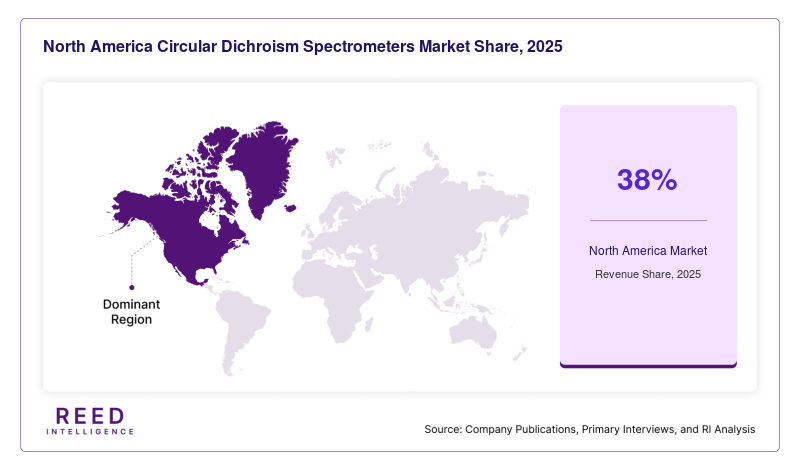
North America accounted for approximately 38% of the Circular Dichroism Spectrometers Market share in 2025 and is expected to maintain steady growth with a forecast CAGR of 5.8% through 2034. The region’s established pharmaceutical and biotechnology ecosystem has historically supported demand for advanced analytical instruments. Strong funding for life sciences research and the presence of leading research institutions have contributed to the market’s expansion.
The United States emerged as the dominant country in the region due to its extensive network of research laboratories and innovation-driven environment. A key growth factor in the country is the increasing focus on precision medicine, which requires detailed biomolecular analysis. This has led to a consistent demand for CD spectrometers in both academic and industrial settings.
Europe
Europe held a 27% share of the Circular Dichroism Spectrometers Market in 2025 and is projected to grow at a CAGR of 5.9% during the forecast period. The region has a strong tradition of scientific research and technological development, which has supported the adoption of spectroscopic techniques.
Germany dominated the European market, driven by its advanced research infrastructure and strong emphasis on industrial innovation. The country’s focus on collaborative research projects between academia and industry has facilitated the adoption of CD spectrometers for structural analysis applications.
Asia Pacific
Asia Pacific accounted for 22% of the market share in 2025 and is expected to register the fastest CAGR of 7.4% through 2034. Rapid industrialization, increasing healthcare investments, and growing awareness of advanced analytical techniques are contributing to the region’s growth.
China emerged as the dominant country, supported by its expanding pharmaceutical manufacturing sector. Government initiatives aimed at boosting domestic research capabilities have encouraged the adoption of advanced laboratory instruments, including CD spectrometers.
Middle East & Africa
The Middle East & Africa region held a smaller share of around 7% in 2025 and is projected to grow at a CAGR of 6.1%. The region is gradually developing its research infrastructure, with increasing investments in healthcare and education sectors.
The United Arab Emirates led the regional market due to its focus on building world-class research facilities. The country’s efforts to diversify its economy and invest in scientific research have created opportunities for advanced analytical instrument adoption.
Latin America
Latin America accounted for approximately 6% of the Circular Dichroism Spectrometers Market in 2025 and is expected to grow at a CAGR of 6.3% during the forecast period. The region’s growth is supported by expanding pharmaceutical industries and increasing research collaborations.
Brazil dominated the market in Latin America, driven by its growing academic research sector. Investments in higher education and scientific research have led to increased demand for analytical instruments, including CD spectrometers.
Competitive Landscape
The Circular Dichroism Spectrometers Market is moderately consolidated, with several established players competing based on technology innovation and product performance. Leading companies are focusing on expanding their product portfolios and enhancing software capabilities to strengthen their market position.
JASCO Corporation is recognized as a leading player, offering a wide range of CD spectrometers with advanced features. The company recently introduced a new automated CD system designed to improve efficiency and data accuracy in protein analysis.
Other prominent players are adopting strategies such as mergers, partnerships, and product launches to expand their global presence. Continuous investment in research and development is a key focus area for maintaining competitiveness in the market.
Key Players
- JASCO Corporation
- Applied Photophysics Ltd.
- Bio-Logic Science Instruments
- Bruker Corporation
- Agilent Technologies, Inc.
- Thermo Fisher Scientific Inc.
- Shimadzu Corporation
- PerkinElmer, Inc.
- Horiba Ltd.
- Hitachi High-Tech Corporation
- Edinburgh Instruments Ltd.
- Aviv Biomedical Inc.
- Olis Inc.
- Ocean Insight
- Specac Ltd.
Recent Developments
- JASCO Corporation launched an advanced automated CD spectrometer with improved sensitivity and data processing capabilities.
- Applied Photophysics introduced a new stopped-flow system for kinetic studies in protein folding research.
- Bio-Logic Science Instruments expanded its product line with enhanced software integration features.
- Bruker Corporation invested in R&D to develop next-generation spectroscopic solutions.
- Agilent Technologies announced collaborations with research institutions to enhance analytical instrument applications.
Circular Dichroism Spectrometers Market Segments
Type
- Benchtop CD Spectrometers
- Stopped-Flow CD Spectrometers
Application
- Pharmaceutical & Biotechnology
- Academic Research
- Others
End-Use
- Research Laboratories
- Contract Research Organizations
- Others
Wavelength Range
- Far-UV
- Near-UV
By Region
- North America
- Europe
- APAC
- Middle East and Africa
- LATAM