Circular Weaving Machine Market Size, Share & Demand Report By Machine Type (8-Shuttle Circular Weaving Machines, 10-Shuttle Circular Weaving Machines), By Application (Woven Sacks, Jumbo Bags, Tarpaulins, Geotextiles, Industrial Fabrics), By End-Use Industry (Packaging Manufacturing, Agriculture, Chemicals, Food Processing, Logistics and Transportation), By Region & Segment Forecasts, 2026–2034
USD 3950
Market Overview
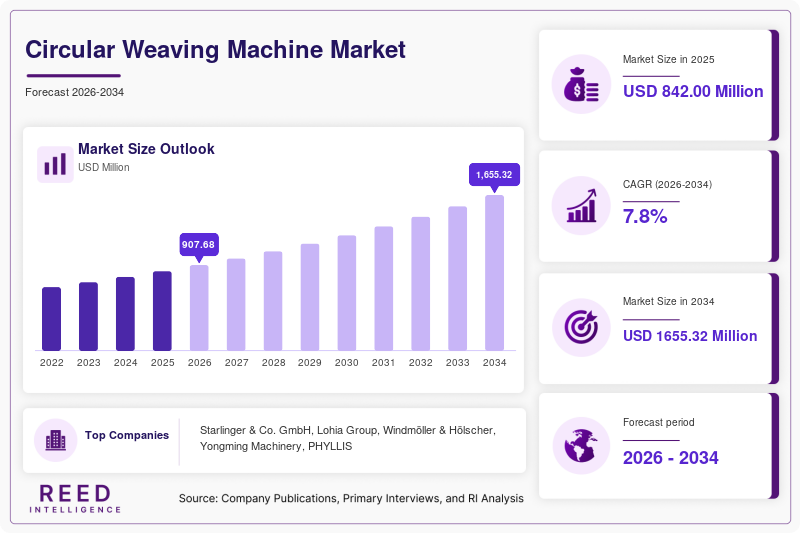
The global Circular Weaving Machine Market size was valued at USD 842 million in 2026 and is projected to reach USD 1540 million by 2034, expanding at a CAGR of 7.8% during the forecast period from 2026 to 2034. Circular weaving machines are widely used for manufacturing woven polypropylene and polyethylene sacks, tubular fabrics, jumbo bags, and industrial packaging materials. These machines play a critical role in packaging operations across agriculture, chemicals, cement, food processing, and construction industries. Rising industrial production and the growing preference for durable and reusable packaging solutions continue to support long-term market expansion.
A major global factor supporting market growth is the rapid increase in bulk packaging demand from industrial supply chains. Manufacturers across logistics, chemicals, fertilizers, and infrastructure sectors are increasingly shifting toward woven packaging materials due to their strength, flexibility, and cost efficiency. Circular weaving machines enable high-speed production with consistent fabric quality, making them suitable for large-scale packaging operations. In addition, automation upgrades, energy-efficient motors, and digital monitoring systems are improving machine productivity and reducing operational downtime. Emerging economies are also witnessing higher investments in woven sack manufacturing facilities to support exports and industrial development.
Key Highlights
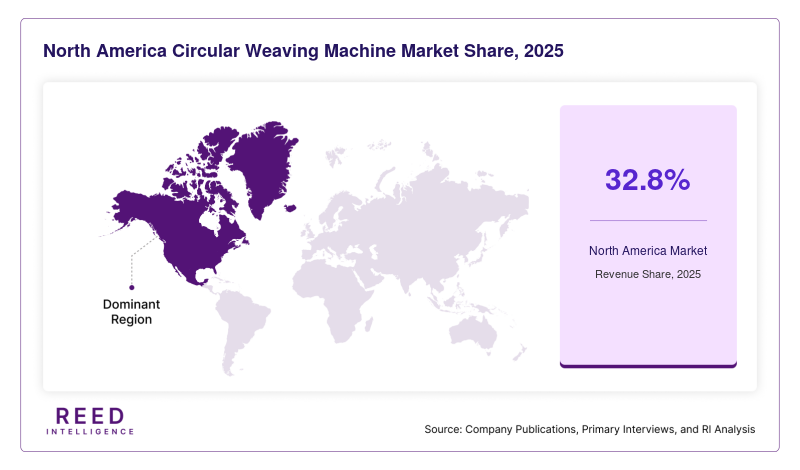
- North America dominated the market with a 32.8% share in 2025.
- Asia Pacific is expected to grow at the fastest CAGR of 9.6% during 2026–2034.
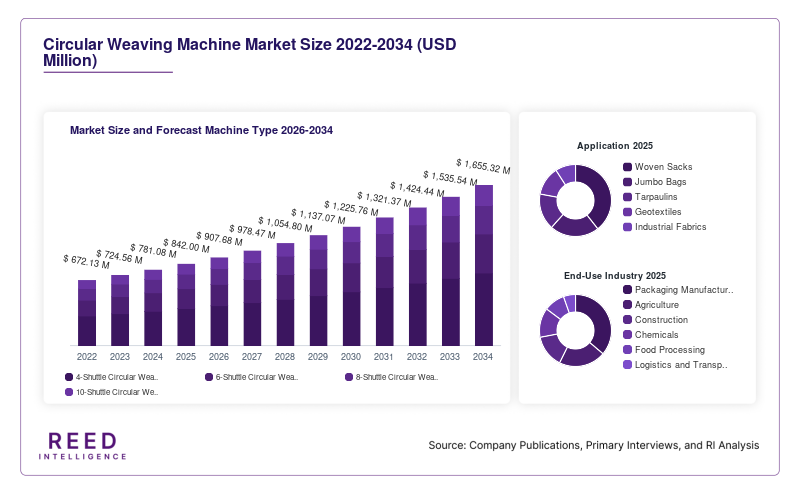
- By machine type, 6-shuttle circular weaving machines accounted for the largest share of 39.4%.
- while 8-shuttle machines are projected to grow at a CAGR of 10.1%.
- By application, woven sacks led with a 44.1% share.
- whereas jumbo bags are expected to expand at a CAGR of 9.8%.
- By end-use industry, packaging manufacturing held the dominant share of 36.7%, while agriculture applications are forecast to grow at a CAGR of 9.2%.
- China remained the dominant country, with market values of USD 168 million in 2024 and USD 182 million in 2025.
Market Trends
Automation and smart monitoring integration in weaving operations
The Circular Weaving Machine Market is witnessing increased adoption of automation technologies designed to improve manufacturing productivity and reduce operational costs. Modern circular weaving systems are now equipped with programmable logic controllers, touchscreen interfaces, and automated fault detection systems that help operators maintain stable production conditions. Manufacturers are focusing on machines with electronic yarn monitoring, automatic lubrication, and digital tension control to reduce material wastage and enhance weaving precision. These technologies are becoming increasingly important for large-scale packaging manufacturers handling high production volumes.
The growing need for operational efficiency has also encouraged the integration of remote diagnostics and predictive maintenance systems. Smart monitoring platforms enable manufacturers to track machine performance, energy consumption, and output quality in real time. Automated weaving systems are particularly gaining traction in Asia Pacific and Europe, where labor costs and production optimization requirements are influencing factory modernization efforts. Companies investing in smart factory initiatives are expected to continue driving demand for technologically advanced circular weaving machines over the forecast period.
Growing preference for recyclable woven packaging materials
Sustainability trends across the packaging sector are influencing the adoption of circular weaving machines capable of processing recyclable materials and lightweight polymer fabrics. Industrial packaging manufacturers are increasingly using woven polypropylene and polyethylene materials due to their reusability, durability, and lower environmental impact compared to conventional packaging alternatives. As regulatory authorities introduce stricter packaging waste reduction targets, manufacturers are upgrading production facilities with machines that support recycled raw materials without compromising fabric strength.
The trend toward lightweight woven sacks and flexible bulk containers is also creating demand for advanced weaving technologies with precise yarn management systems. Food grain suppliers, chemical producers, and fertilizer companies are emphasizing packaging solutions that improve transportation efficiency while reducing material consumption. Machine manufacturers are responding by developing energy-efficient systems with improved weaving speed and lower defect rates. The adoption of eco-friendly woven packaging across emerging economies is expected to support long-term growth opportunities for the Circular Weaving Machine Market.
Market Drivers
Expansion of industrial packaging and bulk material handling industries
The rapid expansion of industrial packaging operations is one of the primary growth drivers for the Circular Weaving Machine Market. Industries including cement, chemicals, fertilizers, food processing, and mining require durable woven sacks and flexible intermediate bulk containers for transportation and storage applications. Circular weaving machines provide high-speed production capabilities that help manufacturers meet rising packaging demand while maintaining fabric consistency and strength. Growing international trade activities and industrial output are further supporting demand for woven packaging products.
Bulk material handling requirements are increasing across both developed and emerging economies due to infrastructure development and rising agricultural production. Packaging companies are investing in advanced weaving machinery to improve operational efficiency and reduce production downtime. Modern machines with higher shuttle capacity and improved automation features are enabling manufacturers to increase output while reducing labor dependency. As industrial packaging demand continues to rise globally, the need for efficient and scalable weaving equipment is expected to strengthen significantly.
Rising investments in manufacturing modernization and production efficiency
Manufacturing companies are increasingly prioritizing production efficiency and cost optimization, which is accelerating investments in modern circular weaving equipment. Traditional weaving systems often involve higher maintenance requirements, slower production rates, and greater material wastage. Advanced circular weaving machines address these challenges by incorporating automated controls, energy-efficient motors, and high-speed weaving mechanisms that improve operational productivity.
Many manufacturers are replacing outdated machinery with digitally controlled systems capable of supporting continuous production cycles and real-time performance tracking. This trend is particularly visible in China, India, Vietnam, and Turkey, where industrial packaging exports are expanding rapidly. Government initiatives supporting manufacturing automation and industrial modernization are also encouraging capital investments in advanced weaving infrastructure. Improved machine durability and reduced maintenance costs are making modern circular weaving machines increasingly attractive for small and medium-scale packaging manufacturers.
Market Restraint
High initial investment and maintenance costs affecting small manufacturers
The high capital investment associated with advanced circular weaving machines remains a significant restraint for market growth, particularly among small and medium-sized manufacturers. Modern weaving systems equipped with automated controls, electronic monitoring platforms, and high-speed production capabilities require substantial upfront expenditure. Many regional packaging companies operating with limited budgets often delay machinery upgrades due to concerns regarding return on investment and financing constraints.
In addition to installation costs, maintenance expenses for technologically advanced weaving systems can also create operational challenges. Skilled technicians are required for machine calibration, software integration, and component replacement, which increases ongoing operating costs. Smaller manufacturers in developing economies frequently continue using older machinery because replacement costs remain difficult to justify during periods of fluctuating raw material prices and uncertain demand conditions. Supply chain disruptions affecting electronic components and machine spare parts may further increase maintenance complexity.
The restraint is particularly evident in regions where industrial automation adoption remains limited. Local manufacturers competing primarily on price may avoid investments in advanced machinery despite long-term productivity benefits. As a result, the market faces slower technology penetration among cost-sensitive customers, which can moderate the pace of modernization across certain developing industrial sectors.
Market Opportunities
Increasing demand for woven packaging in agricultural applications
The agricultural sector is creating substantial growth opportunities for the Circular Weaving Machine Market due to rising demand for durable packaging solutions for grains, seeds, fertilizers, and animal feed products. Woven polypropylene sacks are widely preferred because they provide moisture resistance, strength, and improved storage efficiency. Agricultural supply chains in Asia Pacific, Latin America, and Africa are expanding rapidly, encouraging packaging manufacturers to increase production capacity through investments in advanced weaving systems.
Governments in emerging economies are also promoting agricultural exports and food security programs, which is increasing the need for reliable bulk packaging infrastructure. Circular weaving machines capable of producing lightweight yet strong fabrics are becoming increasingly important for reducing transportation costs and minimizing product losses during storage. Manufacturers introducing energy-efficient machines for agricultural packaging production are expected to gain long-term competitive advantages in regional markets.
Development of high-capacity machines for flexible intermediate bulk containers
The growing use of flexible intermediate bulk containers across chemicals, pharmaceuticals, minerals, and food industries is opening new opportunities for circular weaving machine manufacturers. Bulk container production requires strong woven fabrics capable of handling heavy loads and harsh transportation conditions. As industrial trade volumes increase, manufacturers are demanding high-capacity weaving machines that can deliver consistent quality at faster production speeds.
Advanced 8-shuttle and 10-shuttle circular weaving systems are increasingly being adopted for jumbo bag and bulk container manufacturing applications. These machines support higher productivity, lower defect rates, and improved fabric uniformity. Demand is particularly strong in export-oriented manufacturing hubs where companies are scaling production to meet international packaging standards. Technological developments in yarn feeding systems and automated fabric control are expected to further enhance production capabilities and create attractive revenue opportunities for machinery suppliers during the forecast period.
Segmental Analysis
By Machine Type
The 6-shuttle circular weaving machine segment accounted for the largest market share of 39.4% in 2024 due to its balanced production efficiency, operational flexibility, and cost-effectiveness. These machines are widely adopted across woven sack manufacturing facilities because they provide stable weaving speed while maintaining fabric quality for industrial packaging applications. Medium-scale manufacturers prefer 6-shuttle systems because they offer lower maintenance requirements and moderate energy consumption compared to larger high-capacity equipment. The machines are extensively used for producing woven polypropylene sacks utilized in agriculture, chemicals, food grains, and construction sectors. Their widespread adoption in developing economies continues to strengthen market dominance. Additionally, the availability of spare parts and operator familiarity with 6-shuttle systems contributes to consistent demand from packaging manufacturers seeking reliable and economical production solutions.
The 8-shuttle circular weaving machine segment is projected to expand at the fastest CAGR of 10.1% during the forecast period due to increasing demand for higher production capacity and improved fabric uniformity. Large industrial packaging manufacturers are adopting 8-shuttle machines to meet rising order volumes for woven sacks and flexible bulk containers. These systems support higher weaving speeds, enhanced yarn control, and reduced defect rates, making them suitable for export-oriented manufacturing operations. Technological improvements such as electronic tension control, automated lubrication systems, and digital performance monitoring are further enhancing machine efficiency. Demand for high-capacity weaving systems is particularly strong in Asia Pacific, where packaging production facilities are expanding rapidly. The growing requirement for durable jumbo bags and industrial packaging products is expected to continue driving adoption of advanced 8-shuttle weaving technologies.
By Application
The woven sacks segment held the dominant share of 44.1% in 2024 because woven sacks remain one of the most widely used industrial packaging products globally. Industries including agriculture, fertilizers, cement, food processing, and chemicals rely heavily on woven sacks for bulk storage and transportation applications. Circular weaving machines designed for woven sack production are capable of delivering high output volumes while maintaining durability and dimensional consistency. The growing demand for lightweight yet strong packaging materials has further strengthened adoption across emerging industrial economies. Packaging manufacturers continue to invest in modern weaving systems to improve production efficiency and reduce material wastage. Woven sacks also support recyclability and reusability initiatives, making them attractive for industries seeking cost-effective and environmentally conscious packaging alternatives. The consistent expansion of industrial supply chains continues to sustain long-term demand for woven sack manufacturing equipment.
The jumbo bags segment is anticipated to register the fastest CAGR of 9.8% during the forecast period due to increasing bulk transportation requirements across industrial sectors. Flexible intermediate bulk containers are gaining popularity because they provide higher load capacity, improved handling efficiency, and reduced logistics costs for large-scale material transportation. Industries including chemicals, minerals, food ingredients, and pharmaceuticals are increasingly adopting jumbo bags for export and warehouse applications. Circular weaving machine manufacturers are developing advanced systems specifically optimized for producing high-strength fabrics required in jumbo bag manufacturing. Enhanced weaving precision and automated yarn control technologies are improving product quality and supporting higher production rates. Rapid industrialization in Asia Pacific and the Middle East is also contributing to rising demand for jumbo bag manufacturing infrastructure. Growing international trade activities are expected to further accelerate investments in high-capacity weaving machinery.
By End-Use Industry
The packaging manufacturing segment accounted for the largest market share of 36.7% in 2024 due to extensive demand for woven packaging products across industrial supply chains. Packaging companies utilize circular weaving machines to manufacture woven fabrics, sacks, and bulk containers for diverse commercial applications. The segment benefits from rising industrial production and increasing transportation requirements across construction, agriculture, retail, and chemical industries. Manufacturers are prioritizing machinery upgrades to improve production efficiency, reduce energy consumption, and maintain product consistency. Automated circular weaving systems are particularly gaining traction among large packaging firms operating high-volume production facilities. The availability of recyclable woven materials and cost-efficient production methods also supports segment growth. As global trade and industrial packaging demand continue to expand, the packaging manufacturing industry is expected to remain the largest consumer of advanced circular weaving equipment.
The agriculture segment is forecast to grow at the fastest CAGR of 9.2% during the forecast period owing to rising food production, fertilizer distribution, and grain export activities. Agricultural supply chains require durable woven packaging materials capable of protecting products from moisture, contamination, and handling damage during storage and transportation. Circular weaving machines are increasingly being adopted to produce lightweight woven sacks and bulk agricultural packaging products with enhanced durability. Government initiatives supporting agricultural modernization and food security are encouraging investments in advanced packaging infrastructure across developing economies. Countries such as India, Brazil, and Indonesia are witnessing rapid growth in agricultural packaging demand due to expanding export activities. Technological advancements in weaving systems are enabling manufacturers to produce stronger fabrics with reduced material usage, improving operational efficiency and sustainability within agricultural packaging operations.
Regional Analysis
North America
North America accounted for 32.8% of the global Circular Weaving Machine Market in 2025 and is projected to expand at a CAGR of 6.9% through 2034. The region maintains a strong market position due to advanced industrial packaging infrastructure and widespread adoption of automated manufacturing systems. Packaging producers across the United States and Canada are increasingly investing in energy-efficient weaving equipment to reduce operational costs and improve productivity. Rising demand for woven industrial sacks and bulk packaging solutions across chemicals, construction, and food processing sectors is further supporting market expansion.
The United States remains the dominant country within the North American market due to its extensive industrial packaging industry and strong technological adoption rates. Packaging manufacturers are emphasizing production modernization to improve competitiveness and comply with sustainability targets. One unique growth factor supporting the U.S. market is the increasing use of woven polypropylene packaging in logistics and warehouse operations. The rapid expansion of e-commerce supply chains and industrial transportation activities is encouraging investments in durable and lightweight packaging materials.
Europe
Europe represented 27.1% of the global Circular Weaving Machine Market in 2025 and is expected to register a CAGR of 6.7% during the forecast period. The region benefits from strong demand for sustainable packaging technologies and advanced industrial automation practices. European manufacturers are actively upgrading weaving systems to improve energy efficiency and reduce carbon emissions associated with production operations. Demand for woven sacks and industrial fabrics remains stable across construction, agriculture, and chemical industries throughout Germany, France, Italy, and Spain.
Germany continues to dominate the European market due to its established machinery manufacturing sector and high level of industrial automation. The country is home to several engineering companies specializing in advanced weaving technologies and packaging equipment solutions. A unique factor driving market growth in Germany is the increasing integration of Industry 4.0 systems within textile and packaging manufacturing facilities. Real-time monitoring, predictive maintenance, and digital production management platforms are improving operational performance and encouraging machinery replacement investments.
Asia Pacific
Asia Pacific held a 24.6% share of the global Circular Weaving Machine Market in 2025 and is forecast to grow at the fastest CAGR of 9.6% between 2026 and 2034. Rapid industrialization, rising exports, and increasing packaging production capacities are major factors supporting regional growth. Countries such as China, India, Vietnam, Indonesia, and Thailand are witnessing significant investments in woven sack manufacturing facilities. Lower manufacturing costs and expanding industrial activities continue to attract machinery investments across the region.
China remains the leading country in Asia Pacific due to its large-scale industrial production and dominant position in woven packaging exports. The country has a strong manufacturing ecosystem for polypropylene and polyethylene packaging materials, supporting continuous demand for weaving machinery. A unique growth factor driving the Chinese market is the rapid expansion of bulk chemical and fertilizer packaging operations. Industrial export growth and rising infrastructure projects are increasing demand for high-volume woven packaging products, encouraging companies to modernize their production equipment.
Middle East & Africa
The Middle East & Africa accounted for 8.1% of the global Circular Weaving Machine Market in 2025 and is expected to expand at a CAGR of 7.4% during the forecast period. Demand for woven packaging products is increasing steadily due to infrastructure development, agricultural investments, and industrial expansion activities across Gulf countries and African economies. Packaging manufacturers are gradually adopting automated weaving technologies to improve production efficiency and support regional industrial growth.
Saudi Arabia remains the dominant country within the regional market because of its growing petrochemical industry and large-scale industrial packaging requirements. The country continues to invest in industrial diversification initiatives that encourage local manufacturing and packaging production. One unique growth factor supporting the Saudi Arabian market is the increasing demand for woven sacks used in cement and construction material transportation. Ongoing infrastructure projects and urban development activities are creating sustained demand for durable industrial packaging solutions.
Latin America
Latin America captured 7.4% of the global Circular Weaving Machine Market in 2025 and is projected to grow at a CAGR of 7.1% through 2034. Expanding agricultural exports and rising industrial packaging requirements are supporting market development across the region. Packaging manufacturers in Brazil, Mexico, Argentina, and Chile are investing in improved weaving technologies to increase production efficiency and meet growing demand for woven sacks and flexible bulk containers.
Brazil dominates the Latin American market due to its strong agricultural production and extensive packaging requirements for grains, fertilizers, and animal feed. The country’s export-oriented agricultural sector relies heavily on durable woven packaging materials for transportation and storage operations. A unique growth factor driving the Brazilian market is the increasing modernization of agricultural supply chains and logistics networks. Investments in storage infrastructure and export facilities are encouraging local manufacturers to adopt advanced circular weaving systems capable of higher production capacity.
Competitive Landscape
The Circular Weaving Machine Market is characterized by moderate competition with the presence of international machinery manufacturers and regional equipment suppliers focusing on automation, production efficiency, and energy optimization. Leading companies are emphasizing product innovation, strategic partnerships, and geographic expansion to strengthen their market position. Manufacturers are increasingly investing in advanced weaving technologies equipped with digital controls, automated diagnostics, and energy-efficient drive systems to meet evolving customer requirements.
Starlinger & Co. GmbH remains one of the leading players in the market due to its strong global presence and broad portfolio of circular weaving solutions for industrial packaging applications. The company continues to focus on automation upgrades and sustainable manufacturing technologies. In 2025, the company introduced a new high-speed circular weaving system designed to improve fabric precision while reducing energy consumption in woven sack production.
Key Players
- Starlinger & Co. GmbH
- Lohia Group
- Yongming Machinery
- PHYLLIS
- Mandals Technology
- Windmöller & Hölscher
- Hengli Machinery
- Yanfeng Group
- SANLONG Machinery
- Zhejiang Xinsheng Machinery
- Wenzhou Huadong Packing Machinery
- Shandong Tongjia Machinery
- Taiwan Giu Chun Ind. Co.
- Ecomaq Industries
- Rishi FIBC Solutions
Recent Developments
- In February 2025, Starlinger & Co. GmbH launched an energy-efficient circular weaving machine with enhanced digital monitoring capabilities for industrial sack manufacturing facilities.
- In August 2025, Lohia Group expanded its manufacturing capacity in India to support rising demand for automated weaving machinery across Asia Pacific packaging markets.
- In November 2024, Windmöller & Hölscher introduced an upgraded weaving control platform designed to improve yarn tension accuracy and reduce production defects.
- In March 2025, Yongming Machinery partnered with regional packaging manufacturers in Southeast Asia to strengthen distribution and technical support operations.
Circular Weaving Machine Market Segments
Machine Type
- 4-Shuttle Circular Weaving Machines
- 6-Shuttle Circular Weaving Machines
- 8-Shuttle Circular Weaving Machines
- 10-Shuttle Circular Weaving Machines
Application
- Woven Sacks
- Jumbo Bags
- Tarpaulins
- Geotextiles
- Industrial Fabrics
End-Use Industry
- Packaging Manufacturing
- Agriculture
- Construction
- Chemicals
- Food Processing
- Logistics and Transportation
By Region
- North America
- Europe
- APAC
- Middle East and Africa
- LATAM