Citric Acid Anhydrous Market Size, Share & Demand Report By Form (Powder, Granules), By Application (Food & Beverages, Pharmaceuticals, Personal Care, Industrial Applications), By End-Use Industry (Food Processing, Healthcare, Cosmetics, Chemical Industry), By Distribution Channel (Direct Sales, Distributors, Online Platforms), By Region & Segment Forecasts, 2025–2034
USD 3950
Market Overview
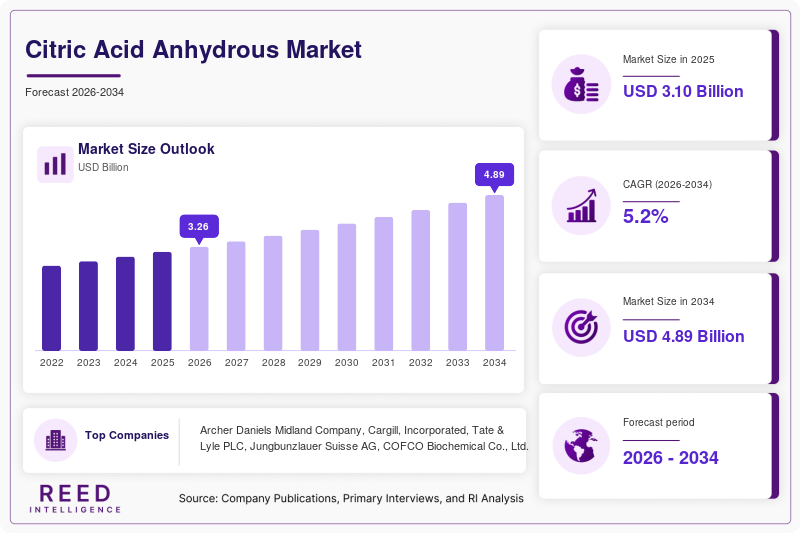
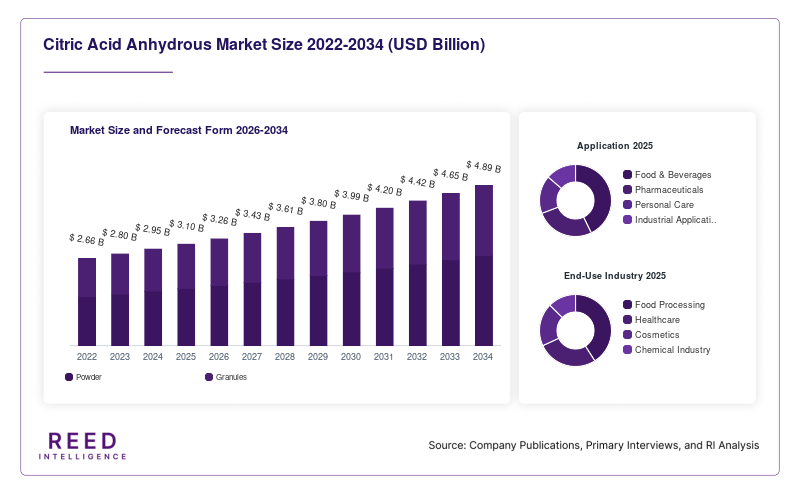
The global Citric Acid Anhydrous Market size was valued at USD 3.1 billion in 2025 and is projected to reach USD 4.9 billion by 2034, expanding at a CAGR of 5.2% during the forecast period (2025–2034). The market growth is primarily supported by the rising global demand for food preservatives and acidulants, driven by the expansion of processed and packaged food consumption across both developed and emerging economies. Citric acid anhydrous, known for its excellent stability, solubility, and extended shelf life, has become a preferred ingredient in beverages, pharmaceuticals, and personal care formulations.
One global factor contributing significantly to the growth of the Citric Acid Anhydrous Market is the increasing shift toward clean-label and natural ingredients. Manufacturers are actively replacing synthetic additives with bio-based alternatives, positioning citric acid as a safe and versatile organic compound derived mainly from fermentation processes.
Key Highlights
- Asia Pacific dominated the market with 41.3% share in 2025, while Latin America is projected to register the fastest CAGR of 6.4%.
- Food & beverages emerged as the leading application segment with 52.6% share, while pharmaceuticals is expected to grow at the fastest CAGR of 6.1%.
- Powder form accounted for the largest share among forms at 68.2%, while granules are anticipated to grow at a CAGR of 5.8%.
- The United States led the market with values of USD 520 million in 2025 and USD 545 million in 2026.
Market Trends
Rising Adoption in Clean-Label Food Products
The Citric Acid Anhydrous Market is experiencing strong momentum due to increasing consumer demand for transparency in food ingredients. Food manufacturers are reformulating products to include recognizable and naturally derived additives. Citric acid anhydrous, produced through microbial fermentation, aligns with clean-label expectations and is widely used in beverages, sauces, and confectionery. This trend is particularly prominent in North America and Europe, where regulatory frameworks encourage ingredient clarity.
Expansion in Pharmaceutical and Nutraceutical Applications
Another notable trend shaping the Citric Acid Anhydrous Market is its growing use in pharmaceutical and nutraceutical formulations. The compound acts as a buffering agent, stabilizer, and excipient in tablets, syrups, and effervescent formulations. With increasing global health awareness and demand for dietary supplements, manufacturers are incorporating citric acid into formulations that require pH control and improved bioavailability. This trend is further supported by advancements in drug delivery systems and the rise of over-the-counter healthcare products.
Market Drivers
Increasing Demand for Processed Food and Beverages
The rapid expansion of the global food processing industry has significantly boosted the Citric Acid Anhydrous Market. The compound is widely used as a preservative, flavor enhancer, and acidulant in carbonated drinks, dairy products, and ready-to-eat meals. Urbanization, changing dietary habits, and growing disposable incomes have increased the consumption of packaged foods, directly supporting demand.
Growth of Personal Care and Cosmetic Industry
The personal care sector is another important driver for the Citric Acid Anhydrous Market. Citric acid is commonly used in skincare and cosmetic formulations due to its exfoliating and pH-adjusting properties. As consumers increasingly prioritize skincare routines and natural formulations, manufacturers are integrating citric acid into a wide range of products, including creams, serums, and shampoos.
Market Restraint
Volatility in Raw Material Supply and Production Costs
A major challenge in the Citric Acid Anhydrous Market is the fluctuation in raw material availability, particularly sugar-based feedstocks such as molasses and corn. Since citric acid production heavily depends on fermentation processes, any disruption in agricultural supply chains can impact production efficiency and pricing. Additionally, rising energy costs and environmental compliance requirements add to manufacturing expenses. These factors can lead to price instability, affecting profit margins for producers and limiting market expansion in price-sensitive regions.
Market Opportunities
Growth in Emerging Economies
Emerging markets present strong opportunities for the Citric Acid Anhydrous Market due to increasing industrialization and rising consumer demand for packaged food and beverages. Countries in Asia Pacific, Latin America, and Africa are witnessing significant expansion in food processing and pharmaceutical industries. This creates a favorable environment for citric acid manufacturers to expand production capacities and distribution networks.
Advancements in Biotechnology and Fermentation Techniques
Technological advancements in fermentation processes are opening new growth avenues in the Citric Acid Anhydrous Market. Innovations in microbial strains and production efficiency are reducing costs and improving yield. These developments enable manufacturers to scale operations sustainably while maintaining product quality, supporting long-term market growth.
Segmental Analysis
By Form
The powder form dominated the Citric Acid Anhydrous Market, accounting for 68.2% of the share in 2025. Its ease of handling, storage stability, and wide applicability in food and pharmaceutical industries contributed to its dominance.
Granular citric acid is expected to grow at the fastest CAGR of 5.8% during the forecast period. Its improved flow properties and reduced dust formation make it suitable for industrial applications, particularly in automated production systems.
By Application
Food & beverages emerged as the leading application segment, holding 52.6% of the Citric Acid Anhydrous Market share in 2025. The widespread use of citric acid as a flavor enhancer and preservative supported its dominance.
The pharmaceutical segment is anticipated to grow at the fastest CAGR of 6.1%. The increasing demand for effervescent tablets and drug formulations requiring pH control is driving growth in this segment.
By End-Use Industry
The food processing industry dominated the Citric Acid Anhydrous Market with a share of 48.9% in 2025. The rising consumption of ready-to-eat products has significantly contributed to demand.
The personal care industry is projected to grow at a CAGR of 5.7%, driven by increasing demand for skincare products incorporating natural ingredients.
By Distribution Channel
Direct sales accounted for the largest share of 61.4% in 2025, as manufacturers prefer direct contracts with large-scale buyers.
Online distribution channels are expected to grow at a CAGR of 6.5%, supported by digitalization and the expansion of e-commerce platforms for industrial chemicals.
Regional Analysis
North America
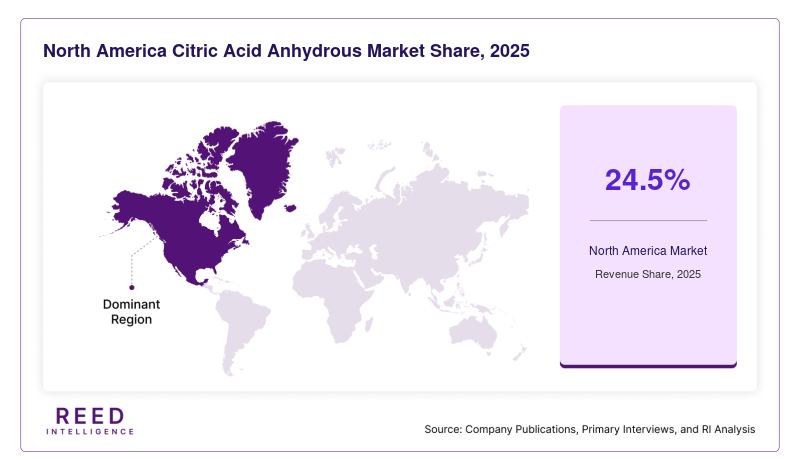
North America accounted for 24.5% of the Citric Acid Anhydrous Market share in 2025 and is expected to grow at a CAGR of 4.8% during the forecast period. The region’s growth is driven by the presence of established food and beverage industries and increasing demand for natural additives.
The United States dominated the regional market due to its advanced food processing sector and strong demand for functional ingredients. The widespread use of citric acid in beverages and dietary supplements has supported steady market expansion.
Europe
Europe held approximately 22.7% of the Citric Acid Anhydrous Market share in 2025 and is projected to grow at a CAGR of 4.6%. The region has a well-established regulatory framework promoting safe and natural food additives.
Germany emerged as the dominant country due to its strong pharmaceutical and food industries. The country’s focus on sustainable production practices has encouraged the adoption of bio-based citric acid.
Asia Pacific
Asia Pacific led the Citric Acid Anhydrous Market with a 41.3% share in 2025 and is expected to grow at a CAGR of 5.9%. The region benefits from large-scale production facilities and abundant raw materials.
China dominated the market due to its extensive manufacturing base and export capabilities. The country’s cost-effective production and strong global supply chain position have made it a key contributor to market growth.
Middle East & Africa
The Middle East & Africa region accounted for 5.6% of the Citric Acid Anhydrous Market share in 2025 and is expected to grow at a CAGR of 5.3%. Increasing investments in food processing and pharmaceuticals are supporting market expansion.
Saudi Arabia led the region due to growing industrial diversification and rising demand for processed food products. Government initiatives to boost local manufacturing have also contributed to growth.
Latin America
Latin America held 5.9% of the Citric Acid Anhydrous Market share in 2025 and is projected to register the fastest CAGR of 6.4%. The region is witnessing increased demand for packaged foods and beverages.
Brazil dominated the market due to its expanding food processing industry and abundant agricultural resources. The availability of raw materials has supported local production and reduced dependency on imports.
Competitive Landscape
The Citric Acid Anhydrous Market is moderately consolidated, with key players focusing on capacity expansion, product innovation, and strategic partnerships. Leading companies are investing in advanced fermentation technologies to improve production efficiency and sustainability.
Archer Daniels Midland Company is recognized as a market leader, leveraging its extensive global presence and integrated supply chain. The company recently expanded its citric acid production capacity to meet growing demand from the food and pharmaceutical sectors.
Other major players continue to strengthen their market position through mergers, acquisitions, and regional expansions, aiming to capture emerging opportunities in developing economies.
Key Players
- Archer Daniels Midland Company
- Cargill, Incorporated
- Tate & Lyle PLC
- Jungbunzlauer Suisse AG
- COFCO Biochemical Co., Ltd.
- RZBC Group Co., Ltd.
- Weifang Ensign Industry Co., Ltd.
- Gadot Biochemical Industries Ltd.
- S.A. Citrique Belge N.V.
- Huangshi Xinghua Biochemical Co., Ltd.
- TTCA Co., Ltd.
- Foodchem International Corporation
- Shandong Juxian Hongde Citric Acid Co., Ltd.
- ATP Group
- DSM Nutritional Products
Recent Developments
- In 2024, Archer Daniels Midland Company expanded its fermentation facilities to enhance citric acid production capacity.
- In 2024, Jungbunzlauer introduced a new high-purity citric acid grade for pharmaceutical applications.
- In 2025, Cargill announced investments in sustainable production technologies to reduce carbon emissions.
- In 2025, RZBC Group strengthened its export network across Latin America and Africa.
- In 2025, Tate & Lyle focused on clean-label ingredient innovation, including citric acid-based solutions.
Citric Acid Anhydrous Market Segments
Form
- Powder
- Granules
Application
- Food & Beverages
- Pharmaceuticals
- Personal Care
- Industrial Applications
End-Use Industry
- Food Processing
- Healthcare
- Cosmetics
- Chemical Industry
Distribution Channel
- Direct Sales
- Distributors
- Online Platforms
By Region
- North America
- Europe
- APAC
- Middle East and Africa
- LATAM