Clamshell Labeling Machine Market Size, Share & Demand Report By Type (Automatic Clamshell Labeling Machines, Semi-Automatic Clamshell Labeling Machines), By Application (Food & Beverage Packaging, Pharmaceutical Products, Consumer Goods, Electronics Packaging), By End-Use Industry (Retail Sector, Manufacturing Industry, Logistics & E-commerce), By Region & Segment Forecasts, 2025–2034
USD 3950
Market Overview
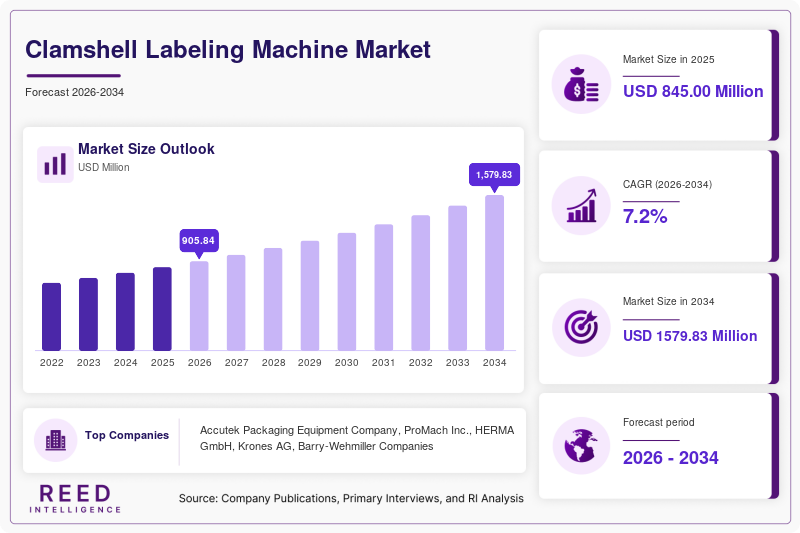
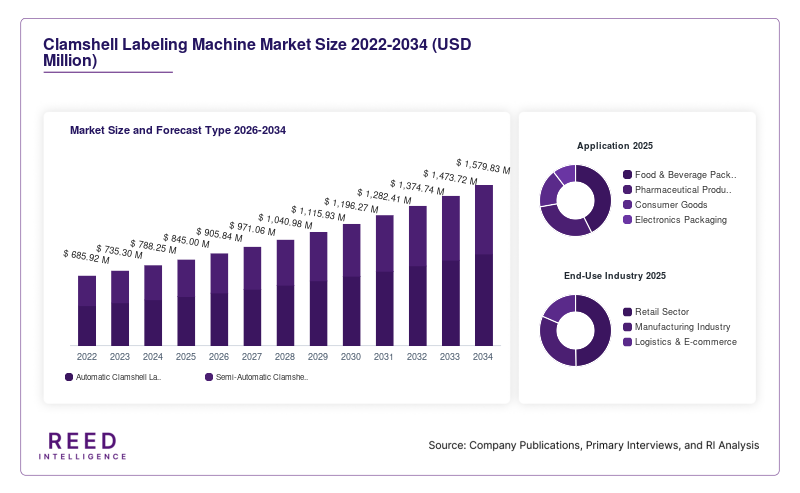
The Clamshell Labeling Machine Market size is experiencing steady expansion driven by increasing automation in packaging processes across food, pharmaceutical, and retail sectors. In 2025, the global market size is estimated at approximately USD 845 million, rising to nearly USD 905 million in 2026. The market is projected to reach USD 1680 million by 2034, registering a compound annual growth rate (CAGR) of 7.2% during 2025–2034. This growth trajectory reflects rising demand for efficient, high-speed labeling systems that can handle clamshell packaging formats widely used in consumer goods and perishables.
Clamshell labeling machines are widely adopted due to their ability to apply labels precisely on transparent and rigid plastic packaging. These machines support compliance with regulatory requirements, improve brand visibility, and enhance shelf appeal. Increasing consumption of ready-to-eat foods, fresh produce, and electronic accessories has further driven demand for clamshell packaging, subsequently boosting the need for specialized labeling solutions.
Key Highlights
- Market size expected to reach USD 1.68 billion by 2034
- CAGR of 7.2% from 2025 to 2034
- Strong demand from food, pharmaceutical, and retail industries
- Automation and smart labeling technologies driving adoption
- Increasing use of clamshell packaging in global supply chains
Market Trends
Integration of Smart and Automated Labeling Technologies
The integration of smart technologies into labeling machines is shaping the evolution of the Clamshell Labeling Machine Market. Manufacturers are increasingly adopting automated systems equipped with sensors, machine vision, and programmable logic controllers. These features enable real-time error detection, label placement precision, and seamless synchronization with packaging lines. Smart labeling machines reduce downtime and improve efficiency, especially in high-volume production environments. Additionally, cloud connectivity allows remote monitoring and predictive maintenance, which helps minimize operational disruptions. As industries move toward digital transformation, the demand for intelligent labeling systems is expected to grow steadily.
Rising Demand for Sustainable and Eco-Friendly Labeling Solutions
Sustainability is becoming a key trend influencing the labeling machinery market. Companies are focusing on reducing environmental impact by adopting eco-friendly labeling materials and energy-efficient machines. Clamshell labeling machines are being designed to handle recyclable labels, biodegradable adhesives, and reduced material usage. This shift aligns with global regulations and consumer preferences for sustainable packaging. Manufacturers are also optimizing machine performance to minimize waste and energy consumption. The growing emphasis on circular economy practices is expected to drive innovations in labeling technologies, making sustainability a central trend in the market.
Market Drivers
Expansion of Packaged Food and Retail Industries
The rapid growth of the packaged food sector is a major driver of the Clamshell Labeling Machine Market. Consumers are increasingly purchasing ready-to-eat meals, fresh produce, and pre-packaged goods, all of which often utilize clamshell packaging. This packaging format requires accurate and durable labeling for product identification, nutritional information, and branding. Retail chains and supermarkets also demand standardized labeling to maintain consistency across products. As global food consumption patterns shift toward convenience, the demand for efficient labeling solutions continues to rise, supporting market growth.
Increasing Adoption of Automation in Manufacturing
Automation is transforming manufacturing processes, and labeling is no exception. Companies are investing in automated clamshell labeling machines to enhance productivity and reduce manual intervention. These machines offer high-speed operations, consistent output, and minimal errors, making them suitable for large-scale production. Automation also helps companies meet regulatory requirements by ensuring accurate label placement and traceability. The integration of advanced technologies such as robotics and AI further strengthens the role of automation in driving market expansion.
Market Restraint
High Initial Investment and Maintenance Costs
One of the key challenges in the Clamshell Labeling Machine Market is the high initial investment required for advanced labeling systems. Small and medium-sized enterprises often face budget constraints, making it difficult to adopt automated machines. In addition to the upfront cost, maintenance expenses and the need for skilled operators add to the overall financial burden. For example, a mid-sized food processing company may delay upgrading its labeling equipment due to the significant capital required, opting instead for semi-automatic solutions. This restraint can limit market penetration, particularly in developing regions where cost sensitivity is high. Despite long-term efficiency benefits, the initial investment remains a barrier for many businesses.
Market Opportunities
Growth in E-commerce and Logistics Sectors
The expansion of e-commerce and logistics industries presents significant opportunities for the Clamshell Labeling Machine Market. Online retail platforms require accurate labeling for product identification, tracking, and delivery. Clamshell packaging is commonly used for electronics, cosmetics, and small consumer goods, increasing the demand for specialized labeling machines. As global e-commerce continues to grow, companies are investing in automated labeling systems to handle high order volumes efficiently. This trend creates new growth avenues for manufacturers of clamshell labeling machines.
Emerging Markets and Industrialization
Emerging economies are witnessing rapid industrialization and growth in manufacturing sectors. Countries in Asia Pacific, Latin America, and Africa are investing in packaging infrastructure to support expanding industries. This development is driving demand for modern labeling solutions, including clamshell labeling machines. Government initiatives promoting manufacturing and exports further contribute to market growth. As businesses in these regions adopt advanced technologies, the demand for efficient labeling systems is expected to increase significantly, creating long-term opportunities for market players.
Segmental Analysis
By Type
Automatic clamshell labeling machines dominated the market in 2024, accounting for approximately 62% of the total share. These machines are widely used in large-scale production environments due to their high efficiency and ability to handle continuous operations. Automatic systems reduce labor dependency and ensure consistent labeling quality, making them suitable for industries such as food processing and pharmaceuticals. The integration of advanced features such as touch-screen controls and programmable settings further enhances their functionality, driving their widespread adoption.
Semi-automatic machines are the fastest-growing segment, with a projected CAGR of 7.8% during the forecast period. These machines offer a balance between cost and performance, making them ideal for small and medium-sized enterprises. The growth of this segment is driven by increasing demand from businesses seeking affordable labeling solutions without compromising efficiency. Semi-automatic machines are also gaining popularity in emerging markets where cost sensitivity is high.
By Application
Food and beverage applications held the largest market share in 2024, accounting for around 48%. Clamshell packaging is widely used for fresh produce, bakery items, and ready-to-eat meals, requiring accurate labeling for product information and branding. The demand for convenient and hygienic packaging solutions continues to drive the adoption of labeling machines in this segment. Additionally, regulatory requirements for food labeling further support market growth.
The pharmaceutical segment is expected to grow at the fastest CAGR of 8.1% during the forecast period. The need for precise labeling to ensure product safety and traceability is a key growth factor. Clamshell packaging is commonly used for medical devices and small pharmaceutical products, increasing the demand for specialized labeling machines. Technological advancements in labeling systems also support the growth of this segment.
By End-Use Industry
The retail sector dominated the market in 2024, accounting for approximately 44% of the total share. Retailers rely on clamshell packaging for various products, including electronics, cosmetics, and consumer goods. Labeling plays a crucial role in product identification, pricing, and branding. The growth of organized retail and supermarkets has significantly contributed to the demand for clamshell labeling machines.
The logistics and e-commerce sector is the fastest-growing segment, with a projected CAGR of 8.6%. The rapid expansion of online shopping platforms has increased the need for efficient labeling solutions to manage high order volumes. Clamshell packaging is widely used for shipping small items, and accurate labeling is essential for tracking and delivery. This growth trend is expected to drive significant demand for labeling machines.
Regional Analysis
North America
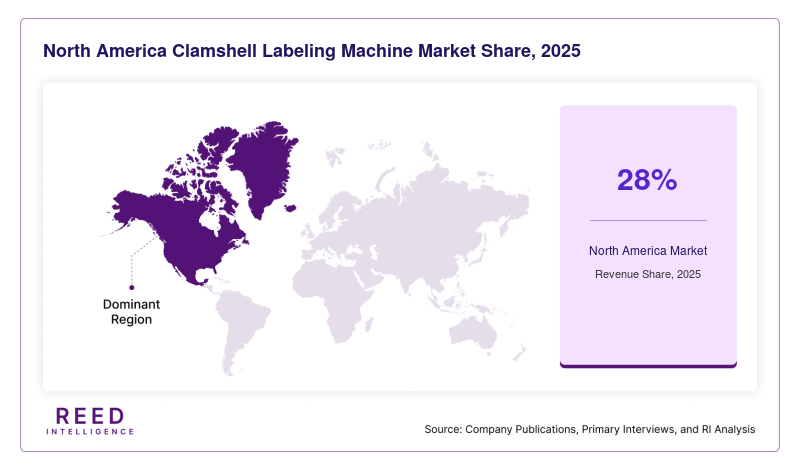
North America held a significant share of the Clamshell Labeling Machine Market in 2025, accounting for approximately 28% of global revenue. The region is expected to grow at a CAGR of 6.5% during the forecast period. The presence of advanced manufacturing infrastructure and early adoption of automation technologies contribute to market growth. Additionally, stringent labeling regulations in industries such as food and pharmaceuticals drive the demand for precise labeling solutions.
The United States dominates the regional market due to its well-established packaging industry and strong retail sector. A unique growth factor is the increasing adoption of smart labeling systems integrated with IoT technologies. These systems enable real-time monitoring and improve operational efficiency, making them highly attractive to manufacturers seeking to enhance productivity.
Europe
Europe accounted for around 24% of the global market share in 2025 and is projected to grow at a CAGR of 6.8%. The region’s focus on sustainability and regulatory compliance supports the adoption of advanced labeling machines. Industries such as food processing and pharmaceuticals rely heavily on accurate labeling to meet strict standards, driving market demand.
Germany leads the European market due to its strong industrial base and emphasis on technological innovation. A unique growth factor is the region’s commitment to eco-friendly packaging solutions. Manufacturers are investing in machines capable of handling recyclable materials, aligning with environmental regulations and consumer preferences.
Asia Pacific
Asia Pacific is the fastest-growing region, holding approximately 30% market share in 2025 and expected to expand at a CAGR of 8.5%. Rapid industrialization, urbanization, and growth in consumer goods industries are key factors driving the market. The increasing demand for packaged food and beverages further supports the adoption of labeling machines.
China dominates the regional market due to its large manufacturing sector and export-oriented economy. A unique growth factor is the expansion of e-commerce platforms, which require efficient labeling solutions for high-volume shipments. This trend significantly boosts demand for clamshell labeling machines.
Middle East & Africa
The Middle East & Africa region accounted for about 9% of the market share in 2025 and is expected to grow at a CAGR of 6.2%. The region’s growing retail and food processing industries are driving demand for labeling solutions. Investments in packaging infrastructure also contribute to market expansion.
The United Arab Emirates leads the market in this region due to its strong logistics and retail sectors. A unique growth factor is the increasing demand for packaged goods driven by tourism and urbanization. This creates opportunities for advanced labeling technologies to support high-quality packaging standards.
Latin America
Latin America held around 9% of the global market share in 2025 and is projected to grow at a CAGR of 6.9%. The region is experiencing steady growth in food processing and consumer goods industries, which drives demand for labeling machines. Increasing investments in manufacturing also support market development.
Brazil dominates the regional market due to its large consumer base and expanding retail sector. A unique growth factor is the rising demand for packaged agricultural products, which require efficient labeling for distribution and export. This trend supports the adoption of clamshell labeling machines.
Competitive Landscape
The Clamshell Labeling Machine Market is moderately fragmented, with several global and regional players competing based on technology, pricing, and product innovation. Key companies are focusing on developing advanced labeling systems with enhanced automation and efficiency. Strategic partnerships, mergers, and product launches are common strategies adopted to strengthen market position.
One of the leading players in the market is Accutek Packaging Equipment Company, known for its wide range of labeling solutions and strong global presence. The company recently introduced a high-speed clamshell labeling machine with improved accuracy and reduced downtime, addressing the growing demand for efficient packaging solutions. Other major players are also investing in research and development to introduce innovative products and expand their market reach.
Key Players List
- Accutek Packaging Equipment Company
- ProMach Inc.
- HERMA GmbH
- Krones AG
- Barry-Wehmiller Companies
- Quadrel Labeling Systems
- Weber Packaging Solutions
- CVC Technologies Inc.
- Label-Aire Inc.
- Newman Labelling Systems
- Nita Labeling Equipment
- Pack Leader Machinery Inc.
- Marchesini Group
- Multivac Group
- SACMI Group
Recent Developments
- A leading manufacturer launched a next-generation clamshell labeling machine featuring AI-based defect detection and real-time monitoring capabilities.
- Several companies have expanded their production facilities in Asia Pacific to meet growing regional demand for labeling equipment.
- Strategic collaborations between packaging companies and technology providers have resulted in the development of energy-efficient labeling systems with reduced material waste.
Clamshell Labeling Machine Market Segments
Type
- Automatic Clamshell Labeling Machines
- Semi-Automatic Clamshell Labeling Machines
Application
- Food & Beverage Packaging
- Pharmaceutical Products
- Consumer Goods
- Electronics Packaging
End-Use Industry
- Retail Sector
- Manufacturing Industry
- Logistics & E-commerce
By Region
- North America
- Europe
- APAC
- Middle East and Africa
- LATAM