Clay Desiccant Bag Market Size, Share & Demand Report By Product Type (Activated Clay Desiccant Bags, Natural Clay Desiccant Bags, Custom-Sized Desiccant Bags), By Application (Pharmaceutical Packaging, Electronics Packaging, Food Packaging, Industrial Goods), By End-Use Industry (Healthcare, Food & Beverage, Electronics, Logistics), By Packaging Format (Standard Pouches, Strips, Sachets), By Region & Segment Forecasts, 2025–2034
USD 3950
Market Overview
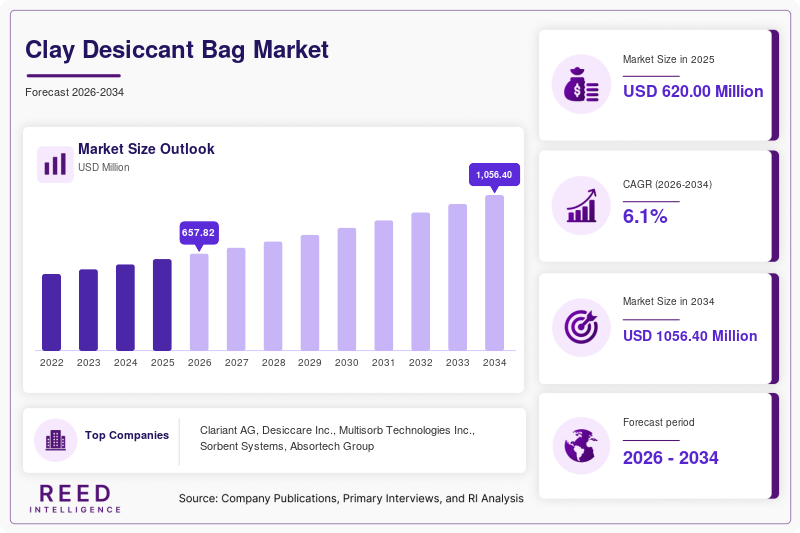
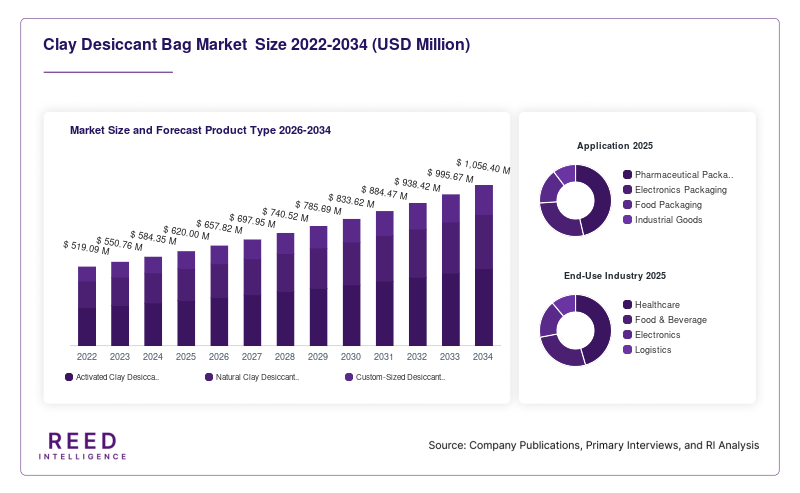
The global Clay Desiccant Bag Market was valued at approximately USD 620 million in 2025 and is projected to reach USD 1.05 billion by 2034, expanding at a CAGR of 6.1% during 2025–2034. The market growth is being supported by the increasing demand for moisture control solutions across industries such as pharmaceuticals, food packaging, electronics, and logistics. Clay desiccant bags, known for their cost-effectiveness and eco-friendly nature, are widely adopted for protecting products against humidity-related damage during storage and transportation.
A key global factor contributing to market expansion is the rising emphasis on sustainable packaging solutions. Industries are gradually shifting toward naturally derived desiccants like bentonite clay due to environmental regulations and consumer preference for biodegradable materials. This transition has strengthened the role of clay desiccants as a reliable alternative to synthetic options.
Key Highlights:
- Asia Pacific dominated the market with a 38.5% share in 2025, while it is projected to grow at the fastest CAGR of 6.8% through 2034.
- By product type, activated clay desiccant bags held the largest share, whereas custom-sized desiccant bags are expected to grow at a CAGR of 7.2%.
- By application, pharmaceutical packaging led the market, while electronics packaging is projected to witness the fastest growth at a CAGR of 7.5%.
- The United States remained the dominant country with a market size of USD 140 million in 2024, rising to USD 148 million in 2025.
Market Trends
Increasing Adoption of Sustainable Packaging Solutions
The Clay Desiccant Bag Market is witnessing a notable shift toward environmentally friendly materials. Manufacturers are focusing on biodegradable and non-toxic desiccants derived from natural clay minerals. Regulatory frameworks across developed economies are encouraging the use of eco-conscious packaging components, pushing companies to integrate clay desiccant bags into their supply chains. This trend is particularly evident in food and pharmaceutical industries, where sustainability and compliance requirements are critical.
Integration with Smart Packaging Technologies
Another emerging trend is the integration of clay desiccant bags with smart packaging systems. Companies are developing desiccant solutions combined with humidity indicators and sensors to provide real-time monitoring of moisture levels. This advancement enhances product safety, especially in sensitive sectors like electronics and medical devices. The ability to track environmental conditions during transit is expected to create new opportunities for innovation and differentiation within the market.
Market Drivers
Growing Demand from Pharmaceutical and Healthcare Industries
The expansion of the pharmaceutical sector has significantly increased the demand for moisture-control solutions. Clay desiccant bags are widely used to preserve the stability and shelf life of medicines and diagnostic kits. Stringent regulatory standards for drug safety are encouraging manufacturers to adopt reliable desiccant solutions, thereby driving market growth.
Expansion of Global Logistics and E-commerce Sectors
The rapid growth of global trade and e-commerce has increased the need for protective packaging during transportation. Products shipped across long distances are exposed to varying humidity conditions, making desiccant bags essential. Clay desiccants, being cost-efficient and effective, are preferred for bulk shipments, which is fueling their adoption across logistics networks.
Market Restraint
Competition from Alternative Desiccant Materials
The Clay Desiccant Bag Market faces competition from alternative desiccants such as silica gel and molecular sieves. These alternatives often offer higher moisture absorption capacity and reusability, making them suitable for specialized applications. Industries requiring precise humidity control, such as advanced electronics and aerospace, tend to favor these alternatives over clay-based products. Additionally, the perception of clay desiccants as a lower-performance option in high-end applications can limit their adoption. Price sensitivity in certain markets further intensifies competition, as buyers may opt for alternatives that provide better long-term efficiency despite higher upfront costs.
Market Opportunities
Rising Demand in Emerging Economies
Developing regions are experiencing rapid industrialization and growth in manufacturing sectors. This creates significant demand for cost-effective packaging solutions. Clay desiccant bags, due to their affordability and availability, are well-positioned to cater to these markets. Expansion of pharmaceutical and food processing industries in emerging economies is expected to create new growth avenues.
Customization and Product Innovation
Manufacturers are increasingly offering customized desiccant bags tailored to specific industry requirements. Innovations in packaging formats, sizes, and absorption capacities are enabling companies to address diverse applications. The development of multi-functional desiccant solutions, including those combined with odor control or antimicrobial properties, is expected to open new opportunities for market players.
Segmental Analysis
By Type
Activated clay desiccant bags held the largest share of 62.8% in 2024, driven by their high absorption efficiency and cost-effectiveness. These products are widely used across industries due to their ability to maintain low humidity levels in enclosed environments. Their natural composition and compliance with environmental standards have further strengthened their dominance.
Custom-sized desiccant bags are projected to grow at the fastest CAGR of 7.2% during the forecast period. The growth will be driven by the increasing demand for tailored packaging solutions across diverse industries. Companies are expected to adopt customized formats to meet specific requirements, enhancing product performance and efficiency.
By Application
Pharmaceutical packaging accounted for the largest share of 34.5% in 2024, owing to the critical need for moisture control in drug storage. Desiccant bags are essential for maintaining the stability and effectiveness of pharmaceutical products, which has driven their widespread use in this segment.
Electronics packaging is expected to grow at a CAGR of 7.5%, supported by the increasing production of electronic devices. The need to protect sensitive components from humidity-related damage will drive the adoption of desiccant solutions in this segment.
By End-Use Industry
The healthcare industry held a dominant share of 29.7% in 2024, driven by the need for reliable moisture control in medical products. Clay desiccant bags are widely used in packaging diagnostic kits and medical devices, ensuring product safety.
The food and beverage industry is projected to grow at a CAGR of 6.9%. The increasing demand for packaged and processed foods will drive the use of desiccant bags to maintain product freshness and extend shelf life.
By Packaging Format
Standard pouch packaging dominated the market with a 58.2% share in 2024, as it offers convenience and cost efficiency. These pouches are widely used in bulk packaging applications.
Strip and sachet formats are expected to grow at a CAGR of 6.7%, driven by their suitability for compact packaging requirements. Their flexibility and ease of integration into various packaging systems will support their growth.
Regional Analysis
North America
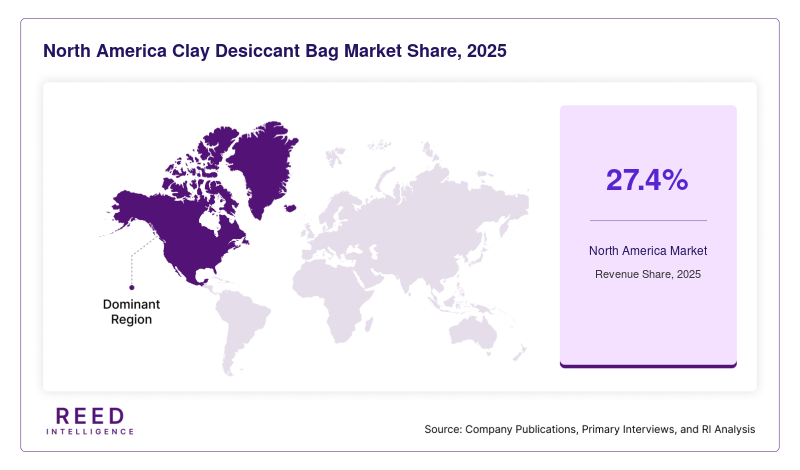
North America accounted for 27.4% of the Clay Desiccant Bag Market share in 2025 and had demonstrated steady demand across industrial and consumer applications. The region is expected to grow at a CAGR of 5.8% during 2025–2034. Growth is anticipated to be driven by consistent demand from pharmaceuticals, electronics, and food packaging sectors, supported by established supply chain systems and advanced packaging standards.
The United States dominated the regional market due to its well-developed pharmaceutical industry. A key growth factor is the increasing adoption of protective packaging for temperature-sensitive products. The presence of stringent regulatory requirements for drug storage has encouraged manufacturers to use reliable moisture control solutions, strengthening the demand for clay desiccant bags.
Europe
Europe held a 23.6% share of the Clay Desiccant Bag Market in 2025 and is projected to grow at a CAGR of 5.6% through 2034. The region has experienced stable growth due to its focus on sustainable packaging practices and regulatory compliance. Environmental concerns have led to increased use of natural desiccants, supporting the adoption of clay-based products.
Germany emerged as the dominant country in Europe. A key growth factor is its strong manufacturing base, particularly in automotive and industrial equipment sectors. The need to protect sensitive components during export has driven the use of desiccant solutions, contributing to steady market growth.
Asia Pacific
Asia Pacific accounted for the largest share of 38.5% in 2025 and is expected to grow at the fastest CAGR of 6.8% during the forecast period. The region’s expansion is driven by rapid industrialization, increasing exports, and the growth of e-commerce platforms.
China dominated the regional market due to its extensive manufacturing and export activities. A distinct growth factor is the high volume of international shipments requiring moisture protection. The increasing focus on product quality during transit has encouraged manufacturers to adopt desiccant solutions, boosting market demand.
Middle East & Africa
The Middle East & Africa held a 6.2% share of the Clay Desiccant Bag Market in 2025 and is projected to grow at a CAGR of 5.4% through 2034. Growth is expected to be supported by expanding logistics networks and increasing industrial activities.
Saudi Arabia led the regional market. A key growth factor is the expansion of the chemical and petrochemical industries, which require effective moisture control during storage and transportation. This has created consistent demand for desiccant solutions.
Latin America
Latin America accounted for 4.3% of the market share in 2025 and is expected to grow at a CAGR of 5.2% during the forecast period. The region’s growth is driven by increasing trade activities and the expansion of food processing industries.
Brazil dominated the market in Latin America. A key growth factor is the growing export of agricultural products, which require protection from moisture during transit. The need to maintain product quality has led to increased adoption of clay desiccant bags.
Competitive Landscape
The Clay Desiccant Bag Market is moderately fragmented, with several global and regional players competing based on product quality, pricing, and customization capabilities. Leading companies are focusing on expanding their product portfolios and strengthening distribution networks.
Clariant AG is a prominent market leader, known for its advanced desiccant solutions. The company has recently introduced enhanced clay-based desiccant products with improved absorption efficiency, supporting its competitive position. Other players are also investing in research and development to innovate and meet evolving customer requirements.
Strategic collaborations and regional expansions are common strategies adopted by market participants to enhance their market presence and capture new opportunities.
Key Players
- Clariant AG
- Desiccare Inc.
- Multisorb Technologies Inc.
- Sorbent Systems
- Absortech Group
- Interra Global Corporation
- IMPAK Corporation
- AGM Container Controls Inc.
- Brownell Limited
- Drytech Inc.
Recent Developments
- In 2024, leading manufacturers introduced biodegradable clay desiccant solutions to align with sustainability goals.
- Several companies expanded production capacities in Asia Pacific to meet rising demand from export-oriented industries.
- New product launches focused on improved absorption efficiency and customizable packaging formats.
- Strategic partnerships were formed to enhance distribution networks across emerging markets.
Clay Desiccant Bag Market Segments
Product Type
- Activated Clay Desiccant Bags
- Natural Clay Desiccant Bags
- Custom-Sized Desiccant Bags
Application
- Pharmaceutical Packaging
- Electronics Packaging
- Food Packaging
- Industrial Goods
End-Use Industry
- Healthcare
- Food & Beverage
- Electronics
- Logistics
Packaging Format
- Standard Pouches
- Strips
- Sachets
By Region
- North America
- Europe
- APAC
- Middle East and Africa
- LATAM