Clean Technology Market Size, Share & Trends Analysis Report By Fuel Type (Solar, Wind, Biomass, and Natural Gas), By Technology Type (Renewable Energy, Energy Storage, Electric Vehicle & Charging, Waste Management, Green Building Materials, and Others), By End Use (Industrial, Residential, and Commercial), and By Region (North America, Europe, Asia Pacific, Latin America, Middle East & Africa) Forecasts, 2026–2034
USD 3950
Clean Technology Market Size
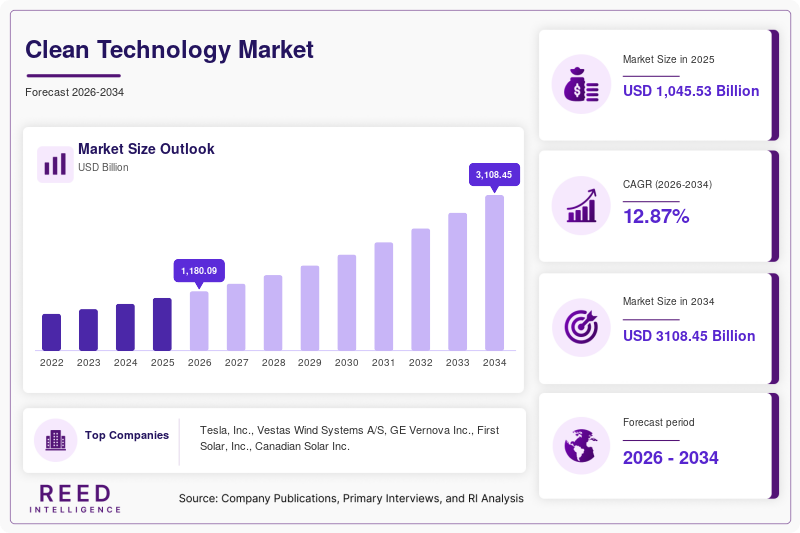
The global clean technology market size was valued at USD 1,045.53 billion in 2025 and is projected to grow from USD 1,180.09 billion in 2026 to USD 3,108.45 billion by 2034, registering a CAGR of 12.87% during the forecast period from 2026 to 2034.
The clean technology market encompasses technologies, products, systems, and services designed to reduce environmental impacts, improve energy efficiency, conserve natural resources, and support the transition toward lower-emission economic activity. The market includes renewable energy generation, energy storage, electric vehicles and charging infrastructure, waste management systems, energy-efficient buildings, and other technologies that support environmental sustainability. Increasing demand for low-carbon energy, industrial decarbonization, electrification, resource efficiency, and sustainable infrastructure is expanding the application of clean technologies across industrial, residential, and commercial environments.
Clean Technology Market Drivers
Increasing Demand for Renewable Energy and Decarbonization
Government emissions-reduction commitments, corporate climate targets, and the need to diversify energy supplies are encouraging investment in clean technology. Solar and wind power are being deployed to reduce dependence on conventional fossil-fuel generation and support lower-emission electricity systems. Industrial companies are also adopting renewable electricity procurement, electrification, and energy-efficiency measures to manage emissions and energy costs. These developments support demand for renewable generation equipment, storage technologies, grid infrastructure, and related services.
Rising Electrification Across Transportation and Industry
The expansion of electric vehicles, charging infrastructure, electric industrial equipment, and electrified heating systems is increasing the need for reliable clean electricity. Transportation electrification also creates demand for charging management, battery systems, power electronics, and grid upgrades. In manufacturing, process electrification and energy-management solutions can support operational efficiency and emissions-reduction objectives. The interaction between electrification and renewable power is strengthening the role of clean technology across interconnected energy and industrial systems.
Technological Innovation and Improving System Integration
Advances in solar modules, wind turbines, battery chemistry, power electronics, smart-grid systems, and digital controls are improving the range of applications available to clean technology users. Better monitoring and predictive maintenance can improve asset performance, while integrated storage and energy-management systems help address variability in renewable electricity generation. Innovation in recycling, water treatment, sustainable materials, and industrial process optimization is also expanding the addressable market beyond electricity generation.
Clean Technology Market Restraints
High Initial Capital Requirements
Many clean technology projects require substantial upfront investment in equipment, installation, grid connections, storage, construction, and supporting infrastructure. Although operating costs can be lower for some technologies, the initial financing burden can delay projects, particularly for smaller companies, households, municipalities, and developing markets. Higher borrowing costs, uncertain revenue streams, and limited access to long-term financing can further affect project viability and slow adoption.
Infrastructure Limitations and Integration Challenges
Electricity networks, charging infrastructure, transmission capacity, and storage availability may not expand at the same pace as clean technology deployment. Variable renewable generation can create additional requirements for grid flexibility, balancing resources, and network upgrades. Industrial facilities may also face technical constraints when integrating new systems with existing equipment. Permitting delays, land availability, interconnection queues, and shortages of specialized installation and maintenance capabilities can lengthen project timelines.
Clean Technology Market Opportunities
Expansion of Energy Storage and Smart-Grid Technologies
Growing renewable electricity capacity creates opportunities for battery storage, long-duration storage, smart inverters, grid-management software, and flexible-demand systems. These technologies can help balance supply and demand, reduce renewable curtailment, improve grid resilience, and support distributed generation. Commercial and industrial customers may also deploy storage to manage peak demand, improve backup power availability, and optimize electricity consumption. Continued innovation in storage technology and system integration creates opportunities for equipment manufacturers, software providers, utilities, and project developers.
Growth in Circular Economy and Sustainable Infrastructure Solutions
Increasing attention to material efficiency, resource conservation, waste reduction, and water security is creating opportunities in recycling, waste processing, wastewater treatment, industrial resource recovery, and sustainable construction materials. Businesses and public authorities are exploring systems that recover value from waste streams, reduce landfill dependence, and improve the efficiency of material use. Clean technology providers that combine equipment, monitoring software, maintenance, and performance-based services can address the needs of industrial facilities, municipalities, commercial buildings, and infrastructure operators.
Clean Technology Market Segmental Analysis
By Fuel Type
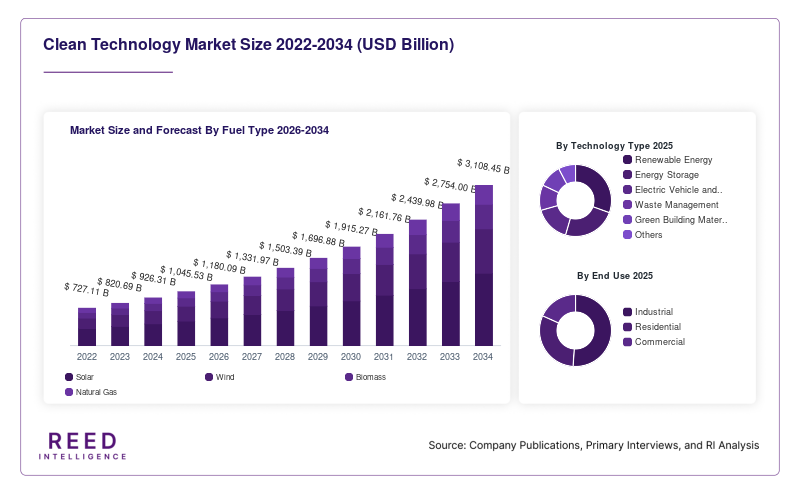
Solar is identified as the leading fuel-type segment, accounting for approximately 38% of the global clean technology market in the referenced market assessment. Demand is supported by utility-scale solar installations, commercial rooftop systems, distributed generation, and increasing integration with battery storage. Improvements in photovoltaic efficiency, project design, inverters, and digital monitoring help developers improve system performance. Solar deployment also benefits from corporate renewable-electricity procurement and efforts to diversify power supplies. Its continued development depends on grid connections, project financing, land availability, manufacturing costs, and policies governing renewable-energy deployment.
Wind energy represents approximately 26% of the market in the referenced assessment. Onshore and offshore wind projects contribute to renewable electricity generation, with larger turbines, improved forecasting, and predictive maintenance supporting operational performance. Offshore projects offer access to substantial wind resources but often require complex installation, transmission, and financing arrangements. Wind energy can complement solar generation within diversified renewable portfolios. Deployment is influenced by permitting, transmission infrastructure, equipment availability, project costs, and local environmental considerations.
Biomass contributes approximately 18% of the market in the referenced assessment. It includes technologies that convert agricultural residues, forestry materials, organic waste, and other suitable biological feedstocks into heat, electricity, and fuels. Biomass can support waste utilization and provide dispatchable energy in selected applications. Its commercial viability depends on feedstock availability, transport costs, conversion efficiency, emissions management, and sustainability standards. The lifecycle emissions profile also varies according to the feedstock, land-use effects, production process, and supply-chain practices.
Natural gas accounts for approximately 18% in the referenced market assessment, where it is treated as a transitional energy source. Gas-based systems can provide flexible generation and support electricity balancing where renewable output fluctuates. The extent to which natural gas qualifies as clean technology depends on the market definition and the inclusion of efficiency improvements, methane management, or carbon-capture systems. Conventional natural gas remains a fossil fuel, and its climate impact depends on combustion emissions and methane leakage across the supply chain. This classification should therefore be interpreted in the context of the source report's taxonomy.
By Technology Type
Renewable energy is a major technology category, covering solar, wind, and other renewable power-generation systems. The referenced market assessment estimates that renewable energy applications represent approximately 34% of total clean technology demand. Demand is supported by renewable procurement, electricity-sector decarbonization, energy security considerations, and the expansion of distributed and utility-scale generation. Hybrid renewable systems and integration with storage can improve power availability. Grid capacity, permitting, financing, equipment supply, and the pace of electricity-market reform remain important factors affecting deployment.
Energy storage accounts for approximately 17% of the market in the referenced assessment. Batteries and other storage technologies can shift electricity across time, provide backup power, manage peak demand, and improve the integration of variable renewable generation. Utilities, commercial facilities, industrial operators, and microgrid developers use storage for different operating requirements. Market development depends on system costs, battery lifespan, safety, recycling infrastructure, connection rules, and revenue models. Advances in battery chemistry and long-duration storage technologies may broaden applications where conventional short-duration batteries are insufficient.
Electric vehicles and charging infrastructure account for approximately 16% of clean technology demand in the referenced assessment. This category includes charging equipment, charging networks, power-management systems, and supporting infrastructure for passenger vehicles and commercial fleets. Demand is linked to vehicle electrification, fleet-emissions targets, charging accessibility, and improvements in battery performance. Public fast charging, workplace charging, home charging, and depot-based fleet charging address different use cases. Infrastructure expansion is influenced by electricity-grid capacity, charger utilization, vehicle adoption, installation costs, and interoperability requirements.
Waste management represents approximately 12% of the market in the referenced assessment. Technologies include recycling equipment, waste sorting, organic-waste processing, waste-to-energy systems, and industrial waste treatment. These solutions help municipalities and businesses manage waste streams, recover reusable materials, and reduce disposal requirements. Adoption is influenced by waste collection infrastructure, recycling economics, environmental regulation, feedstock quality, and demand for recovered materials. Digital tracking and automated sorting can improve process visibility and material recovery, while waste-to-energy applications require careful assessment of emissions and local waste-management priorities.
Green building materials represent approximately 11% of the market in the referenced assessment. The category includes materials and construction solutions intended to reduce embodied emissions, improve insulation, and increase building energy performance. Examples include lower-carbon cement, recycled construction materials, efficient insulation, and products designed for improved lifecycle performance. Adoption is supported by building-efficiency requirements, sustainability certifications, corporate real-estate objectives, and demand for lower operating costs. Initial material costs, local availability, construction practices, and certification requirements affect implementation.
By End Use
The industrial segment holds approximately 45% of the market in the referenced assessment, making it the largest end-use category within that source's segmentation. Manufacturing, chemicals, metals, energy, and other energy-intensive sectors use clean technologies to improve energy efficiency, reduce emissions, manage waste, and optimize resource consumption. Applications include renewable electricity procurement, industrial energy storage, electrification, waste-heat recovery, and digital energy-management systems. Adoption depends on capital availability, production requirements, equipment compatibility, payback periods, and emissions regulations.
The residential segment accounts for approximately 25% of the market in the referenced assessment. Household applications include rooftop solar, residential battery storage, efficient appliances, smart energy controls, heat pumps, and home electric-vehicle charging. Consumer adoption is influenced by energy prices, financing options, installation costs, property ownership, government incentives, and access to qualified installers. Energy-management systems and storage can improve the utilization of distributed renewable electricity, although their benefits vary according to local tariffs, household consumption patterns, and grid reliability.
Clean Technology Market Regional Analysis
North America Clean Technology Market
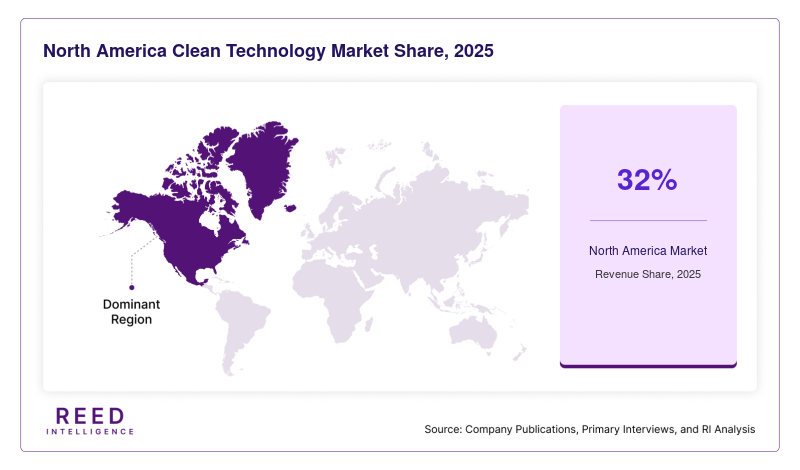
North America accounted for 32% of the global clean technology market in the referenced 2025 market assessment, making it the leading region under that source's geographic breakdown. Market activity is supported by renewable energy deployment, energy storage, electric mobility, industrial efficiency projects, and investment in sustainable infrastructure. The United States has an established ecosystem of clean technology developers, equipment manufacturers, utilities, technology companies, and project financiers. Canada contributes through renewable electricity, grid modernization, clean industrial processes, and resource-efficiency initiatives.
The region's market development is shaped by federal and state policies, electricity-market structures, incentives, financing costs, and the availability of transmission infrastructure. Demand spans utility-scale renewable energy, commercial building upgrades, battery storage, charging infrastructure, and industrial decarbonization. However, permitting timelines, grid interconnection delays, changing policy incentives, and supply-chain dependencies can affect deployment. The precise North American CAGR for the exact market definition used in this report is not verifiable from the available evidence.
Europe Clean Technology Market
Europe is estimated to represent approximately 28% of the global clean technology market in the referenced market assessment. Demand is supported by decarbonization targets, renewable electricity deployment, building-efficiency initiatives, electric mobility, recycling systems, and industrial emissions-reduction programmes. Countries including Germany, France, the United Kingdom, Spain, and Italy have activity across renewable generation, energy storage, sustainable construction, and clean industrial equipment. Regional demand also reflects the need to modernize electricity networks and reduce dependence on imported energy.
Market expansion is influenced by climate policy, industrial competitiveness, energy prices, project financing, and the pace of permitting and infrastructure development. Energy storage, heat pumps, building retrofits, charging networks, and circular-economy solutions provide applications across residential, commercial, and industrial settings. Manufacturers also face competition from international suppliers and changing trade conditions. An exact regional CAGR for the Clean Technology Market, using the same valuation and segmentation basis as this report, is not verifiable from the available evidence.
Asia Pacific Clean Technology Market
Asia Pacific is estimated to account for approximately 30% of the global clean technology market in the referenced assessment. China, India, Japan, South Korea, and Australia contribute through renewable electricity, clean technology manufacturing, electric mobility, storage systems, and industrial efficiency. Large electricity demand, urbanization, industrial production, and infrastructure expansion support deployment across multiple technology categories. The region also plays an important role in the manufacturing and export of solar modules, batteries, electric vehicles, and related components.
Growth conditions vary considerably between countries. China has substantial manufacturing and deployment capacity, India is expanding renewable energy and associated infrastructure, Japan and South Korea have established advanced manufacturing industries, and Australia has opportunities in renewable power and storage. Grid capacity, financing, land availability, local supply chains, and differences in policy frameworks influence adoption. Although Asia Pacific is a major clean technology manufacturing and deployment centre, its precise CAGR for the market definition used here is not verifiable from the available evidence.
Latin America Clean Technology Market
Latin America participates in the Clean Technology Market through renewable electricity, bioenergy, sustainable transport, waste management, and industrial resource-efficiency projects. Brazil is a key market for bioenergy and renewable power, while Mexico and other countries offer opportunities in distributed energy, industrial efficiency, electric mobility, and sustainable infrastructure. Regional electricity resources and demand from industrial and commercial users create opportunities for technologies that diversify energy supply and reduce environmental impacts.
Market development depends on access to financing, grid investment, regulatory consistency, currency conditions, and infrastructure readiness. Renewable energy projects may benefit from established solar, wind, hydroelectric, and bioenergy resources, but project implementation can be affected by transmission constraints and permitting requirements. Waste recovery, water treatment, and energy-efficient buildings offer additional areas for deployment. A precise Latin American market share and CAGR matching the report's market definition could not be verified from the available evidence.
Middle East & Africa Clean Technology Market
The Middle East and Africa region has clean technology opportunities across solar power, energy storage, water treatment, waste management, energy efficiency, and sustainable urban infrastructure. Gulf countries are investing in renewable generation and diversification of energy systems, while selected African markets are exploring distributed solar, mini-grids, battery storage, and clean cooking or water-related solutions. Industrial decarbonization and efficient resource use are also relevant to energy-intensive economies and infrastructure projects.
Adoption is influenced by project financing, electricity access, water scarcity, grid reliability, policy frameworks, and the availability of technical capabilities. Utility-scale projects may benefit from strong solar resources, while distributed systems can address the needs of locations with limited grid access. However, financing constraints, currency risk, infrastructure gaps, and differences in regulatory capacity affect deployment across countries. An exact regional share and CAGR for the defined global Clean Technology Market are not verifiable from the available evidence.
Clean Technology Market Competitive Landscape
The Clean Technology Market is fragmented across renewable energy equipment, batteries, electric vehicles, charging infrastructure, energy-management systems, sustainable materials, and environmental services. Competition therefore varies by technology and application. Some companies manufacture equipment, others develop and operate infrastructure, and others provide software, engineering, financing, or integrated services.
Competitive activity includes product innovation, manufacturing-capacity development, strategic partnerships, project development, acquisitions, and expansion into new geographic markets. Solar and wind manufacturers compete on performance, cost, reliability, and project delivery. Battery and electric-mobility companies focus on energy density, system integration, safety, charging performance, and lifecycle costs. Providers of waste-management and building-efficiency technologies compete on operating efficiency, compliance, automation, and measurable environmental outcomes.
Key Market Players
- Tesla, Inc.
- Vestas Wind Systems A/S
- GE Vernova Inc.
- First Solar, Inc.
- Canadian Solar Inc.
- Enphase Energy, Inc.
- Siemens Energy AG
- Schneider Electric SE
- ABB Ltd.
Clean Technology Market Recent Developments
- 6 March 2026 - Support for lithium-ion battery recycling in India. India's Technology Development Board announced financial support for MiniMines Cleantech Solutions Pvt. Ltd. to commercialize a battery-recycling and critical-mineral-refining process. The project aims to recover battery-grade lithium, cobalt, nickel, and manganese salts from end-of-life lithium-ion batteries.
- 24 July 2026 - Canadian Solar reported a solar-cell manufacturing development. Canadian Solar's investor-relations release list records the launch of a high-performance heterojunction (HJT) solar-cell plant by CS PowerTech. This is directly relevant to solar manufacturing capacity within the clean technology supply chain.
Clean Technology Market Segments
By Fuel Type
- Solar
- Wind
- Biomass
- Natural Gas
By Technology Type
- Renewable Energy
- Energy Storage
- Electric Vehicle and Charging
- Waste Management
- Green Building Materials
- Others
By End Use
- Industrial
- Residential
- Commercial
By Region
- North America
- Europe
- APAC
- Middle East and Africa
- LATAM