Client Onboarding Software Market Size, Share & Trends Analysis Report By Component (Identity Verification, KYC/KYB & AML, Workflow & Case Management, E-Signature & Document Management, Risk & Fraud Management), By Deployment (Cloud-Based, On-Premise), By Organization Size (Large Enterprises, Small & Medium Enterprises), By Application (Customer Onboarding, Business Onboarding, Account Opening), By End Use (BFSI, Fintech & Payments, Insurance, Professional Services) Forecasts, 2026–2034
USD 3950
Client Onboarding Software Market Size
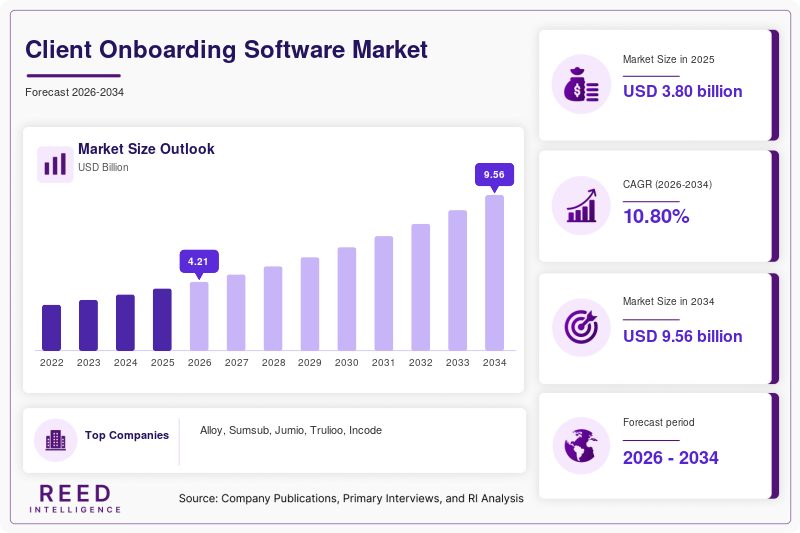
The global client onboarding software market size was valued at USD 3.80 billion in 2025 and is projected to grow from USD 4.21 billion in 2026 to USD 9.56 billion by 2034, registering a CAGR of 10.80% during the forecast period from 2026 to 2034.
The market is shifting from basic digital application forms toward integrated identity, KYC/KYB, AML screening, document collection, risk assessment, workflow orchestration, e-signature and ongoing monitoring. Regulation is reinforcing this transition: the EU's AML Regulation requires customer and beneficial-owner identification, verification and risk assessment, while FATF guidance specifically addresses the use of digital identity systems during onboarding.
Client onboarding software is becoming an operating layer between customer acquisition and account activation. Financial institutions, fintech companies, insurers, healthcare providers, marketplaces and other digital businesses increasingly need to collect information, verify identities, assess risk, obtain documents, complete agreements and establish accounts without relying on disconnected manual processes.
The strongest demand mechanism is the combination of digital customer expectations and compliance obligations. The EU's AML Regulation establishes detailed requirements for identifying customers and beneficial owners, understanding the purpose of a business relationship, and maintaining supporting records. It also explicitly recognizes electronic identification as a means of facilitating remote customer due diligence.
In the U.S., FinCEN continues to require covered financial institutions to identify and verify beneficial owners of legal-entity customers, although its February 2026 exceptive relief allows institutions to avoid repeating beneficial-owner verification at every account opening under specified circumstances.
Client Onboarding Software Market Drivers
Regulatory requirements are increasing the need for structured onboarding
Client onboarding in regulated industries is no longer simply a sales or customer-experience function. It is part of the organization's financial-crime, identity and compliance infrastructure. The EU AML Regulation requires obliged entities to identify and verify customers and beneficial owners, understand the purpose and nature of relationships, and apply enhanced measures where risk is higher.
The regulation also recognizes electronic identification as a mechanism for secure remote verification. This creates a direct technology pathway from regulation to software demand: organizations need systems that can collect required information, connect to identity sources, apply risk rules, maintain evidence and demonstrate compliance to supervisors.
In the U.S., FinCEN's CDD framework similarly requires covered financial institutions to identify and verify customers and beneficial owners, while the February 2026 relief modifies when beneficial-owner verification must be repeated.
The commercial implication is sustained demand for configurable onboarding workflows rather than static digital forms.
Digital identity and remote verification are becoming standard onboarding infrastructure
Customers increasingly expect to open accounts remotely, while organizations need stronger assurance that the person or business behind an application is genuine. This has expanded the use of document verification, biometric matching, liveness detection, digital IDs, address verification and database checks.
FATF's current digital-identity guidance specifically considers how digital ID can support customer identification and verification at onboarding and potentially ongoing due diligence. The EU is also establishing technical requirements for remote onboarding into European Digital Identity Wallets. Commission Implementing Regulation 2026/798, adopted in April 2026, sets standards for remote wallet-user onboarding using electronic identification means and additional remote procedures.
Jumio expanded digital-ID acceptance in June 2026 to more than 60 countries and territories through a single integration, illustrating how identity providers are building broader international coverage for onboarding.
This creates demand for reusable identity infrastructure, international document coverage and APIs that can be embedded directly into application flows.
AI and automation are reducing manual onboarding work
Manual onboarding creates delays because compliance teams must review documents, verify identities, investigate risk and resolve exceptions. Software vendors are increasingly automating these steps and using AI for decision support.
Alloy reported more than 900 financial institutions and fintech customers in July 2026 and introduced an AI Assistant designed to automate risk and compliance work. It also launched perpetual KYB in the UK and Europe, extending risk-based monitoring beyond initial onboarding.
Sumsub launched an AI-agent interface in June 2026 that can convert compliance policies into configured verification levels, risk questionnaires and onboarding workflows.
The commercial mechanism is labor substitution and workflow acceleration: routine checks can be automated while compliance specialists focus on ambiguous or high-risk cases. This also allows organizations to scale customer volumes without increasing manual-review capacity at the same rate.
Client Onboarding Software Market Restraints
Identity fraud is becoming more sophisticated
The same technologies that automate legitimate onboarding can be exploited by fraudsters. Deepfakes, synthetic identities, document manipulation, account farming and coordinated fraud networks make single-layer verification increasingly unreliable.
Sumsub's 2026 KYC research identifies AI-generated fraud, deepfakes, synthetic identities, behavioral signals and network-level analysis as major changes in identity verification. Its 2026 KYC guidance recommends combining document verification, liveness, biometric matching, device intelligence, sanctions screening and risk assessment rather than relying on one verification step.
This increases software requirements and operating costs. Vendors must continuously update detection models and data sources, while customers must balance stronger controls against legitimate-user friction.
Regulatory fragmentation complicates international deployments
Onboarding requirements differ across countries, industries and customer-risk categories. Documentation, electronic-identification standards, beneficial-owner requirements, video identification and data-processing rules can vary considerably.
Spain, for example, has specific regulatory expectations around recorded video identification for certain regulated onboarding processes. Sumsub introduced SEPBLAC-aligned Video KYC in February 2026 with recorded identity verification, liveness checks and human review.
This means multinational businesses often need configurable country-specific workflows rather than one global onboarding sequence. Vendors must continuously maintain regulatory coverage, which increases implementation complexity and creates barriers for smaller providers.
Client Onboarding Software Market Opportunities
Reusable digital identity and continuous onboarding
The next stage of client onboarding is moving beyond a one-time verification event toward reusable identity and continuous trust. A customer who has already completed a verified identity process may not need to repeatedly submit the same documents when accessing another service or product, subject to consent, legal requirements and risk conditions.
Sumsub and Noah announced a February 2026 partnership using reusable KYC identity so verified users can avoid repeated document submissions and liveness checks across participating platforms. Jumio is similarly expanding reusable identity capabilities, including its September 2026 expansion into APAC.
This creates a new commercial model around identity portability, verification credentials, trust networks and lifecycle monitoring. It can reduce customer friction while lowering repeated verification costs for organizations.
Automated KYB and business onboarding
Business onboarding is becoming more complex as organizations need to verify legal entities, ownership structures, directors, sanctions exposure and corporate documentation. This creates a substantial opportunity for KYB automation.
In July 2026, Sumsub introduced automated company-level risk scoring, periodic rechecks and corporate-document expiry tracking. Trulioo reported in April 2026 that its UBO-discovery innovations were associated with a 51% increase in APAC business-verification volume, highlighting the commercial importance of resolving ownership information in complex markets.
The opportunity extends beyond banks into marketplaces, payment platforms, procurement networks, insurance, logistics and B2B SaaS, where companies need to establish trust in vendors, merchants and business customers.
Segmental Analysis
By Component
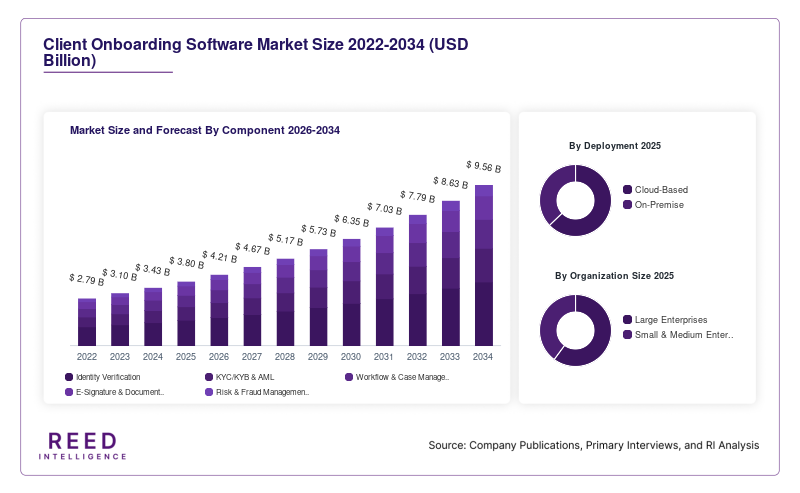
Identity Verification represents approximately 31% of the global market in 2025, supported by the need to establish that applicants are genuine individuals or authorized representatives. Document verification, biometrics, liveness and digital-ID connectivity are becoming core onboarding functions.
KYC/KYB & AML accounts for approximately 28% and is the fastest-growing component at about 13.2% CAGR. Regulatory requirements, sanctions screening, beneficial-owner verification and ongoing risk monitoring are increasing the amount of compliance activity embedded in onboarding. EU AML requirements and FinCEN's CDD framework directly support this demand.
Workflow & Case Management represents approximately 19%, connecting data collection, automated decisions, exceptions and human review.
E-Signature & Document Management accounts for approximately 12%, while Risk & Fraud Management represents approximately 10%.
By Deployment
Cloud-Based deployment represents approximately 79% of the global market in 2025 and is the fastest-growing deployment model at about 12.1% CAGR. APIs and cloud infrastructure allow organizations to embed verification into websites, mobile applications and account-opening systems without building identity infrastructure internally.
The development of AI-powered onboarding and digital-ID integrations is reinforcing this model. Sumsub's Auth0 integration, for example, allows KYC and AML checks to be triggered directly within registration or authentication flows.
On-Premise deployment represents approximately 21%, mainly among organizations with stringent infrastructure-control requirements, legacy architectures or specific data-residency policies.
By Organization Size
Large Enterprises account for approximately 64% of the market in 2025, reflecting complex regulatory requirements, large customer volumes, multiple jurisdictions and extensive compliance operations.
Small & Medium Enterprises represent approximately 36% and are the fastest-growing organization-size segment at about 13.5% CAGR. Cloud onboarding platforms reduce the need for internal development teams and allow smaller organizations to access identity verification, AML screening and automated workflows through APIs.
The expansion of self-service onboarding tools also reduces implementation barriers for smaller businesses. Sumsub's 2026 product releases increasingly emphasize configurable, lower-code onboarding and compliance workflows.
By Application
Customer Onboarding represents approximately 43% of the global market in 2025, making it the largest application. Banks, fintechs, insurers, healthcare platforms and digital businesses need to establish customer identity and eligibility before granting access to products or services.
Business Onboarding accounts for approximately 27% and is the fastest-growing application at about 14.2% CAGR. KYB requires more complex information than individual onboarding, including legal-entity data, beneficial ownership, directors and corporate documentation. Trulioo and Sumsub have both expanded KYB and UBO capabilities in 2026.
Account Opening represents approximately 19%, while Partner & Vendor Onboarding accounts for approximately 11%.
By End Use
BFSI represents approximately 31% of the global market in 2025, supported by KYC, AML, customer identification and account-opening requirements. FinCEN's CDD framework makes identity and beneficial-owner verification a formal component of covered financial institutions' compliance processes.
Fintech & Payments accounts for approximately 23% and is the fastest-growing end-use segment at about 14.6% CAGR. Digital financial businesses need fast customer activation while managing fraud and regulatory requirements across multiple jurisdictions.
Insurance represents approximately 12%, while Healthcare accounts for 10% and is expanding as telehealth and digital health services require remote identity verification. Trulioo's April 2026 partnership with Phoenix Digital Health demonstrates the use of identity verification during virtual-care onboarding.
Retail & E-Commerce represents approximately 9%, Telecommunications approximately 6%, Professional Services approximately 5%, and Other Industries approximately 4%.
Regional Analysis
North America Client Onboarding Software Market
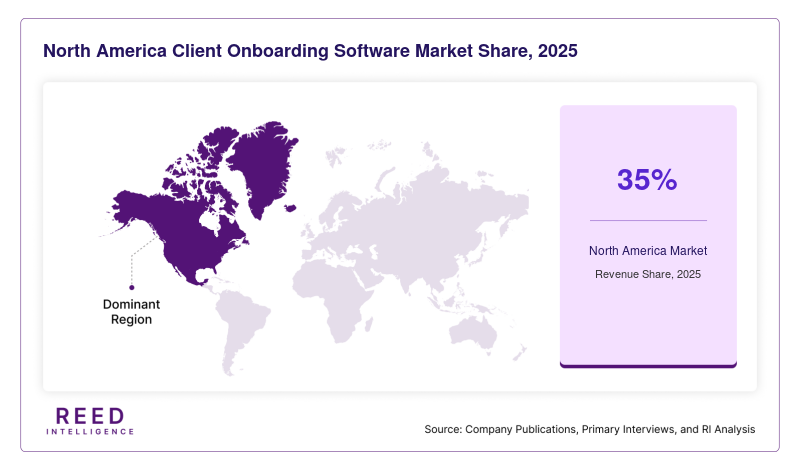
North America represents approximately 35% of the global market in 2025 and is growing at about 9.8% CAGR. The region benefits from mature fintech adoption, large financial institutions, digital commerce, telehealth and an established identity-verification ecosystem.
U.S. financial institutions operate within formal customer-identification and customer-due-diligence requirements. FinCEN's February 2026 exceptive relief reduced one repetitive beneficial-owner verification burden while retaining risk-based ongoing due diligence obligations.
The regulatory development does not eliminate onboarding software demand. Instead, it shifts the technology requirement toward centralized customer records, risk-based workflows and the ability to determine when previously collected information remains reliable. This favors platforms that can connect initial onboarding with ongoing monitoring.
Healthcare is another demand channel. In April 2026, Trulioo announced a partnership with Phoenix Digital Health to verify patient identities during onboarding for virtual healthcare services in Canada.
The U.S. and Canada also have strong demand for AI-driven fraud detection and digital identity. The main constraint is platform competition and integration complexity because large enterprises often already operate multiple identity, fraud and compliance systems.
Europe Client Onboarding Software Market
Europe represents approximately 27% of the global market in 2025 and is growing at about 10.2% CAGR. Regulatory harmonization is a major market mechanism, particularly through the EU's new AML framework and European Digital Identity infrastructure.
The EU AML Regulation introduces detailed requirements for customer and beneficial-owner identification, risk-based due diligence, record keeping and ongoing monitoring. It also recognizes electronic identification as a means of supporting secure remote customer identification.
The European Digital Identity Wallet creates another potential onboarding channel. In April 2026, the European Commission adopted implementing rules covering remote onboarding of wallet users using electronic identification means.
Country-specific regulation remains important. Sumsub's February 2026 launch of recorded Video KYC for Spain illustrates how national requirements can influence onboarding architecture even within the EU framework.
The region therefore has strong demand for compliant identity verification, digital-ID connectivity, KYB, AML workflow automation and audit trails. The principal challenge is maintaining compliance across national differences while ensuring onboarding remains commercially efficient.
APAC Client Onboarding Software Market
APAC represents approximately 22% of the global market in 2025 and is the fastest-growing region at about 14.1% CAGR. The region combines rapid fintech adoption, digital payments growth, expanding e-commerce, large mobile populations and increasing use of remote identity verification.
India is particularly important because digital identity infrastructure can be connected with financial and commercial onboarding. Other markets, including Singapore, Australia, Japan, South Korea and Southeast Asia, have mature digital-government and financial ecosystems that support remote identity verification.
Jumio expanded digital-ID acceptance to more than 60 countries and territories in June 2026, while Incode added India KYB verification using company identifiers such as CIN, LLPIN and UDYAM in July 2026.
Trulioo reported a 51% increase in APAC business-verification volume associated with its UBO-discovery innovations in April 2026.
The region's fastest-growth mechanism is therefore a combination of digital financial services, business formation, cross-border commerce and expanding identity infrastructure. The key constraint is market fragmentation: languages, document formats, regulatory regimes and identity systems differ substantially between countries.
Middle East and Africa Client Onboarding Software Market
The Middle East and Africa represent approximately 8% of the market in 2025 and are growing at about 12.4% CAGR. Growth is supported by financial inclusion, digital banking, fintech, telecommunications, e-commerce and government digitization.
Remote onboarding is especially valuable where organizations are expanding services across geographically dispersed customer populations. Cloud-based identity verification allows businesses to connect customers to financial and digital services without requiring physical branch visits.
The technology requirement is increasingly moving beyond document verification toward AML screening, fraud detection, device intelligence and risk scoring. Sumsub's 2026 regional activity includes expansion in Africa and partnerships designed to strengthen digital trust and compliance infrastructure.
The region also provides opportunities in business verification because cross-border businesses and marketplaces require corporate identity, ownership and sanctions checks.
Infrastructure availability, regulatory differences and uneven digital-ID adoption remain constraints. Vendors that provide localized documents, languages and regulatory workflows can therefore address a broader share of the regional opportunity.
LATAM Client Onboarding Software Market
LATAM represents approximately 8% of the global market in 2025 and is growing at about 11.8% CAGR. Fintech, digital banking, payments, e-commerce and online marketplaces are the main demand channels.
Customer onboarding needs to balance speed with identity assurance because digital financial services frequently operate without the branch infrastructure associated with traditional banking. This increases demand for document verification, biometrics, liveness, fraud detection and AML screening.
Sumsub expanded non-document verification in Colombia in August 2026 using RUNT and RNEC data, while its July 2026 partnership with Bitso Business addressed automated compliance for cross-border B2B payments across Latin America.
These developments demonstrate a shift toward local-data connectivity rather than generic global verification. The main constraint is regulatory fragmentation between countries, requiring vendors to maintain country-specific workflows and data sources.
Competitive Landscape
The client onboarding software market is becoming more competitive as identity verification, compliance, fraud prevention and workflow vendors converge around a broader concept of digital trust.
Alloy focuses heavily on financial institutions and fintechs, combining identity, fraud and risk decisioning. In July 2026, Alloy reported more than 900 financial institution and fintech customers and highlighted its AI Assistant and perpetual-KYB capabilities.
Sumsub is expanding from KYC verification into broader compliance infrastructure. Its 2026 launches include automated KYB risk scoring, AI-assisted compliance configuration, reusable identity, Auth0 integration and marketplace-specific onboarding.
Jumio is expanding identity intelligence through digital-ID acceptance and reusable identity. Its June 2026 expansion supports digital IDs across more than 60 countries and territories through one integration.
Key Market Players
- Alloy
- Sumsub
- Jumio
- Trulioo
- Incode
- Persona
- Veriff
- Onfido
- LexisNexis Risk Solutions
- Experian
- Socure
- Entrust
Recent Market Developments
- September 2026 – Sumsub launched Workforce Verification. The new capability addresses identity verification for enterprise workforces and AI-related fraud, extending the company's identity infrastructure beyond conventional customer onboarding.
- September 2026 – Jumio expanded reusable identity into APAC. Its selfie.DONE capability extends reusable identity concepts into additional markets, reducing repeated identity-document submission for trusted users.
Client Onboarding Software Market Segments
By Component
- Identity Verification
- KYC/KYB & AML
- Workflow & Case Management
- E-Signature & Document Management
- Risk & Fraud Management
By Deployment
- Cloud-Based
- On-Premise
By Organization Size
- Large Enterprises
- Small & Medium Enterprises
By Application
- Customer Onboarding
- Business Onboarding
- Account Opening
- Partner & Vendor Onboarding
By End Use
- BFSI
- Fintech & Payments
- Insurance
- Healthcare
- Retail & E-Commerce
- Telecommunications
- Professional Services
- Other Industries
By Region
- North America
- Europe
- APAC
- Middle East and Africa
- LATAM