Climate Change Consulting Market Size, Share & Trends Analysis Report By Service Type (Climate Risk Assessment & Scenario Analysis, Decarbonization & Net-Zero Strategy), By Organization Size (Large Enterprises, Small & Medium-Sized Enterprises), By End-Use Industry (Energy & Utilities, Manufacturing & Industrial, Financial Services), By Engagement Type (Strategy & Advisory, Technical Implementation) Forecasts, 2026–2034
USD 3950
Climate Change Consulting Market Size
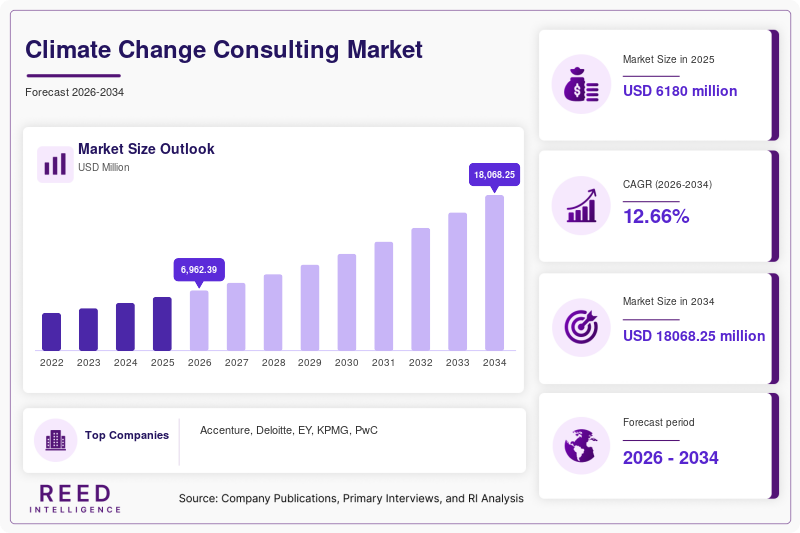
The Climate Change Consulting Market was valued at USD 6,180 million in 2025 and is estimated at USD 7,100 million in 2026. Based on the supplied forecast, the market is projected to reach USD 18,068.25 billion by 2034, at a stated CAGR of 12.66% over the 2026–2034 forecast period.
The supplied 2026 and 2034 values imply a CAGR of approximately 12.65%, which is consistent with the stated 12.66% after rounding. The report retains the supplied market values.
Climate change consulting includes professional services that help businesses, financial institutions, public agencies and other organizations understand climate-related risks, quantify greenhouse gas emissions, develop decarbonization plans, comply with disclosure requirements and adapt operations to physical climate impacts.
The market is expanding beyond conventional sustainability strategy. Clients increasingly need to translate climate commitments into measurable operational plans, defensible emissions inventories, investment decisions and reporting processes. The OECD’s Global Corporate Sustainability Report 2025 found that companies representing 91% of global listed-company market capitalization disclosed sustainability-related information in 2024, up from 86% in 2022. The data indicate that sustainability reporting has become a mainstream corporate activity, although disclosure rates do not directly measure consulting expenditure.
The market’s commercial trajectory will depend on the implementation of climate-disclosure standards, corporate net-zero commitments, physical-risk exposure, energy-transition investment and demand for adaptation planning. Regulatory uncertainty and differences between national requirements may also cause clients to delay projects or narrow their consulting scope.
Climate change consulting is a professional services market that combines environmental science, financial analysis, engineering, risk management, emissions accounting and corporate strategy. Consultants help clients understand how climate change may affect assets, supply chains, operating costs, financing, insurance, regulatory exposure and long-term business plans.
Climate Change Consulting Market Drivers
Climate-Disclosure Requirements Increase Demand for Measurement and Reporting Support
The expansion of sustainability and climate-related reporting has created work around emissions inventories, materiality assessments, data controls, governance processes and reporting readiness.
The International Sustainability Standards Board’s IFRS S1 and IFRS S2 standards provide a common framework for sustainability-related financial disclosures and climate-related disclosures. Jurisdictions are progressing at different speeds in adopting or using these standards, creating a need for companies to assess the rules that apply to their operations and reporting periods.
Consultants can help clients identify relevant requirements, establish data ownership, calculate Scope 1 and Scope 2 emissions, evaluate relevant Scope 3 categories and prepare documentation for internal review or external assurance. The commercial opportunity is not simply the production of a report; it includes building repeatable systems that allow companies to update information each reporting cycle.
However, regulatory change can create uneven demand. Where rules are delayed, simplified or challenged, clients may postpone implementation or concentrate on voluntary reporting and investor expectations rather than mandatory compliance.
Corporate Decarbonization Plans Require Implementation Expertise
Organizations that have established climate targets must determine how to achieve them. This typically involves creating an emissions baseline, identifying major sources of emissions, assessing reduction measures, prioritizing projects and tracking progress against targets.
Consulting assignments may cover renewable-energy procurement, energy-efficiency upgrades, fleet electrification, process redesign, supplier engagement and low-carbon technology adoption. Consultants may also assess the capital expenditure, operating costs, technology readiness and execution risks associated with different pathways.
The commercial mechanism is direct: a target creates demand for a plan, but a credible plan requires operational data, investment analysis and accountable implementation. Firms with experience in engineering, procurement, supply chains and financial modeling can compete for work beyond high-level strategy.
Physical Climate Risks Increase Demand for Resilience Planning
Flooding, extreme heat, drought, wildfires, storms and water stress can affect facilities, transport networks, labor productivity and the availability of critical inputs. Businesses need to understand where their assets and suppliers are exposed, how severe disruptions could be, and which adaptation measures offer practical value.
Consulting work may include geospatial risk screening, climate scenario analysis, site-level vulnerability assessments, business-continuity planning and adaptation investment prioritization.
UNEP’s Adaptation Gap Report 2025 estimated annual adaptation finance needs in developing countries at USD 310 billion by 2035 under modeled costs, rising to USD 365 billion when extrapolated from national adaptation plans and commitments. These are financing needs, not consulting revenues, but they illustrate the scale of the adaptation challenge and the need to convert climate-risk assessments into funded projects.
Investors and Lenders Need Climate-Risk Information
Financial institutions use climate-related information to evaluate borrower resilience, collateral exposure, portfolio concentration and the implications of the transition to a lower-emissions economy.
Consultants support climate scenario analysis, financed-emissions measurement, portfolio screening, risk governance and climate-related disclosure. Financial institutions may also need to evaluate the exposure of counterparties and assets across multiple geographies and sectors.
Demand depends on how climate risk is incorporated into investment mandates, credit processes, supervisory expectations and risk-management systems. The strongest opportunities arise where climate analysis is connected to established financial decisions rather than maintained as a separate sustainability exercise.
Supply-Chain Requirements Extend Climate Work Beyond Large Corporations
Large buyers increasingly need emissions information from suppliers to understand value-chain emissions and evaluate progress against climate goals. As a result, smaller suppliers may face requests to measure emissions, report energy use, establish targets or provide evidence of environmental performance.
Consultants can help suppliers establish practical measurement systems and help buyers develop supplier-engagement programs. Industry-specific tools and standardized data collection can reduce the cost of serving a large number of smaller companies.
The opportunity is particularly relevant to manufacturing, logistics, food, construction and other industries with extensive value chains. Adoption may be limited where suppliers lack staff, reliable activity data or the budget to commission bespoke assessments.
Climate Change Consulting Market Restraints
Regulatory Fragmentation Creates Uncertainty for Buyers
Climate-related disclosure rules, implementation timelines and reporting scopes vary by jurisdiction. Requirements may also change through amendments, transitional relief, litigation or changes in government policy.
For consulting firms, this creates recurring work in regulatory interpretation but can make revenue less predictable. Clients may delay larger engagements until they understand which requirements will apply, while multinational companies may need different reporting approaches across business units and markets.
Reliable Emissions and Climate-Risk Data Can Be Difficult to Obtain
A climate assessment is only as reliable as the underlying data and assumptions. Scope 3 emissions may depend on supplier information, spend-based estimates or industry averages. Physical-risk assessments may require asset-level location data, appropriate climate scenarios and an understanding of local conditions.
Weak data can increase project time, create uncertainty in results and reduce confidence in reported figures. Consultants must document assumptions and limitations rather than present estimates as precise measurements.
Implementation Costs Can Limit SME Participation
Large organizations may have dedicated sustainability teams, established reporting systems and budgets for multi-year transformation programs. Smaller businesses may lack the resources to purchase extensive climate strategy, engineering or assurance-readiness services.
This limits the addressable market for high-cost engagements. Standardized assessments, shared industry tools, digital workflows and modular consulting packages can reduce entry costs, but clients still need internal personnel to collect data and act on recommendations.
Consulting Outcomes Depend on Capital and Operational Decisions
A consultant can identify emissions-reduction measures or adaptation investments, but implementation depends on funding, management priorities, technology availability and operational feasibility.
If a company postpones capital expenditure or lacks access to low-carbon technologies, recommendations may not translate into measurable results. This can weaken the perceived value of advisory work and place greater pressure on firms to demonstrate financial and operational benefits.
Climate Change Consulting Market Opportunities
Climate Adaptation and Physical-Risk Advisory
Organizations need to move from identifying hazards to deciding which assets, facilities and supply chains require investment. This creates demand for site-level risk assessments, resilience plans, adaptation roadmaps and investment prioritization.
The opportunity is particularly relevant to infrastructure, property, utilities, agriculture, logistics and water-intensive industries. Consulting firms that connect climate science with engineering, insurance, finance and local planning can provide more actionable recommendations than firms offering only high-level exposure screening.
Net-Zero Implementation and Industrial Decarbonization
Heavy industry, transport, buildings and energy-intensive operations face complex choices about efficiency, electrification, fuel switching, process redesign and low-carbon inputs.
Clients need feasibility studies, technology comparisons, emissions-reduction pathways and capital-allocation support. Firms with engineering and sector-specific capabilities may capture higher-value assignments because implementation requires detailed operational knowledge.
Climate Data, Digital Platforms and AI-Enabled Analysis
Climate consulting increasingly relies on emissions databases, geospatial information, climate models and software that consolidates data across business units and suppliers.
Digital tools can automate repetitive calculations and improve reporting workflows, while consultants remain responsible for selecting appropriate methods, interpreting results, checking data quality and advising on decisions. The opportunity lies in combining software with expert analysis rather than treating technology as a complete substitute for consulting.
Segmental Analysis
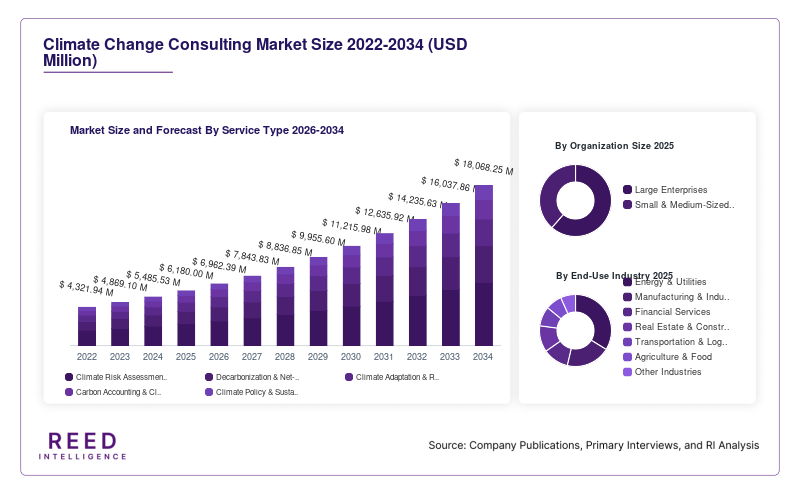
The service, organization-size, industry and engagement-type shares and values below are internal analytical allocations, not independently published market estimates. The shares are modeled against the supplied 2025 market size of USD 6,180 million. The indicative 2034 values use a modeled allocation of the supplied USD 18.42 billion market forecast. Actual segment revenue may differ, and these figures should be validated with primary company disclosures and service-line revenue data before external publication.
By Service Type
Climate Risk Assessment & Scenario Analysis represents approximately 20% of the 2025 market, equivalent to about USD 1,236 million under the internal allocation. The segment is modeled to reach approximately USD 3,684 million by 2034, reflecting an indicative CAGR of about 12.9%. Demand is associated with physical-risk screening, transition-risk analysis, scenario modeling and the need to incorporate climate factors into business continuity and financial risk management.
Decarbonization & Net-Zero Strategy represents approximately 25% of the 2025 market, equivalent to about USD 1,545 million. It is modeled to reach approximately USD 4,421 million by 2034, implying an indicative CAGR of about 12.4%. This segment includes emissions baselines, reduction roadmaps, transition planning, energy efficiency, electrification and the evaluation of low-carbon technologies. Its commercial potential depends on whether organizations move from target setting to funded implementation.
Climate Adaptation & Resilience represents approximately 15% of the 2025 market, equivalent to about USD 927 million. It is modeled to reach approximately USD 3,131 million by 2034, corresponding to an indicative CAGR of about 14.5%. The faster modeled growth reflects the need to assess physical hazards and plan responses for exposed facilities, infrastructure and supply chains. Project delivery remains dependent on available financing and the ability to implement recommended measures.
By Organization Size
Large Enterprises represent approximately 72% of the 2025 market, equivalent to about USD 4,450 million. The segment is modeled to reach approximately USD 13,446 million by 2034, at an indicative CAGR of about 13.1%. Large companies tend to have more complex reporting obligations, extensive supply chains, multiple operating locations and greater need for scenario analysis and transition planning. They are also more likely to commission multi-country engagements and technical implementation programs.
Small & Medium-Sized Enterprises represent approximately 28% of the 2025 market, equivalent to about USD 1,730 million. It is modeled to reach approximately USD 4,974 million by 2034, corresponding to an indicative CAGR of about 12.4%. Demand is often tied to customer reporting requests, supply-chain requirements, energy-efficiency projects and exposure to physical climate hazards. Lower consulting budgets make standardized assessments and modular services commercially important.
By End-Use Industry
Energy & Utilities represents approximately 22% of the 2025 market, equivalent to about USD 1,360 million. It is modeled to reach approximately USD 3,960 million by 2034, at an indicative CAGR of about 12.6%. The sector faces both transition-related pressures and physical risks to generation, transmission and distribution assets. Consulting work includes transition planning, resilience, emissions reduction and climate-related capital allocation.
Manufacturing & Industrial represents approximately 20% of the 2025 market, equivalent to about USD 1,236 million. It is modeled to reach approximately USD 3,684 million by 2034, at an indicative CAGR of about 12.9%. Industrial clients require support with process emissions, energy efficiency, supplier data and the evaluation of low-carbon production technologies. The economics of technology deployment and the availability of lower-emissions inputs affect project timing.
Financial Services represents approximately 16% of the 2025 market, equivalent to about USD 989 million. It is modeled to reach approximately USD 2,947 million by 2034, at an indicative CAGR of about 12.9%. Banks, insurers and investors use climate analysis to evaluate portfolio exposure, financed emissions, collateral risk and transition scenarios. Methodological consistency and access to counterparty data remain important constraints.
Real Estate & Construction represents approximately 14% of the 2025 market, equivalent to about USD 865 million. It is modeled to reach approximately USD 2,579 million by 2034, at an indicative CAGR of about 12.9%. Services cover building energy performance, embodied carbon, flood and heat exposure, resilient design and transition planning for property portfolios. Adoption depends on building regulations, asset-owner budgets and the economics of retrofit measures.
By Engagement Type
Strategy & Advisory represents approximately 42% of the 2025 market, equivalent to about USD 2,596 million. It is modeled to reach approximately USD 7,000 million by 2034, at an indicative CAGR of about 11.7%. Work includes climate strategy, risk assessment, scenario analysis, target setting and transition-roadmap development. Competition is strong because many professional-services firms can offer broad strategy services, so specialist expertise and implementation credibility matter.
Technical Implementation represents approximately 35% of the 2025 market, equivalent to about USD 2,163 million. It is modeled to reach approximately USD 6,815 million by 2034, at an indicative CAGR of about 13.6%. This category covers emissions-data systems, technical decarbonization studies, adaptation planning and the integration of climate analysis into operating processes. Implementation work can create deeper client relationships but requires technical capacity and coordination across functions.
Reporting & Assurance Support represents approximately 23% of the 2025 market, equivalent to about USD 1,421 million. It is modeled to reach approximately USD 4,605 million by 2034, at an indicative CAGR of about 14.0%. Services include reporting readiness, internal controls, emissions documentation and preparation for independent assurance. The growth assumption reflects increasing reporting maturity, but the category's actual size will depend on regulatory scope and the extent of work performed by consultants versus auditors and internal teams.
Regional Analysis
The regional shares and forecast values below are internal analytical allocations. They are designed to reconcile to the supplied global market values and should not be interpreted as independently reported regional market estimates.
North America Climate Change Consulting Market
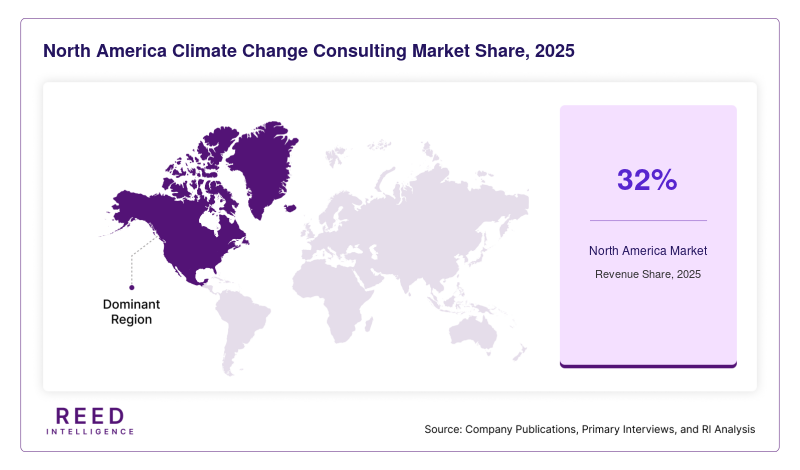
North America is modeled to account for approximately 32% of the 2025 market, equivalent to about USD 1,978 million. It is modeled to reach approximately USD 5,158 million by 2034, corresponding to an indicative CAGR of about 11.2%.
Demand is supported by corporate climate strategy, investor expectations, climate-risk management and the need to address emissions across complex supply chains. Consulting opportunities include decarbonization roadmaps, emissions inventories, physical-risk analysis and climate-related financial disclosures.
The region also faces policy and regulatory uncertainty. Companies operating across multiple jurisdictions may continue to require climate expertise even when specific disclosure rules change, but the timing and size of compliance-driven projects can be affected by regulatory revisions.
Europe Climate Change Consulting Market
Europe is modeled to represent approximately 27% of the 2025 market, equivalent to about USD 1,669 million. It is modeled to reach approximately USD 4,421 million by 2034, at an indicative CAGR of about 11.4%.
The region's consulting market is influenced by climate policy, sustainability reporting, industrial decarbonization and the need to assess climate-related risks across corporate operations. Work may include reporting readiness, emissions reduction, supply-chain measurement and climate adaptation for infrastructure and property portfolios.
Companies operating across the European Union and other jurisdictions must determine which reporting and due-diligence requirements apply to them as regulations evolve. Consultants that can interpret the rules while connecting reporting to operational improvements may be better positioned than providers focused solely on documentation.
APAC Climate Change Consulting Market
APAC is modeled to represent approximately 28% of the 2025 market, equivalent to about USD 1,730 million. It is modeled to reach approximately USD 6,263 million by 2034, the largest regional value in this allocation, with an indicative CAGR of about 15.4%.
The region includes major manufacturing, energy, export and financial centers with different climate-policy frameworks and adaptation needs. Companies may commission consulting to measure industrial emissions, respond to customer requirements, improve energy performance, assess physical risks and prepare for evolving disclosure rules.
APAC's modeled growth reflects the breadth of its industrial base and the potential for climate-related requirements to spread through export supply chains. Actual demand will depend on local implementation timelines, corporate budgets, access to reliable data and the availability of qualified climate specialists.
Middle East and Africa Climate Change Consulting Market
Middle East and Africa are modeled to account for approximately 6% of the 2025 market, equivalent to about USD 371 million. The region is modeled to reach approximately USD 1,105 million by 2034, at an indicative CAGR of about 12.9%.
Consulting demand is associated with energy-transition planning, infrastructure resilience, water scarcity, extreme heat, climate-risk assessment and sustainable-finance programs. The priorities differ considerably between energy-exporting economies, rapidly urbanizing markets and climate-vulnerable countries.
Large infrastructure and energy projects can generate complex consulting assignments, while public-sector budgets and limited data capacity may constrain smaller projects. Partnerships with local engineering firms and financial institutions can help consultants deliver work suited to regional conditions.
LATAM Climate Change Consulting Market
LATAM is modeled to represent approximately 7% of the 2025 market, equivalent to about USD 433 million. It is modeled to reach approximately USD 1,474 million by 2034, at an indicative CAGR of about 14.6%.
Demand may arise from agriculture and food supply chains, mining, energy, forestry, infrastructure and financial institutions seeking to understand physical climate risks and transition exposure. Drought, flooding, heat and ecosystem-related risks can affect commodity production and infrastructure reliability.
Consulting firms can support emissions measurement, adaptation planning, climate-related finance and operational resilience. Project delivery may be affected by economic volatility, public procurement cycles and uneven access to climate data across countries.
Competitive Landscape
The Climate Change Consulting Market is fragmented across global professional-services networks, environmental and engineering consultancies, specialist climate-risk firms, sustainability advisory companies and technology-enabled providers. Competition is based on technical expertise, industry knowledge, geographic reach, data capabilities, implementation experience and the ability to connect climate analysis with financial and operational decisions.
Large professional-services firms can serve multinational clients across climate strategy, risk, reporting, tax, finance and transformation. Specialist consultancies compete through deep expertise in climate science, emissions accounting, adaptation, industrial decarbonization or particular industries. Engineering and environmental firms may have an advantage when a climate assessment must lead to asset-level design or physical implementation.
Key Market Players
- Accenture
- Deloitte
- EY
- KPMG
- PwC
- Boston Consulting Group
- McKinsey & Company
- ERM
- WSP Global
- Arup
- Ramboll
- DNV
- South Pole
- Guidehouse
- Sustainalytics
Recent Market Developments
- In December 2025, the International Sustainability Standards Board issued targeted amendments to greenhouse gas disclosure requirements under IFRS S2. The changes address implementation challenges identified by companies applying the standard and are effective for reporting periods beginning on or after January 1, 2027, with early application permitted. Changes to reporting standards create demand for interpretation, gap analysis and updates to emissions-data processes. The amendments also illustrate that consulting work must account for implementation reliefs and jurisdiction-specific requirements rather than assume that every company follows an identical reporting timetable.
- In October 2025, the OECD published its Global Corporate Sustainability Report 2025. It reported that companies representing 91% of global listed-company market capitalization disclosed sustainability-related information in 2024, compared with 86% in 2022. It also found that 88% of market capitalization was represented by companies disclosing Scope 1 and Scope 2 emissions, while 76% disclosed at least one category of Scope 3 emissions. Broader disclosure creates work in emissions accounting, data controls, reporting systems and supplier engagement. The gap between Scope 1 and 2 disclosure and Scope 3 disclosure also indicates that value-chain data remains a challenging area.
Climate Change Consulting Market Segments
By Service Type
- Climate Risk Assessment & Scenario Analysis
- Decarbonization & Net-Zero Strategy
- Climate Adaptation & Resilience
- Carbon Accounting & Climate Disclosure
- Climate Policy & Sustainable Finance Advisory
By Organization Size
- Large Enterprises
- Small & Medium-Sized Enterprises
By End-Use Industry
- Energy & Utilities
- Manufacturing & Industrial
- Financial Services
- Real Estate & Construction
- Transportation & Logistics
- Agriculture & Food
- Other Industries
By Engagement Type
- Strategy & Advisory
- Technical Implementation
- Reporting & Assurance Support
By Region
- North America
- Europe
- APAC
- Middle East and Africa
- LATAM