Closed Transition Transfer Switch Market Size, Share & Demand Report By Type (Automatic Closed Transition Transfer Switch, Manual Closed Transition Transfer Switch), By Application (Healthcare, Data Centers, Industrial, Commercial, Others), By End-Use (Commercial, Industrial, Residential) By Region & Segment Forecasts, 2025–2034
USD 3950
Market Overview
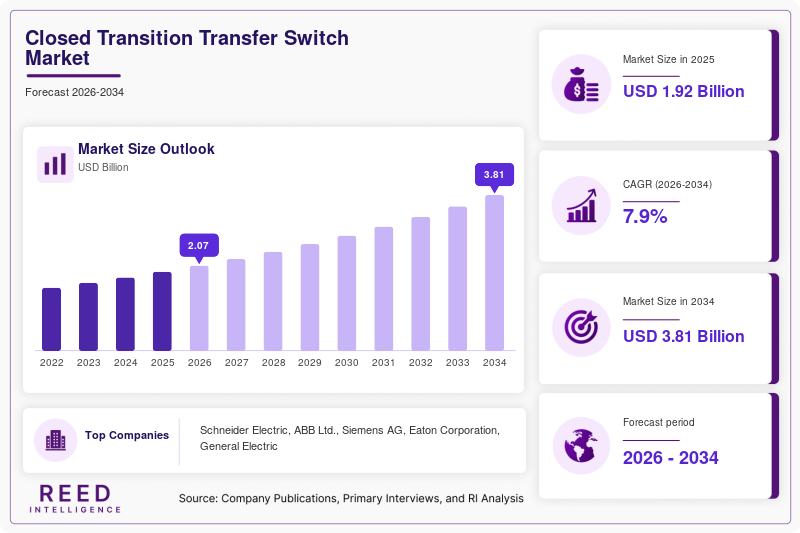
The Closed Transition Transfer Switch Market size is estimated at USD 1.92 billion, and it is projected to reach approximately USD 2.08 billion in 2026. By 2034, the market is forecast to grow to USD 4.12 billion, registering a compound annual growth rate (CAGR) of 7.9% from 2025 to 2034. This growth reflects increasing adoption of advanced electrical switching solutions that ensure seamless power transfer without interruption.
Closed transition transfer switches, also known as “make-before-break” switches, are gaining traction due to their ability to momentarily parallel two power sources, thereby eliminating power disruption during switching. This functionality is particularly important in industries such as healthcare, data centers, manufacturing, and commercial buildings where even a brief power outage can result in operational losses or safety risks.
Key Highlights
- North America dominated the market with ~34% share in 2025, driven by strong data center presence and grid modernization initiatives
- Asia Pacific is the fastest-growing region with a CAGR of 8.9% (2025–2034), supported by rapid industrialization and infrastructure expansion
- Automatic closed transition transfer switches led the segment with ~68% share in 2024 due to higher reliability and automation benefits
- Data centers are the fastest-growing application segment, expanding at a CAGR of 9.4% owing to rising cloud and digital infrastructure demand
- Commercial end-use segment accounted for ~41% share in 2024, supported by increasing construction of commercial buildings and smart facilities
Market Trends
Integration of Smart and IoT-Enabled Transfer Switch Systems
The Closed Transition Transfer Switch Market is experiencing a shift toward intelligent and connected systems. Manufacturers are integrating IoT capabilities into transfer switches to enable real-time monitoring, predictive maintenance, and remote control. These smart systems allow operators to track performance metrics such as load conditions, switching frequency, and fault detection, improving operational efficiency. The adoption of Industry 4.0 practices across manufacturing and infrastructure sectors is accelerating this trend. Additionally, digital dashboards and cloud-based platforms are helping facility managers optimize power usage and reduce downtime risks. As businesses increasingly rely on automation and data-driven decision-making, the demand for smart transfer switches is expected to grow steadily.
Rising Adoption in Renewable Energy and Hybrid Power Systems
Another notable trend is the increasing use of closed transition transfer switches in renewable and hybrid power setups. As solar and wind installations expand globally, there is a growing need for systems that can seamlessly switch between multiple power sources without disruption. Closed transition switches enable smooth synchronization between grid power and renewable energy, ensuring consistent power quality. This trend is particularly strong in commercial and industrial facilities that aim to reduce energy costs and carbon emissions. Hybrid systems combining diesel generators, battery storage, and renewable sources are also driving demand for advanced transfer switches capable of handling complex power transitions.
Market Drivers
Growing Demand for Uninterrupted Power Supply in Critical Infrastructure
The increasing reliance on uninterrupted power supply across critical sectors is a major driver for the Closed Transition Transfer Switch Market. Industries such as healthcare, data centers, and financial institutions cannot afford even momentary power interruptions. Closed transition transfer switches ensure a seamless transition between power sources, eliminating downtime and protecting sensitive equipment. With the rise in digitalization and automation, even small disruptions can lead to significant financial losses. Governments and private organizations are therefore investing heavily in reliable power infrastructure, which is boosting the demand for advanced transfer switch systems.
Expansion of Commercial and Industrial Infrastructure
Rapid industrialization and urbanization, especially in emerging economies, are contributing significantly to market growth. New commercial complexes, manufacturing plants, and smart buildings require reliable power backup systems to maintain operations. Closed transition transfer switches are increasingly preferred over open transition systems due to their ability to provide continuous power without interruption. Additionally, regulatory standards related to power reliability and safety are encouraging the adoption of advanced switching technologies. As infrastructure development continues across regions, the demand for these systems is expected to rise consistently.
Market Restraint
High Initial Cost and Complex Installation Requirements
One of the key restraints in the Closed Transition Transfer Switch Market is the high initial investment associated with these systems. Compared to traditional open transition switches, closed transition systems are more complex and require additional components such as synchronization controls and protective relays. This increases both the product cost and installation expenses, making it less accessible for small and medium enterprises. Furthermore, installation requires skilled professionals and careful system integration to ensure safe operation, which adds to overall project costs.
The complexity also leads to longer deployment timelines, which can be a challenge for projects with tight schedules. In developing regions, where budget constraints are significant, organizations often opt for lower-cost alternatives despite the benefits of closed transition systems. This cost barrier limits market penetration, particularly in price-sensitive markets. However, as technology advances and economies of scale improve, the cost gap is expected to narrow over time.
Market Opportunities
Growth in Data Centers and Digital Infrastructure
The rapid expansion of data centers presents a significant opportunity for the Closed Transition Transfer Switch Market. With increasing demand for cloud services, streaming platforms, and AI-driven applications, data centers require highly reliable power systems. Closed transition transfer switches play a critical role in ensuring zero downtime during power transitions. Hyperscale data center operators are investing heavily in advanced electrical infrastructure, creating strong demand for these systems. Additionally, edge data centers are emerging in urban areas, further expanding the market scope.
Increasing Adoption in Emerging Economies
Emerging economies offer substantial growth potential due to ongoing industrialization and infrastructure development. Countries in Asia Pacific, Latin America, and Africa are investing in power reliability solutions to support economic growth. Closed transition transfer switches are gaining attention as businesses seek to minimize power disruptions and improve operational efficiency. Government initiatives aimed at improving energy infrastructure and promoting renewable energy integration are also creating new opportunities. As awareness increases and costs gradually decline, adoption in these regions is expected to accelerate.
Segmental Analysis
By Type
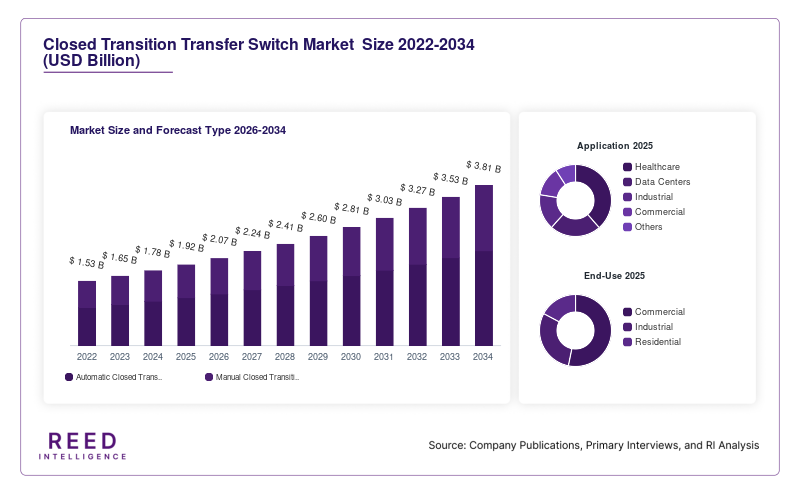
The closed transition automatic transfer switch segment dominated the market in 2024, accounting for approximately 68% share. These switches are widely used in critical applications due to their ability to operate without manual intervention. Automatic systems offer faster switching, improved reliability, and reduced risk of human error. Industries such as healthcare, data centers, and manufacturing prefer these systems for continuous operations. The integration of advanced control systems and real-time monitoring capabilities further enhances their performance. As automation becomes a key focus across industries, the demand for automatic closed transition transfer switches continues to rise steadily.
The fast-growing segment is the closed transition manual transfer switch, expected to register a CAGR of 6.8% during the forecast period. These switches are gaining traction in smaller commercial and industrial applications where cost considerations are important. Manual systems offer flexibility and lower installation costs, making them suitable for facilities with less critical power requirements. Increasing adoption in emerging markets is a key growth factor, as businesses seek cost-effective solutions for power management. Technological improvements are also enhancing the efficiency and reliability of manual systems.
By Application
The healthcare segment dominated the market in 2024 with a 32% share, driven by the need for uninterrupted power in hospitals and medical facilities. Closed transition transfer switches ensure seamless power transitions, which is critical for life-saving equipment and patient care systems. The increasing number of healthcare facilities and modernization of existing infrastructure are supporting demand. Additionally, regulatory requirements for power reliability in healthcare settings are driving the adoption of advanced switching systems. The integration of backup generators and renewable energy sources further boosts the need for closed transition solutions.
The fastest-growing segment is data centers, expected to grow at a CAGR of 9.4%. The rapid expansion of digital infrastructure and cloud computing is driving demand for reliable power systems. Closed transition transfer switches play a crucial role in maintaining continuous operations and preventing data loss. Increasing investments in hyperscale and edge data centers are key growth factors. As data consumption continues to rise globally, the demand for advanced power management solutions is expected to increase significantly.
By End-Use
The commercial segment held the largest share of 41% in 2024, driven by the growing number of commercial buildings, offices, and retail spaces. These facilities require reliable power systems to ensure smooth operations and customer satisfaction. Closed transition transfer switches are widely used in commercial applications to prevent power disruptions. The increasing adoption of smart building technologies and energy-efficient systems is further driving demand. Additionally, the expansion of urban infrastructure is supporting growth in this segment.
The industrial segment is expected to be the fastest-growing, with a CAGR of 8.6%. Industries such as manufacturing, oil and gas, and mining require continuous power supply to maintain production processes. Closed transition transfer switches help minimize downtime and improve operational efficiency. The growing focus on automation and digitalization in industrial operations is a key growth factor. As industries adopt advanced technologies, the demand for reliable power management systems is expected to rise.
Regional Analysis
North America
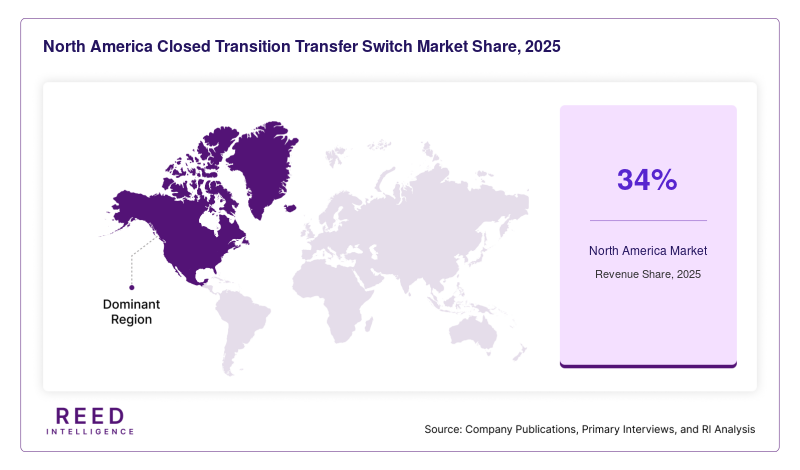
North America accounted for approximately 34% market share in 2025, making it the largest regional market. The region is expected to grow at a CAGR of 7.2% through 2034, driven by strong demand from data centers, healthcare facilities, and commercial infrastructure. The presence of established players and advanced technological adoption further supports market expansion. Investments in grid modernization and energy efficiency initiatives are also contributing to sustained growth.
The United States dominates the regional market due to its extensive data center network and high demand for reliable power systems. A key growth factor is the increasing adoption of smart grid technologies, which require advanced switching solutions. The integration of renewable energy sources into the grid is also driving the need for seamless power transition systems.
Europe
Europe held around 26% market share in 2025 and is projected to grow at a CAGR of 7.5% during the forecast period. The region’s focus on energy efficiency and sustainability is driving the adoption of advanced transfer switch systems. Strict regulatory standards related to power reliability and emissions are encouraging industries to upgrade their electrical infrastructure.
Germany leads the European market, supported by its strong industrial base and emphasis on renewable energy integration. A unique growth factor is the region’s commitment to reducing carbon emissions, which is driving the adoption of hybrid power systems. This, in turn, increases the demand for closed transition transfer switches.
Asia Pacific
Asia Pacific accounted for approximately 24% market share in 2025 and is expected to register the highest CAGR of 8.9% through 2034. Rapid industrialization, urbanization, and infrastructure development are key factors driving market growth. Increasing investments in smart cities and commercial buildings are also contributing to demand.
China dominates the region due to its large manufacturing sector and expanding infrastructure projects. A significant growth factor is the rising demand for reliable power systems in industrial facilities. Additionally, government initiatives to improve power infrastructure are supporting market expansion.
Middle East & Africa
The Middle East & Africa region held about 9% market share in 2025 and is expected to grow at a CAGR of 7.8%. The market is driven by investments in commercial infrastructure, oil and gas facilities, and healthcare sectors. Increasing focus on energy reliability is supporting adoption.
Saudi Arabia leads the region, driven by large-scale infrastructure projects and economic diversification initiatives. A key growth factor is the development of smart cities, which require advanced power management systems. This is creating strong demand for closed transition transfer switches.
Latin America
Latin America accounted for approximately 7% market share in 2025 and is projected to grow at a CAGR of 7.6%. The region is witnessing increasing demand for reliable power systems in industrial and commercial sectors. Infrastructure development and energy projects are supporting growth.
Brazil dominates the regional market due to its large industrial base and energy requirements. A unique growth factor is the increasing adoption of backup power systems in manufacturing facilities. This is driving demand for advanced transfer switch solutions.
Competitive Landscape
The Closed Transition Transfer Switch Market is moderately consolidated, with several global and regional players competing based on product innovation, reliability, and pricing. Leading companies are focusing on expanding their product portfolios and integrating smart technologies to enhance performance. Strategic partnerships, mergers, and acquisitions are common as companies aim to strengthen their market presence.
One of the leading players in the market is Schneider Electric, known for its advanced electrical solutions and strong global presence. The company has recently introduced smart transfer switch systems with enhanced monitoring capabilities, catering to the growing demand for digital solutions. Other key players are also investing in research and development to improve efficiency and reliability.
Competition is driven by the need to meet evolving customer requirements and regulatory standards. Companies are increasingly focusing on providing customized solutions for specific applications, such as data centers and healthcare facilities. As the market continues to grow, innovation and technological advancement will remain key competitive factors.
Key Players List
- Schneider Electric
- ABB Ltd.
- Siemens AG
- Eaton Corporation
- General Electric
- Cummins Inc.
- Vertiv Group Corp.
- Generac Power Systems
- Socomec Group
- ASCO Power Technologies
- Kohler Co.
- Mitsubishi Electric
- Fuji Electric
- Caterpillar Inc.
- Legrand
Recent Developments
- In 2024, Schneider Electric launched a new range of smart transfer switches with IoT-enabled monitoring features.
- In 2023, ABB Ltd. expanded its product portfolio by introducing energy-efficient transfer switch solutions for industrial applications.
- In 2024, Eaton Corporation announced a strategic partnership to develop advanced power management systems for data centers.
Closed Transition Transfer Switch Market Segments
Type
- Automatic Closed Transition Transfer Switch
- Manual Closed Transition Transfer Switch
Application
- Healthcare
- Data Centers
- Industrial
- Commercial
- Others
End-Use
- Commercial
- Industrial
- Residential
By Region
- North America
- Europe
- APAC
- Middle East and Africa
- LATAM