Co Fired Ceramic Market Size, Share & Demand Report By Type (Low Temperature Co Fired Ceramic (LTCC), High Temperature Co Fired Ceramic (HTCC)), By Material (Alumina, Glass Ceramic, Zirconia, Other Ceramic Materials), By Application (RF Modules, Communication Components, Automotive Electronics, Sensors and Control Modules, Industrial Electronic Systems), By End Use (Consumer Electronics, Automotive, Industrial Electronics, Communication Infrastructure, Healthcare Electronics), By Region & Segmen
USD 3950
Market Overview
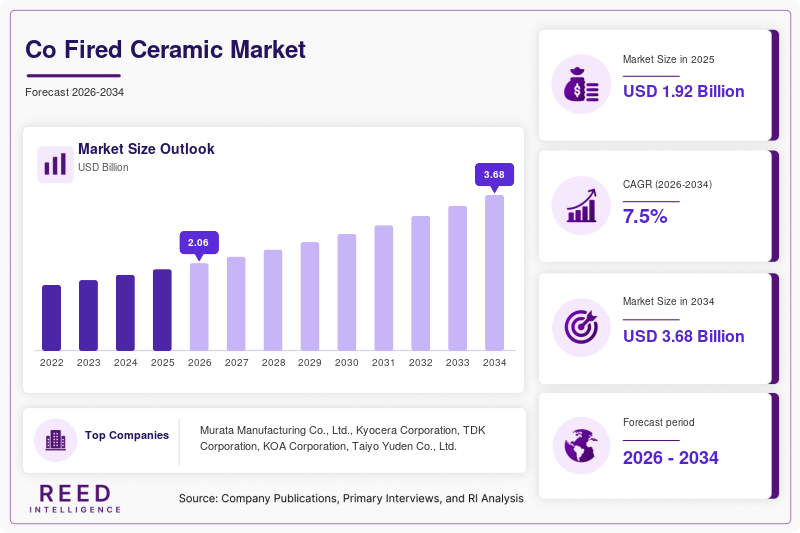
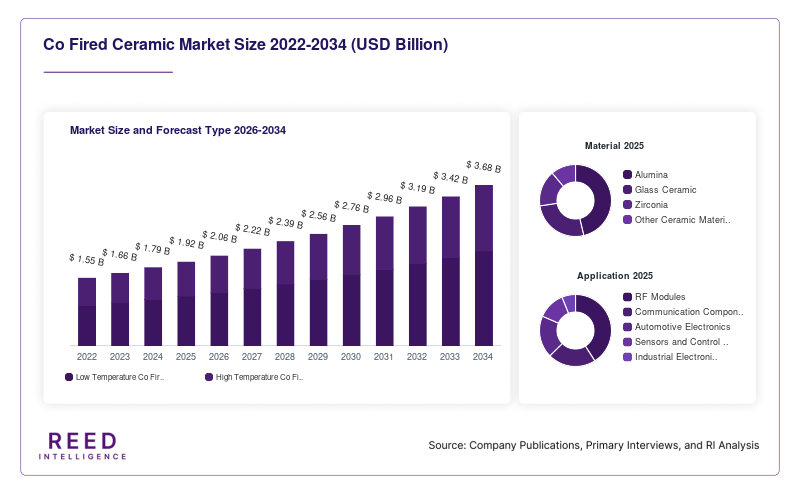
The Co Fired Ceramic Market size was valued at USD 1.92 billion in 2025 and is projected to reach USD 3.68 billion by 2034, expanding at a compound annual growth rate (CAGR) of 7.5% during 2025–2034. Co fired ceramic technologies, particularly Low Temperature Co Fired Ceramics (LTCC) and High Temperature Co Fired Ceramics (HTCC), are widely used for advanced electronic packaging, high-frequency communication modules, and miniaturized electronic components. Their ability to integrate multilayer circuits, passive components, and thermal management features in compact structures continues to support adoption across electronics manufacturing ecosystems.
One global factor supporting market expansion is the rapid growth of advanced communication infrastructure. The deployment of high-frequency communication systems, including satellite communication modules, advanced automotive electronics, and RF components, has increased demand for multilayer ceramic substrates capable of supporting high reliability and signal integrity. Co fired ceramics offer excellent dielectric properties, high thermal stability, and compatibility with compact circuit integration, making them suitable for high-density electronics used in modern communication devices.
Key Highlights
- Asia Pacific accounted for 44.3% of the global market share in 2025 and will grow at a CAGR of 8.3%, making it the fastest-growing region.
- By type, Low Temperature Co Fired Ceramic (LTCC) was the dominant subsegment with 61.8% share in 2025, while High Temperature Co Fired Ceramic (HTCC) will grow faster at a CAGR of 8.0%.
- By application, RF modules and communication components led the market with 33.5% share in 2025, whereas automotive electronics applications will grow at a CAGR of 8.6%.
- The United States remained the dominant country, with the market valued at USD 410 million in 2025 and projected to reach USD 438 million in 2026.
Market Trends
Expansion of High-Frequency Electronics Integration
A notable trend in the Co Fired Ceramic Market is the integration of ceramic substrates in high-frequency electronics systems. Advanced communication devices require materials capable of handling high signal frequencies while maintaining stability and reliability. Co fired ceramics provide low signal loss and excellent dielectric properties, making them suitable for RF circuits, microwave modules, and antenna components. Manufacturers are developing multilayer structures that integrate multiple electronic functions within a single ceramic module, which helps reduce assembly complexity and improves signal performance. As communication systems continue to evolve toward higher frequencies and compact form factors, the adoption of ceramic-based multilayer packaging solutions is increasing.
Increasing Use in Automotive Electronics
Another trend shaping the market is the growing use of co fired ceramic components in automotive electronic systems. Vehicles increasingly rely on advanced electronic modules for sensing, control systems, and connectivity features. Ceramic substrates offer resistance to heat, vibration, and environmental stress, making them suitable for automotive electronics that operate in demanding conditions. Components such as radar modules, control units, and sensor packages are gradually incorporating ceramic packaging solutions to improve reliability and performance. This trend reflects broader shifts toward electronic integration in transportation systems.
Market Drivers
Rising Demand for Compact Electronic Components
The increasing requirement for compact and high-density electronic components is a key factor driving the Co Fired Ceramic Market. Modern electronic devices require integrated circuit modules capable of supporting multiple functionalities while maintaining a small footprint. Co fired ceramics enable multilayer integration of circuits, resistors, capacitors, and interconnects within a single substrate. This capability allows manufacturers to reduce board space and improve electrical performance. As device manufacturers continue to prioritize smaller and lighter electronic products, ceramic-based multilayer substrates are expected to remain important in component manufacturing.
Growth of Satellite and Communication Systems
The expansion of satellite communication networks and communication infrastructure is also contributing to market growth. High-frequency communication equipment requires substrates with stable dielectric characteristics and high thermal resistance. Co fired ceramics meet these requirements and are commonly used in RF modules, antenna systems, and signal processing units. With communication technologies becoming increasingly complex, the demand for reliable packaging solutions is expected to continue increasing across communication hardware manufacturing.
Market Restraint
High Manufacturing Costs
A significant restraint in the Co Fired Ceramic Market is the relatively high cost associated with ceramic substrate manufacturing. Production involves precise material formulation, multilayer lamination, and controlled firing processes that require specialized equipment and expertise. These factors contribute to higher production costs compared with conventional printed circuit boards. Additionally, the integration of multiple layers and embedded components increases fabrication complexity. As a result, some electronics manufacturers may prefer alternative packaging solutions in cost-sensitive applications, limiting broader adoption in certain segments of the electronics industry.
Market Opportunities
Emerging Applications in Medical Electronics
The increasing use of electronic devices in healthcare presents new opportunities for the Co Fired Ceramic Market. Medical equipment such as diagnostic devices, implantable sensors, and monitoring systems require materials that offer biocompatibility, thermal stability, and long-term reliability. Co fired ceramics can support miniaturized electronic circuits with stable electrical performance. As healthcare technologies continue to incorporate advanced electronics for monitoring and diagnostics, the demand for durable ceramic packaging solutions is expected to increase.
Expansion in Industrial Automation Systems
Industrial automation technologies represent another emerging opportunity for the market. Automated production systems require reliable electronic modules capable of operating in environments involving temperature fluctuations, mechanical vibration, and electrical interference. Ceramic substrates offer mechanical strength and resistance to harsh conditions, making them suitable for industrial electronics. The expansion of automated manufacturing systems and smart industrial equipment is expected to increase the need for robust electronic packaging solutions.
Segmental Analysis
By Type
The Low Temperature Co Fired Ceramic (LTCC) segment dominated the Co Fired Ceramic Market with 61.8% share in 2025. LTCC technology has been widely adopted for electronic packaging applications because it allows multilayer circuit integration at relatively lower firing temperatures. This characteristic enables the use of conductive metals such as silver and copper, improving electrical performance and supporting compact electronic module design.
The High Temperature Co Fired Ceramic (HTCC) segment will grow at a CAGR of 8.0% during the forecast period. HTCC substrates are designed to operate at higher temperatures and provide mechanical strength and chemical stability. These properties will support their use in applications requiring long-term durability and high thermal resistance. Industrial electronics and specialized electronic modules will continue to incorporate HTCC components where high operational reliability is required.
By Material
The alumina-based ceramic materials segment accounted for 48.6% of the market share in 2025. Alumina ceramics have been widely used in ceramic substrate manufacturing because they offer strong mechanical properties, good thermal conductivity, and reliable dielectric characteristics. These features make them suitable for multilayer electronic components and communication modules.
The glass ceramic material segment will grow at a CAGR of 8.2% through 2034. Glass ceramics provide improved dielectric properties and dimensional stability during multilayer fabrication processes. Their ability to support precision circuit formation will encourage adoption in advanced electronic packaging technologies.
By Application
The RF modules and communication components segment held 33.5% share of the Co Fired Ceramic Market in 2025. Ceramic substrates have been widely used in communication modules because they provide stable signal transmission and reduced electromagnetic interference. Their integration in high-frequency circuit designs supports improved communication performance.
The automotive electronics application segment will expand at a CAGR of 8.6% during the forecast period. Electronic systems used in vehicles require components capable of withstanding heat, vibration, and environmental exposure. Ceramic packaging technologies will continue to support these requirements, enabling their use in automotive electronic modules and sensing devices.
By End Use
The consumer electronics segment represented 37.2% share of the market in 2025. Ceramic substrates have been incorporated in electronic modules used in compact devices due to their high reliability and miniaturization capabilities.
The industrial electronics segment will grow at a CAGR of 8.4% during 2025–2034. Industrial systems require durable electronic components capable of operating in demanding environments. Ceramic-based substrates will continue to support reliable electronic module performance in industrial automation equipment.
Regional Analysis
North America
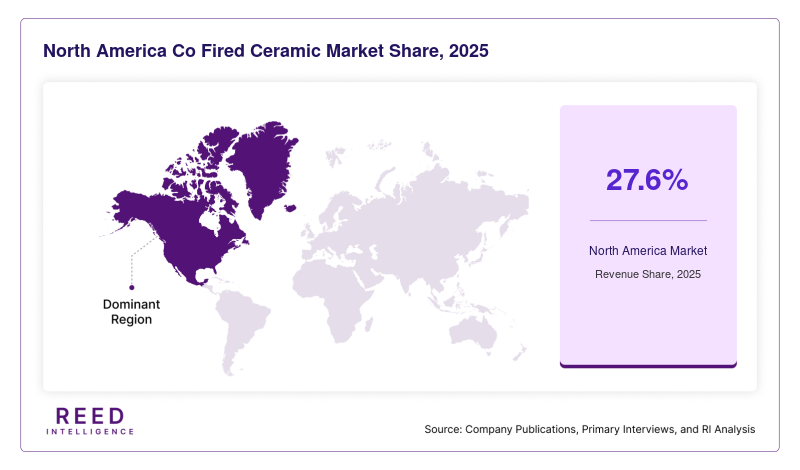
North America accounted for 27.6% of the global Co Fired Ceramic Market share in 2025. The regional market will grow at a CAGR of 7.1% during 2025–2034. The region has maintained a strong presence in electronic component manufacturing, supported by technological advancements and ongoing innovation in semiconductor packaging technologies. Demand for advanced ceramic substrates has remained stable due to the presence of communication infrastructure development and electronics research activities.
The United States represented the dominant country within the region. The growth of high-performance communication systems has supported demand for ceramic-based RF components. Companies operating in the electronics and communication industries continue to incorporate ceramic substrates in advanced electronic modules designed for high-frequency signal processing. Research initiatives focused on electronic miniaturization and high-performance packaging technologies are expected to contribute to steady market development.
Europe
Europe held 22.4% share of the global Co Fired Ceramic Market in 2025 and will expand at a CAGR of 6.8% during the forecast period. The region’s electronics manufacturing ecosystem has contributed to steady demand for advanced ceramic components used in communication and industrial applications. Ceramic substrates have been incorporated in high-performance electronics systems that require stable dielectric characteristics and thermal resistance.
Germany represented the dominant country in the European market. The country has maintained a strong industrial electronics manufacturing base that utilizes ceramic packaging technologies. Companies operating in advanced electronics production continue to incorporate ceramic substrates in specialized components for industrial equipment and communication hardware. The presence of established manufacturing infrastructure has supported regional market development.
Asia Pacific
Asia Pacific accounted for 44.3% of the global Co Fired Ceramic Market share in 2025 and will grow at a CAGR of 8.3% through 2034, making it the fastest-growing regional market. The region’s growth has been supported by large-scale electronics manufacturing activities and increasing demand for advanced electronic components across consumer and communication industries.
China represented the dominant country within the region. The country has a large electronics manufacturing sector producing communication equipment, electronic modules, and integrated circuits. Ceramic substrates have been widely incorporated in electronic packaging solutions used in high-frequency communication modules and compact electronic devices. Continued investments in electronics production infrastructure are expected to support market expansion.
Middle East & Africa
The Middle East & Africa region held 3.6% of the global Co Fired Ceramic Market in 2025 and will grow at a CAGR of 6.5% during the forecast period. Market growth in the region has been supported by gradual expansion in electronics distribution networks and industrial equipment manufacturing.
The United Arab Emirates emerged as the dominant country in the regional market. The country has invested in communication infrastructure and technology development initiatives that require advanced electronic components. Ceramic substrates used in communication equipment and electronic modules have gradually gained adoption in the region as infrastructure projects expand.
Latin America
Latin America represented 2.1% share of the global Co Fired Ceramic Market in 2025 and will grow at a CAGR of 6.3% between 2025 and 2034. Regional demand has been associated with the gradual expansion of electronics assembly activities and communication infrastructure development.
Brazil accounted for the largest share of the regional market. Electronics manufacturing and assembly operations have incorporated ceramic substrates for specific communication hardware and industrial electronics applications. As electronics manufacturing capabilities continue to develop within the region, the demand for ceramic packaging solutions is expected to increase steadily.
Competitive Landscape
The Co Fired Ceramic Market features a mix of global electronics component manufacturers and specialized ceramic substrate producers. Companies focus on product innovation, multilayer integration technologies, and expansion of manufacturing capacity to maintain their market presence.
Murata Manufacturing Co., Ltd. remains a key market participant due to its advanced ceramic technology capabilities and strong presence in electronic component manufacturing. The company has introduced new multilayer ceramic modules designed for high-frequency communication systems, supporting the integration of compact electronic circuits.
Other companies in the market continue to focus on improving ceramic substrate performance, developing advanced multilayer structures, and expanding their production capabilities to meet growing demand from electronics manufacturers.
Key Players
- Murata Manufacturing Co., Ltd.
- Kyocera Corporation
- TDK Corporation
- KOA Corporation
- Taiyo Yuden Co., Ltd.
- Yokowo Co., Ltd.
- NTK Technologies Inc.
- Micro Systems Engineering GmbH
- CeramTec GmbH
- Adamant Namiki Precision Jewel Co., Ltd.
- Maruwa Co., Ltd.
- NEO Tech
- Electronic Products Inc.
- Hitachi Metals Ltd.
- Tong Hsing Electronic Industries Ltd.
Recent Developments
- Murata Manufacturing introduced multilayer ceramic modules designed for high-frequency communication applications.
- Kyocera Corporation expanded production capacity for ceramic substrates used in electronic packaging solutions.
- TDK Corporation developed advanced LTCC substrates designed for compact communication modules.
- Maruwa Co., Ltd. invested in manufacturing technology improvements for multilayer ceramic substrates.
- Taiyo Yuden introduced new ceramic packaging components designed for high-density electronic circuits.
Co Fired Ceramic Market Segments
Type
- Low Temperature Co Fired Ceramic (LTCC)
- High Temperature Co Fired Ceramic (HTCC)
Material
- Alumina
- Glass Ceramic
- Zirconia
- Other Ceramic Materials
Application
- RF Modules
- Communication Components
- Automotive Electronics
- Sensors and Control Modules
- Industrial Electronic Systems
End Use
- Consumer Electronics
- Automotive
- Industrial Electronics
- Communication Infrastructure
- Healthcare Electronics
By Region
- North America
- Europe
- APAC
- Middle East and Africa
- LATAM