Co Polyester Ether Elastomers Cope Market Size, Share & Demand Report By Type (Injection Molding Grade, Extrusion Grade, Blow Molding Grade), By Application (Automotive Components, Medical Devices, Consumer Goods, Wire & Cable, Industrial Equipment), By End-Use Industry (Automotive & Transportation, Healthcare, Electronics & Electrical, Consumer Products, Industrial Manufacturing) By Region & Segment Forecasts, 2026–2034
USD 3950
Market Overview
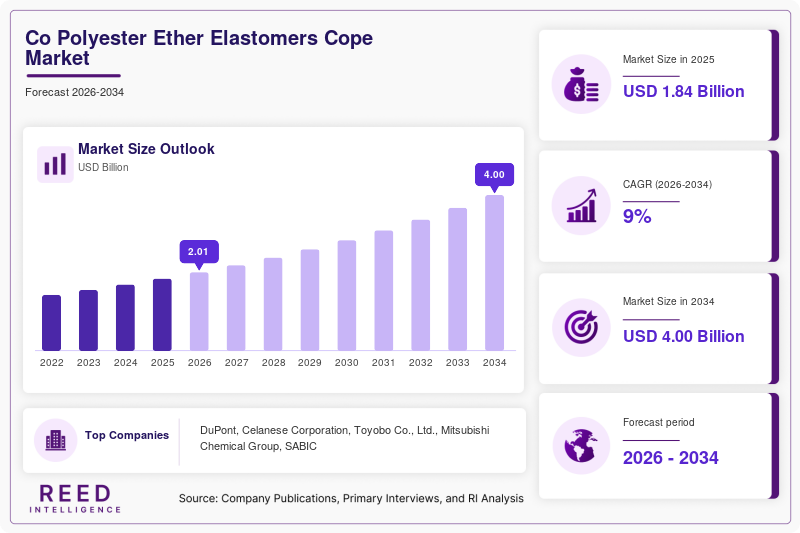
The global Co Polyester Ether Elastomers Cope Market size was valued at USD 1.84 billion in 2026 and is projected to reach USD 3.67 billion by 2034, expanding at a CAGR of 9.0% during the forecast period. Co polyester ether elastomers, widely recognized for their flexibility, chemical resistance, thermal stability, and durability, are increasingly used across automotive, consumer goods, medical devices, wire and cable, and industrial manufacturing sectors. One major global factor supporting market expansion is the accelerated transition toward lightweight, recyclable, and high-performance polymer materials in transportation and electronics manufacturing. Manufacturers are shifting from conventional rubber and PVC-based materials to advanced thermoplastic elastomers due to tightening fuel efficiency regulations, electric vehicle production growth, and sustainability mandates. The rise of EV battery systems, wearable electronics, and flexible tubing applications has further expanded product demand. Additionally, innovation in bio-based feedstocks and enhanced polymer blending technologies has improved material versatility, allowing producers to target premium applications with higher margins. Demand remains strong due to the material’s balance of elasticity and processability, especially in injection molding and extrusion operations. Strategic investments in Asia Pacific manufacturing hubs and growing industrial automation are also reshaping supply chains and improving regional access.
Key Highlights
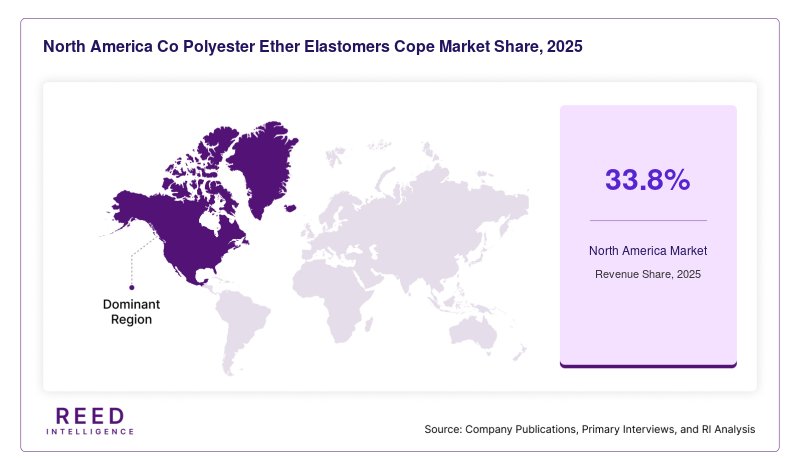
- North America dominated the market with a 33.8% share in 2025.
- Asia Pacific is expected to grow at the fastest CAGR of 10.8% during 2026–2034.
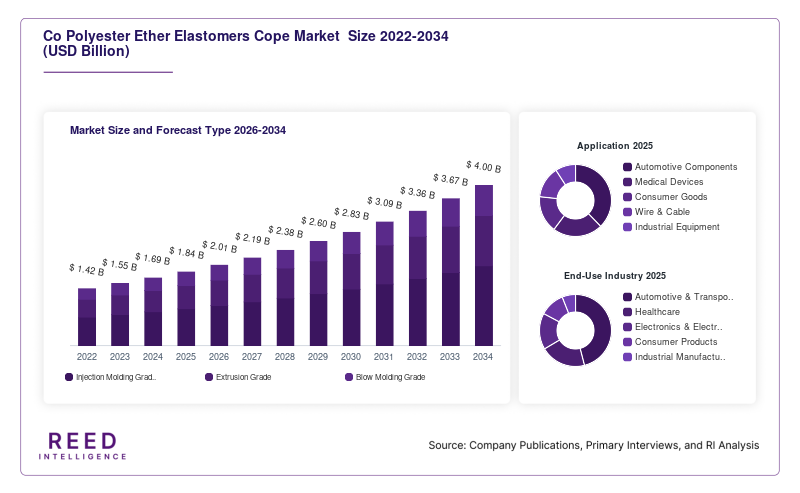
- By type, injection molding grade accounted for the largest share of 39.4%, while extrusion grade is projected to grow at a CAGR of 10.9%.
- By application, automotive components led with a 36.7% share, whereas medical devices are expected to expand at a CAGR of 11.4%.
- The United States remained the dominant country, with market values of USD 468 million in 2024 and USD 512 million in 2025.
Market Trends
Rising integration in electric mobility and charging infrastructure
Co polyester ether elastomers are increasingly used in electric vehicles, charging connectors, battery seals, cable jackets, and flexible under-hood systems due to their resistance to heat, oil, and dynamic stress. As EV production scales globally, manufacturers require materials that combine flexibility with electrical insulation and dimensional stability. This trend has created strong demand for high-performance cope formulations that can endure repeated thermal cycling and aggressive environmental conditions. Automotive OEMs are also adopting lightweight elastomeric materials to improve vehicle efficiency and component longevity. Growing EV charging station deployment has further increased demand for durable elastomer-based wire and connector systems.
Expansion of sustainable and recyclable thermoplastic elastomer solutions
Sustainability goals across industrial sectors are driving interest in recyclable thermoplastic elastomers, including co polyester ether elastomers. Unlike traditional thermoset rubber, cope materials can often be reprocessed, reducing waste and supporting circular manufacturing strategies. Polymer producers are developing partially bio-based grades and lower-emission production methods to align with environmental regulations. Consumer electronics and footwear brands increasingly prioritize sustainable materials without sacrificing mechanical performance. This trend is strengthening market demand for advanced formulations that support eco-friendly product development while maintaining resilience, design flexibility, and production efficiency in large-scale manufacturing.
Market Drivers
Increasing demand for lightweight and durable materials in automotive manufacturing
Automotive manufacturers continue to replace metal and heavier polymer components with advanced elastomeric materials to meet fuel economy and emission standards. Co polyester ether elastomers provide an ideal combination of strength, flexibility, abrasion resistance, and lower weight, making them suitable for air ducts, CVJ boots, seals, tubing, and cable protection systems. As global vehicle production diversifies into electric and hybrid categories, the need for materials capable of handling both mechanical and thermal demands is rising. This material substitution trend supports broader cope adoption across OEM and aftermarket channels.
Growth of medical-grade elastomer applications
Healthcare equipment manufacturers are increasingly utilizing co polyester ether elastomers in catheters, tubing, respiratory masks, and wearable health devices due to biocompatibility potential, sterilization compatibility, and flexibility. The growth of minimally invasive medical devices and home healthcare technologies has expanded the requirement for safe, soft-touch, and durable polymers. Aging populations and rising healthcare expenditure across developed and emerging markets further support this demand. Cope materials offer performance advantages over PVC in many applications, particularly where repeated bending and chemical resistance are required.
Market Restraint
Volatility in raw material pricing and competition from alternative thermoplastic elastomers
The Co Polyester Ether Elastomers Cope Market faces pressure from fluctuating prices of petrochemical feedstocks and specialty monomers used in production. Variations in crude oil pricing, supply chain disruptions, and regulatory shifts can directly impact manufacturing costs, compressing producer margins and increasing end-user pricing. This challenge is particularly relevant for price-sensitive industries such as consumer goods and footwear. Additionally, competition from thermoplastic polyurethane, styrenic block copolymers, and thermoplastic vulcanizates limits cope penetration in certain applications where lower-cost alternatives can meet performance thresholds. Smaller manufacturers may struggle to justify premium pricing unless performance differentiation is clearly demonstrated.
Market Opportunities
Emerging industrialization in Asia and Latin America
Rapid industrial growth in countries such as India, Vietnam, Brazil, and Mexico is creating new opportunities for co polyester ether elastomer manufacturers. Expanding automotive assembly, electronics production, and infrastructure development in these markets are increasing demand for durable polymer solutions. Local manufacturing investments and favorable government policies are also improving regional supply chains. As domestic industries modernize, demand for high-performance thermoplastic elastomers in cables, machinery, and transportation systems is expected to accelerate significantly.
Product innovation in consumer electronics and wearable devices
Flexible electronics, smartwatches, wireless accessories, and connected healthcare devices are creating new application spaces for co polyester ether elastomers. These products require materials with tactile comfort, durability, chemical resistance, and aesthetic flexibility. Manufacturers are increasingly designing specialized cope grades for miniaturized, ergonomic, and soft-touch components. This opportunity is especially valuable as electronics brands prioritize durability and premium user experience while reducing product weight. High-growth wearable segments could generate substantial long-term demand for specialty formulations.
Segmental Analysis
By Type
Injection molding grade emerged as the dominant type segment, accounting for 39.4% of global market share in 2024. Its leadership is attributed to broad adoption in automotive connectors, industrial parts, consumer electronics housings, and flexible mechanical components. Injection molding offers scalability, precision, and cost efficiency for high-volume manufacturing, making it the preferred format for OEMs. These grades are favored for their dimensional stability and ability to support intricate part designs while maintaining flexibility and toughness. Rising demand for engineered lightweight materials has reinforced this segment’s dominance.
Extrusion grade is expected to record the fastest CAGR of 10.9% through 2034. This growth is primarily driven by expanding wire and cable insulation, tubing, hose, and profile applications in automotive, healthcare, and infrastructure sectors. Extrusion-grade cope materials provide continuous processing efficiency and superior flexibility for long-form applications. Increased EV charging cable production and industrial automation are strengthening demand. Additionally, healthcare tubing applications are broadening due to sterilization compatibility and performance reliability.
By Application
Automotive components held the leading application share of 36.7% in 2024 due to widespread use in seals, ducts, boots, flexible connectors, and insulation systems. Vehicle manufacturers increasingly rely on cope materials for balancing flexibility, thermal resistance, and lightweighting requirements. Traditional internal combustion systems and EV platforms both support segment demand. Global fuel efficiency standards and EV battery design needs continue to sustain this category’s leading position.
Medical devices are projected to grow at the fastest CAGR of 11.4% through 2034. Demand is fueled by increasing use in flexible tubing, respiratory devices, wearable medical technologies, and catheter systems. Cope’s ability to provide chemical resistance, softness, and design versatility supports growing medical applications. Rising home healthcare and personalized medical equipment markets are particularly influential growth drivers.
By End-Use Industry
Automotive and transportation remained the largest end-use segment, capturing 34.8% share in 2024. Strong consumption in passenger vehicles, EVs, commercial vehicles, and industrial transportation systems has sustained this leadership. Manufacturers prioritize cope materials for lightweighting, flexible durability, and resistance under varying operational conditions. Regulatory pressure to improve fuel economy has further accelerated substitution from heavier materials.
Electronics and electrical is anticipated to be the fastest-growing end-use segment, with a CAGR of 11.1% during the forecast period. Wearables, charging systems, consumer electronics, and industrial electronics require materials that combine flexibility with insulation and durability. Expansion of 5G devices, EV charging infrastructure, and smart electronics ecosystems is supporting this accelerated growth pattern.
Regional Analysis
North America
North America accounted for 33.8% of the global Co Polyester Ether Elastomers Cope Market in 2025 and is expected to maintain a CAGR of 8.1% through 2034. Strong regional demand stems from advanced automotive manufacturing, medical device production, and industrial automation. The region benefits from mature polymer innovation ecosystems and high investment in specialty materials.
The United States dominates the regional market due to its robust automotive and healthcare manufacturing sectors. EV expansion and advanced medical technology adoption remain unique growth drivers. Domestic producers also benefit from extensive R&D capabilities and high-value industrial applications requiring precision elastomer engineering.
Europe
Europe represented 27.1% of the global market in 2025 and is projected to expand at a CAGR of 8.4% over the forecast period. Regulatory emphasis on sustainable materials and lightweight automotive engineering has accelerated cope demand. Strong adoption in industrial seals, cable systems, and medical tubing supports regional expansion.
Germany leads the European market, supported by its automotive engineering strength and industrial manufacturing base. The country’s focus on EV platforms, sustainable polymers, and precision engineering has encouraged cope integration into advanced component systems, supporting both domestic demand and export-driven production.
Asia Pacific
Asia Pacific held 24.9% market share in 2025 and is forecast to grow at the fastest CAGR of 10.8% from 2026 to 2034. Rapid industrialization, electronics manufacturing expansion, and rising automotive output are primary growth contributors. Regional polymer processing capacity also continues to expand significantly.
China dominates the Asia Pacific market due to its large-scale manufacturing ecosystem and growing EV production. A unique growth factor is the country’s integrated electronics and polymer processing infrastructure, which supports cost-efficient cope adoption across multiple industrial verticals.
Middle East & Africa
Middle East & Africa captured 7.2% of the market in 2025 and is anticipated to grow at a CAGR of 7.6% during the forecast period. Industrial diversification initiatives and infrastructure projects are increasing demand for durable cable, construction, and machinery materials.
Saudi Arabia leads regional demand due to industrial diversification under manufacturing development strategies. Investments in petrochemical downstream industries and industrial modernization are creating new opportunities for elastomer applications, especially in infrastructure and industrial systems.
Latin America
Latin America accounted for 7.0% of the global market in 2025 and is expected to register a CAGR of 8.7% through 2034. Regional automotive assembly, packaging, and infrastructure development continue to stimulate demand for high-performance thermoplastic materials.
Brazil dominates the Latin American market due to its industrial manufacturing footprint and expanding automotive sector. Increased domestic production of automotive parts and industrial equipment serves as a distinctive growth factor supporting cope material consumption.
Competitive Landscape
The Co Polyester Ether Elastomers Cope Market is moderately consolidated, with major players focusing on specialty formulations, sustainability innovation, and regional expansion. Leading companies compete on material performance, pricing flexibility, and application-specific customization. DuPont remains a market leader due to its established product portfolio, global manufacturing footprint, and strong penetration across automotive and healthcare sectors. Recent developments include increased investment in sustainable thermoplastic elastomer technologies. Other notable players such as Celanese, Toyobo, Mitsubishi Chemical Group, and SABIC are expanding production capacity and introducing advanced formulations targeting EV and medical applications. Strategic partnerships with automotive OEMs and electronics manufacturers remain central to competitive positioning.
Key Players
- DuPont
- Celanese Corporation
- Toyobo Co., Ltd.
- Mitsubishi Chemical Group
- SABIC
- LG Chem
- Arkema S.A.
- BASF SE
- Covestro AG
- Teknor Apex
- Kuraray Co., Ltd.
- RTP Company
- Avient Corporation
- DSM Engineering Materials
- Asahi Kasei Corporation
Recent Developments
- DuPont expanded specialty elastomer production capacity in Asia Pacific to support EV and electronics demand.
- Celanese introduced new sustainable cope formulations with partially bio-based feedstock integration.
- SABIC partnered with regional automotive suppliers to enhance thermoplastic elastomer applications in lightweight EV systems.
Co Polyester Ether Elastomers Cope Market Segments
Type
- Injection Molding Grade
- Extrusion Grade
- Blow Molding Grade
Application
- Automotive Components
- Medical Devices
- Consumer Goods
- Wire & Cable
- Industrial Equipment
End-Use Industry
- Automotive & Transportation
- Healthcare
- Electronics & Electrical
- Consumer Products
- Industrial Manufacturing
By Region
- North America
- Europe
- APAC
- Middle East and Africa
- LATAM